

The most effective tips to avoid burnout while working remotely include recognizing early warning signs such as persistent fatigue, concentration difficulty, and professional cynicism before they advance; setting defined daily work hours with hard shutdown rituals that enforce genuine disconnection; creating physical and psychological boundaries that separate work from personal life in shared home environments; building strategic recovery into daily routines through intentional breaks, genuine evening transitions, and protected vacation time; managing workload proactively through honest audits and deliberate undercommitment;
investing in social connection to ounteract the isolation that amplifies remote burnout risk; maintaining physical wellness through consistent sleep, exercise, and nutrition as physiological burnout resilience; designing a low-stress physical work environment with natural light, ergonomic equipment, and minimal notification overload; and addressing structural root causes — including career misalignment and financial stress — when behavioral strategies alone are insufficient.
Remote workers who implement these burnout prevention strategies consistently experience stronger professional performance, faster career advancement, better mental health, and longer-lasting remote careers than those who treat sustainability as secondary to short-term productivity. Burnout prevention is not a trade-off against professional ambition — it is the foundation on which sustainable remote career success is built.
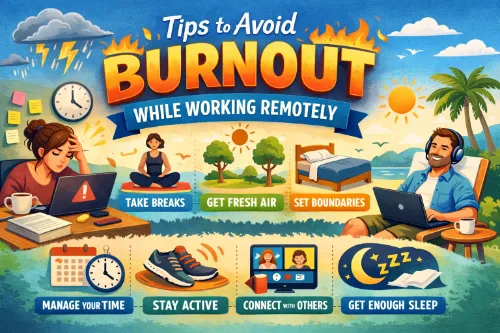
Burnout does not arrive like a storm. It builds like water erosion — slowly, quietly, one depleting day at a time, until the foundation gives way and what felt like a manageable workload suddenly feels impossible. For remote workers, this process is faster, less visible, and more common than most people realize until they are already deep inside it.
The structure of remote work — always-on availability, the collapse of physical boundaries between work and rest, social isolation, the relentless self-management that replaces external accountability — creates a uniquely fertile environment for burnout to develop. Without the natural recovery checkpoints that office environments provide — the commute, the social interactions, the physical separation from work at the end of the day — chronic stress accumulates without the release valves that prevent it from becoming burnout.
The tips to avoid burnout while working remotely are not about working less. They are about working more sustainably — with systems, boundaries, and recovery habits that protect the human being doing the work so that professional performance remains possible and genuinely fulfilling over the long term.
This guide covers everything remote workers need to prevent burnout — from recognizing its earliest signals to addressing the structural conditions that cause it in the first place.
1. Tips to Avoid Burnout While Working Remotely– What Remote Work Burnout Actually Is and Why It Happens
Burnout is a frequently used and frequently misunderstood term. It is not the same as being tired after a busy week, feeling stressed before a deadline, or experiencing temporary motivation loss during a difficult project. Burnout is a distinct psychological state with specific characteristics, specific causes, and specific consequences that differ meaningfully from ordinary occupational stress.
The World Health Organization officially classifies burnout as an occupational phenomenon — not a medical condition, but a workplace-originated syndrome characterized by three core dimensions: chronic energy depletion and exhaustion, increasing mental distance from one’s work or feelings of cynicism and negativity toward professional responsibilities, and a significant reduction in professional efficacy — the sense that your work is no longer producing meaningful results regardless of effort invested.
What makes remote work specifically burnout-prone is the combination of structural factors that simultaneously increase chronic stress and remove the natural buffers that moderate it in office environments.
Increased exposure without natural recovery: Office workers have built-in recovery moments — the commute, the casual conversations, the physical separation from work at day’s end. Remote workers often lack all three. Their workday begins the moment they open their laptop and ends — if it ends at all — only when they decide to close it. This continuous exposure to work stimuli without natural recovery breaks creates the chronic stress accumulation that is the primary driver of burnout.
Social depletion: Human beings are social organisms, and professional isolation takes a measurable toll on psychological wellbeing over time. Research from Cigna’s Loneliness Index found that more than half of Americans report sometimes or always feeling alone — and remote workers, who lack even the passive social contact of shared office space, are disproportionately represented in this statistic.
Identity blurring: When home and work occupy the same physical space, the psychological boundaries between professional self and personal self become difficult to maintain. Many remote workers find themselves in a state of perpetual partial engagement — never fully at work, never fully at rest — that is cognitively and emotionally exhausting in ways that are difficult to articulate but unmistakable in their cumulative effect.
Overwork normalization: Without fixed office hours to enforce a stop time, remote workers tend to work longer hours than their office counterparts. Each additional hour feels manageable in isolation — but the cumulative deficit of consistently working beyond sustainable limits without adequate recovery is one of the most reliable paths to clinical burnout.
The complete remote worker guide provides the foundational framework for understanding these dynamics and building a remote work life that addresses them systematically rather than hoping for the best.
2. Recognize the Early Warning Signs Before It Is Too Late
The most important thing to understand about burnout is that it is far easier to prevent or reverse in its early stages than to recover from once it has advanced. The challenge is that early-stage burnout is easy to rationalize, dismiss, or attribute to temporary external circumstances — a difficult project, a stressful week, a busy season — rather than recognizing it as a pattern requiring intervention.
These are the early warning signs that remote workers should treat as serious signals rather than temporary moods:
Persistent concentration difficulty: Tasks that previously felt manageable now require disproportionate mental effort. You find yourself re-reading the same paragraph, starting the same task repeatedly, or losing track of what you were doing mid-thought. This is not laziness — it is a measurable consequence of cognitive resource depletion.
Emotional detachment from previously meaningful work: Projects, clients, or responsibilities that once generated genuine engagement now feel hollow, burdensome, or pointless. The professional cynicism dimension of burnout often manifests first as a subtle loss of caring — a withdrawal of the emotional investment that made work feel worthwhile.
Physical fatigue that sleep does not resolve: Burnout fatigue is qualitatively different from normal tiredness. A good night of sleep restores normal tiredness. Burnout fatigue persists despite adequate rest because it is rooted in chronic physiological stress rather than simple energy expenditure.
Increasing irritability and emotional reactivity: Small frustrations produce disproportionate emotional responses. You find yourself impatient with colleagues, snapping at household members, or experiencing emotional reactions that feel out of proportion to the circumstances triggering them.
Declining work quality despite sustained or increased effort: You are working harder but producing less. The gap between effort and output that burnout creates is one of its most demoralizing characteristics — it feeds a cycle of working more to compensate, which depletes resources further, which degrades performance further.
Dread as a default emotional state toward work: The Sunday evening anxiety that anticipates Monday morning. The reluctance to open your laptop in the morning. A persistent, low-grade sense of dread about professional obligations that used to feel neutral or positive.
If you are experiencing three or more of these signs consistently over two or more weeks, treat it as an early-stage burnout signal requiring immediate attention. The resources on work-life balance tips for remote workers and the wellness tips for better mental health provide the intervention frameworks most relevant at this stage.
3. Set Boundaries That Protect Your Energy Every Day
Boundaries are not personality traits of particularly assertive people — they are professional systems that protect the cognitive and emotional resources that work quality depends on. Remote workers without clear, enforced boundaries around their work hours and availability are running their professional performance on an account that is always being withdrawn from and never adequately replenished.
Define Your Working Hours and Hold Them
The starting point for burnout prevention is the same as the starting point for work-life balance: defined, consistent work hours with a genuine commitment to honoring them. Choose your hours deliberately based on your professional obligations and biological energy rhythms. Communicate them clearly to colleagues, managers, and clients. Then protect them with the same consistency you apply to external commitments.
The moment work hours become elastic — starting a little earlier because there is a lot to do, finishing a little later because a project is not quite done, checking in on weekends because it only takes a few minutes — the foundation of burnout prevention begins to crack. Elasticity in both directions is acceptable occasionally. As a habitual pattern, it is how burnout builds.
The guide on how to set boundaries when working from home provides the specific communication frameworks and household management strategies that make daily work-hour boundaries stick across every type of home environment and professional context.
Create Hard Stops With Shutdown Rituals
A daily shutdown ritual — a brief, consistent end-of-workday sequence that closes your professional systems, captures open items, sets tomorrow’s priorities, and physically marks the transition out of work mode — is one of the most reliably effective burnout prevention tools available. It creates the psychological closure that genuine recovery requires and prevents the diffuse mental engagement with work that erodes personal time without ever providing the recovery of genuine disconnection.
Your shutdown ritual should take 15–20 minutes and always end with physical actions: closing your laptop, turning off your desk lamp, leaving your workspace. The physicality of these actions reinforces the psychological transition in a way that digital-only shutdown processes cannot match.
Say No as a Professional Skill
The inability to say no to additional work, additional commitments, and additional demands is one of the most common behavioral contributors to remote worker burnout. Without the natural volume limiters that office work provides — a physical workspace that fills up, a departure time that ends the day, the visible fatigue of colleagues that normalizes limits — remote workers can take on more than is sustainable with very little immediate feedback that they have done so.
Saying no professionally — to additional projects, to non-essential meetings, to scope creep, to out-of-hours requests — is not a character flaw. It is the exercise of a professional boundary that protects your ability to do excellent work on what you have already committed to.
4. Build Recovery Into Your Daily Routine
Recovery is not what happens when you eventually collapse and have no choice but to rest. It is a daily practice — a deliberate, structured set of recovery activities built into your routine that prevent the cumulative resource depletion that makes burnout inevitable.
The productive remote work routine that protects against burnout is not one that maximizes work hours. It is one that strategically alternates between focused effort and genuine recovery in rhythms that sustain high performance over the long term.
Strategic Breaks During the Workday
Taking real breaks — not screen-switching from work content to social media content, but genuine disengagement from cognitive effort — is one of the most evidence-backed burnout prevention strategies available. Research on ultradian performance rhythms published in the National Library of Medicine shows that your brain naturally cycles through periods of high and low alertness approximately every 90 minutes. Working through the low-alertness periods without recovery — which most remote workers do habitually — accelerates the cognitive depletion that drives burnout.
Schedule genuine breaks of 10–20 minutes every 90 minutes during your workday. Use them for physical movement, brief nature exposure, genuine rest away from screens, or light social interaction. These breaks are not productivity losses — they are recovery investments that sustain the cognitive performance capacity that the rest of your workday depends on.
The Evening Transition as Recovery
Your transition from work to personal time is one of the most important recovery windows of the day. Remote workers who move directly from work mode to passive evening screen consumption — scrolling social media, watching television — get less cognitive and emotional recovery than those who include active recovery elements in their evenings: physical exercise, meaningful social interaction, creative hobbies, time in nature, or genuine relaxation without screens.
Build your evenings with recovery intentionality. What activities genuinely restore you — not just distract you — from the cognitive and emotional demands of professional work? Schedule those activities with the same deliberateness you schedule your work blocks.
Vacation as a Non-Negotiable
Remote workers take less vacation than office workers on average — research from the U.S. Travel Association consistently shows that Americans leave significant vacation time unused, and remote workers are disproportionately represented in this pattern. This is not a badge of dedication. It is a burnout accelerator.
Schedule your vacation time at the beginning of each year rather than waiting until you feel you can afford it. The feeling that you cannot afford to take time off is itself an early burnout warning sign. Protect your scheduled vacation as you would protect any critical professional commitment.
5. Manage Your Workload Before It Manages You
Workload mismanagement is the most direct behavioral path to burnout. When the volume and complexity of professional commitments consistently exceeds available time and cognitive capacity — and when this imbalance is sustained over weeks and months without correction — burnout is the predictable destination.
Audit Your Current Workload Honestly
Most remote workers have never done a genuine workload audit. They know they feel overwhelmed, but they have not specifically examined which commitments are creating the overload, which could be eliminated or reduced, and which are genuinely non-negotiable. A workload audit involves listing every current professional commitment — projects, recurring responsibilities, meetings, informal obligations — and evaluating each one against two questions: Is this genuinely within my role and responsibilities? Is this producing value proportionate to the time and energy it requires?
The answers frequently reveal a significant volume of commitments that accumulated without deliberate decision — meetings that nobody finds valuable but nobody has cancelled, projects that have outlived their original purpose, informal obligations that have become habitual without being explicitly required. Eliminating or reducing these commitments is not shirking responsibility — it is creating the capacity to do your actual responsibilities with the quality and attention they deserve.
For effective workload management through structured scheduling, the remote work time management guide provides the frameworks for translating your workload audit into a realistic, sustainable daily schedule. And the focus tips for remote workers resource shows you how to protect the focused work time that high-quality output on your remaining commitments requires.
Underpromise and Overdeliver
One of the most effective workload management habits for remote workers is the practice of consistent, deliberate undercommitment relative to capacity — promising slightly less than you know you can deliver, and delivering more than you promised. This creates a sustainable buffer between your committed volume and your actual capacity, reducing the chronic pressure of always operating at the edge of your limits.
This approach is not about working less. It is about creating the recovery margin that prevents the overload accumulation that drives burnout, while simultaneously building a professional reputation for reliable delivery that compounds into long-term career advancement.
Use the tools for remote workers — specifically project management and time tracking tools — to maintain an accurate, real-time picture of your current workload commitments before accepting new ones.
6. Protect Your Social Connection and Emotional Health
The social dimension of remote worker burnout is among the most important and least addressed. Human beings are social organisms — our cognitive performance, emotional regulation, motivational systems, and immune function all depend on regular, meaningful social interaction in ways that are biological rather than merely psychological.
Remote work removes the ambient social contact of office life — the casual conversations, the shared lunch, the spontaneous collaboration, the simple experience of being in the physical presence of other people who are engaged in purposeful activity alongside you. Over time, the absence of this contact creates a social deficit that accumulates into the loneliness, disconnection, and professional cynicism that are hallmarks of advanced burnout.
Intentional Social Connection as a Professional Practice
Build social connection into your weekly routine as a non-negotiable professional practice — not a nice-to-have when time permits, but a scheduled, protected element of your workweek. This means regular video check-ins with colleagues that include personal conversation, active participation in team communication channels, and intentional relationship investment with professional peers.
Outside of work, actively schedule and protect social activities with friends, family, and community. Remote workers who treat personal social connection as optional are systematically depleting one of the most important resources for both professional performance and personal wellbeing.
Platforms like Focusmate provide structured virtual coworking sessions that offer a form of social accountability and ambient human presence during work hours — a surprisingly effective partial substitute for the social energy of shared office space that many remote workers underestimate until they try it.
The wellness tips for better mental health resource provides the complete framework for maintaining emotional health and social wellbeing within the specific challenges of remote work — including strategies for managing loneliness, building professional community, and maintaining the human connections that burnout systematically erodes.
Professional Mental Health Support
For remote workers experiencing significant burnout symptoms — persistent depression, anxiety, emotional dysregulation, or a sense of hopelessness about their professional situation — professional mental health support is not a sign of weakness. It is the appropriate level of intervention for a serious occupational health issue. Therapists who specialize in work-related stress and burnout, accessible through platforms like BetterHelp and Talkspace, provide professional support specifically calibrated to the psychological dimensions of occupational burnout.
7. Use Physical Wellness as a Burnout Prevention Strategy
Physical wellness and burnout prevention are inseparably connected. The same physiological systems that support cognitive performance — the stress-response systems, the sleep-restoration processes, the neurochemical regulation mechanisms — are directly degraded by physical inactivity, poor nutrition, inadequate sleep, and chronic sedentary behavior. Investing in physical wellness is simultaneously investing in burnout resilience.
Sleep as the Primary Recovery Mechanism
Sleep is the single most important physical wellness practice for burnout prevention. During sleep your brain clears metabolic waste products accumulated during waking hours, consolidates the day’s learning, restores emotional regulation capacity, and replenishes the prefrontal cortex resources that executive function and stress management require. The American Academy of Sleep Medicine recommends seven or more hours per night for adults — not as a lifestyle preference but as a physiological requirement for normal cognitive and emotional function.
Remote workers who consistently sacrifice sleep — because work runs late, because evening screen time delays sleep onset, because anxiety about the next day’s workload disrupts sleep quality — are systematically dismantling their burnout resilience one night at a time.
Regular Physical Exercise
Research from Harvard Medical School demonstrates that regular aerobic exercise increases the production of BDNF — a protein that supports neuron health and cognitive function — while reducing cortisol levels and improving the emotional regulation capacity that burnout degrades. For remote workers, exercise also provides the physical movement, change of environment, and social contact — if exercising in shared spaces — that counteract several of the structural burnout risk factors of home-based work simultaneously.
The healthy habits for remote workers guide provides specific, practical frameworks for building consistent physical wellness habits into a full remote workday — including strategies for motivation, scheduling, and maintaining consistency during high-pressure professional periods when the temptation to skip exercise is greatest.
Nutrition and Stress Physiology
Chronic stress depletes specific nutritional resources — particularly B vitamins, magnesium, and antioxidants — that support the neurological systems involved in stress regulation and cognitive performance. A diet consistently high in processed foods, refined sugars, and caffeine while low in vegetables, protein, and healthy fats both reflects and amplifies the chronic stress state that drives burnout. Remote workers who are actively managing burnout risk should treat nutrition as part of their recovery protocol rather than an afterthought.
8. Create a Work Environment That Reduces Chronic Stress
Your physical work environment is not a neutral backdrop to the burnout prevention strategies in this guide — it is an active contributor to or buffer against the chronic stress that causes burnout. Environmental factors including lighting, noise, visual clutter, ergonomics, and workspace organization all affect the level of ambient cognitive load and physiological stress your body carries throughout the workday.
Design Your Workspace for Calm Efficiency
A workspace that is visually cluttered creates measurable increases in cortisol — the primary stress hormone — according to research from the Princeton Neuroscience Institute on the neurological effects of visual disorder. Keeping your workspace clean, organized, and visually calm is not an aesthetic preference — it is a physiological stress management strategy.
Natural light significantly reduces cortisol levels and improves mood compared to artificial lighting. Position your workspace near a window whenever possible. Ergonomic furniture and equipment that prevents physical discomfort reduces the low-grade physiological stress of pain and physical strain that accumulates silently over hours of sedentary work.
Manage Digital Environment Stress
Notification overload is one of the most insidious sources of chronic low-level stress in remote work. Each unread notification is a micro-demand on your attention — a small, persistent call for cognitive resources that accumulates across dozens or hundreds of daily notifications into a significant stress load.
Conduct a comprehensive notification audit across every device and application. Remove every notification that does not require immediate action that justifies interrupting focused work. Implement scheduled Do Not Disturb periods during deep work blocks and after work hours. The reduction in ambient stress from this single intervention surprises most remote workers who implement it consistently.
9. Address the Root Causes — Not Just the Symptoms
The strategies in sections 3 through 8 address the behavioral and lifestyle factors that create burnout resilience. But for many remote workers, burnout has structural root causes — in the nature of the work itself, in the relationship with their employer, in the fundamental misalignment between the role they are in and the career they actually want — that behavioral interventions alone cannot resolve.
When Burnout Signals a Career Alignment Problem
Persistent burnout that does not respond to boundary-setting, wellness investments, and workload management is often signaling something deeper: that the current role, employer, or career path is fundamentally misaligned with your values, strengths, or professional goals.
This is uncomfortable to confront because it implies change that feels risky or disruptive. But continuing to optimize behavioral coping strategies for a fundamentally misaligned situation is like treating the symptoms of a disease without addressing its cause.
If this resonates, the remote worker career guide provides the framework for evaluating your current trajectory and designing a professional path that aligns with your actual strengths and goals. The skills for career growth resource identifies the competencies worth developing for the career realignment that burnout is sometimes pointing toward. And the remote jobs for long-term career growth guide helps you identify roles and industries where structural burnout risk is lower and sustainable long-term performance is more naturally supported.
Income Stress as a Burnout Driver
Financial stress is one of the most common and least discussed contributors to remote worker burnout. Remote workers who feel trapped in a role they find depleting because they cannot afford to leave — or who are working multiple roles simultaneously to meet financial needs — face a burnout risk that wellness habits alone cannot fully address.
Building financial resilience through diversified income is both a financial strategy and a burnout prevention measure. The tips to increase income as a remote worker — developed within your current capacity rather than added to an already overloaded workload — create the financial cushion that reduces the trapped feeling that financial stress produces.
The resources on side hustles for remote workers and multiple income streams provide the specific strategies for building that cushion sustainably. And the guide on negotiating higher pay in a remote job helps you address income inadequacy at the source — through better compensation for work you are already doing.
10. How Burnout Prevention Fuels Career and Income Growth
The reframe that most remote workers need is understanding burnout prevention not as a cost to professional ambition but as one of its most important enablers.
The brain that is protected from burnout — through boundaries, recovery, social connection, physical wellness, and structural alignment — produces dramatically better professional output than the one chronically depleted by unmanaged overwork.
Career advancement in remote work depends fundamentally on the quality and consistency of your performance over time. Burnout systematically degrades both. Remote workers who burn out — whether they recognize it as burnout or simply as a period of underperformance — damage their professional reputation, their relationships with managers and colleagues, and their capacity to develop the skills that drive career growth. Recovery from advanced burnout typically takes months. Prevention costs minutes per day.
When your burnout prevention systems are working — when your boundaries are holding, your recovery is genuine, your social connection is adequate, and your physical wellness is protected — you have the cognitive and emotional resources to invest in the high-income skills that command premium remote compensation. You have the energy to pursue the productivity tips for remote workers that elevate your daily output quality. You have the focus to implement the focus tips for remote workers that produce the deep work results that advance careers.
The remote work time management strategies that protect your schedule from overload are simultaneously burnout prevention strategies. The productive remote work routine that structures your day for sustainable performance is simultaneously a burnout prevention system. The tools for remote workers that automate organizational overhead reduce the ambient cognitive load that contributes to burnout accumulation.
Burnout-protected remote workers are the ones who successfully get promoted remotely — because their consistent, high-quality performance over time creates the professional reputation that advancement requires. They are the ones who have the bandwidth to build multiple income streams and explore side hustles for remote workers — because their primary role is not consuming every available resource.
And they are the ones who build careers that are still worth having after ten or twenty years of remote work — because they built them on foundations that sustain rather than deplete.
Use the resume tips to get hired fast online to position your track record of sustainable high performance as a professional asset when pursuing new opportunities. Explore the remote jobs for long-term career growth resource to identify roles where burnout risk is structurally lower. And invest continuously in the work-life balance tips for remote workers that form the outer protective layer of everything in this guide.
Burnout prevention is not the enemy of professional ambition. It is the condition under which professional ambition is sustainable — and worth having.
FAQs
1. What is remote work burnout?
Remote work burnout is a state of chronic exhaustion, detachment, and reduced performance caused by prolonged stress and lack of recovery.
2. How is burnout different from regular stress?
Stress is temporary and manageable, while burnout is persistent, deeply draining, and affects motivation, performance, and wellbeing.
3. Why are remote workers more prone to burnout?
Because of constant accessibility, lack of physical boundaries, social isolation, and the absence of natural workday transitions.
4. What are the three core dimensions of burnout?
According to the World Health Organization: exhaustion, mental detachment or cynicism, and reduced professional effectiveness.
5. What causes burnout in remote work setups?
Continuous work exposure, limited recovery, isolation, blurred identity between work and home, and unmanaged workload.
6. How does lack of physical separation contribute to burnout?
It removes natural cues for starting and ending work, leading to prolonged work engagement without proper mental disengagement.
7. Why is social isolation a serious risk factor?
Humans require regular interaction; prolonged isolation reduces motivation, mood stability, and cognitive performance.
8. What is “identity blurring” in remote work?
It refers to the merging of personal and professional roles due to working in the same environment.
9. What are early warning signs of burnout?
Difficulty concentrating, irritability, persistent fatigue, reduced work quality, and emotional detachment.
10. How long should burnout symptoms persist before taking action?
If symptoms last two weeks or more consistently, intervention should begin immediately.
11. Why is boundary-setting critical for burnout prevention?
It protects mental and physical energy by limiting overwork and ensuring time for recovery.
12. What is a “hard stop” in remote work?
A strict, non-negotiable end to the workday reinforced by routines like shutdown rituals.
13. Why is saying “no” important for remote workers?
It prevents overload and preserves capacity for high-quality work on existing responsibilities.
14. What role do breaks play in preventing burnout?
Regular breaks restore cognitive energy and prevent mental fatigue from accumulating.
15. How often should remote workers take breaks?
Roughly every 90 minutes, aligned with natural brain performance cycles.
16. What types of activities promote real recovery?
Physical movement, social interaction, time in nature, and non-screen relaxation.
17. Why is vacation important for remote workers?
It provides extended recovery time that daily breaks cannot replace and prevents long-term exhaustion.
18. How can workload mismanagement lead to burnout?
Taking on excessive tasks without evaluation creates sustained overload and cognitive strain.
19. What is a workload audit?
A structured review of all responsibilities to identify unnecessary, low-value, or excessive commitments.
20. Can burnout indicate a deeper career issue?
Yes. Persistent burnout may signal misalignment between your role, values, and long-term career goals.