

Work-life balance tips for remote workers that actually work include setting defined daily work hours and honoring them consistently, creating physical boundaries through a dedicated workspace, building a deliberate evening shutdown ritual to psychologically disconnect from work, developing sleep, movement, and mindfulness habits that sustain cognitive performance, managing social isolation proactively through intentional connection, protecting weekends as genuine recovery time, communicating availability boundaries clearly and professionally, and recognizing burnout warning signs early enough to intervene before they advance.
Remote workers who build these strategies into deliberate daily and weekly systems — rather than relying on willpower alone — consistently report higher job satisfaction, better mental health, stronger professional performance, and faster career growth than those who sacrifice balance in pursuit of constant availability. Work-life balance is not a trade-off against career success for remote workers — it is one of its most powerful and most underutilized enablers.
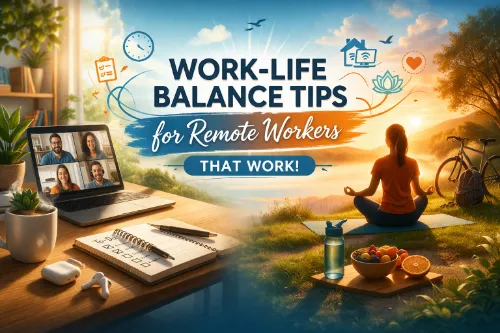
Remote work promised the perfect balance. No commute. Flexible hours. More time with family. The ability to structure your day around life rather than the other way around. For many remote workers, those promises have been at least partially fulfilled. But for a significant and growing number, remote work has delivered something unexpected — a version of work that never ends, never fully starts, and never quite feels separate from the rest of life.
The always-on nature of remote work — where your office is permanently open because it lives inside your home, where colleagues can reach you at any hour through any device, where the psychological distance between work and rest has collapsed entirely — has made genuine work-life balance tips for remote workers more necessary than ever before.
The remote workers who get this right are not the ones with the most willpower or the most disciplined personalities. They are the ones with the most deliberate systems. They have designed their work-life balance intentionally — built it into their schedule, their environment, their communication habits, and their daily rituals — rather than hoping it would emerge naturally from the freedom of working from home.
This guide delivers every proven work-life balance strategy that actually works — drawn from behavioral research, wellness science, and the practical experience of remote professionals who have built sustainable, fulfilling careers without sacrificing the life that makes those careers worth having.
1. Why Work-Life Balance Is Harder and More Important in Remote Work
Understanding why work-life balance is specifically challenging in remote work is the foundation for solving it effectively. The challenges are not the same as those in office work — they are different in kind, not just degree.
The absence of physical separation is the most fundamental challenge. In an office, the commute serves as a twice-daily psychological transition — from home mode to work mode in the morning, and from work mode to home mode in the evening. This transition is not just logistical. It is neurological.
The change of environment, the physical movement, the shift in social context — all of these cues signal to your brain which behavioral mode is appropriate. Remove the commute and the separate workspace, and those transitions disappear entirely, leaving your brain in perpetual ambiguity about which mode to be in.
The digital accessibility problem compounds this. When your work tools live on the same device as your personal life — the same phone, the same laptop, the same email client — there is no physical barrier to work encroaching into personal time. A work message that arrives at 8 PM is visible immediately. A project thought that occurs during dinner can be acted on instantly. The boundaries that physical separation used to enforce must now be actively constructed and continuously defended.
Research from the International Labour Organization found that remote workers are significantly more likely to work more than 48 hours per week than office-based workers — not because they are more motivated, but because the structural signals to stop working are absent. Without deliberate intervention, work expands to fill all available time and space.
The stakes of getting this wrong are serious. Chronic work-life imbalance leads to burnout, relationship deterioration, physical health decline, reduced cognitive performance, and ultimately career damage — the exact opposite of what the relentless work was intended to produce. The complete remote worker guide provides the broader framework for sustainable remote work success that work-life balance is a central part of.
2. Work-Life Balance Tips for Remote Workers– Set Clear Work Hours and Honor Them Every Day
The most foundational work-life balance intervention for remote workers is the establishment of defined, consistent work hours — and the daily discipline to honor them as genuine commitments rather than loose guidelines.
Defined work hours serve several interconnected functions. They create the temporal boundaries that signal to your brain when to be in work mode and when to disengage. They set expectations for colleagues and clients that protect your personal time without requiring constant renegotiation.
They give the people who share your home a reliable framework for your availability. And they provide the psychological certainty — knowing that work ends at a defined time — that allows genuine commitment to focused work during working hours rather than the half-engaged, always-available mode that undefined hours produce.
Choosing Your Work Hours
Your defined work hours should reflect three things: your professional obligations — core hours when your team or clients need availability; your biological peak performance windows — when your cognitive output is naturally highest; and your personal life priorities — family commitments, exercise, social time, and personal obligations that matter to you.
For most remote workers, a clearly defined 8–9 hour window with a specific start time, a real lunch break, and a specific end time provides the structure needed for both professional performance and personal restoration. The specific hours matter less than the consistency and the daily commitment to honoring them.
Communicating Your Hours
Define your hours and communicate them explicitly. Add them to your email signature, your Slack profile, and your calendar availability settings. Have the direct conversation with your manager and key colleagues. This communication does two things simultaneously: it sets expectations that protect your boundaries, and it demonstrates the professional self-awareness and reliability that managers associate with high-performing remote workers.
The guide on remote work time management covers how to structure your defined hours into a time-blocked schedule that maximizes both output and boundary protection — making your hours work for your career, not just your calendar.
3. Create Physical and Psychological Boundaries at Home
Defined work hours establish temporal boundaries. Physical and psychological boundaries address the spatial dimension of work-life balance — the challenge of maintaining meaningful separation between work and personal life when both happen in the same building.
Physical Boundaries
A dedicated workspace is the most important physical boundary a remote worker can create. When you work in a specific location used exclusively or primarily for work — even a specific desk in a shared room — your brain learns to associate that location with focused professional engagement. When you leave it, you leave work behind.
The inverse matters equally: keeping work physically confined to your designated workspace prevents the creeping colonization of personal spaces by professional demands. Laptops that live on the dining table, work documents spread across the living room, work calls taken from the bedroom — each of these erodes the psychological separation between work and rest that physical boundaries are designed to create.
At the end of each workday, physically close your workspace. Close your laptop. Organize your desk. If possible, close the door or visually separate the work area from your living space. These physical actions reinforce the psychological transition out of work mode in a way that purely digital shutdown actions cannot replicate alone.
Building a productive remote work routine that includes specific workspace entry and exit rituals makes this physical boundary-setting automatic rather than effortful over time.
Psychological Boundaries
Physical boundaries alone are insufficient if your mental engagement with work continues beyond your defined hours. Psychological boundary-setting — the internal discipline to genuinely disengage from work thoughts during personal time — is one of the most challenging and most important work-life balance skills for remote workers to develop.
Effective psychological boundary techniques include a consistent shutdown ritual that closes the workday deliberately, a transition activity after work that physically separates the work period from personal time such as a walk or exercise session, and a firm rule against checking work communications during personal hours enforced at the device level through scheduled Do Not Disturb settings.
The comprehensive guide on how to set boundaries when working from home provides specific scripts, systems, and frameworks for creating and maintaining both physical and psychological boundaries in every type of home environment and household situation.
4. Master the Art of Disconnecting After Work
Disconnecting from work after hours is simple in principle and genuinely difficult in practice. The digital infrastructure of remote work — email, Slack, project management notifications, work-related applications — is always a tap or click away, and the habit of checking “just once more” before bed is one of the most pervasive and most damaging patterns in remote work culture today.
The Evening Shutdown Ritual
A deliberate, consistent evening shutdown ritual is the most effective single intervention for genuine after-work disconnection. It works because it provides psychological closure — the sense that the workday is genuinely complete — which is the prerequisite for genuine rest and recovery.
An effective shutdown ritual takes 15–20 minutes and includes reviewing what was accomplished during the day, capturing any open tasks or thoughts into your task management system, setting your top three priorities for tomorrow, blocking them on your calendar, closing all work applications, silencing work-related notifications on all devices, and performing a physical shutdown action such as closing your laptop, turning off your desk lamp, and leaving your workspace.
The physical and digital shutdown signals combined create the clear boundary your brain needs to shift from work mode to recovery mode. Without this deliberate transition, many remote workers spend their evenings in a low-grade work state — not actively working, but not genuinely resting either — which provides neither the productivity of focused work nor the restoration of genuine recovery.
Device Management for After-Hours Disconnection
Configure your devices to enforce your disconnection. Schedule Do Not Disturb on your phone for all work channels after your defined work end time. Use separate browser profiles for work and personal use — closing the work profile at the day’s end and not reopening it until the following morning. Consider keeping your work laptop physically separate from your living spaces in the evenings, removing the visual trigger that provokes work checking.
The focus tips for remote workers resource extends these techniques into the workday itself — because the same discipline that protects your after-hours time also protects your focused work blocks during the day, creating the complete work-life architecture that balance requires.
5. Build Wellness Habits That Sustain Long-Term Performance
Work-life balance is not just about managing work hours — it is equally about protecting and investing in the physical and mental health that makes sustained professional performance possible. Remote workers who neglect wellness in pursuit of productivity consistently find that their output degrades over time as the biological foundations of cognitive performance erode beneath them.
Sleep as the Foundation
Sleep is not a lifestyle preference — it is the primary biological mechanism through which your brain consolidates learning, restores decision-making capacity, regulates emotional responses, and repairs the cellular damage of daily cognitive effort. The American Academy of Sleep Medicine recommends a minimum of seven hours per night for adults, with eight being optimal for most cognitive performance metrics.
Remote workers have a unique opportunity to optimize their sleep because they control their schedule in ways office workers cannot. Consistent sleep and wake times — the same time every day including weekends — stabilize your circadian rhythm and produce better sleep quality than variable schedules, regardless of total sleep duration. Protect this consistency with the same seriousness you give your most important professional commitments.
Physical Movement
Regular physical exercise is one of the most evidence-backed interventions for both professional performance and personal wellbeing available to remote workers. Research from Harvard Medical School demonstrates that consistent aerobic exercise measurably improves attention, memory, decision-making, and emotional regulation — all of which directly impact remote work performance and quality of life simultaneously.
The healthy habits for remote workers guide provides comprehensive frameworks for integrating consistent movement into a full remote workday — including strategies for remote workers in small spaces, those with variable schedules, and those building from a low activity baseline.
Mindfulness and Stress Management
Brief, consistent mindfulness practices — even 5–10 minutes of focused breathing or meditation per day — produce measurable reductions in stress, improvements in emotional regulation, and enhanced attentional control. Research from Johns Hopkins University found that mindfulness meditation has a moderate-to-strong effect on anxiety, depression, and pain — all common contributors to remote work wellbeing challenges. Apps like Headspace and Calm make consistent mindfulness practice accessible within minimal daily time investment.
For the complete framework of physical and emotional wellbeing strategies built specifically for remote professionals, the wellness tips for better mental health resource covers every dimension of remote wellness from sleep and nutrition to emotional resilience and professional stress management.
6. Manage Social Isolation Before It Manages You
Social isolation is one of the most consistently reported and most underaddressed challenges of remote work. Buffer’s annual State of Remote Work survey has found for multiple consecutive years that loneliness and collaboration difficulty are among the top struggles remote workers face globally — and the psychological consequences of chronic isolation extend well beyond occasional loneliness into measurable impacts on mood, motivation, cognitive function, and long-term wellbeing.
For remote workers, intentional social connection is not optional — it is a professional performance requirement and a fundamental wellness need that work-life balance depends on.
Building Social Connection Into Your Work Week
Schedule regular video check-ins with colleagues that include personal conversation beyond work topics. Participate actively in team communication channels and virtual social events rather than engaging minimally. Use platforms like Focusmate for virtual coworking sessions that provide the ambient human presence that solo remote work consistently lacks.
Outside of work, actively maintain and invest in personal social relationships. Schedule regular social activities with deliberate intention — because without the passive social contact of an office environment, meaningful personal connection requires proactive planning that remote workers must build into their weekly rhythm.
Coworking and Community Spaces
Periodic use of coworking spaces is one of the most effective antidotes to remote isolation available. Even one or two days per week in a shared workspace significantly reduces the loneliness that full-time home working can produce, while maintaining the flexibility benefits of remote work.
Many remote workers find that the combination of home working for deep focus and coworking for social energy creates an ideal hybrid that serves both performance and wellbeing.
Professional communities — online forums, industry groups, mastermind groups, and peer networks — serve a similar function for the professional social connection that offices provide naturally. Investing time in these communities is not a distraction from productive work — it is a career investment and a wellness practice simultaneously.
7. Protect Your Weekends and Personal Time Deliberately
Weekend erosion is one of the quietest and most damaging patterns in remote work life. Without the clear Monday-to-Friday rhythm that office attendance enforces, weekends become vulnerable to work creep — a few emails Saturday morning, a quick project review Sunday afternoon, “just getting ahead” of the week that slowly transforms rest days into extended work days.
The cost of this erosion is not just personal — it is professional. Genuine rest and recovery over weekends is not a luxury. It is the biological reset that restores the cognitive resources, creative capacity, and emotional resilience that quality professional work requires. Remote workers who consistently fail to protect their weekends arrive at Monday depleted rather than restored, entering each week already running a deficit.
Creating Real Weekend Boundaries
Implement a Friday shutdown ritual that is more thorough and deliberate than your daily shutdown. Review the full week — what was accomplished, what carries forward, and what the coming week requires. Set Monday’s priorities and block them. Communicate anything time-sensitive before signing off. Then close your professional systems completely for the weekend — not just on silent, but genuinely closed.
Configure all work communication tools to suppress notifications on weekends. Communicate your weekend unavailability to colleagues and clients proactively so that the boundary is understood rather than discovered through non-response. For remote workers in leadership or client-facing roles, this communication is particularly important — setting the expectation clearly is more professional than disappearing silently.
The tools for remote workers guide covers the specific app settings and device configurations that make weekend disconnection automatic rather than requiring willpower to maintain each week.
Using Weekends for Genuine Recovery
Genuine weekend recovery is active, not passive. Screen-based leisure — social media, streaming, gaming — provides some restoration but significantly less than activities involving physical movement, social connection, time in nature, creative engagement, and genuine rest.
Build weekends that include activities in multiple recovery categories rather than defaulting to passive screen consumption, which leaves many people feeling no more restored than when the weekend began.
8. Communicate Your Boundaries Professionally and Clearly
Work-life balance ultimately requires other people to respect your boundaries — and they can only do that if your boundaries are communicated clearly, consistently, and professionally. Many remote workers struggle with this communication out of a fear of appearing less committed or less available than colleagues who have not set similar limits.
This fear, while understandable, is largely unfounded. Research on boundary-setting in professional contexts consistently shows that professionals who communicate their availability clearly and reliably are perceived as more organized, more trustworthy, and more professional — not less dedicated. The remote worker who responds to messages within a predictable window is easier to work with than the one whose availability is unpredictable, regardless of how many hours the latter is technically available.
Boundary Communication Frameworks
Be specific rather than vague. “I am available for urgent matters between 8 AM and 6 PM” is more useful to colleagues than “I try to maintain reasonable hours.” Specificity allows people to plan around your availability with confidence.
Provide alternatives rather than just limits. “I don’t respond to messages after 6 PM — for urgent matters, please call my mobile” is more collaborative than a flat unavailability statement. Alternatives maintain professional relationships while protecting personal time.
Maintain consistency without apology. Every time you respond to a work message outside your stated hours, you undermine the boundary you communicated and re-train the expectation of availability. Consistency is what makes boundaries real.
The guide on how to set boundaries when working from home provides word-for-word scripts for communicating availability boundaries in every professional context — with managers, colleagues, clients, and stakeholders — in ways that protect your personal time without creating professional friction.
9. Recognize Burnout Before It Derails Your Career
Burnout is the destination that unmanaged work-life imbalance reliably reaches. It is not a sudden event — it is a gradual accumulation of chronic stress, insufficient recovery, eroded boundaries, and depleted physical and emotional resources that eventually crosses a threshold where normal professional functioning becomes impossible.
The World Health Organization officially classifies burnout as an occupational phenomenon characterized by three dimensions: feelings of energy depletion or exhaustion, increased mental distance from one’s job or cynicism, and reduced professional efficacy. Remote workers are statistically more vulnerable to burnout than office workers for the structural reasons described throughout this guide — the absence of natural transition points, the erosion of social support, and the always-available dynamic of home-based work.
Early Warning Signs
Recognizing burnout early — when intervention is still relatively simple — is infinitely better than addressing it after it has advanced to the point of affecting your health and career. Early warning signs include persistent difficulty concentrating on work that previously felt manageable, emotional detachment or cynicism toward projects and colleagues you previously found engaging, physical fatigue that adequate sleep does not resolve, declining work quality despite maintained or increased effort, irritability and emotional reactivity that feel out of proportion to circumstances, and the persistent feeling that no matter how much you work, it is never enough.
If you recognize three or more of these signs consistently, treat it as a serious signal rather than a temporary mood. The tips to avoid burnout while working remotely provide the complete early intervention framework — including the specific boundary, recovery, and lifestyle changes that reverse early-stage burnout before it advances into a full career disruption.
Prevention as the Primary Strategy
Burnout prevention is structurally identical to work-life balance practice. Every strategy in this guide — defined work hours, physical boundaries, evening shutdown rituals, wellness habits, social connection, weekend protection, and clear boundary communication — is simultaneously a burnout prevention measure. The remote workers who never experience serious burnout are not exceptionally resilient by nature — they have built the systems that make burnout structurally difficult to develop.
10. How Work-Life Balance Fuels Career and Income Growth
The most important reframe for many remote workers is understanding that work-life balance is not a trade-off against career success — it is one of its most important enablers. The brain that is genuinely rested, emotionally regulated, physically healthy, and sustainably engaged produces dramatically better professional output than the one that is chronically depleted, anxiously available, and running on empty.
The career implications are direct and measurable. Remote workers who maintain strong work-life balance produce higher-quality work because their cognitive resources are consistently restored rather than chronically depleted. They advance faster because their performance is sustainable and their professional relationships are intact. And they create the mental bandwidth and personal energy needed to invest in the career and income growth that most remote workers say they want but rarely reach.
When your work-life balance is healthy, you have the energy and focus to develop high-income skills that command premium compensation in the remote job market. You have the bandwidth to implement the tips to increase income as a remote worker that require consistent effort beyond your primary role. You have the psychological resources to explore side hustles for remote workers and build the multiple income streams that create genuine financial resilience.
Your ability to get promoted remotely depends on consistent, high-quality performance over time — which requires the sustained cognitive and emotional resources that only genuine recovery provides. The remote worker career guide maps the direct path from sustainable daily performance to long-term career advancement, showing how the foundations of work-life balance translate into the professional reputation and results that drive promotion and income growth.
For remote workers investing in professional skills alongside personal wellbeing, the skills for career growth resource identifies the competencies most worth developing during the discretionary time that work-life balance protects. The productivity tips for remote workers show how to maximize the quality of your working hours so that your defined work schedule produces exceptional results without requiring endless overtime. And the productive remote work routine guide builds the daily structure that makes both high performance and genuine rest reliably achievable within the same workday.
For remote workers who are also navigating compensation negotiations, the guide on negotiate higher pay in a remote job covers how to leverage your track record of sustainable, high-quality performance into concrete financial outcomes. And as you consider which roles and industries best support the kind of balanced, long-term remote career you are building, the guide on remote jobs for long-term career growth helps you identify opportunities where work-life balance is structurally supported rather than structurally undermined.
Use the tools for remote workers to build the digital infrastructure that enforces your boundaries automatically. Apply the resume tips to get hired fast online to communicate your sustainable, high-performance remote work approach to prospective employers who increasingly recognize that balanced remote workers outperform burned-out ones over every meaningful time horizon.
Work-life balance is not a retreat from ambition. It is the infrastructure of sustainable ambition — the foundation on which every other career and income goal is most reliably built.
FAQs
1. What is work-life balance in remote work?
Work-life balance in remote work refers to maintaining clear boundaries between professional responsibilities and personal life despite working from home.
2. Why is work-life balance harder for remote workers?
Because physical separation between work and home is removed, making it easier for work to extend into personal time.
3. Do remote workers really work longer hours?
Yes. Studies (e.g., by the International Labour Organization) show remote workers often exceed traditional working hours due to lack of boundaries.
4. What is the most important first step to improve balance?
Setting clear, consistent daily work hours and strictly honoring them.
5. How many hours should a remote worker work daily?
Typically 8–9 structured hours, including breaks, depending on role and workload.
6. Why is a dedicated workspace important?
It creates a psychological association between a specific place and work, helping you mentally “leave work” when you exit that space.
7. What is a shutdown ritual?
A structured end-of-day routine that helps you mentally disconnect from work by reviewing tasks and preparing for the next day.
8. How long should a shutdown ritual take?
Around 15–20 minutes is sufficient for closure and planning.
9. Can remote work harm mental health?
Yes, especially due to isolation, overwork, and blurred boundaries if not managed properly.
10. How can remote workers avoid burnout?
By setting boundaries, maintaining routines, taking breaks, and recognizing early warning signs like fatigue and disengagement.
11. What are early signs of burnout?
Persistent exhaustion, reduced productivity, irritability, and loss of motivation.
12. Why is sleep important for remote workers?
Sleep restores cognitive function and emotional stability; organizations like the American Academy of Sleep Medicine recommend at least 7 hours nightly.
13. How does exercise impact remote work performance?
Research from Harvard Medical School shows exercise improves memory, focus, and decision-making.
14. How can remote workers manage loneliness?
By scheduling regular social interactions, joining communities, or using coworking spaces.
15. Should remote workers protect weekends?
Yes. Weekends should be reserved for recovery to prevent long-term burnout.
16. Is checking work messages after hours harmful?
Frequent after-hours checking prevents mental recovery and contributes to chronic stress.
17. How should boundaries be communicated professionally?
Clearly, consistently, and with specific availability times shared with colleagues and clients.
18. Does work-life balance reduce productivity?
No. It improves productivity by sustaining energy, focus, and long-term performance.
19. Can good work-life balance improve career growth?
Yes. Balanced workers tend to produce higher-quality work and maintain consistent performance, which supports promotions.
20. Is work-life balance a trade-off with success?
No. It is a foundation for sustainable success, not a limitation.