

Building a productive remote work routine requires establishing consistent work hours, creating morning and evening rituals that anchor your day, designing a workspace that supports focus, scheduling deep work during peak energy hours, batching similar tasks, protecting boundaries between work and personal time, and maintaining physical and mental wellness habits that sustain performance over the long term.
Remote workers who operate within deliberate, personalized daily routines consistently produce higher-quality output, experience lower stress and burnout, advance faster in their careers, and build the financial momentum needed to grow income beyond a single role. This guide delivers a complete, step-by-step framework for building a remote work routine that works — not just for a week, but for the full length of a sustainable remote career.
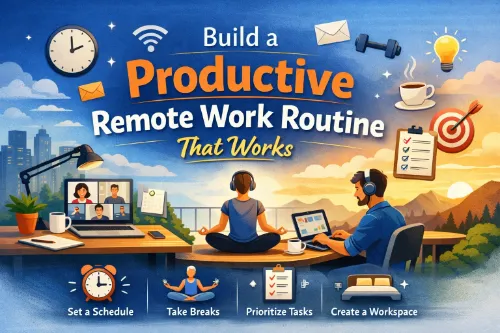
There is a version of remote work that looks like total freedom — no fixed schedule, work when you feel like it, start late, finish early, structure your day however seems right in the moment. For a small number of people, usually those with highly variable creative work and significant professional autonomy, this genuinely works.
For the vast majority of remote workers, it is a path to underperformance, chronic stress, professional stagnation, and eventual burnout. The freedom of no structure, lived daily, feels less like liberation and more like directionlessness. Tasks pile up. Priorities blur. The work expands to fill all available time without ever feeling complete. Days end without satisfaction. Weeks pass without meaningful progress.
The counterintuitive truth about remote work is this: structure creates freedom. When your day has a deliberate, well-designed routine — a consistent framework of starts, transitions, focus blocks, and ends — you stop spending your limited mental energy negotiating with yourself about what to do next and start spending it on the work that actually matters. You produce more in less time. You finish your day with a genuine sense of accomplishment. And you protect the personal time that makes the whole arrangement worth having.
This guide gives you the complete framework for building a productive remote work routine that is not just effective for a week but genuinely sustainable for the length of your remote career.
1. Why Routine Is the Foundation of Remote Work Success
Before building a routine, it helps to understand precisely why routine matters so much in the remote work context — because the reasons go deeper than simply “being organized.”
Routine reduces decision fatigue. Every decision you make throughout the day depletes a limited cognitive resource. Research by social psychologist Roy Baumeister established that decision-making draws on the same mental resource as willpower and self-control, and that this resource diminishes with use.
Remote workers without defined routines spend enormous quantities of this resource on trivial daily decisions — when to start, what to work on first, whether to check email now, when to take a break — leaving less available for the complex, high-value thinking that professional work actually requires. A well-designed routine automates these decisions, conserving mental energy for what matters.
Routine creates psychological safety. Human brains are pattern-recognition organs that function optimally in predictable environments. Consistent daily rhythms reduce the low-level background anxiety that comes from constant uncertainty about what comes next, freeing up cognitive bandwidth for focused work.
This is why studies on habit formation from University College London show that people who operate within consistent behavioral routines report lower stress and higher wellbeing — even when the routine itself contains demanding work.
Routine separates work mode from life mode. One of the most psychologically challenging aspects of remote work is the absence of physical and temporal separation between professional and personal life. Without a commute to mark the transition, without a different physical space to signal the shift, the two modes blur together in ways that degrade both.
A well-designed daily routine creates artificial but effective transitions that serve the same function — giving your brain the clear signals it needs to fully engage in work when working and fully disengage when not.
For the full context of how routine fits into every dimension of a successful remote career, the complete remote worker guide provides the foundational framework.
2. Start by Designing Your Ideal Work Day on Paper
Before implementing any routine, spend time designing it intentionally. Most remote workers fall into routines by default — shaped by external demands, convenience, and habit rather than deliberate choice. Designing your routine proactively means creating a day that serves your actual priorities, matches your biological rhythms, and reflects what success genuinely looks like for your specific work.
Start with these design questions:
When is your cognitive performance at its natural peak? Most adults experience their best focused thinking capacity in the late morning. But individual variation is significant, and the only way to know your specific peak is to pay attention. When during the day do you find it easiest to concentrate? When do you feel sharpest and most creative? When do you experience the most mental resistance to demanding work? Your answers define which hours deserve your most important tasks.
What are the non-negotiables in your day? Meetings you cannot move, commitments you cannot reschedule, household responsibilities that require your presence at specific times? Map these first — they are the fixed constraints around which everything else is designed.
What does your ideal ratio of deep work to communication to administrative work look like? Most knowledge workers benefit from at least 2–4 hours of uninterrupted deep work daily. How many hours of meetings are genuinely productive for you versus draining? What administrative load is necessary versus avoidable? These ratios should shape your schedule architecture.
What are your physical and wellness requirements? When do you want to exercise? When do you take your most meaningful break? What meal timing supports your energy? How much transition time do you need between major activities? A routine that ignores physical and wellness needs is one that will fail eventually — often within weeks.
Write the answers down and sketch a draft schedule before opening any calendar or productivity app. The act of designing on paper — without the constraints of existing calendar commitments — allows genuinely creative schedule design that digital tools tend to constrain.
3. Build a Morning Routine That Powers Your Day
Your morning routine is the most important part of your entire daily structure because it sets the cognitive, emotional, and motivational tone for everything that follows. Remote workers who start their mornings reactively — checking messages in bed, moving immediately from sleep to screen — consistently report lower daily focus, higher stress, and worse end-of-day satisfaction than those who begin with a structured, deliberate morning sequence.
The critical insight about morning routines for remote workers is that they serve two distinct functions: personal restoration (the activities that bring you to full physical and mental readiness) and professional transition (the activities that shift your brain from home mode to work mode). Both are necessary, and conflating them creates mornings that accomplish neither well.
Personal restoration phase (before work begins): Wake at a consistent time — the same time every day, including weekends when possible. Circadian rhythm research from the Sleep Foundation shows that consistent wake times stabilize your biological clock, improving sleep quality, alertness during work hours, and overall cognitive performance more than almost any other single sleep intervention.
Spend the first 20–40 minutes after waking away from screens. This allows your brain’s naturally elevated cortisol levels to do their job — waking you up progressively — without the interruption of digital stimulation. Use this window for physical activity (even a brief walk), hydration, a nutritious breakfast, and whatever personal practices (journaling, meditation, reading) support your mental state.
Professional transition phase (the work start ritual): This is the sequence of activities that bridges personal morning time and professional work time. It typically runs 10–20 minutes and always concludes with the opening of your first work task.
A reliable work start ritual might include: making a specific coffee or tea at your workspace, reviewing your calendar and priorities for the day, identifying the single most important task that must be completed, clearing your desktop of everything irrelevant to that task, and beginning — without detours into email or messaging.
The power of the work start ritual comes from its consistency. When you perform the same sequence every workday, your brain learns to associate the ritual with the upcoming shift into focused professional mode, and the transition becomes faster and easier over time. The productivity tips for remote workers resource explores how morning structure integrates into a complete daily productivity system.
4. Structure Your Core Work Hours for Maximum Output
The architecture of your core work hours — the block of time between your work start ritual and your midday break — determines the quality and quantity of your most important professional output. Getting this structure right is the highest-leverage element of your entire daily routine.
Open With Your Most Important Work
The single most impactful scheduling decision you can make is to begin each workday with your most cognitively demanding, highest-value task — before email, before messages, before team check-ins, before anything reactive. This “most important task first” principle, popularized in various forms by productivity researchers including Brian Tracy and backed by research on decision fatigue and cognitive performance, ensures that your best mental resources go to the work that produces the most professional value.
The resistance to this approach is almost universal — starting with the hardest thing feels difficult because it is difficult. But the alternative is spending your peak cognitive hours on email and administrative work, then arriving at your most important task in the afternoon when your mental capacity has already been significantly depleted.
Protect Deep Work Blocks
Following your most important task, structure your core work hours around defined deep work blocks — periods of 60 to 120 minutes dedicated to single, demanding tasks with all notifications silenced and all distractions blocked. The specific duration of your deep work blocks should match your current attention span, extended gradually over time as your capacity builds.
Research from Cal Newport, who developed the concept of deep work as a professional discipline, demonstrates that the ability to perform sustained, distraction-free cognitive work is increasingly rare and increasingly valuable in the modern economy. Remote workers who build genuine deep work capacity — through consistent daily practice within their routine — develop a professional advantage that compounds over their entire career.
The focus tips for remote workers resource provides the complete toolkit for designing and protecting deep work blocks within your daily routine, including distraction management, focus techniques, and recovery strategies.
Schedule Communication Windows Deliberately
Rather than monitoring and responding to email and messages continuously — which fragments your entire workday into a series of reactive micro-tasks — schedule two or three defined communication windows at specific times and process all messages within those windows. A morning window after your first deep work block (around 10:30–11:00 AM), a midday window (1:00–1:30 PM), and an end-of-day window (4:30–5:00 PM) covers the communication needs of virtually any remote role while protecting the focused work time between them.
This approach requires explicit communication with colleagues and clients about your response time standards. Setting the expectation that you respond to messages within a few hours — rather than instantly — is professional and appropriate for non-urgent communication, and it protects the focused work time that your most valuable output depends on.
Effective remote work time management centers on this balance between responsive communication and protected focus — the guide provides the complete framework for managing both without sacrificing either.
5. Master the Midday Reset
The midday transition point — the break between your morning work block and your afternoon work block — is one of the most underinvested elements of the remote work routine. Most remote workers either skip it entirely (working straight through lunch while eating at their desk) or use it so passively (scrolling social media, watching video) that it provides no genuine cognitive recovery.
A genuine midday reset of 30–60 minutes transforms your afternoon productivity. The mechanism is biological: your brain has been operating in an engaged, effortful mode for several hours, and the neural resources supporting sustained attention genuinely need replenishment before another demanding afternoon session.
Cognitive recovery does not happen passively in front of a screen — it requires disengagement from screens, ideally combined with physical movement, social interaction, or genuine rest.
A high-quality midday reset might include a proper meal away from your workspace, a 15–20 minute walk (which provides both physical movement and the cognitive reset benefits of nature exposure), and a brief period of genuine rest or light social contact before returning to your desk refreshed.
The healthy habits for remote workers guide provides detailed frameworks for the specific habits — nutritional, physical, and social — that make your midday break genuinely restorative rather than merely a break in the continuous stream of screen time.
6. Design an Evening Shutdown Routine That Restores You
Your evening shutdown routine is the bookend to your morning start ritual, and it is equally important for both the quality of your recovery and the quality of your next day’s work. A well-designed shutdown routine accomplishes four things: it closes out the current workday cleanly, it captures anything that needs to carry forward, it prepares tomorrow’s schedule and priorities, and it creates the psychological transition out of work mode that genuine personal restoration requires.
The Shutdown Sequence
Review what you completed today against what you planned. This brief comparison — without self-judgment — builds the self-awareness about your own work patterns and estimation accuracy that underpins continuous improvement in your scheduling.
Capture any open loops — tasks that were started but not completed, commitments made during the day, ideas that need follow-up. Write them into your task management system so that your brain can release them. The psychological effect of capturing open loops — what psychologist Bluma Zeigarnik identified as the tendency of incomplete tasks to occupy mental bandwidth — is significant. Getting them out of your head and into a trusted system reduces the background cognitive load that makes genuine rest difficult.
Set your top three priorities for tomorrow and block them on your calendar before you close your laptop. This pre-commitment eliminates morning decision-making and ensures that tomorrow begins with direction rather than ambiguity.
Perform a physical shutdown ritual: close all work applications, put your phone on do-not-disturb for work channels, close your laptop, and physically leave or reorganize your workspace. The physical actions reinforce the psychological transition and signal to your brain that work is genuinely finished for the day.
The guide on how to set boundaries when working from home provides specific frameworks for making your shutdown routine stick — including strategies for managing the common pattern of work re-engaging through evening message checking.
7. Weekly Rhythms — The Layer Above Daily Routine
A strong daily routine operates within the larger context of weekly rhythms — predictable patterns that repeat each week and create the macro-structure that supports your daily micro-structure. Without intentional weekly rhythms, even the best daily routines erode under the week-to-week variation in demands, deadlines, and priorities.
Effective weekly rhythms for remote workers typically include:
A weekly planning session: 30–45 minutes at the start of each week (Monday morning or Sunday evening) to review the week ahead, identify the most important outcomes to achieve, check deadlines and commitments, and set the time blocks that will make the week’s priorities happen. This weekly overview prevents the common pattern of daily routines operating without a weekly strategic context — where you execute tasks efficiently but lose sight of whether they are the right tasks.
Designated meeting days: Clustering meetings on specific days of the week — typically two or three days — and protecting the remaining days for deep individual work creates a weekly rhythm that dramatically reduces the fragmentation that spread-out meetings create. Many remote professionals designate specific “no-meeting days” and communicate them proactively to colleagues and managers.
A weekly review and reflection: 20–30 minutes at the end of each week to review what was accomplished, what carried over, what patterns are emerging in your performance and energy, and what adjustments to your routine might be warranted. This weekly reflection is the feedback loop that allows your routine to improve continuously rather than operating as a static structure.
Weekly skill development blocks: Consistent time allocated to learning, professional development, or career investment — protected from operational demands. The skills for career growth resource identifies which competencies to prioritize during these development blocks for maximum career impact.
8. Protect Your Routine from the Forces That Erode It
Even well-designed routines face constant erosive pressure from the demands and dynamics of remote work. Understanding the most common sources of routine disruption allows you to build defenses against them before they undermine your structure.
Meeting Creep
As described in the previous section, remote work cultures tend toward meeting multiplication that can progressively consume the time blocks reserved for focused work. Protect your routine by maintaining a consistent meeting policy — batching meetings on specific days, declining meetings that could be handled asynchronously, and proactively blocking deep work time on your calendar before it gets claimed by others.
Notification Overload
The constant availability of digital communication creates a persistent pull toward reactive responsiveness that erodes routine discipline over time. Use system-level tools to enforce your communication windows and protect your focus blocks. Freedom for blocking distracting platforms during work sessions. Scheduled Do Not Disturb on your phone during deep work blocks. Slack status updates that communicate your availability honestly and set appropriate expectations.
Flexibility Overuse
The flexibility of remote work is one of its greatest benefits — and one of its greatest routine threats. Making exceptions to your routine structure is sometimes necessary and appropriate. Making them frequently is how routine dissolves into chaos. Treat your routine as a professional commitment that requires a genuine reason to override, not a preference that yields to minor inconvenience.
Isolation and Motivational Drift
Without the ambient social energy of an office, remote workers are vulnerable to motivational drift — a gradual erosion of professional engagement that undermines routine adherence from the inside. Counteract this with intentional social connection: regular video check-ins with colleagues, virtual coworking sessions through platforms like Focusmate, and periodic in-person connection with professional peers when possible.
9. Wellness Habits That Make Your Routine Sustainable
A productive remote work routine that ignores wellness is a routine built on sand. The physical and emotional foundations of your daily performance determine how effectively every other routine element functions — and how long the whole structure holds up under the sustained demands of a remote career.
Sleep as a Routine Anchor
Consistent sleep timing is both a wellness necessity and a routine cornerstone. Research from the National Sleep Foundation shows that consistent wake and sleep times — more than total sleep duration alone — improve cognitive performance, mood stability, and daily energy. Your morning routine begins with your sleep schedule. Protect both.
Movement as a Performance Investment
Regular physical activity is one of the most evidence-backed cognitive performance enhancers available. Harvard Medical School research demonstrates measurable improvements in attention, memory, and executive function from consistent aerobic exercise. Build movement into your routine as a non-negotiable scheduled element — not something you do if time permits, but something your schedule is designed to include. The healthy habits for remote workers guide provides practical frameworks for integrating movement throughout a full remote workday.
Mental Health and Emotional Wellbeing
Remote work’s isolation, boundary challenges, and performance pressures create specific mental health risks that a sustainable routine must address proactively. The wellness tips for better mental health resource provides a comprehensive framework for maintaining emotional resilience and psychological wellbeing within the demands of remote professional life.
Burnout Prevention Through Routine Design
A routine that includes adequate recovery — genuine breaks, clear work-end times, protected personal time, and regular social connection — is itself a burnout prevention strategy. The tips to avoid burnout while working remotely provide the early warning signs and proactive interventions that keep high-performing remote workers sustainable over the long term. And the work-life balance tips for remote workers show you how to design the boundary between work and life into your routine structure rather than negotiating it anew every day.
10. How Your Routine Builds Career and Income Growth
A productive daily routine is not just a personal performance tool — it is a direct career and income growth accelerator. The compounding effect of consistent, well-structured daily execution over months and years produces professional outcomes that sporadic, unstructured effort cannot approach.
When your routine protects consistent deep work time, your output quality rises — and rising output quality is the foundation of professional reputation, which is the foundation of career advancement. Strong routine discipline directly supports your ability to get promoted remotely because it produces the kind of consistent, visible results that make advancement a logical outcome rather than a political negotiation.
When your routine includes dedicated skill development blocks, your professional value compounds over time. The remote worker career guide maps the path from daily routine excellence to career advancement — including how to position your performance for promotion, raise, and expanded professional opportunity. The high-income skills guide identifies which specific competencies to develop during your routine’s learning blocks for maximum income impact.
When your routine creates genuine discretionary time — hours reclaimed from inefficiency, distraction, and poor scheduling — you gain the bandwidth to build multiple income streams, explore side hustles for remote workers, and implement the tips to increase income as a remote worker that most remote professionals never reach because their primary hours are too fragmented and exhausted.
Use the tools for remote workers guide to identify the specific platforms and applications that best support your routine’s structure. Apply the resume tips to get hired fast online to communicate your routine-driven performance record to prospective employers.
Explore the remote jobs for long-term career growth resource to identify the roles and industries where disciplined, self-directed remote professionals have the most room to advance. And use the negotiate higher pay in a remote job guide to ensure your consistent, routine-powered performance translates into the financial compensation it deserves.
Build Your Routine Starting Tomorrow
A productive remote work routine is not a rigid schedule that constrains your freedom. It is a thoughtfully designed daily framework that gives your brain the structure it needs to do its best work, your body the consistency it needs to sustain peak performance, and your professional life the discipline it needs to produce results that compound into a remarkable career.
The framework is here. Design your ideal workday on paper before you build it digitally. Create a morning routine that transitions you deliberately from personal time to professional engagement. Structure your core work hours around energy rhythms, deep work blocks, and batched communication.
Take a genuine midday reset that restores rather than just pauses. Design an evening shutdown routine that closes the day cleanly and prepares tomorrow’s priorities. Layer weekly rhythms above your daily structure. Protect your routine from meeting creep, notification overload, and flexibility overuse. And invest in the wellness habits that make the whole structure sustainable for the long term.
Start with one element tomorrow morning. Pick the part of your current daily structure that is causing the most pain — the chaotic starts, the wasted middays, the evenings where work refuses to end — and design a better version of just that one piece. Build from there, one layer at a time, until you have a complete routine that reflects the professional you want to be and the career results you are working to create.
The productive remote work routine resource is your ongoing reference as your routine evolves. Return to the complete remote worker guide for the full framework of remote career success — and use everything in this guide to build a daily structure that is not just productive today, but powerfully compounding for every day that follows.
FAQs
1. What is a productive remote work routine?
A productive remote work routine is a structured daily system that includes consistent work hours, focused work blocks, and clear start and end rituals.
2. Why is routine important for remote workers?
Routine reduces decision fatigue, improves focus, and creates structure that helps remote workers stay productive and less stressed.
3. How does routine reduce decision fatigue?
A consistent routine automates daily choices, allowing you to conserve mental energy for important tasks instead of small decisions.
4. What happens if remote workers don’t follow a routine?
Lack of structure often leads to poor productivity, stress, blurred boundaries, and eventual burnout.
5. How do you design an ideal remote work day?
Start by identifying peak energy hours, fixed commitments, and task priorities, then build a schedule around those factors.
6. What should be included in a morning routine for remote work?
A strong morning routine includes consistent wake time, no early screen use, light activity, and a structured work start ritual.
7. What is a work start ritual?
A work start ritual is a short, consistent sequence that signals the transition from personal time to focused work.
8. Why should you start your day with your hardest task?
Your cognitive energy is highest early in the day, making it the best time to complete high-value, demanding work.
9. What are deep work blocks in a routine?
Deep work blocks are uninterrupted periods dedicated to focused, high-value tasks without distractions.
10. How many hours of deep work should remote workers aim for?
Most remote workers benefit from 2 to 4 hours of deep work daily to produce meaningful results.
11. Why should communication be scheduled in blocks?
Batching communication prevents constant interruptions and protects time for focused work.
12. What is a midday reset and why is it important?
A midday reset is a real break that includes rest and movement, helping restore energy and improve afternoon productivity.
13. How long should a midday break be?
A 30–60 minute break is ideal to allow proper cognitive recovery and maintain performance throughout the day.
14. What is an evening shutdown routine?
An evening shutdown routine involves reviewing your day, planning tomorrow, and closing work to support recovery.
15. Why is a shutdown routine important for remote workers?
It creates a clear boundary between work and personal life, preventing overwork and improving mental recovery.
16. What are weekly routines in remote work?
Weekly routines include planning sessions, meeting days, and review periods that create structure beyond daily habits.
17. How can remote workers protect their routine?
By managing meetings, limiting notifications, setting boundaries, and avoiding overuse of flexibility.
18. Why is flexibility a risk in remote work routines?
Too much flexibility can lead to inconsistency, loss of structure, and decreased productivity.
19. How do wellness habits support a productive routine?
Sleep, exercise, and mental health practices sustain energy, focus, and long-term performance.
20. How does a strong routine lead to career growth?
Consistent routines improve output quality, skill development, and productivity, leading to better opportunities and higher income.