

The healthy habits every remote worker should build daily include waking at a consistent time every day and protecting the first 30 minutes from all screens, taking a physical walk transition before beginning work, integrating hourly movement breaks and walking meetings throughout the workday, eating nutritious meals that stabilize blood glucose and support sustained afternoon cognitive performance, maintaining consistent hydration with water as the primary between-meal beverage, protecting seven or more hours of sleep per night with consistent timing and a pre-sleep screen-free window, practicing daily mindfulness and journaling for emotional regulation and mental clarity, building intentional social connection into both professional and personal daily routines, conducting regular notification audits to protect attentional health, using a deliberate evening shutdown ritual to create genuine psychological recovery before sleep, and scheduling evening skill development time that compounds into long-term career and income growth.
Remote workers who build these habits consistently and deliberately outperform those who rely on motivation and willpower alone across every meaningful professional and personal metric — including focus quality, output consistency, career advancement speed, burnout resilience, income growth potential, and overall life satisfaction. Healthy habits are not the reward for a successful remote career. They are the non-negotiable foundation on which one is built and sustained.
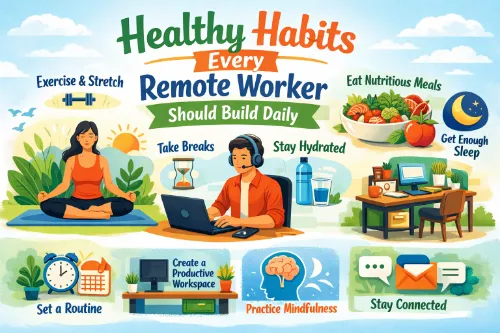
Remote work offers something genuinely rare in modern professional life — real control over your daily environment, your schedule, and the conditions in which you do your best work. But this control is only an advantage when you use it deliberately. Left unmanaged, the remote work environment produces some of the least healthy professional conditions imaginable: chronic sedentariness, social isolation, blurred boundaries between work and rest, disrupted sleep, irregular nutrition, and unrelenting screen exposure from the moment of waking to the moment of sleeping.
The gap between the healthy remote work life that is possible and the depleting one that develops by default is entirely determined by the daily habits you build and sustain. Remote work does not automatically make you healthier. It gives you the conditions to become healthier — if you design those conditions with intention.
The healthy habits for remote workers in this guide are not aspirational additions to an already full life. They are the daily operational practices that determine the quality of your cognitive performance, the resilience of your emotional health, the sustainability of your career, and the depth of your daily satisfaction. Build them one at a time. Stack them consistently. Over months and years, they compound into the foundation of a remote work life that is genuinely fulfilling — professionally, physically, and personally.
1. Why Healthy Habits Are the Foundation of Remote Work Success
Before exploring specific habits, it is worth understanding precisely why healthy daily habits matter so much more for remote workers than for office workers — because the stakes and the mechanisms are different in important ways.
In a traditional office environment, the structure of the workplace enforces a baseline of certain health-relevant behaviors almost automatically. The commute provides daily physical movement and psychological transition between work and home. The office social environment creates regular human interaction that meets basic belonging needs. Physical separation from the home at least gestures toward work-life distinction. Even the simple fact of needing to be presentable and punctual creates daily anchors of structure and purpose.
Remote work removes every one of these structural defaults simultaneously. Every health behavior that the office environment passively enforced must now be actively chosen, deliberately designed into your daily routine, and consistently practiced without external prompts or social accountability. Nothing good happens automatically.
This is simultaneously the greatest challenge and the greatest opportunity of remote work health. The challenge is that default patterns in a home environment tend toward sedentariness, isolation, irregular nutrition, and boundary erosion.
The opportunity is that with deliberate habit design, the flexibility and control of remote work can support a genuinely healthier lifestyle than office work — more sleep, more movement integrated throughout the day, better nutrition from home cooking, more time for wellness practices — but only if you consciously design that lifestyle rather than defaulting to what the environment makes easy.
Research from the Journal of Occupational Health Psychology consistently finds that remote workers who maintain structured daily routines — including deliberate health habits — report significantly higher job satisfaction, better psychological wellbeing, and lower burnout rates than those who work without routine structure. The complete remote worker guide provides the full framework for building the structured remote work life that healthy habits require and support.
2. Morning Habits That Power Your Entire Day
Your morning habits are the most consequential habits of your day — not because mornings are mystically important, but because the neurological, hormonal, and psychological state you carry into your first work block determines the quality of your focus, your emotional regulation, and your motivational energy for everything that follows.
Remote workers who begin their mornings reactively — alarm dismissed, phone checked immediately, messages scrolled before getting out of bed, work launched without any meaningful transition from sleep — consistently report lower daily focus, higher baseline stress, and lower end-of-day satisfaction than those who build deliberate morning structure. The morning hours, handled poorly, establish a fragmented and reactive cognitive tone that the rest of the day struggles to recover from.
Wake at a Consistent Time Every Single Day
Consistent wake timing is the single highest-leverage sleep and wellness intervention available to remote workers — more impactful on sleep quality than total sleep duration alone, according to research from the Sleep Foundation. Your circadian rhythm — the biological clock that regulates your sleep-wake cycles, hormone release, body temperature, and cognitive performance windows — stabilizes and optimizes around consistent timing.
When your wake time varies significantly from day to day, your circadian rhythm is in perpetual adjustment rather than delivering the peak alertness and cognitive performance that stable, predictable timing produces.
Choose a wake time that is sustainable seven days a week — including weekends — and commit to it with the same reliability you give your most important professional obligations. Even on days off, staying within 30–60 minutes of your weekday wake time prevents the “social jet lag” that makes Monday mornings feel so cognitively difficult.
Protect Your First 30 Minutes From All Screens
The neurological state immediately after waking is distinctly different from the waking state that follows. Cortisol levels are naturally elevated — through the cortisol awakening response, a biological mechanism that primes your brain for alertness and productive engagement with the day. Exposing this neurologically primed state to the high-stimulation, high-anxiety content of email, news feeds, and social media activates stress-response systems that you then spend the rest of the morning trying to regulate, consuming cognitive resources better spent on focused professional work.
Protect the first 30 minutes of every day for activities that support your natural awakening: physical movement, natural light exposure, proper hydration, a nutritious breakfast, journaling, quiet reading, or gentle mindfulness practice. Build this screen-free morning buffer into your productive remote work routine as a protected daily anchor rather than an optional extra.
Create a Physical Work Transition Before Starting
Because remote work eliminates the commute that previously served as a physical and psychological transition from home to work mode, remote workers benefit enormously from creating an intentional substitute. A 15–20 minute walk before beginning work is the most universally effective option — providing light aerobic activity, natural light exposure, and a clear environmental shift that tells your brain the work period is beginning.
For remote workers who struggle with the phenomenon of “I’m already home so it doesn’t feel like work has really started,” a morning walk transition is often the single most transformative morning habit change available. It costs 20 minutes and pays back in cognitive readiness that can be worth hours of recovered focus.
3. Movement and Physical Activity Habits During Work Hours
Physical inactivity is one of the most serious and most normalized health risks of remote work. When the commute is eliminated and the workplace occupies a single room at home, it becomes entirely normal — and for many remote workers, entirely typical — to go a complete workday with fewer than 1,000 steps, to spend 8–10 consecutive hours in a single seated position, and to end the working day having experienced almost no meaningful physical movement whatsoever.
The health consequences of this pattern are severe and well-documented. Research published in the Annals of Internal Medicine found that prolonged sedentary time independently increases risk of cardiovascular disease, type 2 diabetes, and all-cause mortality — even in individuals who exercise regularly outside their sedentary periods. Sitting for long, unbroken stretches is harmful in ways that exercise alone does not fully counteract.
Integrate Hourly Movement Breaks
The most effective approach to remote work movement is structural integration — weaving physical activity into the fabric of your workday rather than treating it as a separate obligation that requires additional motivation. Set a recurring timer or use a tool like Stretchly to prompt a brief movement break every 60–90 minutes. Five minutes of walking, stretching, or light exercise at each break provides meaningful cumulative physical activity across the workday while simultaneously serving as a cognitive reset that helps sustain afternoon focus.
These are not productivity losses — they are recovery investments that protect the cognitive performance capacity that your focused work blocks depend on. The focus tips for remote workers resource covers how to integrate these movement breaks into focus systems without disrupting deep work sessions.
Walking Meetings and Audio Calls
Any professional call that does not require screen sharing or visual reference can be taken while walking — audio check-ins, brainstorming conversations, mentoring calls, casual colleague catch-ups, and personal calls all qualify. Research from Stanford University found that walking increases creative output by an average of 81 percent compared to sitting, making walking calls a legitimate professional productivity strategy alongside a physical health habit.
Scheduled Daily Exercise Sessions
Beyond integrated movement breaks, building a dedicated daily or near-daily exercise session into your routine provides the sustained cardiovascular and neurological benefits that brief movement breaks cannot fully replicate. Research from Harvard Medical School demonstrates that consistent aerobic exercise increases production of BDNF — a protein that supports neuron health and cognitive function — while measurably improving attention, memory, decision-making, and emotional regulation over time.
The flexibility of remote work makes scheduled exercise genuinely easier than office work allows — workouts can happen during lunch, between morning and afternoon work blocks, or at whatever time of day your energy naturally supports physical activity best. Use this flexibility as a deliberate health advantage.
4. Nutrition and Hydration Habits for Peak Cognitive Performance
Remote work gives you complete, daily control over your nutrition in a way that office work rarely does — no vending machines, no low-quality catered lunches, no group food orders defaulting to the nearest fast option. This is a significant health opportunity that most remote workers substantially underutilize.
The connection between nutrition and cognitive performance is direct and physiological. Your brain consumes approximately 20 percent of your body’s total caloric energy despite representing only about two percent of body weight. The quality, consistency, and timing of the fuel you provide it directly affects the quality and consistency of your professional output throughout the workday.
Prioritize Blood Glucose Stability
The most practically important nutritional principle for remote workers focused on cognitive performance is blood glucose stability. High-sugar, high-glycemic meals and snacks produce rapid blood glucose spikes followed by equally rapid crashes — the predictable “afternoon slump” that derails focus for remote workers daily. These crashes are not inevitable features of the afternoon hour. They are specific, predictable consequences of specific dietary patterns that can be addressed through specific dietary changes.
Prioritizing meals rich in protein, healthy fats, fiber, and complex carbohydrates — and minimizing refined sugars and highly processed foods during work hours — produces the stable blood glucose levels that sustain cognitive performance through the afternoon without the energy crashes that reactive eating patterns reliably produce.
Research from the British Journal of Health Psychology found that fruit and vegetable consumption was positively associated with greater curiosity, creativity, and psychological flourishing in daily life — connecting nutritional quality directly to the cognitive qualities that professional excellence requires.
Hydration as a Zero-Cost Performance Tool
Dehydration is one of the most consistently overlooked performance factors for remote workers. Research published in the European Journal of Nutrition found that even mild dehydration — below the threshold at which you feel thirsty — produces measurable decreases in concentration, working memory, and psychomotor performance.
For remote workers whose professional output depends on sustained cognitive precision, maintaining consistent hydration throughout the workday is a simple, zero-cost performance optimization that most people neglect because it lacks the novelty of more complicated interventions.
Keep a large water bottle at your workspace. Refill it consistently. Make water your default between-meal beverage rather than defaulting entirely to coffee or caffeinated drinks — which in excess exacerbate dehydration and disrupt the sleep quality that cognitive performance depends on overnight.
Protect Genuine Lunch Breaks
Remote workers have a particular tendency to eat lunch at their desks while continuing to work — a pattern that provides no meaningful cognitive recovery and degrades both the quality of the meal and the quality of the afternoon work that follows it. Schedule actual lunch breaks away from your workspace and away from screens. Even 20–30 minutes of genuine meal-focused eating — away from professional stimuli — provides a meaningful midday cognitive reset that supports sustained afternoon performance in ways that desk lunches cannot.
5. Sleep Habits That Restore Your Brain and Body Nightly
Sleep is not a passive state of doing nothing — it is the most active and most essential biological recovery process available to you. During sleep your brain consolidates the day’s learning into long-term memory, clears metabolic waste through the glymphatic system, regulates emotional memory processing, restores prefrontal cortex executive function, and replenishes the neurotransmitter systems that focus, motivation, and emotional regulation depend on throughout the following day.
The American Academy of Sleep Medicine recommends a minimum of seven hours per night for adults as a physiological minimum for normal cognitive and emotional function — not a generous allowance but an actual biological requirement. Consistently sleeping less than this threshold is associated with impaired sustained attention, degraded working memory, poor decision quality, increased emotional reactivity, and — over longer periods — substantially elevated risk of metabolic, cardiovascular, and immune dysfunction.
Consistent Sleep and Wake Timing
The single most impactful sleep habit is consistent timing — going to bed and waking up at the same time every day including weekends. Timing consistency stabilizes your circadian rhythm and produces progressively improving sleep quality over weeks of practice. This benefit compounds: the longer you maintain consistent timing, the more reliably your biology delivers peak alertness during work hours and genuine sleepiness at your intended sleep time.
A Screen-Free Pre-Sleep Window
Turn off work-related devices and reduce all screen exposure at least 60 minutes before your target sleep time. The blue light emitted by screens suppresses melatonin production — the hormone that signals sleep readiness to your brain — in ways that delay sleep onset by 30–60 minutes on average. Replace this window with physical book reading, light stretching, journaling, gentle conversation, or quiet relaxation that supports rather than delays your body’s natural sleep preparation.
Pre-Sleep Worry Download
Work anxiety is one of the most common causes of sleep disruption for remote workers — the unfinished tasks, tomorrow’s priorities, unresolved professional concerns that activate your cognitive stress-response system exactly when your brain needs to be winding toward sleep.
A brief pre-sleep journaling practice — specifically writing down the professional concerns on your mind alongside the specific next actions you will take to address each one — externalizes these thoughts from active mental processing, reducing the ruminative cognitive activation that disrupts both sleep onset and sleep quality.
The wellness tips for better mental health resource provides the comprehensive framework for sleep optimization within the specific psychological challenges of remote professional life.
6. Mental Health and Emotional Wellness Habits
Mental health is professional health — not a separate category of personal concern but the direct upstream determinant of the cognitive capacities that remote work most demands. Sustained focus, complex problem-solving, creative thinking, adaptive decision-making, clear communication, and interpersonal effectiveness — every one of these professional competencies depends on emotional regulation capacity that mental health directly determines.
Remote workers who neglect mental health are not simply affecting their personal wellbeing. They are degrading the professional tools their career depends on.
Daily Mindfulness Practice
Brief, consistent daily mindfulness practice produces measurable improvements in the cognitive and emotional capacities that remote professional performance requires. Research from Massachusetts General Hospital found that an eight-week mindfulness program produced measurable increases in gray matter density in brain regions associated with learning, memory, and emotional regulation, while reducing gray matter density in the amygdala — the brain’s primary stress and threat processing center.
You do not need an eight-week program or a significant daily time commitment to benefit. Five to ten minutes of daily focused breathing, body scan meditation, or open awareness practice — consistent over weeks and months — produces accumulating cognitive and emotional benefits that compound into meaningful professional performance improvements. Apps like Headspace and Calm make daily practice accessible and structured.
Journaling for Emotional Processing and Clarity
Daily journaling — even 5–10 minutes of unstructured writing about your thoughts, feelings, and current experiences — provides a proven emotional processing mechanism that reduces rumination, improves mood, and enhances self-awareness over time. Research by psychologist James Pennebaker at the University of Texas demonstrated that expressive writing about emotionally significant experiences improved immune function, reduced healthcare utilization, and improved psychological wellbeing across consistently practicing populations.
For remote workers navigating the specific psychological challenges of isolation, boundary erosion, and professional uncertainty that remote work creates, journaling provides a daily private space for emotional processing that the absence of office social support sometimes removes from other available channels.
Gratitude Practice as a Neurological Intervention
Daily gratitude practice — the intentional daily identification and recording of things you are genuinely grateful for — is among the most evidence-backed positive psychology interventions available. Research from UC Davis psychologist Robert Emmons found that individuals who maintained gratitude journals reported higher wellbeing, greater optimism, better physical health, and more progress toward personal goals than matched control groups.
For remote workers vulnerable to the professional cynicism and motivational drift that isolation can produce over time, a daily gratitude practice provides a neurological counter to negativity bias with genuine professional performance implications.
7. Social Connection Habits That Fight Isolation
Social isolation is not merely unpleasant — it is physiologically harmful in ways that directly degrade professional performance and long-term health with measurable specificity. Research from Brigham Young University found that social isolation and loneliness increase all-cause mortality risk to a degree comparable to smoking 15 cigarettes per day — a statistic that reframes isolation from a minor personal inconvenience into a serious health risk requiring active management.
Remote workers are structurally more vulnerable to chronic isolation than office workers because the ambient social contact of shared physical space — the spontaneous conversations, the background human presence, the passive social interaction of simply being around people engaged in shared purposeful activity — is entirely absent from the home office environment.
Build Daily Professional Social Touchpoints
Do not rely on social connection happening spontaneously within remote work. It will not. Build it deliberately into your daily routine as a scheduled, protected practice. Begin each workday with a brief genuine check-in with at least one colleague — not a work status update, but a human conversation about how they are actually doing. This simple daily habit maintains the professional relationships that purely transactional remote communication systematically erodes.
Participate actively and visibly in team communication channels rather than engaging minimally or lurking. Volunteer perspectives, share relevant finds, celebrate colleague wins, and contribute to the social fabric of your professional community in the same way an engaged office colleague would.
Schedule Personal Social Commitments as Non-Negotiables
Block specific personal social activities — dinner with friends, calls with family, group exercise, community involvement — on your calendar with the same level of commitment protection you give professional meetings. In a remote work environment, personal social activities that are not explicitly scheduled are reliably displaced by work demands or the inertia of home comfort. Scheduling them transforms them from intentions into actual events.
Use Focusmate for structured virtual coworking sessions that provide social presence and mutual accountability during individual work sessions. For remote workers who notice motivation declining during solo work, the social commitment of a scheduled coworking session is one of the most practically effective and most overlooked antidotes available.
8. Digital Wellness Habits That Protect Your Focus
Digital wellness — the deliberate, intentional management of your relationship with screens, devices, applications, and digital content — is one of the most practically important and most routinely neglected health habit categories for remote workers. Because your work happens on a computer and leisure increasingly happens on additional screens, total daily screen exposure for many remote workers exceeds 12–14 hours — a level of continuous digital immersion that has measurable consequences for attention quality, sleep health, physical wellbeing, and psychological resilience.
Establish Screen-Free Daily Windows
The goal of digital wellness for remote workers is not to eliminate screen use — that is neither possible nor appropriate for professionals whose work is inherently digital. It is to protect specific daily windows of genuine screen disengagement that allow your visual system, your attentional networks, and your stress-response systems to recover from the continuous stimulation of digital work.
Protect at minimum: the first 30 minutes after waking, all meal periods, the last 60 minutes before sleep, and at least one midday break period. These protected windows provide the cognitive recovery from continuous digital stimulation that sustained attention quality and emotional regulation both require.
Conduct a Comprehensive Notification Audit
Every active notification across every device and application is a micro-interruption — a small, persistent call on your attentional resources that accumulates across dozens or hundreds of daily occurrences into a significant cognitive load that degrades focus quality and elevates ambient stress. Research from the University of California, Irvine found that it takes an average of 23 minutes to fully regain deep focus after a single interruption — meaning that frequent notifications destroy far more productive time than the interruption duration alone suggests.
Conduct a full notification audit. Remove every notification that does not require immediate action that genuinely justifies interrupting focused work. For most remote workers, this means disabling virtually all social media, news, shopping, entertainment, and non-urgent communication notifications — and discovering that their work quality improves immediately and dramatically as a result.
The tools for remote workers guide covers the specific distraction management applications — including Freedom, Cold Turkey, and RescueTime — that enforce digital wellness habits at the system level when individual willpower proves insufficient against the attentional engineering of modern digital platforms.
9. Evening and Recovery Habits That Set Up Tomorrow
The habits you practice in the hours between your workday’s end and your sleep onset do not just affect your personal time — they directly determine the quality of your next day’s professional performance. Evening habits that support genuine cognitive and emotional recovery produce the restored neurological resources that next-day focus, creativity, decision quality, and interpersonal effectiveness all depend on.
The Evening Shutdown Ritual
A consistent, deliberate workday shutdown ritual is simultaneously a work-life balance boundary strategy and an evening recovery preparation practice. The 15–20 minutes invested in a complete workday closure — reviewing what was accomplished, capturing open items and next actions, setting tomorrow’s top three priorities, closing all professional applications, and physically leaving or reorganizing your workspace — produces the psychological closure that genuine evening recovery requires.
Without this closure, the diffuse mental engagement with unresolved work that persists through most remote workers’ evenings provides neither the productivity of focused work nor the restoration of genuine recovery. A consistent shutdown ritual closes the professional loop cleanly and gives your nervous system clear permission to shift into recovery mode.
The guide on how to set boundaries when working from home provides detailed shutdown ritual frameworks for every type of home environment and professional context.
Physical Evening Recovery
Evening physical recovery practices — gentle yoga, a post-dinner walk, progressive muscle relaxation, light stretching — serve the dual purpose of reversing the physical tension that accumulates during sedentary workdays and activating the parasympathetic nervous system response that supports both emotional recovery and sleep onset quality. Even 10–15 minutes of deliberate physical relaxation practice in the evening produces measurable improvements in sleep quality and next-day cognitive performance for consistent practitioners.
Skill Development and Learning
The evening hours represent one of the highest-value discretionary time windows for the professional development that compounds into long-term career advancement. Even 30–45 minutes of consistent evening learning — reading professional literature, completing an online course, practicing a developing skill — produces remarkable compound results across months and years of consistent practice.
The skills for career growth resource identifies the specific competencies most worth developing during these protected windows for maximum career and income impact.
10. How Daily Healthy Habits Drive Career and Income Growth
The relationship between daily health habits and long-term professional career outcomes is one of the most consequential and most underappreciated dynamics in remote work. It is direct, measurable, and compounding — meaning that the habits you build or fail to build today are shaping the professional results you will experience months and years from now.
The brain that sleeps consistently and adequately, moves regularly throughout the day, maintains stable nutrition, manages stress through daily mindfulness, processes emotions through journaling and social connection, and recovers through protected digital-free evening time is categorically more cognitively capable — in sustained focus, creative output, decision quality, emotional regulation, and professional communication effectiveness — than the one operating on depleted physical and psychological resources.
Every career outcome that remote workers aspire to depends on this upstream biological reality. Remote workers with strong daily health habits have the cognitive capacity to develop the high-income skills that command premium compensation in the remote job market. They have the mental stamina to implement the productivity tips for remote workers that elevate daily output quality and professional reputation.
They have the emotional resilience to maintain the professional relationships and organizational visibility that enable them to get promoted remotely. And they have the sustained energy to build multiple income streams and explore the side hustles for remote workers that create the financial resilience career advancement requires.
Healthy daily habits are also the primary infrastructure of burnout prevention. The complete resource on tips to avoid burnout while working remotely shows how the physical and psychological habits in this guide function as the frontline protection against the chronic depletion that derails remote careers. Remote workers who maintain these habits are structurally more resilient to burnout than those relying on willpower — because their biology is working with their professional ambitions rather than against them.
The remote work time management strategies that protect your schedule create the structured daily time to practice these habits consistently. The productive remote work routine framework shows you how to embed health habits into the architecture of your workday so they happen reliably as part of your professional system rather than aspirationally when time allows.
For remote workers building toward specific career advancement goals, the remote worker career guide maps how daily performance excellence — grounded in physical and mental wellness — translates into the professional reputation and results that drive advancement. The remote jobs for long-term career growth resource helps you identify roles where healthy professional habits are structurally supported rather than structurally undermined by role demands and company culture.
Use the resume tips to get hired fast online to communicate your track record of sustained, consistent, high-quality remote performance to prospective employers who increasingly recognize that habitually healthy remote workers outperform burned-out ones across every meaningful professional metric. Apply the tips to increase income as a remote worker — including strategies to negotiate higher pay in a remote job — to translate the career results your health habits make possible into the financial compensation you deserve.
A remote career built on a foundation of daily healthy habits is not just more productive in the short term. It is more sustainable, more financially rewarding, more professionally fulfilling, and more resilient to every challenge that a long career inevitably encounters. The habits you build today are quite literally the career — and the life — you will be living in ten years.
FAQs
1. Why are daily habits important for remote workers?
Daily habits determine consistency in focus, health, and performance, especially without external structure from an office environment.
2. Can remote work become unhealthy without structure?
Yes. Without intentional routines, it often leads to inactivity, poor sleep, irregular meals, and excessive screen time.
3. What is the most important morning habit for remote workers?
Waking up at a consistent time every day to stabilize the body’s internal clock.
4. Why should remote workers avoid screens after waking up?
Early screen exposure increases stress and disrupts mental clarity for the rest of the day.
5. What is a “work transition” habit?
A short activity like a walk before work that signals the brain to shift into work mode.
6. How does physical inactivity affect remote workers?
It increases risks of chronic diseases and reduces energy, focus, and overall productivity.
7. How often should remote workers move during the day?
Every 60–90 minutes through short breaks or light activity.
8. Are walking meetings effective?
Yes. They improve creativity, engagement, and physical activity simultaneously.
9. Why is daily exercise important for remote professionals?
It improves brain function, mood, and long-term cognitive performance.
10. How does nutrition affect work performance?
Stable, balanced meals support consistent energy and prevent afternoon fatigue.
11. What causes the “afternoon slump”?
Blood sugar spikes and crashes from high-sugar or processed meals.
12. Why is hydration important during remote work?
Even mild dehydration reduces concentration, memory, and mental performance.
13. Should remote workers take real lunch breaks?
Yes. Eating away from screens improves digestion and provides mental recovery.
14. How much sleep do remote workers need?
At least 7 hours per night, as recommended by the American Academy of Sleep Medicine.
15. Why is consistent sleep timing important?
It stabilizes circadian rhythms and improves sleep quality and daytime alertness.
16. What is a pre-sleep routine?
A screen-free period before bed that helps the brain prepare for rest.
17. How does mindfulness help remote workers?
It improves focus, reduces stress, and strengthens emotional regulation.
18. Why is journaling useful in remote work?
It helps process thoughts, reduce stress, and improve clarity.
19. How can remote workers reduce digital overload?
By limiting notifications, setting screen-free periods, and managing app usage.
20. Do healthy habits impact career growth?
Yes. Strong habits improve performance, resilience, and long-term professional outcomes.