

A remote worker guide serves as a structured resource for professionals working outside traditional office settings. It covers core areas such as productivity, career growth, income strategies, work-life balance, and well-being.
Productivity improves when remote workers follow consistent routines, apply time-blocking, reduce distractions, and use digital tools for task management.
Income growth is achieved through skill development (e.g., AI, data analysis), strategic salary negotiation, and diversification via freelancing or digital products.
High-demand skills for 2026 include AI and automation, project management, digital communication, data analysis, UX design, and content strategy—particularly across tech and service-based industries.
Burnout prevention relies on maintaining boundaries, prioritizing physical and mental health, fostering social interaction, and taking regular breaks.
Overall, research indicates that remote work can match or exceed office productivity when supported by proper systems, habits, and tools.
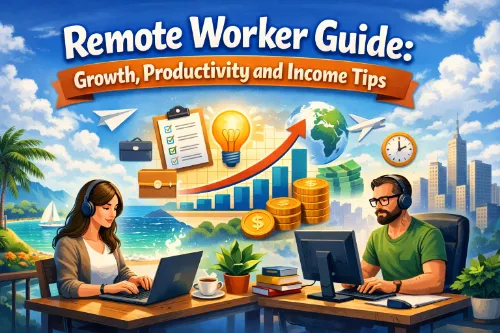
Working remotely is no longer a perk — it is a full-fledged career model reshaping how millions of professionals earn, grow, and live. But thriving as a remote worker takes more than a laptop and a Wi-Fi connection. The best remote professionals treat it like a business: they invest in skills, protect their focus, build income streams, and advance their careers with intention.
This guide covers everything you need — from building a productive remote routine to growing your income and advancing professionally — so you can make the most out of every hour you work from home.
What Does It Mean to Thrive as a Remote Worker in 2026?
The remote work landscape has evolved dramatically. According to Robert Half’s 2026 remote work research, hybrid and fully remote arrangements have stabilized, with 24% of job postings offering hybrid schedules and 11% offering fully remote roles — a signal that flexible work is a permanent fixture, not a fad.
Meanwhile, Zoom’s analysis of remote work statistics reveals that 70% of remote professionals say focused work is easier when remote, and 65% say managing stress is more manageable outside of an office environment. These are not small gains — they are structural advantages that remote workers can leverage to outperform and out-earn their peers.
But statistics only tell half the story. To truly thrive, you need a deliberate approach to your career, your daily habits, and your income strategy.
Start by reading the full Remote Worker Guide to build a strong foundation before diving into the strategies below.
Career Growth for Remote Workers
How to Build a Long-Term Remote Career
One of the biggest mistakes remote professionals make is treating their work as a series of contracts rather than a career. Career growth in a remote environment requires visibility, skill development, and strategic job selection.
According to Money Talks News remote work trend data, Q2 2025 saw remote job postings grow by 8%, with the largest surges in computer and IT, communications, and project management. Education and training roles grew by over 20%. This shows that remote work is expanding into new sectors — and professionals who upskill now will be positioned to capture those opportunities.
To build a sustainable remote career, focus on:
- Choosing roles with long-term viability. Read the guide on remote jobs built for long-term career growth to identify fields where remote work is both stable and well-compensated.
- Treating your resume like a living document. Remote hiring is competitive. Review these resume tips to get hired fast online to ensure your application stands out from hundreds of applicants.
- Following a clear career roadmap. Use the remote worker career guide to map your progression from entry level to leadership.
Getting Promoted While Working Remotely
Promotions happen in offices when people see your effort. Remotely, you have to engineer visibility. That means documenting your wins, communicating proactively with leadership, and taking on high-impact projects that align with company goals.
The guide on how to get promoted remotely walks through specific tactics — from how to position yourself in virtual meetings to how to build relationships with decision-makers you may rarely see face-to-face.
Skills That Accelerate Career Growth
The fastest-growing remote roles in 2025 and 2026 demand a blend of technical ability and soft skills. AI literacy, project management, data analysis, and communication are consistently ranked among the top skills companies look for in remote hires.
Explore the skills for career growth resource to get a prioritized list of competencies worth developing, along with platforms and learning paths that fit a remote schedule.
Productivity Tips That Actually Work
Building a Productive Remote Work Routine
Structure is the productivity foundation that most remote workers underestimate. Without a commute as a natural boundary marker, the lines between “work time” and “personal time” blur quickly — and so does your output.
A productive remote work routine does not have to be rigid. It simply needs to signal to your brain when you are in work mode and when you are not. This might include a consistent start time, a designated workspace, a morning ritual that simulates a “commute,” and hard stop times that enforce recovery.
Research from Splashtop’s 2025 remote work trend analysis found that a two-year Stanford study of over 1,600 workers confirmed that employees working from home two days a week were just as productive and likely to be promoted as their full-time office counterparts. The key variable was not the location — it was the quality of their work habits.
Time Management for Remote Workers
Remote work gives you time freedom. Poor time management turns that freedom into chaos. Effective remote professionals are not necessarily working more hours — they are working smarter ones.
Core time management strategies include:
- Time blocking: Assign specific tasks to specific windows of time rather than working reactively from an inbox.
- The 90-minute deep work cycle: Research in neuroscience supports working in focused 90-minute blocks followed by short recovery breaks.
- Weekly planning sessions: A 15-minute session every Sunday or Monday morning pays dividends throughout the week.
The remote work time management guide provides a framework tailored specifically to work-from-home professionals who need structure without rigidity.
Tools That Multiply Remote Worker Productivity
The right tools reduce friction — the wrong ones add it. A common trap is tool overload: adopting too many platforms that create more coordination overhead than they solve.
The most effective remote worker toolkit in 2026 centers on four categories:
- Communication — Slack, Loom, Zoom
- Project and task management — Notion, Asana, Linear
- Focus and time tracking — Toggl, Reclaim.ai, Forest
- Document collaboration — Google Workspace, Notion, Coda
For a complete breakdown of tools tested and recommended for remote professionals, see tools for remote workers.
Staying Focused in a Distraction-Rich Home Environment
Home environments are full of competing demands — household tasks, family members, social media, and the temptation to do non-work activities during work hours. Protecting your focus is an active, daily practice.
Practical focus strategies include using site-blocking apps during deep work sessions, wearing headphones as a “do not disturb” signal, batching communication into set windows, and building a workspace that is physically separate from leisure spaces.
Find a deeper dive into environment design and habit stacking at the focus tips for remote workers guide.
Productivity Tips Beyond Tactics
Sustainable productivity is not just about systems — it is about energy. Many remote workers optimize their task lists while ignoring the biological inputs that determine cognitive performance: sleep quality, movement, nutrition, and mental state.
For a comprehensive look at daily habits that build long-term output capacity, the productivity tips for remote workers resource covers both tactical and lifestyle-level strategies.
Work-Life Balance and Mental Health
Why Work-Life Balance Is Harder to Maintain Remotely
Contrary to popular belief, remote workers often struggle with overwork more than underwork. When your office is your home, it is easy to answer one more email after dinner, skip lunch breaks, or work through weekends “just to get ahead.”
Zoom’s remote work data found that 41% of in-office workers experience burnout symptoms, compared to just 26% of their remote counterparts — but only when remote workers maintain healthy boundaries. Without those boundaries, the gap disappears.
The guide on work-life balance tips provides a realistic, sustainable approach to protecting personal time while remaining professionally engaged.
Setting Boundaries When You Work From Home
Boundaries are the infrastructure of remote work sustainability. This means communicating availability windows clearly to both your employer and your household, having a physical “shutdown ritual” that signals the end of your workday, and saying no to requests that encroach on your recovery time.
The guide to setting boundaries when working from home is one of the most practical resources available for workers who find themselves “always on.”
Avoiding Burnout as a Remote Worker
Burnout is not caused by hard work — it is caused by sustained effort without adequate recovery, autonomy, recognition, or meaning. Remote workers face a unique version of burnout because isolation compounds the other risk factors.
Early warning signs include chronic fatigue, decreased motivation for work you previously enjoyed, increased irritability, and physical symptoms like headaches or disrupted sleep. The moment you recognize these signs is the right time to act.
Read the full tips to avoid burnout while working remotely for evidence-based intervention strategies.
Building Healthy Habits That Sustain Performance
Long-term remote work performance is built on physical and mental health foundations. Remote workers who protect their sleep, exercise regularly, eat well, and maintain social connections consistently outperform those who grind without recovery.
The healthy habits guide for remote workers outlines the minimum viable health routine that high-performing remote professionals follow — without requiring hours of wellness practices each day.
Mental Health and Remote Work
Loneliness, anxiety, and the loss of professional identity are real challenges in remote work. A proactive mental wellness strategy is not optional for long-term careers — it is essential.
The wellness tips for better mental health guide covers strategies from social connection to mindfulness to professional support resources.
Income Growth Strategies for Remote Workers
How to Increase Your Income as a Remote Worker
Income growth in remote work does not happen passively. Professionals who earn more do so through deliberate skill development, strategic job transitions, salary negotiation, and diversified income streams.
The tips to increase income as a remote worker guide breaks this down into a step-by-step income growth strategy anyone can follow — regardless of their current income level or job type.
Negotiating Higher Pay in a Remote Job
Most remote workers leave money on the table by not negotiating. This is especially common in remote-first environments where compensation benchmarks are less visible and workers feel uncertain about their leverage.
The reality is that remote roles are often filled from a global talent pool, which means companies are already paying a premium for the right people. If you are delivering results, you have leverage.
Key negotiation principles include:
- Anchor high. The first number in any negotiation sets the frame.
- Lead with value, not need. Your case for a raise should be built on documented contributions, not cost-of-living arguments.
- Use competing offers. A competing offer is the single most powerful salary negotiation tool available to any employee.
- Negotiate the full package. Salary is just one dimension. Equipment allowances, professional development budgets, equity, and paid time off all have real monetary value.
The guide to negotiating higher pay in a remote job walks through each step of this process with scripts and frameworks you can use immediately.
Developing High-Income Skills
High-income remote skills are those where demand significantly outpaces supply and where the work itself can command premium rates. In 2026, the highest-compensated remote roles consistently involve AI and automation, data analysis, software engineering, UX design, performance marketing, and strategic consulting.
The high-income skills guide identifies which skills are worth investing in based on earning trajectory, remote accessibility, and time-to-proficiency.
Building Multiple Income Streams as a Remote Worker
Relying on a single income source is a financial risk that remote workers are uniquely positioned to mitigate. Unlike office-based employees, remote professionals have both the skills and the flexibility to build parallel income streams.
Common income diversification strategies for remote workers include:
- Freelancing in your core skill set — Platforms like Upwork, Toptal, and Contra allow you to take on project-based work alongside a full-time role.
- Creating digital products — Courses, templates, ebooks, and SaaS tools can generate passive income with a one-time creation effort.
- Content creation and monetization — Blogs, YouTube channels, newsletters, and social media accounts can be monetized through ads, sponsorships, and affiliate partnerships.
- Consulting and coaching — Senior professionals can command $100–$500+ per hour for advisory work in their area of expertise.
- Investing — Dividend stocks, index funds, and real estate investment trusts (REITs) turn savings into growing assets over time.
The multiple income streams guide offers a practical roadmap for building your first — or next — income stream alongside your primary remote role.
Side Hustles That Fit the Remote Work Lifestyle
Not every income opportunity requires a major time investment. Many remote workers supplement their primary income with side hustles that can be managed in 5–10 hours per week.
High-potential side hustles for remote workers include freelance writing, social media management, virtual assistance, SEO consulting, video editing, bookkeeping, and online tutoring.
Explore the side hustles for remote workers guide for curated options based on skill level, time availability, and income potential.
Putting It All Together: Your Remote Work Growth Plan
Sustainable success as a remote worker is the result of building systems, not relying on motivation. The most productive, highest-earning remote professionals are not working harder than everyone else — they are working with more clarity, better tools, and a deliberate approach to career and financial growth.
Here is a simple framework to start:
- Audit your current state. Where are you losing time? Where is your income capped? What skills are you missing?
- Choose one career goal. A promotion, a new role, a skills upgrade, or a transition to a new field.
- Choose one productivity upgrade. A new morning routine, a time-blocking system, or a tool that removes friction.
- Choose one income growth lever. A salary negotiation, a freelance side project, or a new skill development investment.
- Build in recovery. Without sustainable habits and mental health practices, none of the above can compound over time.
FAQs
1. What is a remote worker guide?
A remote worker guide is a structured resource that covers productivity, career growth, income strategies, work-life balance, and well-being for professionals working outside traditional office settings.
2. How can remote workers improve productivity?
By following consistent routines, using time-blocking, minimizing distractions, and leveraging digital productivity tools.
3. Is remote work as productive as office work?
Yes. Research shows remote work can match or exceed office productivity when supported by proper systems and habits.
4. What skills are in demand for remote workers in 2026?
AI, data analysis, project management, UX design, communication, and content strategy are among the most sought-after skills.
5. How can remote workers grow their careers?
By developing in-demand skills, maintaining visibility, choosing sustainable roles, and continuously improving their professional profile.
6. How do you get promoted while working remotely?
By documenting achievements, communicating proactively, and contributing to high-impact projects aligned with company goals.
7. What is time-blocking and why is it important?
Time-blocking is assigning tasks to specific time slots, helping remote workers stay structured and avoid reactive work patterns.
8. What tools help remote workers stay productive?
Communication tools, task managers, time trackers, and collaboration platforms improve efficiency and coordination.
9. How can remote workers stay focused at home?
By reducing distractions, creating a dedicated workspace, and using techniques like batching communication and deep work sessions.
10. Why is work-life balance harder in remote work?
Because boundaries between work and personal life can blur, leading to overwork if not managed properly.
11. How can remote workers prevent burnout?
By maintaining boundaries, taking breaks, prioritizing health, and ensuring regular recovery periods.
12. What are signs of burnout in remote workers?
Fatigue, reduced motivation, irritability, and disrupted sleep patterns.
13. How can remote workers increase their income?
Through skill development, salary negotiation, and diversifying income streams such as freelancing or digital products.
14. Why is salary negotiation important in remote jobs?
Because many remote workers under-negotiate, leaving potential income on the table despite delivering strong results.
15. What are high-income remote skills?
Skills in AI, software development, marketing, data analysis, and consulting often command higher pay.
16. Can remote workers have multiple income streams?
Yes. Many build additional income through freelancing, content creation, consulting, or investments.
17. What are common side hustles for remote workers?
Freelance writing, virtual assistance, social media management, SEO, tutoring, and video editing.
18. How can remote workers maintain mental health?
By staying socially connected, practicing mindfulness, and setting clear work boundaries.
19. What is a productive remote work routine?
A routine with consistent start times, structured work periods, and clear shutdown rituals to separate work from personal life.
20. What is the best way to succeed long-term as a remote worker?
Treat remote work as a career—build skills, maintain discipline, create systems, and continuously improve productivity and income strategies.