

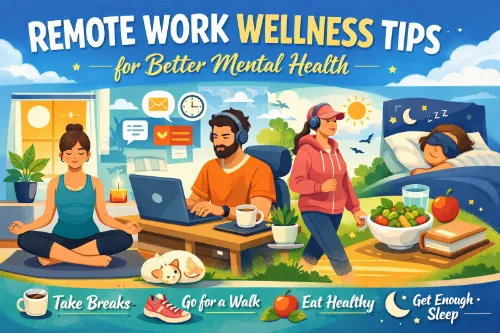
Remote work wellness tips for better mental health include building a consistent daily routine with structured morning and evening rituals that anchor psychological stability, proactively managing social isolation through daily professional social touchpoints and scheduled personal social commitments, applying evidence-based stress management practices including physical exercise, nature exposure, and creative engagement, developing daily mindfulness and emotional regulation habits through meditation and journaling.
Protecting physical health through adequate sleep, regular exercise, proper nutrition, and daily sunlight exposure as the biological foundation of mental wellbeing, setting and enforcing clear professional and personal boundaries that enable genuine psychological recovery from work, recognizing when self-directed strategies are insufficient and accessing professional mental health support through telehealth platforms and employer assistance programs, and understanding that mental wellness is not separate from professional performance but is its primary upstream determinant.
Remote workers who invest consistently in their psychological wellbeing produce higher-quality professional output, advance faster in their careers, build stronger professional relationships, sustain high performance across longer periods without burnout, and experience greater personal fulfillment than those who treat mental health as secondary to professional productivity. Mental wellness is not the reward for a successful remote career — it is the non-negotiable foundation on which one is built, sustained, and genuinely enjoyed.
Mental health is not a soft topic. It is not a peripheral concern that successful remote workers can afford to address after the real work is done. It is the operational foundation of everything that remote work requires — focus, creativity, decision quality, communication effectiveness, emotional regulation, professional resilience, and the sustained cognitive performance that career advancement depends on. When your mental health is compromised, every dimension of your professional performance is compromised with it.
Remote work creates specific mental health challenges that office work does not produce in the same way or to the same degree. The structural isolation of working alone without ambient human contact. The boundary erosion that makes genuine psychological recovery from work perpetually difficult.
The always-on availability pressure that activates chronic low-level stress. The identity challenges of a work life that never clearly separates from personal life. These are not minor inconveniences — they are genuine psychological stressors with measurable consequences for wellbeing and professional functioning.
The remote work wellness tips in this guide address these challenges directly and practically. Not with generic self-care advice but with specific, evidence-based strategies calibrated to the actual mental health demands of remote professional life. Build these practices deliberately. Start with what resonates most. And treat your mental wellbeing with the same professional seriousness you bring to your most important work — because without it, that work will eventually become impossible.
1. Why Mental Health Is a Remote Work Priority — Not an Afterthought
The persistent cultural message in professional environments — particularly high-performing remote professional environments — is that mental health is something you address when performance suffers, when the stress becomes visibly unmanageable, or when a crisis forces the issue. This reactive approach is both ineffective and expensive. By the time mental health challenges are affecting professional performance in obvious, undeniable ways, they have typically been accumulating for months.
The proactive framing — treating mental wellness as a daily professional practice rather than an emergency response — produces dramatically better outcomes for both personal wellbeing and professional performance. Remote workers who invest consistently in their mental health do not just feel better. They think more clearly. They make better decisions. They communicate more effectively. They maintain stronger professional relationships. They advance faster in their careers. And they sustain high performance across longer periods without the burnout cycles that reactive approaches inevitably produce.
Research from Deloitte found that poor mental health costs employers an estimated $300 billion annually in lost productivity, absenteeism, and turnover — a figure that reflects the direct professional performance consequences of inadequate psychological wellbeing. For remote workers, who lack the organizational mental health supports that office environments sometimes provide, proactive personal investment in mental wellness is both a personal necessity and a professional strategy.
The complete remote worker guide provides the foundational framework for understanding how mental wellness integrates with every other dimension of sustainable remote work success.
2. Recognize the Specific Mental Health Risks of Remote Work
Effective mental health management begins with accurate understanding of the specific risks that remote work creates. These are not the same as the mental health challenges of office work — they have distinct characteristics that require distinct responses.
Chronic Isolation and Loneliness
The most consistently reported mental health challenge in remote work is loneliness — not the acute loneliness of being completely alone, but the chronic background loneliness of lacking the ambient social contact that office environments provide passively. The casual conversations, the background human presence, the shared coffee breaks, the spontaneous interactions that office life generates without effort — all of these disappear in remote work, leaving a social deficit that accumulates quietly and powerfully over time.
Cigna’s national loneliness index found that loneliness has reached epidemic proportions in the United States, with remote workers disproportionately represented among those experiencing significant isolation. The psychological consequences of chronic loneliness extend beyond emotional discomfort into measurable impacts on immune function, cognitive performance, emotional regulation, and — in severe, prolonged cases — life expectancy.
Anxiety and Chronic Stress
The structural features of remote work create persistent anxiety risk. The always-on availability expectation generates chronic low-level stress that the brain’s threat-detection system treats as a continuous ambient danger. The lack of clear work-end signals creates difficulty disengaging from professional worries during personal time. The performance visibility challenges of remote work — the uncertainty about whether your contributions are being seen and valued — create career anxiety that office workers, with their physical presence as passive proof of engagement, experience less acutely.
Depression Risk
The combination of social isolation, reduced physical movement, disrupted daily structure, inadequate sunlight exposure, and chronic stress creates multiple overlapping risk factors for depression in remote workers. Depression in this context does not always present as the classic dramatic low mood that most people associate with the diagnosis — it more commonly presents as persistent low motivation, difficulty experiencing professional satisfaction, emotional flatness, and a gradual withdrawal from both professional and personal engagement.
Identity and Purpose Challenges
For many remote workers, the physical separation from a professional community and environment creates identity challenges that office workers are rarely required to navigate. The sense of professional belonging, organizational culture connection, and shared purpose that physical office membership provides — even imperfectly — requires active, deliberate construction in remote work. Without this construction, many remote workers experience a gradual erosion of professional meaning that contributes to both burnout and broader psychological wellbeing decline.
3. Build a Daily Routine That Protects Your Psychological Wellbeing
Daily routine is the first and most foundational mental health tool available to remote workers. The relationship between routine and psychological wellbeing is well-established in clinical psychology — predictable daily structure reduces the ambient anxiety of uncertainty, conserves the cognitive resources that constant decision-making depletes, and creates the consistent anchors of start, transition, and end that healthy psychological functioning requires.
Remote workers without deliberate daily structure are perpetually navigating the low-level stress of undefined boundaries and uncertain transitions — a cognitive and emotional load that accumulates into meaningful psychological depletion over weeks and months even when no single day feels dramatically difficult.
The Morning Anchor
Begin each day with a morning sequence that is consistent, deliberate, and structured around your wellbeing before your professional obligations. This means waking at a consistent time, protecting the first 30 minutes from screens and professional stimuli, engaging in at least one activity that supports physical or mental health — movement, mindfulness, journaling, a nutritious breakfast — and transitioning into work through a defined start ritual rather than beginning work reactively the moment consciousness returns.
The psychological effect of a structured morning is not just habitual comfort — it is genuine neurological preparation. The cortisol awakening response that primes cognitive function in the first minutes of waking is best supported by natural, low-stimulation awakening rather than the immediate high-stimulation input of professional communications and social media.
The productive remote work routine guide provides the complete daily structure framework — from morning start through evening shutdown — that supports both professional performance and psychological wellbeing simultaneously.
The Evening Psychological Closure
A deliberate evening shutdown ritual is as important for mental health as it is for work-life balance. The psychological closure that comes from consciously completing the workday — reviewing what was accomplished, capturing open items, setting tomorrow’s priorities, and physically closing your professional environment — prevents the unresolved, ruminative work engagement during personal hours that is one of the primary drivers of remote work anxiety and sleep disruption.
Without this closure, your brain continues processing unresolved professional concerns through the evening and night — not productively, but anxiously — consuming psychological resources that should be recovering for the following day. The guide on how to set boundaries when working from home provides specific shutdown ritual frameworks for every type of remote work context and household situation.
4. Manage Loneliness and Social Isolation Proactively
Because loneliness is the most common and most impactful mental health challenge facing remote workers, it deserves specific, practical attention rather than generic suggestions to “connect more.” The following strategies address remote work isolation at multiple levels simultaneously.
Daily Professional Social Investment
Build at least one genuine social interaction into every workday — not a work status update, but a human conversation with a professional colleague. This might be a brief video call with a teammate that includes personal check-in alongside any professional content. It might be a voice call instead of a message thread. It might be participation in a team social channel with genuine engagement rather than passive viewing. The specific form matters less than the daily consistency.
Buffer’s State of Remote Work survey finds year after year that loneliness is the top reported struggle of remote workers — and the most effective individual intervention is consistent, deliberate professional social investment, not waiting for organizational solutions to provide it.
Virtual Coworking for Ambient Human Presence
Platforms like Focusmate and Caveday provide structured virtual coworking sessions that pair remote workers for focused work periods with brief social bookends. The psychological benefit of these sessions extends beyond the social interaction itself — the simple experience of working in the visible presence of another person, even through a screen, activates the motivational and attentional systems that ambient human presence naturally engages in office environments.
For remote workers who notice declining motivation, increasing difficulty concentrating during solo work sessions, or a growing sense of professional isolation, virtual coworking is one of the most practically and psychologically effective interventions available.
Personal Social Scheduling as Non-Negotiable
Outside of professional connections, actively schedule and protect personal social engagements — dinner with friends, calls with family, community activities, social hobbies — as calendar commitments rather than aspirational intentions. In a remote work environment where inertia and overwork are the constant defaults, personal social activities that are not explicitly scheduled are reliably displaced by work or by the exhausted passivity of home-based leisure.
The healthy habits for remote workers guide addresses social connection as one of the core daily wellness habits that remote workers must build deliberately rather than leaving to chance.
Professional Community Investment
Online professional communities, industry forums, mastermind groups, and peer networks serve the social and intellectual functions that office environments provide naturally. Investing genuinely — contributing perspectives, building relationships, engaging in substantive professional discussions — in at least one professional community creates the sense of professional belonging and peer connection that remote work’s organizational isolation tends to erode.
5. Stress Management Strategies That Work for Remote Workers
Chronic stress is both a symptom and a cause of remote work mental health challenges — it emerges from the structural stressors of remote work and simultaneously degrades the psychological resources needed to manage those stressors effectively. Breaking this cycle requires both stress reduction at the source and active stress recovery practices.
Identify Your Remote Work Stress Triggers
Not all remote work stress has the same origin, and effective stress management begins with accurate identification of your specific triggers. Common remote work stress patterns include: performance anxiety related to visibility concerns, workload overwhelm from unclear scope and absent natural stopping points, relationship anxiety from communication ambiguity in text-based professional interactions, financial stress from income uncertainty, and the diffuse anxiety of boundary erosion that keeps your nervous system in a continuous low-level alert state.
Understanding which patterns are most active for you allows targeted intervention rather than generic stress management — addressing the actual source rather than just managing the symptom.
Active Stress Recovery Practices
Stress recovery is not the absence of stress input — it is the active engagement in practices that physiologically counteract the stress response. The most evidence-backed active recovery practices for remote workers include:
Physical exercise — Research from the Anxiety and Depression Association of America demonstrates that even a single episode of aerobic exercise reduces anxiety and stress significantly, with consistent exercise producing lasting improvements in baseline stress reactivity.
Nature exposure — Research published in Frontiers in Psychology found that spending at least 20 minutes in natural environments measurably reduces cortisol levels — an effect that remote workers can access simply by taking their daily break outdoors rather than at a desk.
Social connection — Positive social interaction activates oxytocin release that directly counteracts the physiological stress response, making the social connection strategies in the previous section simultaneously stress recovery practices.
Creative engagement — Activities that engage the creative and aesthetic dimensions of experience — music, visual arts, cooking, writing, crafting — activate neural networks that are distinct from the stress-response systems activated by professional demands, providing genuine psychological relief rather than just distraction.
The tips to avoid burnout while working remotely resource covers the relationship between chronic stress, burnout, and the specific recovery practices that interrupt the accumulation cycle.
6. Mindfulness and Emotional Regulation Practices
Mindfulness and emotional regulation are the psychological skills that determine how effectively you manage the mental health challenges of remote work — not by eliminating stressors, but by changing your relationship to them in ways that reduce their psychological impact and increase your capacity to respond thoughtfully rather than reactively.
Daily Mindfulness Practice
Mindfulness — the practice of deliberately attending to present-moment experience with openness and without judgment — is the most evidence-backed psychological intervention for anxiety, stress, and emotional dysregulation available outside clinical treatment. Research from Johns Hopkins University identified mindfulness meditation as having a moderate-to-strong effect on anxiety, depression, and pain — comparable to the effect sizes of antidepressant medications for mild-to-moderate presentations.
For remote workers, daily mindfulness practice builds specific capacities that are directly professionally relevant: the ability to sustain attention on a single task without being captured by distraction or worry; the ability to recognize and regulate emotional reactions before they affect professional communication; and the ability to genuinely disengage from work during personal time rather than remaining mentally engaged with professional concerns through nominally personal hours.
Apps like Headspace, Calm, and Insight Timer provide structured, accessible daily practice options that require as little as 5–10 minutes per day to produce accumulating benefits over consistent weeks of practice.
Cognitive Reframing Techniques
Cognitive reframing — the psychological practice of consciously evaluating and revising unhelpful thought patterns — is a core skill of Cognitive Behavioral Therapy that remote workers can apply independently to the specific thought patterns that remote work generates.
Common remote work cognitive distortions include: catastrophizing about career consequences from imperfect remote performance visibility, mind-reading negative interpretations of ambiguous colleague messages, overgeneralizing from difficult days to global negative conclusions about remote work suitability, and the comparison trap of measuring your internal experience of remote work difficulty against the curated external appearances of colleagues who seem to be thriving without effort.
The Beck Institute — the originating institution of Cognitive Behavioral Therapy — provides accessible resources for understanding and applying these reframing techniques independently, without clinical treatment, for remote workers whose stress patterns are primarily situational rather than clinical.
Journaling for Emotional Processing
Daily journaling provides a private, structured space for the emotional processing that remote work’s absent social environment otherwise makes difficult. Writing about professional challenges, interpersonal frustrations, career anxieties, and daily emotional experiences creates both cognitive clarity and emotional relief that the absence of informal social venting in office environments tends to deny remote workers.
Structure your journaling around three questions that support both emotional processing and constructive orientation: What am I feeling, and what specifically triggered it? What is a realistic, balanced perspective on this situation? What is one constructive thing I can do about this? This structure prevents journaling from becoming pure rumination and orients it toward the constructive self-awareness that supports genuine psychological wellbeing.
7. Physical Health as Mental Health Infrastructure
The relationship between physical health and mental health is bidirectional, specific, and profoundly consequential for remote workers who are structurally vulnerable to the physical health neglect — sedentariness, inadequate sleep, poor nutrition, insufficient sunlight — that degrades mental wellbeing from the biological bottom up.
Exercise as Antidepressant and Anxiolytic
Regular physical exercise is among the most powerful and most under-prescribed mental health interventions available. A landmark meta-analysis from the University of Toronto found that regular exercise reduces the risk of developing depression by approximately 20 percent — comparable to pharmacological interventions for prevention, with none of their side effects and with numerous additional physical health benefits.
For remote workers experiencing stress, anxiety, low mood, or motivational decline, establishing a consistent exercise habit is often the single highest-impact wellbeing intervention available — acting simultaneously on the neurochemical, hormonal, cognitive, and social dimensions of psychological health. Even three to five 30-minute sessions of moderate aerobic exercise per week produces clinically meaningful mental health improvements over six to eight weeks of consistent practice.
Sleep as Emotional Regulation Foundation
The relationship between sleep quality and emotional regulation is one of the most robustly established findings in neuroscience. Research from UC Berkeley’s Matthew Walker demonstrated that sleep deprivation significantly amplifies amygdala reactivity — the brain’s emotional threat detection and fear response system — by up to 60 percent compared to fully rested states. This means that poor sleep does not just make you tired. It makes you fundamentally more emotionally reactive, more vulnerable to anxiety, less able to manage interpersonal stress, and less capable of the emotional regulation that professional relationships require.
Protecting seven or more hours of consistent, quality sleep is not a lifestyle preference — it is a mental health intervention with direct professional performance implications. The wellness tips for better mental health resource covers sleep optimization in the specific context of remote work’s particular sleep challenges.
Sunlight and Circadian Health
Natural light exposure is a critical and consistently underutilized mental health resource for remote workers. Adequate morning sunlight exposure synchronizes circadian rhythms, suppresses melatonin appropriately during daytime hours, supports serotonin production, and provides the neurological foundation for stable mood and consistent energy across the workday.
Remote workers who spend entire workdays without meaningful natural light exposure are undermining their mental health from a biological direction that no amount of productivity strategy can fully compensate.
Build natural light exposure into your daily routine — through a morning outdoor walk, a workspace positioned near a window, outdoor breaks during the workday, and deliberate time outside during daylight hours. In climates or seasons with limited natural light, a therapeutic light box providing 10,000 lux of broad-spectrum light used for 20–30 minutes each morning is a clinically validated intervention for seasonal mood effects and circadian disruption.
8. Set Boundaries That Protect Your Psychological Recovery
Boundaries and mental health are inseparably connected for remote workers. Every boundary violation — an email answered after hours, a weekend partially spent on work concerns, a workday that extends past its defined end — is not just a schedule deviation. It is a psychological recovery disruption that depletes the mental health resources that boundary adherence was designed to protect.
The Psychological Cost of Boundary Erosion
Chronic boundary erosion creates a specific psychological pattern in remote workers: the persistent inability to fully engage in either work or personal life. Because work is always potentially accessible and boundaries are consistently soft, your nervous system never receives the clear “work is done” signal that allows genuine parasympathetic recovery — the nervous system state of genuine rest, restoration, and psychological renewal. The result is a continuous low-level activation state that feels like mild anxiety, background stress, and the inability to genuinely relax — even during nominally personal time.
This pattern is one of the primary psychological pathways to remote work burnout, and it is also one of the most reversible with the right boundary practices.
Boundary Setting as Self-Compassion
Reframing boundary setting from a professional strategy into a form of self-compassion — an act of care toward the human being doing the work — changes the psychological relationship to boundary enforcement in ways that make consistent follow-through more sustainable. You are not being unavailable when you close your laptop at your defined time. You are protecting the cognitive and emotional resources that quality work, quality relationships, and quality personal life all require.
The full framework for professional and personal boundary setting in remote work is covered in the set boundaries when working from home guide — including the specific communication strategies that make boundary maintenance possible without professional friction.
Time Management as Mental Health Tool
Effective remote work time management is simultaneously a professional productivity strategy and a mental health intervention. When your time is well-managed — priorities clear, schedule structured, commitments realistic, focus time protected — the ambient anxiety of feeling overwhelmed, behind, and out of control diminishes substantially. The psychological relief of having a system you trust to hold your professional obligations is genuinely significant for remote workers whose anxiety is substantially driven by workload chaos rather than clinical factors.
9. When to Seek Professional Support — and How to Access It
Self-directed wellness strategies are effective for managing the ordinary mental health challenges of remote work. But there are circumstances where professional mental health support is the appropriate level of intervention — and recognizing these circumstances is itself an important wellness skill.
Indicators That Professional Support Is Warranted
Consider professional mental health support when: self-directed strategies have been applied consistently for several weeks without meaningful improvement in your psychological state; your symptoms are significantly affecting your professional performance, personal relationships, or daily functioning; you are experiencing persistent hopelessness, worthlessness, or thoughts of self-harm; or you are using alcohol, substances, or other harmful behaviors to manage work-related stress.
These indicators do not represent failure — they represent the appropriate identification of a situation that requires professional expertise rather than personal effort alone.
Accessing Support Conveniently for Remote Workers
The accessibility of mental health support has expanded dramatically through telehealth platforms that align naturally with the remote work lifestyle. BetterHelp and Talkspace connect clients with licensed therapists through text, video, and voice sessions from any location. Psychology Today’s therapist directory allows filtering by specialty, location, insurance, and availability to identify both in-person and teletherapy providers.
Many employers — including those with remote workforces — offer Employee Assistance Programs (EAPs) that provide free, confidential access to mental health sessions. Check your employer benefits documentation for EAP availability before assuming that cost is a barrier to professional support.
Building Mental Health Literacy
Developing a basic understanding of the mental health concepts most relevant to remote work — anxiety, depression, burnout, adjustment disorders, stress-response physiology — allows more accurate self-assessment, more productive conversations with professionals when you engage them, and more sophisticated self-management of the psychological dimensions of remote work over time. The National Alliance on Mental Illness (NAMI) and Mental Health America both provide high-quality, accessible educational resources on these topics.
10. How Mental Wellness Fuels Career and Income Growth
The professional case for investing in mental health — beyond the personal case, which is self-evident — is direct and substantial. Every cognitive and professional capacity that determines remote career advancement is a downstream product of mental wellbeing.
The ability to sustain deep focus on demanding work — the foundation of the focus tips for remote workers — requires the attentional regulation that adequate sleep, managed anxiety, and consistent mindfulness practice directly support. The creativity and problem-solving quality that distinguishes high-performing remote workers from average ones are both significantly degraded by chronic stress, inadequate sleep, and the cognitive inflexibility that anxiety produces. The communication clarity and interpersonal effectiveness that remote visibility and career advancement require both depend on the emotional regulation that mental wellness enables.
Remote workers who invest in their mental wellbeing consistently produce higher-quality professional output, maintain stronger professional relationships, make better career decisions, and sustain high performance across longer periods without burnout interruptions than those who treat mental health as secondary to professional output. This makes mental wellness investment one of the highest-return professional development activities available — with benefits that compound across every dimension of professional performance simultaneously.
The productivity tips for remote workers become dramatically more effective when your mental health provides the cognitive foundation they build on. The skills for career growth that compound into career advancement are developed most rapidly when your psychological wellbeing supports the focused, motivated learning they require. And the capacity to get promoted remotely — through consistent performance excellence, strong professional relationships, and strategic visibility — depends fundamentally on the emotional regulation and cognitive clarity that mental health provides.
Strong mental wellness also creates the psychological resources needed to build the income diversification that financial resilience requires. Exploring side hustles for remote workers, building multiple income streams, and implementing tips to increase income as a remote worker all require the motivation, creativity, and sustained effort that poor mental health systematically undermines.
Use the remote worker career guide to map how psychological wellbeing connects to every stage of career advancement. Apply the work-life balance tips for remote workers to create the structural conditions that mental wellness requires. Invest in the healthy habits for remote workers — sleep, movement, nutrition, social connection — that provide the biological infrastructure mental health depends on. And develop the high-income skills that create the financial security and professional confidence that reduce the income anxiety contributing to remote work stress.
For remote workers considering new opportunities, the resume tips to get hired fast online help you move into roles better suited to your professional strengths and wellness needs. The remote jobs for long-term career growth guide helps you identify positions where mental health is structurally supported rather than structurally undermined. And the guide on negotiating higher pay in a remote job helps you address the financial stress dimension of remote mental health through appropriate compensation for the value you deliver.
Mental health is not the reward for professional success. It is the prerequisite for it. Invest in it daily with the same professional seriousness you bring to every other career priority — because everything else you are building depends on it.
FAQs
1. Why is mental health important for remote workers?
Mental health directly affects focus, decision-making, productivity, and overall professional performance.
2. Is mental wellness separate from work performance?
No. Mental wellbeing is the foundation that supports all aspects of professional effectiveness.
3. What are the main mental health risks in remote work?
Isolation, chronic stress, blurred boundaries, reduced social interaction, and disrupted routines.
4. Why do remote workers experience more loneliness?
Because they lack daily in-person interaction and ambient social contact found in office settings.
5. How does isolation affect performance?
It reduces motivation, emotional stability, and cognitive function over time.
6. What causes anxiety in remote work?
Constant availability expectations, unclear boundaries, and reduced visibility in teams.
7. Can remote work increase depression risk?
Yes. Factors like inactivity, isolation, and lack of structure can contribute to depressive symptoms.
8. How can remote workers protect their mental health daily?
By building consistent routines, maintaining social connections, and practicing stress management.
9. Why is a daily routine important?
It reduces uncertainty, supports emotional stability, and improves focus.
10. What is a “morning anchor” habit?
A structured start to the day that prepares the mind and body before work begins.
11. How does a shutdown ritual help mental health?
It provides psychological closure and prevents ongoing mental engagement with work.
12. What is the best way to reduce loneliness?
Scheduling regular social interactions and maintaining both professional and personal connections.
13. Are virtual coworking tools helpful?
Yes. They provide accountability and a sense of shared presence.
14. What are effective stress management strategies?
Exercise, nature exposure, social interaction, and creative activities.
15. How does mindfulness benefit remote workers?
It improves focus, emotional control, and reduces anxiety.
16. What is cognitive reframing?
A technique that helps change negative thought patterns into more balanced perspectives.
17. Why is journaling recommended?
It supports emotional processing, reduces stress, and increases self-awareness.
18. How does physical health impact mental health?
Sleep, exercise, nutrition, and sunlight directly influence mood and cognitive function.
19. When should remote workers seek professional help?
When symptoms persist, worsen, or interfere with daily functioning and work performance.
20. Does mental wellness affect career growth?
Yes. Strong mental health supports consistent performance, better decisions, and long-term success.