

Toyota CEO Koji Sato has issued an urgent warning that the company “will not survive” unless it radically improves quality, boosts productivity, and accelerates its shift toward electric and software-defined vehicles. Framed against fierce Chinese competition, fast-moving battery technology, and global climate pressures, this statement marks a pivotal moment for Toyota and for Japan’s wider auto industry. The warning underscores Toyota’s high-stakes bet on solid-state batteries, its multi-pathway strategy that blends EVs, hybrids, and cleaner combustion engines, and a deeper push into software, data, and connected services. How effectively Toyota aligns suppliers, restructures operations, and delivers next-generation products will determine whether it remains an industry leader—or falls behind in the race to define the future of mobility.
Toyota CEO Koji Sato’s recent warning to suppliers and stakeholders signals a major turning point not only for Toyota but for the entire global auto industry. The message attached to the widely discussed Toyota CEO Koji Sato Warning is clear: unless quality, productivity, and innovation dramatically improve, even the world’s largest carmaker “will not survive” the new era of electrification, software‑defined vehicles, and intense Chinese competition. This is more than a one‑off speech; it is a roadmap for how Toyota plans to navigate the biggest transformation the industry has faced in a century.
Who Is Koji Sato and Why His Warning Matters
Koji Sato took over as president and CEO of Toyota in 2023, succeeding Akio Toyoda at a time when the company was being criticized for moving too slowly on battery electric vehicles (BEVs) and software innovation. Before becoming CEO, he led Lexus and Toyota’s Gazoo Racing arm, building a reputation as a leader who understands both engineering and brand positioning. Under his leadership, Toyota has started to refocus on next‑generation batteries, EV platforms, and connected services while still defending its core strengths in hybrids and high‑quality manufacturing.
This is why the Toyota CEO Koji Sato Warning carries so much weight in the industry. Sato is not just any executive sounding cautious notes; he is the head of the world’s top‑selling automaker and a key voice in Japan’s wider automotive lobby, where his words are taken as guidance for the whole sector. When he says Toyota “will not survive” unless it changes, he is indirectly telling suppliers, competitors, and regulators that the status quo in the auto industry is over.
Inside the Toyota CEO Koji Sato Warning
The core of the Toyota CEO Koji Sato Warning came during a major supplier convention in March 2026, where Sato addressed hundreds of executives from 484 key partner companies. In unusually blunt language for Japanese corporate culture, he told them that Toyota must urgently improve quality, boost productivity, and accelerate change if it wants to remain competitive. He stressed that the company is under pressure on three fronts: escalating quality issues and recalls, fierce competition from Chinese manufacturers, and the cost and complexity of the shift to EVs and advanced batteries.
Summaries of the speech in outlets like NDTV and Yahoo Finance emphasize one line above all: Toyota “will not survive” unless things change. That sentence has turned the Toyota CEO Koji Sato Warning into a global headline, amplifying the sense of urgency far beyond Toyota’s internal meetings. For Sato, this isn’t doomsaying; it is a tactical shock to wake up a supply chain that has grown comfortable with Toyota’s long‑running success.
Quality and Productivity: Fixing Toyota’s Immediate Weak Spots
A big part of the Toyota CEO Koji Sato Warning revolves around quality and productivity. Toyota has long been held up as a benchmark for manufacturing excellence, but recent years have seen a series of recalls and quality problems that threaten its reputation. Sato is pushing the message that quality must be built into every stage of design, engineering, and production—not just inspected at the end and corrected through costly recalls.
At the same time, he warns that Toyota’s cost structure and development pace are under attack from faster, leaner competitors, especially from China. This is why the Toyota CEO Koji Sato Warning puts so much emphasis on productivity: suppliers are being told to automate more, cut waste, and work more collaboratively with Toyota on components and platforms that can be shared across vehicles. The aim is to protect margins while funding massive investment in EVs, batteries, and software, which all require enormous up‑front spending before returns appear.
China’s Rise and the New Competitive Reality
To truly understand the Toyota CEO Koji Sato Warning, you have to look at what is happening in China. Chinese brands like BYD and others have rapidly expanded their EV line‑ups, offering high‑tech, competitively priced vehicles that appeal not only to domestic buyers but also to global markets. Recent reports show that China has overtaken Japan in auto exports, symbolically ending Japan’s long reign as the world’s top car exporter.
Analyses such as “Japan Carmakers Misjudged China, Now They Are Scrambling to Correct the Trajectory” argue that Japanese manufacturers underestimated the speed at which Chinese firms would scale EVs and software‑driven features. That is the backdrop to the Toyota CEO Koji Sato Warning, which is part of a broader acknowledgment that Japan’s auto sector is in “collective turmoil.” Faced with aggressive pricing, rapid product cycles, and strong government support for EVs in China, Toyota can no longer rely on its old playbook of incremental improvements.
Toyota’s Multi‑Pathway Strategy Under Pressure
Unlike some rivals who have declared an all‑electric future on short timelines, Toyota under Sato is doubling down on what it calls a “multi‑pathway” strategy. This approach seeks to offer the right mix of technologies—hybrids, plug‑in hybrids, battery electric vehicles, and hydrogen fuel‑cell vehicles—depending on the needs and infrastructure of each region. The Toyota CEO Koji Sato Warning does not abandon this philosophy; instead, it warns that Toyota must execute it much more aggressively and competently.
According to Toyota’s own advanced battery roadmap, the company plans to significantly scale up BEV offerings through the late 2020s, backed by several generations of new battery technologies. Sato’s message is that hybrids and efficient combustion engines are still important, but they cannot be a reason to lag in pure EV innovation. The Toyota CEO Koji Sato Warning is essentially telling the world that Toyota will retain its flexible approach—but it must execute that flexibility at the speed of the new market, not the old one.
Solid‑State Batteries: The High‑Stakes Bet Behind the Warning
One of the most strategic pillars behind the Toyota CEO Koji Sato Warning is Toyota’s investment in solid‑state batteries. These next‑generation batteries promise higher energy density, faster charging, and potentially better safety than today’s liquid‑electrolyte lithium‑ion cells. Toyota has laid out a plan to begin mass production of solid‑state packs around 2027, targeting ranges of roughly 1,000 km or more on a single charge for certain models.
The company’s official battery roadmap describes multiple battery families, including performance‑oriented packs and cost‑optimized batteries for mass‑market EVs. The Toyota CEO Koji Sato Warning implicitly tells suppliers that meeting this roadmap requires deep collaboration on materials, manufacturing processes, and quality control. A new electrolyte factory and other dedicated facilities signal that Toyota is serious about making solid‑state technology a real competitive edge rather than just a lab prototype.
For readers interested in the technical side, independent explainers on solid‑state battery technology are helpful to understand why Sato is pushing so hard. If Toyota can commercialize reliable solid‑state EVs ahead of rivals, the Toyota CEO Koji Sato Warning could be remembered as the moment he aligned the supply chain behind this ambitious bet.
Re‑thinking the Internal Combustion Engine
Even as Toyota ramps up its EV plans, the Toyota CEO Koji Sato Warning makes it clear that internal combustion engines (ICEs) are not dead yet. Instead, Toyota is exploring new ways to make combustion cleaner and more compatible with a low‑carbon world, including engines designed to run on synthetic or carbon‑neutral fuels and to work seamlessly in hybrid powertrains. Together with other Japanese manufacturers, Toyota is investigating how a new generation of compact, efficient engines and hybrid systems can coexist with EVs in markets where charging infrastructure remains weak.
This fits into Toyota’s broader multi‑pathway philosophy but now comes with sharper accountability. Under the Toyota CEO Koji Sato Warning, suppliers and engineers working on engines must prove that their products help meet emissions targets and customer needs, rather than simply preserving legacy technologies for their own sake.
Software, Data, and “Car as a Platform”
Another dimension of the Toyota CEO Koji Sato Warning is the push toward software‑defined vehicles. Tesla, BYD, and other newer players have shown that cars can be continually improved via over‑the‑air updates, integrated with apps and services, and monetized through subscriptions and digital add‑ons. Toyota, traditionally strong in hardware and manufacturing, has lagged somewhat in building these software ecosystems and data platforms.
Sato’s warning is partly aimed at accelerating this shift: suppliers must be ready to support new electronic architectures, software modules, and connectivity solutions. The Toyota CEO Koji Sato Warning hints at a Toyota that behaves less like a classic automaker and more like a tech‑enabled mobility company, where data, user experience, and digital services are core to the product. For Toyota to thrive, its vehicles need to be platforms that can evolve over time, not just finished products that leave the factory and remain unchanged.
The Seven Challenges Facing Japanese Automakers
Industry commentary has described Japanese automakers as facing a set of overlapping challenges, often summarized in lists that echo the themes of the Toyota CEO Koji Sato Warning. These include catching up in EV technology, restoring quality and trust, managing supply chains amid geopolitical risk, competing with Chinese price and speed, meeting climate targets, attracting tech talent, and transforming into software‑first organizations.
In that context, Sato’s remarks at the supplier convention are not isolated; they are part of a wider reckoning across Japan’s auto sector. Articles like “Japanese Automakers in Collective Turmoil” show how Nissan, Honda, and others are grappling with similar problems, though Toyota’s size means its decisions have outsized impact. The Toyota CEO Koji Sato Warning stands out because it is unusually candid and centers survival as the key theme.
What the Warning Means for Suppliers
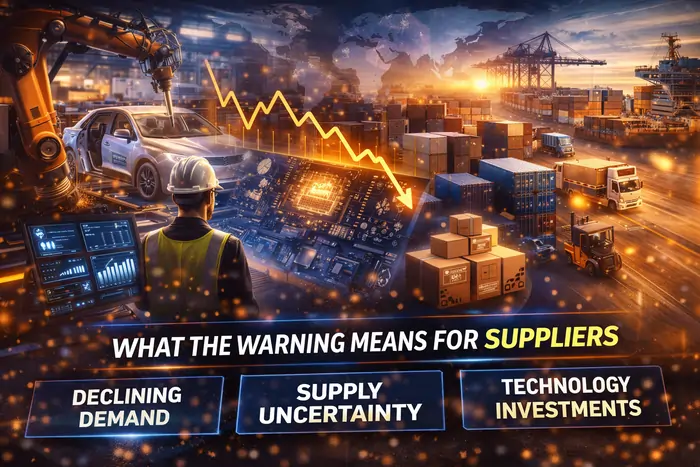
For suppliers, the Toyota CEO Koji Sato Warning is both a risk and an opportunity. Those that cannot meet new expectations around quality, cost, and innovation may lose business as Toyota consolidates its supplier base and shifts spending toward partners that can support its EV and software roadmaps. But for companies willing to invest in new capabilities—such as advanced materials for batteries, high‑voltage components, or embedded software—this could be a path to deeper, longer‑term collaboration with Toyota.
The tone of the Toyota CEO Koji Sato Warning emphasizes “co‑prosperity,” meaning Toyota wants suppliers to grow together with it rather than simply squeezing margins. At the same time, Sato makes it clear that co‑prosperity is conditional on change: investments in automation, skills, and joint development are now prerequisites, not optional extras. Suppliers that adapt quickly can secure their place in the next era of Toyota’s ecosystem; those that do not may find themselves left behind.
Implications for Competitors and Investors
For competitors, the Toyota CEO Koji Sato Warning is a signal that Toyota is preparing to fight hard in the EV and software race. Chinese brands may see this as confirmation that they have successfully put pressure on Japan’s champion, but they also know Toyota has huge resources and global reach if it can move fast enough. European and American automakers can interpret the warning as a reminder that nobody is safe in an industry where regulations, technology, and consumer preferences are shifting quickly.
Investors are already digesting what the Toyota CEO Koji Sato Warning means for earnings, capital expenditure, and long‑term positioning. Articles on financial and technology news platforms note that Toyota will likely need to pour billions into EV plants, battery supply chains, and software development, pressuring short‑term margins but potentially securing long‑term competitiveness. How consistently the company hits its EV volume targets, battery milestones, and quality improvements will determine whether this warning looks, in hindsight, like the beginning of a successful reinvention.
What It Means for Consumers
For consumers, investors, and policymakers alike, the Toyota CEO Koji Sato Warning is a reminder that even dominant incumbents must reinvent themselves in the face of technological disruption and shifting global competition. The way Toyota responds—through quality improvements, supplier transformation, aggressive battery innovation, and a sharper software focus—will help shape the broader trajectory of the auto industry over the next decade.
At the same time, Toyota’s push toward electrification and advanced batteries sits within a larger global pivot to clean energy, where grid readiness, policy support, and consumer adoption all matter as much as product strategy. For a wider perspective on how fast energy transitions can scale when technology, regulation, and market demand align, it is worth looking at how quickly rooftop and utility‑scale solar have expanded in other sectors; for example, Australia’s Solar Panel Boom Offers Key Lessons for Renewable Energy Growth and shows how clear incentives and strong infrastructure can rapidly accelerate clean technology adoption.
FAQs About the Toyota CEO Koji Sato Warning
What is the Toyota CEO Koji Sato Warning about?
It refers to Koji Sato’s statement that Toyota “will not survive” unless it improves quality, productivity, and electrification efforts.
Why did Koji Sato say Toyota might not survive?
To shock suppliers and teams into recognizing rapid market changes, especially from Chinese EV makers and advanced battery innovation.
When did Koji Sato deliver this warning?
In late March 2026 during a major supplier convention, later amplified by global media.
Who was the main audience?
Primarily Toyota’s supplier network, but also employees, investors, competitors, and policymakers.
How does this affect suppliers?
Suppliers must raise quality, cut costs, adopt new technologies, and collaborate more closely or risk losing business.
What role does China play?
China’s dominance in EV production, exports, and software-driven vehicles is raising competitive pressure.
How does this connect to Toyota’s EV strategy?
It reinforces expansion into battery EVs, next-gen batteries, and shifting beyond a hybrid-focused identity.
What is the multi-pathway strategy?
A mix of hybrids, plug-in hybrids, EVs, and hydrogen fuel-cell vehicles tailored to different markets.
Why are solid-state batteries important?
They offer longer range, faster charging, and lower long-term costs, giving Toyota a potential competitive edge.
Is Toyota abandoning combustion engines?
No—Toyota will continue developing cleaner engines and hybrids alongside EV growth.
What about software?
Toyota aims to become a software-driven mobility company with OTA updates, connected services, and data monetization.
What does this mean for customers?
Expect better reliability, more EV choices, improved batteries, and enhanced in-car tech.
How will investors react?
Seen as both risk and opportunity—higher spending now, but stronger long-term positioning.
How does this compare to other industries?
Similar to renewable energy shifts, where technology and policy rapidly reshape markets.
What should we watch next?
Look for new EV launches, solid-state battery progress, fewer recalls, and stronger software ecosystems.