

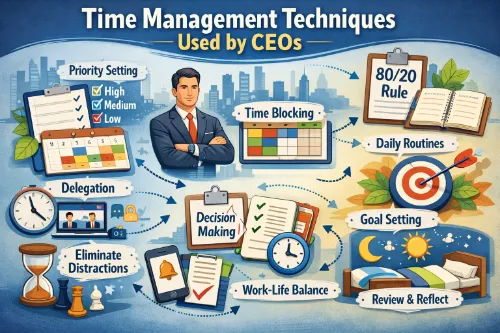
Time management techniques is one of the defining skills of top CEOs: they work long hours, juggle constant demands, and still carve out time for strategy, health and family. Studies of large‑company CEOs show they work around 62–63 hours per week, with most of that time spent in meetings and face‑to‑face interactions, making deliberate time use essential rather than optional.
How CEOs Actually Spend Their Time
Before looking at techniques, it helps to understand the baseline reality of a CEO’s schedule.
A multi‑year Harvard Business School study by Michael Porter and Nitin Nohria, summarized in Harvard Business Review’s “How CEOs Manage Time” and on the HBS faculty page here, tracked how large‑company CEOs spent their time in 15‑minute increments over several months. Key findings from the study and subsequent summaries include:
- CEOs worked an average of 62.5 hours per week.
- Around 61% of their work time was spent in face‑to‑face meetings, 24% on electronic communications, and 15% on phone calls, reading and written correspondence.
- They worked an average of 3.9 hours on weekend days and 2.4 hours on vacation days.
- About 36% of CEO time was spent in reactive mode—responding to unfolding issues—while only 11% was tied up in routine duties like board meetings and earnings calls.
These data highlight an important truth: the job is all‑consuming, and without strong time‑management disciplines, a CEO’s day would be swallowed by meetings, email and emergencies. An Amplēo summary, “How CEOs Manage Time: an Ambitious HBR study”, notes that these leaders still make room for exercise and family time, but only because they actively design their schedules around what matters most.
1. Running on a Clear Agenda (Not a To‑Do List)
One of the strongest findings from the HBR study is that high‑performing CEOs operate from a clear personal agenda rather than a long reactive to‑do list.
In the HBR article “How CEOs Manage Time”, Porter and Nohria report that the CEOs they tracked spent about 43% of their working hours on activities that directly advanced a handful of top priorities. Some were much more disciplined, devoting up to 80% of their time to agenda‑aligned work, while others spent as little as 14%.
The PDF version of the article, “HOW CEOs MANAGE TIME”, emphasizes that:
- An explicit agenda is “one of the CEO’s most important tools” for making progress across multiple work streams.
- CEOs should review their calendar quarterly to check whether time allocation really matches their agenda.
A CEO article from The CEO Project, “How High‑Performing CEOs Manage Their Time Effectively”, echoes this idea, urging leaders to distinguish between strategic activities and “busy work” and to design weeks around strategic priorities first, rather than fitting strategy into leftover time.
Takeaway for readers: Start with a short written agenda of 3–5 priorities (for the quarter or even the week) and regularly check your calendar against it. If most of your time is not spent on those priorities, your schedule—not your intentions—is driving your leadership.
2. Calendar Compartmentalization and Time Blocking
Because meetings are unavoidable, CEOs use calendar compartmentalization and time blocking to prevent their day from fragmenting into reactive chaos.
ExecViva’s article, “This is how CEOs manage time: proven strategies for success”, highlights several practical techniques CEOs use:
- Calendar compartmentalization: Blocking specific segments of the day or week for meetings, deep work, and breaks so priorities are visible and protected.
- Task batching: Grouping similar tasks (emails, calls, admin work) to reduce context‑switching and mental fatigue.
- Delaying morning meetings: Using rules like “no meetings before 10:00 a.m.” to protect peak‑energy hours for strategic work.
The CEO Project notes that many high‑performing CEOs will reserve large uninterrupted blocks for deep thinking, financial reviews or strategic planning, and they rely on their executive assistants to enforce those blocks.
Time‑management experts often point to time blocking as a core technique. Focus Bear’s explainer, “Timeboxing: Elon Musk’s Time Management Technique”, describes the distinction between:
- Time blocking – reserving recurring blocks (e.g., 9–11 a.m. daily) for a type of work.
- Time boxing – assigning a fixed time box for a one‑off task and committing to stop when the time is up.
The article notes that Elon Musk’s famous “5‑minute rule” is a form of aggressive time boxing, breaking the day into small chunks and assigning each chunk a specific task. Even if most people don’t go to that extreme, using a 5‑minute or 15‑minute planner forces more deliberate choices about how you spend each part of the day.
Samphy Y’s analysis, “Elon Musk’s Time Blocking Method: Is It Just A Myth?”, points out that while Musk may not literally schedule every five minutes, he does rely on long blocks of time for deep work, showing that time blocking is essential for both creative and operational leaders.
3. Protecting Time for Deep Work and Strategic Thinking
Despite packed schedules, top CEOs are careful to protect thinking time.
The HBR/Harvard study found that CEOs spent only about 15% of their time alone, doing tasks like deep thinking, reading and analysis. Yet the authors stress that this small fraction is disproportionately important, because it’s where strategy, reflection and high‑level problem‑solving happen.
McKinsey & Company’s 2025 article, “Everyday habits: How CEOs navigate their six core responsibilities”, argues that high‑performing CEOs deliberately schedule “thinking slots” to work on:
- Setting direction and strategy.
- Aligning the organization.
- Developing leaders and culture.
These habits include blocking out mornings for quiet work, retreat‑style days, or regular “strategy sessions” away from the office, all aimed at avoiding being consumed by day‑to‑day operational noise.
ExecViva’s guide reinforces this by recommending energy management—doing high‑priority tasks during your personal peak‑productivity hours and saving low‑energy periods for routine work. That’s the same principle CEOs use when they block off mornings for deep work and push routine meetings into afternoons.
Practical tip: Even if you’re not a CEO, you can copy this by scheduling 90–120 minutes of uninterrupted deep work each morning, treating it as a non‑negotiable meeting with yourself.
4. Delegation, Direct Reports and “Integrating Mechanisms”
Top CEOs achieve leverage by managing through others rather than trying to make every decision themselves.
The Amplēo summary of the HBR study, “How CEOs Manage Time: an Ambitious HBR study”, lists several key habits:
- They rely heavily on their direct reports, using them as extensions of their time and attention.
- They use broad integrating mechanisms—strategy, business reviews, people development, structure and culture—to guide the organization, instead of micromanaging.
The HBR PDF, “HOW CEOs MANAGE TIME”, quantifies this: CEOs spent on average:
- 21% of their work time on strategy.
- 25% on functional and business‑unit reviews.
- 25% on developing people and relationships.
- 16% on organizational structure and culture.
These activities are described as “integrating mechanisms”: they align and empower others so the CEO doesn’t have to be involved in every operational decision.
ExecViva adds that effective CEOs also:
- Push routine decisions down to their teams.
- Use their EAs or chiefs of staff to filter requests and calendar invites.
- Set clear decision rights so people know when they can act autonomously.
Takeaway: Time management at the CEO level is inseparable from delegation and system design. You can apply this by clarifying who owns what decisions on your team and by using recurring reviews (weekly one‑on‑ones, monthly business reviews) as your own “integrating mechanisms.”
5. Limiting Meetings and Making Them Work Harder
The HBR study revealed that CEOs spent about 72% of their work time in meetings, which makes meeting quality a critical time‑management lever. That breaks down into formal meetings, ad‑hoc conversations, board sessions and external events.
A LinkedIn commentary on the study, “How CEOs manage their time: HBR insights”, highlights several best practices drawn from the research:
- Prioritize high‑value activities over “busy work.”
- Dedicate time for strategic thinking and reflection by protecting blocks on the calendar.
- Empower teams to handle operational tasks and reduce unnecessary approvals.
ExecViva suggests specific meeting tactics CEOs use, such as:
- Batching meetings into specific days or half‑days instead of scattering them.
- Setting default durations (for example, 25 or 50 minutes instead of 30 or 60) to create buffer time.
- Instituting informal rules like “no back‑to‑back meetings” to reduce cognitive overload.
The CEO Project article notes that many CEOs also use their assistants to screen and gatekeep meeting requests, only accepting those that align with their agenda or require their unique input. This keeps the calendar from being filled by every request that comes in.
6. Using Timeboxing and Micro‑Deadlines
Highly visible CEOs like Elon Musk have popularized more aggressive time‑management techniques such as timeboxing and micro‑deadlines.
A document summarizing Musk’s approach, “Elon Musk’s time blocking method”, explains that he plans his day in small time blocks, each assigned to a specific task—from meetings to email to meals. Time‑management author Kevin Kruse, cited in that document, found in his research for “15 Secrets Successful People Know About Time Management” that top performers prefer time blocks instead of long to‑do lists, because blocks force real tradeoffs.
Focus Bear’s article, “Timeboxing: Elon Musk’s Time Management Technique”, describes Musk’s “5‑minute rule”: breaking the day into five‑minute chunks and assigning each chunk a task. While most professionals don’t go that far, even 30‑ or 60‑minute boxes can help you:
- Commit to starting a difficult task.
- Limit perfectionism by forcing a stop time.
- Reduce procrastination by making the next step small and concrete.
Samphy Y’s critique, “Elon Musk’s Time Blocking Method: Is It Just A Myth?”, argues that what really matters is not the exact block size, but the principle of protecting blocks for focused work, especially if you tend to procrastinate or get interrupted.
7. Protecting Energy, Health and Personal Time
Time management for CEOs isn’t only about cramming more into the day; it’s also about managing energy and avoiding burnout.
The HBR study found that CEOs, despite intense workloads, exercised on average 45 minutes per day and spent roughly half of their non‑working, awake time with their families. This reflects deliberate choices rather than leftover time.
EHL Hospitality Business School’s article, “Why time management is important for CEOs and executives”, argues that CEOs who manage their time well:
- Enhance productivity and decision‑making by avoiding constant fatigue.
- Reduce stress through realistic schedules and clear boundaries.
- Make room for exercise, sleep and family, which in turn support better performance.
ExecViva’s concept of energy management—doing creative or strategic work during peak hours and saving admin for low‑energy periods—comes directly from how many CEOs structure their days. The CEO Project similarly notes that high performers will protect evenings or weekends for family and recovery, even when they still put in some work hours.
Lesson: Treat sleep, exercise and relationships as calendar items, not optional extras. Many CEOs schedule workouts, family dinners or school events just as they schedule board meetings.
8. Weekend and Quarterly Reviews
One of the most leveraged habits CEOs use is regular review of how they spent their time.
The HBR article suggests that CEOs should, each quarter, look back at their calendar and ask whether their time allocation matched their agenda, then adjust both the agenda and the schedule as needed. This pattern of looking back and re‑planning helps them avoid drift into purely reactive work.
ExecViva recommends combining weekend planning, calendar compartmentalization and structured delegation as “the most effective way to improve CEO time management,” essentially turning Sunday evenings or Friday afternoons into a strategic planning slot.
You can adopt a simpler version by doing a weekly review: scan your calendar, categorize where time went (strategy, people, operations, admin), and then adjust next week’s blocks to move closer to your ideal. Over time, this turns time management into a continuous improvement process.
Final Thoughts: Time as a CEO’s Ultimate Lever
The research is clear: how CEOs use their time is a concrete expression of how they lead. The HBR study’s main conclusion is that a CEO’s schedule “is a manifestation of how the leader leads and sends powerful messages to the rest of the organization.” McKinsey’s habit compilation and practical guides from firms like ExecViva and The CEO Project all point to the same theme—intentional time use separates high‑performing leaders from merely busy ones.
By borrowing these time‑management techniques—clear agendas, calendar blocking, protected deep‑work time, disciplined delegation, smarter meetings, micro‑deadlines, energy management and regular reviews—you don’t need a CEO title to run your day like a chief executive. You simply need to treat your time as seriously as they do.