

Diesel price rollback impact Philippines transport has been significant but uneven across the sector. How fuel rollback affects jeepney driver income Philippines varies widely — some drivers report up to ₱400 in daily savings from combined rollback and subsidy, while others say the reduction has not translated into meaningful savings.
Trucking industry fuel cost savings Philippines 2026 have been amplified by government measures including toll fee waivers and ₱1 harbor fees. Cargo rate adjustment after diesel price cut Philippines has seen mixed implementation, with some businesses lowering prices and others maintaining margins.
Jeepney driver financial relief April 2026 includes the Pantawid Pasada fuel subsidy program, LTFRB Service Contracting Program, and emergency cash assistance for qualifying operators.
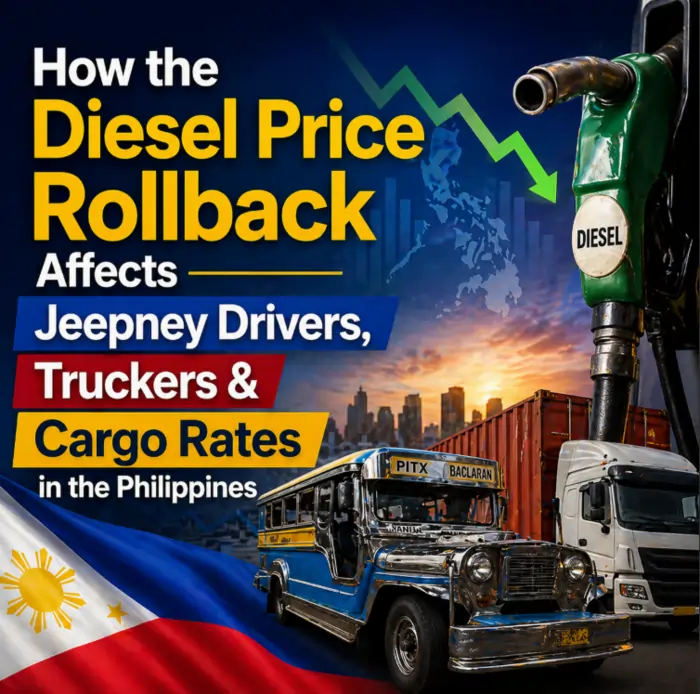
Beyond the Headline Numbers
When President Ferdinand R. Marcos Jr. announced a historic ₱24.94 per liter diesel rollback on April 18, 2026, the headlines celebrated a victory for Filipino consumers. But behind those numbers lies a more complex story — one of jeepney drivers still struggling to make ends meet, truckers hauling agricultural goods finally catching a break, and cargo rates that may or may not trickle down to the prices of rice, vegetables, and construction materials.
The diesel price rollback impact Philippines transport cannot be measured by government statistics alone. It must be understood through the lived experiences of the people who depend on diesel to earn a living: the jeepney driver who leaves home before sunrise and returns with barely ₱500 in his pocket.
The trucker hauling agricultural produce across Luzon, watching every kilometer on his fuel gauge; the delivery rider in Capiz whose daily earnings were slashed by rising fuel costs until this month‘s rollback brought relief.
In this article, we go beyond the numbers to explore how the April 2026 diesel price rollback has affected three critical sectors: jeepney drivers, truckers, and small business owners. We will examine the real savings, the remaining struggles, and the government programs that aim to bridge the gap.
For a complete understanding of the broader context, start with the Diesel & Kerosene Price Rollback Philippines 2026 pillar article. You may also want to review the fuel rollback timeline and the government mandate under EO 110 that made these cuts possible.
Let us now examine the real-world impact, sector by sector.
The Real Diesel Price Rollback Impact on Philippines Transport: Three Sectors, Three Stories
The diesel price rollback impact Philippines transport varies dramatically depending on who you ask. A jeepney driver, a long-haul trucker, and a small bakery owner all use diesel and kerosene differently. Their savings — and their struggles — reflect those differences.
Jeepney Drivers: Relief That Doesn‘t Go Far Enough
For traditional jeepney drivers, April 2026 brought both good news and bad news. The good news: diesel prices fell by a cumulative ₱58.77 to ₱63.65 per liter over four weeks. The bad news: even after these historic cuts, diesel in Metro Manila remained above ₱90 per liter at some gas stations, with others reaching up to ₱100.
What does that mean for a typical jeepney driver?
A driver who consumes 40 liters of diesel per day saw daily fuel costs drop from approximately ₱4,000 (at ₱100/L) to roughly ₱3,600 (at ₱90/L) — a ₱400 daily reduction.
Combined with the government‘s ₱10-per-liter fuel subsidy, that same driver could save up to ₱800 per day. Driver Hiro, a PUV driver in Metro Manila, put it in concrete terms: with his unit consuming around 40 liters daily, the P10 discount translates to P400 in daily savings, money that now stays in his pocket.
Driver Ryan said the subsidy could nearly double what he brings home at the end of the day: “Ang masasabi ko lang po sa discount, malaking tulong na po ‘yun sa mga kapwa driver. At least ‘yung P10 na ‘yun, may maiuuwi kami sa pamilya namin. Dating P400, baka ngayon P700 na.”
Driver Gerard echoed this sentiment: “Malaking tulong po sa amin ‘yan. Magagamit namin pag-gara ng mga bata, unang-una baon, pambili ng bigas, pang-ulam. Maraming maraming salamat po kay PBBM.”
But not all stories are uplifting. Despite the rollbacks, traditional jeepney drivers in Santa Mesa, Manila told the Daily Tribune that the reduction has not translated into meaningful savings. Rommy Franco, a 59-year-old driver, said a full tank still costs about ₱2,700, leaving him with only ₱500 to ₱600 after paying boundary fees and covering daily expenses.
“There is no effect because it is still the same. You cannot even earn a good amount unless you push yourself to the limit,” Franco said.
Marlon Mayor, who has been driving for 27 years, said he takes home just ₱400 to ₱500 daily. He added: “I sleep in the garage with just a blanket, enduring the cold and the mosquitoes, just to save for the next day‘s trip.”
Transport group Piston has been vocal: even after the rollbacks, diesel prices are projected to remain at around ₱98 per liter — nearly 50 percent higher than the ₱66.50 average in 2023, when current fares were last set. This leaves drivers with daily losses of roughly ₱1,700 to ₱3,000, the group said.
Piston has petitioned the LTFRB for a ₱10 fare increase. At 30 liters a day, fuel alone still costs a driver roughly ₱3,700, they argued. The group also warned of a possible strike if their demands are not met.
For a detailed look at the government‘s intervention and the legal framework behind these rollbacks, read our companion piece Marcos Fuel Price Rollback: Is the Government Mandating Oil Price Cuts?.
Truckers and Cargo Haulers: Government Relief Amplifies Rollback Savings
For truckers and cargo haulers, the diesel price rollback impact Philippines transport has been amplified by a series of government relief measures specifically targeting the logistics sector.
On April 21, 2026, Malacañang announced a package of relief measures for truck drivers and shipping operators of agricultural products. Among the key measures:
- Toll fee waivers for Department of Agriculture (DA)-accredited cargo trucks on major expressways, generating over ₱100 million in savings for haulers for a one-month period starting April 20, 2026.
- Reductions in key regulatory and terminal fees for truckers delivering agricultural goods.
- MARINA fee reductions: The Maritime Industry Authority approved a 75-percent reduction on key regulatory fees covering permits, safety certificates, vessel registration, and accreditation. The annual tonnage fee was slashed to just ₱1 per gross tonnage for vessels above 15 gross tonnage, while vessels of 15 gross tonnage and below were fully exempted.
- PPA harbor fee cuts: The Philippine Ports Authority slashed roll-on roll-off (RoRo) terminal fees to just ₱1 for vehicles transporting agricultural goods — a drastic reduction from the current charges ranging from ₱258 to ₱516 depending on vehicle type.
- Truck ban exemptions: The MMDA and LGUs exempted vehicles transporting essential and perishable goods, as well as oil tankers, from truck bans, allowing them to operate at any time.
These measures, combined with the diesel rollback itself, have significantly reduced operating costs for cargo haulers. The Department of Agriculture expects the toll fee waiver alone to generate over ₱100 million in savings for haulers.
For a detailed analysis of how these savings might affect cargo rates — and ultimately the prices of basic goods — read our companion article on the future price forecast.
Small Businesses and Delivery Riders: A Much-Needed Breather
For small businesses and delivery riders, every peso saved on fuel is a peso that can be reinvested into operations — or used to put food on the table.
In Roxas City, Capiz, delivery rider Elmar Bersabal shared his optimism upon hearing the April 14 rollback announcement. Speaking in Hiligaynon, he emphasized that the steady rise in petroleum prices had significantly cut into his daily earnings. “This will be a great relief for us delivery riders,” he said.
Tricycle operator Jay Apuang also welcomed the rollback. He expressed sympathy for the driver operating his unit, who earns only a minimal amount after covering all expenses, including tricycle rental and fuel costs.
Apuang noted that his driver received ₱5,000 cash relief assistance from the Department of Social Welfare and Development on April 8, and he did not ask for any share of it, considering the driver‘s daily struggles.
Roxas City Mayor Ronnie Dadivas expressed support for the rollback, saying it would help ease the burden on motorists and contribute to stabilizing the prices of goods and services. He also noted that the local government had been informed of a forthcoming cash assistance program from the Department of Agriculture aimed at supporting registered and qualified farmers.
On a broader scale, the Philippine Chamber of Commerce and Industry (PCCI) has warned that continuous fuel price hikes lead to thinner margins, forcing businesses to either cut personnel or risk insolvency. Logistics costs in the Philippines are among the highest in the region, and a 35 percent increase in the prices of basic goods had already been projected before the rollbacks.
Exporters have also thrown their support behind further tax suspensions. The Philippine Exporters Confederation (Philexport) noted that suspending VAT on fuel would ease pressures for micro, small, and medium enterprises, allowing them to sustain operations and protect jobs.
According to economic data, suspending fuel-related taxes could reduce diesel prices by as much as ₱6 per liter and gasoline by ₱10 per liter.
For a broader understanding of how global markets influenced these price movements — and why the rollback happened in the first place — read our article on global oil market trends.
Government Relief Programs: Bridging the Gap Beyond Rollbacks
The Marcos administration has recognized that price rollbacks alone are insufficient. A suite of complementary programs has been rolled out to support the transport sector:
1. ₱10-Per-Liter Diesel Fuel Subsidy (Pantawid Pasada Program)
Starting April 14, 2026, qualified public utility vehicle drivers in Metro Manila received a ₱10-per-liter fuel subsidy at 52 accredited gas stations. The subsidy will run for three months, with drivers allowed to claim discounts of up to 150 liters per week, equivalent to savings of as much as ₱1,500 weekly.
The subsidy coincided with the ₱20.89-per-liter diesel rollback, bringing total immediate relief of more than ₱30 per liter for qualified PUV drivers. As of April 14, some 33,000 PUVs in Metro Manila were already enrolled in the program, with plans to expand to provinces.
2. LTFRB Service Contracting Program (SCP)
On April 15, 2026, the LTFRB launched a ₱1-billion Service Contracting Program, offering a subsidy of ₱30 per kilometer in exchange for a 20 percent fare discount to passengers. The program aims to benefit 50,000 PUV drivers and an estimated 15 million commuters.
However, response to the program has been mixed. Some drivers welcomed the guaranteed earnings, while others expressed concern that fuel costs may still exceed the subsidy or that program requirements could complicate operations.
3. DSWD Emergency Cash Assistance
The Department of Social Welfare and Development distributed ₱5,000 cash relief assistance to affected drivers. The program has shifted to e-wallet payouts to improve efficiency and avoid overcrowding during distribution.
4. LTO License and Registration Extensions
The Land Transportation Office granted a three-month extension to the validity of expired licenses, student permits, conductor‘s licenses, and vehicle registrations.
President Marcos assured the public: “Kung mag-e-expire ngayong buwan ang lisensya o rehistro mo, magiging valid pa rin ‘yan hanggang July at wala kang babayarang multa o anumang surcharge.”
5. Toll Fee Waivers and Regulatory Fee Reductions
As detailed earlier, truckers and shipping operators have benefited from toll fee waivers, MARINA fee reductions, and PPA harbor fee cuts — measures expected to generate over ₱100 million in savings for the logistics sector.
Will Cargo Rates Go Down? The Slow Trickle Effect
One of the most anticipated outcomes of the diesel price rollback is a reduction in cargo rates — and, by extension, the prices of basic goods.
The Department of Trade and Industry (DTI) has been closely monitoring logistics costs. On March 11, 2026, DTI Secretary Ma. Cristina Aldeguer-Roque recommended the suspension of logistics handling costs and toll fees for delivery vehicles transporting basic and prime commodities. She also recommended a temporary moratorium on toll fees for cargo vehicles on major expressways.
By April 2026, some of these recommendations had been implemented. Toll fees for DA-accredited cargo trucks were waived starting April 20, and RoRo terminal fees were slashed to just ₱1.
However, whether these savings translate into lower consumer prices remains to be seen. The Philippine Exporters Confederation noted that a ₱6-per-liter reduction in diesel would mean savings for the country‘s transport, logistics, and export industries. But as one industry source noted, “Logistics costs are sticky. Companies have been bleeding for months, and many will use the rollback to recover margins rather than lower prices.”
For a data-driven forecast of whether diesel prices will continue to fall — and what that means for cargo rates — read our companion article Will Diesel Prices Go Down Further?.
Key Takeaways by Sector
| Sector | Savings | Remaining Challenges |
|---|---|---|
| Jeepney Drivers | Up to ₱800/day (rollback + subsidy) | Diesel still ₱90+ per liter; daily take-home as low as ₱400 |
| Truckers & Cargo | ₱100M+ in toll + fee savings | Cargo rates slow to adjust |
| Small Businesses | Lower delivery costs, tax suspension potential | Margins remain thin; logistics costs still high |
Frequently Asked Questions (FAQs)
1. How much does a jeepney driver save daily from the diesel rollback?
A driver consuming 40 liters of diesel per day saves approximately ₱400 daily from the rollback alone. Combined with the ₱10-per-liter fuel subsidy, total savings can reach ₱800 per day.
2. Why do some drivers say the rollback has no effect?
Despite the rollback, diesel in some areas remains above ₱90 per liter, nearly double the pre-crisis level of around ₱50. Drivers with high boundary fees and low passenger volume may still struggle to break even.
3. What is the Pantawid Pasada fuel subsidy?
It is a ₱10-per-liter fuel discount for qualified PUV drivers, available at 52 accredited gas stations in Metro Manila. Drivers can claim up to 150 liters per week, saving up to ₱1,500 weekly.
4. How many PUVs are enrolled in the fuel subsidy program?
As of April 14, 2026, some 33,000 PUVs in Metro Manila were enrolled. The LTFRB plans to expand the program to provinces.
5. What is the Service Contracting Program (SCP)?
The SCP is a ₱1-billion program offering drivers a subsidy of ₱30 per kilometer in exchange for a 20 percent fare discount to passengers.
6. How much did diesel drop in total during April 2026?
Cumulative diesel rollbacks ranged from ₱58.77 to ₱63.65 per liter over four weeks.
7. Are truckers getting any additional relief beyond the rollback?
Yes. Toll fees for DA-accredited cargo trucks have been waived, MARINA fees reduced by 75%, and RoRo terminal fees slashed to just ₱1.
8. Will cargo rates go down as a result of the rollback?
It depends on the logistics company. Some have already lowered rates by 3-5%, but others may use the savings to recover past losses. The DTI is monitoring the situation.
9. How much do toll fee waivers save truckers?
The DA estimates that toll fee waivers will generate over ₱100 million in savings for haulers during the one-month implementation period.
10. What is the ₱1 harbor fee at PPA ports?
The Philippine Ports Authority slashed roll-on roll-off (RoRo) terminal fees to just ₱1 for vehicles transporting agricultural goods — down from ₱258 to ₱516.
11. Did the government provide cash assistance to drivers?
Yes. The DSWD distributed ₱5,000 cash relief to affected drivers, with some receiving assistance as early as April 8.
12. Are there any fare increase petitions?
Yes. Transport group Piston has petitioned the LTFRB for a ₱10 jeepney fare increase, citing unsustainable operating costs even after the rollback.
13. What is the domino effect of fuel price increases?
According to a Cebu transport leader, when fuel prices rise, the impact cascades through fares, logistics costs, and household budgets. “Kahibaw gyud ta sa domino effect sa pagsaka sa gasolina. Grabe gyud ang epekto sa ubos,” he said.
14. Are there fuel discounts for motorcycle taxis?
Motorcycle taxi drivers have also felt the squeeze. Allan Cate said he used to spend only ₱100 on gasoline but now spends ₱200 just to get a full tank, with his net income down to ₱500.
15. How can drivers report violations of the rollback?
Drivers can report violations to the DOE Consumer Welfare Desk at (02) 8479-2900 local 225 or message the DOE‘s official Facebook page. President Marcos also urged the public to report violations directly to the Office of the President.
16. What is the P10 diesel subsidy expansion plan?
The LTFRB plans to expand the subsidy to cover additional PUV categories and eventually roll it out to provinces.
17. Did the government suspend excise taxes on fuel?
Not for diesel and gasoline, but Executive Order No. 114 suspended excise taxes on LPG and kerosene for three months, reducing LPG prices by about ₱3.36 per kilogram and kerosene by ₱5.60 per liter.
18. How does the Philippine transport sector compare regionally?
Logistics costs in the Philippines are among the highest in the region, making every peso of fuel savings critical for business survival.
19. What other government measures are coming?
President Marcos has promised additional relief measures, including continued fuel subsidies, the Service Contracting Program, and license extensions.
20. Where can I find the latest fuel price updates?
Visit the DOE official website, check oil company social media pages, or read our fuel rollback timeline for complete week-by-week data.
Conclusion: Relief That Has Not Yet Reached Everyone
The diesel price rollback impact Philippines transport tells a story of uneven relief. For some jeepney drivers, the combination of rollbacks and subsidies has brought ₱400 to ₱800 in daily savings — money that goes directly to rice, school supplies, and household expenses. For others, the relief has been swallowed by still-high diesel prices, looming boundary fees, and the daily struggle to find enough passengers.
For truckers and cargo haulers, the rollback has been amplified by toll fee waivers, regulatory fee reductions, and harbor fee cuts — measures that together could save the logistics sector over ₱100 million. Whether these savings trickle down to consumers in the form of lower rice and vegetable prices remains a crucial question.
For small business owners and delivery riders, every peso saved on fuel is a lifeline. As the Philippine Chamber of Commerce and Industry has warned, without sustained relief, businesses face stark choices: cut personnel or risk insolvency.
The April 2026 diesel rollback is a historic achievement, but it is not the final solution. Drivers in Santa Mesa still struggle to take home ₱500 a day. Piston still calls for a ₱10 fare increase. And the DOE warns that the rollback streak may end as early as May.
For the latest updates on fuel prices and government programs, follow the DOE and the Philippine News Agency.