

What is the Marcos fuel price rollback Philippines? Marcos fuel price rollback Philippines government mandate allowed the Department of Energy (DOE) to prescribe minimum price cuts after Executive Order No. 110 declared a state of national energy emergency.
Is the government mandating oil price cuts in the Philippines 2026? Philippines energy emergency Executive Order 110 Marcos gave the government power to set caps on price increases and mandate minimum rollbacks. DOE prescribed fuel price adjustments April 2026 included diesel cuts of up to ₱24.94 per liter.
Can the government force oil companies to lower prices in the Philippines? Yes, under EO 110, with penalties of up to one year imprisonment and ₱300,000 fines for non‑compliance. Oil companies compliance with government price rollback Philippines has been enforced through show‑cause orders and daily monitoring since April 2026.
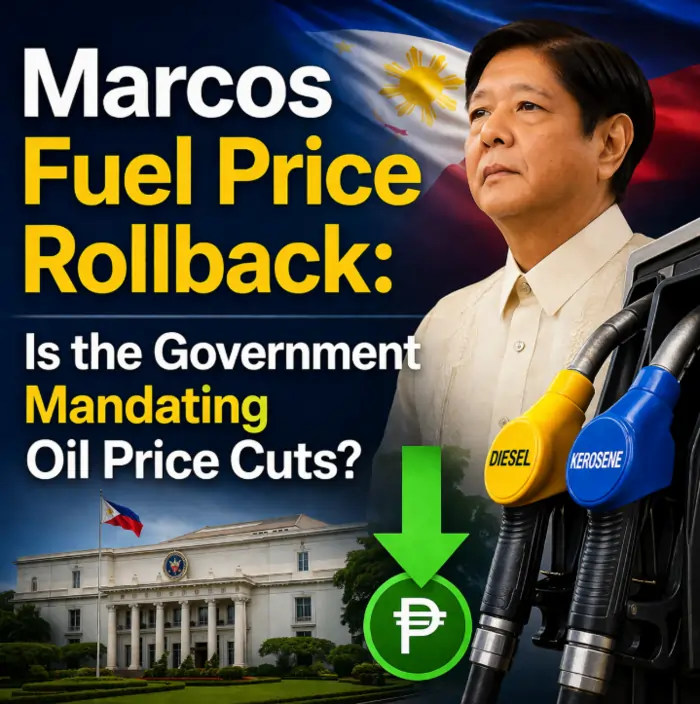
A Historic Shift in Philippine Energy Policy
For decades, the Philippine downstream oil industry operated under a deregulated framework. Since the passage of the Downstream Oil Industry Deregulation Act of 1998, oil companies have largely set their own pump prices, subject only to monitoring by the Department of Energy (DOE). But April 2026 changed everything.
When the Middle East conflict erupted on February 28, 2026, sending global crude prices soaring and pushing Philippine diesel to a staggering ₱172 per liter in some areas, the administration of President Ferdinand R. Marcos Jr. decided that monitoring alone was no longer enough.
On March 28, 2026, the President signed Executive Order No. 110, declaring a State of National Energy Emergency. This landmark order fundamentally altered the balance of power between the government and the oil industry.
The question on every motorist‘s mind became: Marcos fuel price rollback Philippines – is this real, or is the government merely asking nicely? The answer, as this article will show, is that the Marcos administration has moved from monitoring to prescribing fuel prices. For the first time since deregulation, oil companies that defy government‑mandated price adjustments face criminal prosecution.
For a complete overview of the entire April 2026 rollback phenomenon, start with the Diesel & Kerosene Price Rollback Philippines 2026 pillar article. We will also reference our detailed fuel rollback timeline and the global market trends that made these interventions necessary.
Let us examine exactly how the government is mandating oil price cuts – and what it means for Filipino consumers.
Executive Order No. 110: The Legal Foundation of the Marcos Fuel Price Rollback Philippines
The Marcos fuel price rollback Philippines story begins with Executive Order No. 110, signed on March 28, 2026. The order declared a “state of national energy emergency,” citing the “imminent danger” to the country’s energy supply due to global disruptions and rising oil prices.
Speaker Faustino “Bojie” Dy III praised the move as a “timely and necessary step” to shield the country from the Middle East conflict‘s effects on fuel supply, prices, and the broader economy. “President Bongbong Marcos moved with urgency because the threat is real and immediate,” Dy said. “This is about staying ahead of the crisis before it hits Filipino families harder”.
But what does a “state of national energy emergency” actually mean for oil companies and consumers? Under the order, the DOE gained several unprecedented powers:
- Cap on price increases – The government can now set a maximum allowable price hike per week.
- Mandate minimum rollbacks – When global prices fall, the DOE can prescribe a floor below which oil companies cannot go.
- Daily price monitoring – The DOE can inspect and demand daily updates on inventory and pricing.
- Criminal penalties – Non‑compliance can result in imprisonment and fines.
- Temporary takeover authority – Under the Oil Deregulation Law of 1998, the DOE may “temporarily take over or direct the operation” of oil industry players in times of national emergency.
The order also adopted the Unified Package for Livelihoods, Industry, Food, and Transport (UPLIFT) as a whole‑of‑government framework to ensure stable supply chains and uninterrupted essential services.
From Monitoring to Prescribing: How the Marcos Fuel Price Rollback Philippines Works
Before EO 110, the DOE could only monitor oil prices. If a company raised prices too quickly or dropped them too slowly, the agency’s only recourse was to issue a public statement or call for a meeting. There were no teeth.
Under the energy emergency, that has changed. Marcos fuel price rollback Philippines is now a mandate, not a request.
Energy Secretary Sharon Garin explained the shift clearly during a press briefing:
“So that‘s our new rule now. That’s because of the issuance of the executive order, which triggered the additional powers of government to prescribe the price during these times of emergency. The rollback is now mandated by the government. DOE is now subscribing the price increase limitation”.
Garin emphasized that the government is not imposing arbitrary price controls. “We are not capping the price, but we are capping the adjustments. Under that issuance, the DOE is now prescribing the price increase limitation. We have a limit, a minimum rollback and a maximum price increase”.
In practice, this means that every Sunday, the DOE announces a prescribed adjustment: a minimum rollback amount (if global prices fell) and a maximum increase cap (if global prices rose). Oil companies can offer larger discounts than the prescribed minimum, but they cannot offer less. They can raise prices by less than the cap, but not more.
This framework directly addresses the public‘s long‑standing complaint: “why are the increases faster than the rollbacks?”. By setting both floors and ceilings, the government ensures that price movements are symmetrical.
For a deeper look at how the DOE calculates these adjustments using international benchmarks like MOPS, visit our global oil market trends article.
The Penalties: Prison Time and Huge Fines for Non‑Compliant Oil Firms
The most significant aspect of the Marcos fuel price rollback Philippines mandate is the criminal enforcement mechanism. This is not a gentle request. Oil companies that defy the government’s prescribed adjustments face real legal consequences.
Rino Abad, director of the DOE‘s Oil Industry Management Bureau, laid out the penalties:
“The penalty would be three months to one year imprisonment and a fine ranging from P50,000 to P300,000”.
These penalties apply to companies that fail to implement the mandated minimum rollback or that impose price hikes exceeding the allowed cap. The government is ready to issue “show‑cause orders” as early as Tuesday morning for non‑compliant firms, Abad added.
The legal basis for these penalties is Section 24 of the Downstream Oil Industry Deregulation Act of 1998, which remains the primary penal framework for energy emergencies. In addition, violators may face charges under the Price Act (Republic Act No. 7581), which penalizes hoarding and profiteering with imprisonment ranging from 1 to 15 years and fines from ₱5,000 to ₱2 million.
Energy Secretary Garin did not mince words about the government‘s resolve:
“This is not an arbitrary calculation. We are in a state of energy emergency. The logic is you should not be making excessive profits during this time”.
The DOE has also warned that it would not hesitate to revisit or revoke the business permits of any firm that resists the prescribed price ceiling.
For a practical look at how these penalties affected jeepney drivers and small transport operators, read How the Diesel Price Rollback Affects Jeepney Drivers, Truckers & Cargo Rates.
The April 2026 Mandated Rollbacks: By the Numbers
The Marcos fuel price rollback Philippines mandate produced real, measurable savings at the pump. Below are the government‑prescribed minimum adjustments for each week of April 2026:
| Week | Effective Date | Diesel (₱/L) | Gasoline (₱/L) | Kerosene (₱/L) |
|---|---|---|---|---|
| Week 1 | April 7 | ₱20.89 – ₱23.00 | ₱4.43 – ₱5.40 | ₱8.50 – ₱11.50 |
| Week 2 | April 14 | ₱24.94 | ₱3.41 | ₱2.00 |
| Week 3 | April 21 | ₱24.94 | ₱3.41 | ₱2.00 |
| Week 4 | April 28 | ₱12.94 | ⬆️ ₱0.53 | ₱15.71 |
Key highlights:
On April 14, President Marcos personally announced the rollback via video message: “Mayroon po akong ibabalita sa inyo. Simula Martes, Abril 14, may malaking rollback sa presyo ng langis. Mahigit dalawampung piso ang ibaba sa diesel; ang gasolina naman may bawas na PhP4.43 kada litro; Kerosene, PhP8.50 kada litro ang ibababa”.
On April 18, Marcos announced an even larger rollback: “Mas malaki ito kaysa sa rollback noong nakaraang linggo at malinaw ang ibig sabihin nito para sa ating lahat — may ginhawang parating”. He then directly addressed oil companies: “Ipatupad ninyo ang rollback ng buo, tama at walang pagkaantala. Ibigay ninyo sa taong bayan ang dapat naman na nasa kanila”.
The President warned the public that they could report violations directly to the Office of the President or the DOE: “Kung may paglabag, ipaalam po ninyo sa amin. Kikilos kami kaagad”.
For the complete week‑by‑week breakdown, check our fuel rollback timeline article.
Government Procurement: Securing Supply to Support the Rollback
A price rollback means little if there is no fuel to buy. Recognizing this, the Marcos fuel price rollback Philippines strategy included a massive government‑led procurement effort.
On March 26, the first government‑secured diesel shipment — 142,531.23 barrels or 22.66 million liters of diesel from Japan — arrived in Batangas. A second shipment of 329,650 barrels (52.41 million liters) arrived in Subic. A third shipment of 319,576 barrels (50.8 million liters) also went to Subic. A fourth shipment of 329,918 barrels (52.4 million liters) arrived in Davao City.
In total, the four shipments delivered 178.33 million liters of diesel to strengthen the country‘s buffer amid continued volatility in the global oil market.
As of April 24, the DOE reported that diesel supply would last 54.61 days, gasoline for 53.01 days, and kerosene for an extraordinary 168.74 days. Energy Secretary Garin noted that 21,000 metric tons of liquefied petroleum gas (LPG) buffer stock would also arrive between the third and last week of May.
These buffer stocks gave the government confidence to enforce mandated rollbacks without fear of supply‑driven price spikes. The DOE emphasized that the shipments represented a concrete result of the government‘s fuel security efforts under Executive Order No. 110.
Beyond Rollbacks: Additional Relief Measures Under the Marcos Administration
The Marcos fuel price rollback Philippines was never the only weapon in the government‘s arsenal. President Marcos and his cabinet rolled out a comprehensive package of relief measures:
1. Pantawid Pasada Fuel Subsidy Program
The government reactivated and expanded the Pantawid Pasada Program, providing fuel subsidies to public utility jeepneys and UV Express operators and drivers. Eligible beneficiaries receive assistance through Pantawid Pasada Program cards, where their cash subsidy is loaded for use at accredited gas stations.
2. Service Contracting Program (SCP)
The SCP provides PUV operators and drivers with subsidies ranging from PHP40 to PHP100 per kilometer to offset operating losses from surging fuel costs. In return, participating operators must grant a 20‑percent fare discount to commuters on covered routes. The program is expected to benefit 50,000 PUV drivers, 1,000 operators, and an estimated 15 million commuters.
3. Excise Tax Suspension on LPG and Kerosene
On April 16, President Marcos signed Executive Order No. 114, suspending excise taxes on liquefied petroleum gas (LPG) and kerosene for three months. The removal of tax reduced LPG prices by about PHP3.36 per kilogram (or nearly PHP37 per tank) and kerosene by PHP5.60 per liter.
4. License and Registration Extensions
The Land Transportation Office (LTO) granted a three‑month extension to the validity of expired licenses, student permits, conductor‘s licenses, and vehicle registrations. Marcos announced: “Kung mag‑e‑expire ngayong buwan ang lisensya o rehistro mo, magiging valid pa rin ‘yan hanggang July at wala kang babayarang multa o anumang surcharge”.
5. Crackdown on Hoarding and Profiteering
President Marcos condemned incidents of fuel pilferage, hoarding, theft, and stockpiling amid the energy emergency. The Philippine National Police began filing criminal cases for hoarding and profiteering, with penalties under the Price Act of up to 15 years imprisonment and fines up to PHP2 million.
For a forecast of what these measures mean for future fuel prices, read Will Diesel Prices Go Down Further? Fuel Price Forecast & Fuel‑Saving Tips.
Oil Company Reactions: Compliance Under Threat of Prosecution
How did oil companies respond to the Marcos fuel price rollback Philippines mandate? Publicly, they complied. Privately, there was resistance.
On April 12, the DOE threatened legal action against oil companies that failed to implement government‑mandated rollbacks that significantly exceeded industry calculations. The government expected price reductions of ₱20.89 per liter for diesel, but oil companies‘ calculations based on MOPS would only warrant cuts of approximately ₱12.813 per liter.
The industry source said: “The oil companies were told to follow the rollback calculation of the DOE because, according to the Secretary, the expected price cuts had already been reported to President Marcos. If there are oil firms that will not follow, the DOE has threatened to issue show‑cause orders, and these players will face legal sanctions within the purview of the National Energy Emergency Declaration”.
One industry source warned that if the government insisted on controlling prices, oil companies might stop purchasing fuel, which could trigger a broader domestic supply crunch. However, no such stoppage materialized, as the government‘s buffer stocks and legal threats kept the industry in line.
Energy Secretary Garin acknowledged that not all companies were happy but emphasized that the government‘s priority was consumer protection. “The people‘s clamor was, ‘why are the increases faster than the rollbacks?’ So we have decided to closely monitor the adjustments,” she said. “The DOE, with the issuance of Executive Order 110 by the President, has more control over the industry. But we are not taking over any industry, any business or any operations. What we are more focused on is the price”.
The Public Response: Relief, Skepticism, and Calls for More
The Marcos fuel price rollback Philippines was welcomed by most Filipinos, but not without criticism.
A Inquirer Plus editorial noted that the double‑digit rollback was “not a voluntary act by oil companies — nor did it result from a sudden resurgence of conscience among their owners.” The editorial praised the government for finally threatening legal action more than seven weeks into the crisis.
However, the Ibon Foundation estimated that oil firms raked in staggering windfall profits — P46.5 billion in March alone, equivalent to P1.5 billion per day. This led some to argue that even the mandated rollbacks were insufficient.
Transport group Piston, despite the rollbacks, petitioned the LTFRB for a P10 jeepney fare increase. The group argued that at post‑rollback prices, diesel in Metro Manila still costs approximately P123.40 per liter — 86 percent higher than the P66.40 recorded in October 2023. “At 30 liters a day, fuel alone costs a driver roughly P3,700. Drivers are still losing P1,700 to P3,000 per day,” the group said.
President Marcos acknowledged that the rollback alone was not enough. Palace Press Officer Undersecretary Atty. Claire Castro said: “The President knows that the rollback is not sufficient to ease the burden of the people. That is why he shared that in the coming days and weeks, there will be announcements on additional measures to better serve the Filipino people”.
Frequently Asked Questions (FAQs)
1. What is the Marcos fuel price rollback Philippines?
The Marcos fuel price rollback Philippines refers to the government‑mandated reductions in diesel, gasoline, and kerosene prices implemented throughout April 2026 under Executive Order No. 110, which declared a state of national energy emergency.
2. Is the government mandating oil price cuts in the Philippines 2026?
Yes. Under Executive Order No. 110, the Department of Energy (DOE) now has the power to prescribe minimum rollbacks and maximum price increases. Companies that fail to comply face criminal penalties.
3. What is Executive Order 110?
Executive Order No. 110, signed by President Marcos on March 28, 2026, declared a state of national energy emergency. It gave the DOE expanded powers to regulate fuel price adjustments, secure buffer stocks, and penalize non‑compliant oil companies.
4. Can the government force oil companies to lower prices in the Philippines?
Yes, but only under the declared energy emergency. Under normal circumstances, the oil industry remains deregulated. The emergency declaration allows temporary government intervention.
5. What penalties do oil companies face for defying the price mandate?
Violators face three months to one year imprisonment and fines ranging from P50,000 to P300,000 under the Downstream Oil Industry Deregulation Act. Additional charges under the Price Act can lead to up to 15 years imprisonment.
6. How much did diesel drop under the government mandate?
Diesel prices fell by a cumulative ₱58.77 to ₱63.65 per liter over four weeks. The largest single‑week drop was ₱24.94 per liter on April 21, 2026.
7. Did all oil companies comply with the mandated rollbacks?
Publicly, yes. The DOE threatened show‑cause orders and legal action against any non‑compliant firms. Some companies initially resisted, but none ultimately defied the mandate.
8. What is the Pantawid Pasada Program?
It is a fuel subsidy program for public utility jeepneys and UV Express operators and drivers. Qualified beneficiaries receive cash assistance loaded onto Pantawid Pasada Program cards for use at accredited gas stations.
9. What is the Service Contracting Program (SCP)?
The SCP provides PUV operators and drivers with subsidies ranging from PHP40 to PHP100 per kilometer. In return, operators must grant a 20‑percent fare discount to commuters.
10. Did the government suspend any taxes on fuel products?
Yes. Executive Order No. 114, signed on April 16, 2026, suspended excise taxes on LPG and kerosene for three months, reducing LPG prices by about PHP3.36 per kg and kerosene by PHP5.60 per liter.
11. How much diesel did the government procure as buffer stock?
The government secured four shipments totaling 178.33 million liters of diesel, arriving from Japan, Malaysia, South Korea, and Singapore between March 26 and April 25, 2026.
12. How many days of fuel supply does the Philippines have?
As of April 24, 2026, the DOE reported 54.61 days of diesel supply, 53.01 days of gasoline, and 168.74 days of kerosene.
13. What is the difference between monitoring and prescribing prices?
Monitoring means the DOE observes and reports price movements. Prescribing means the DOE sets mandatory floors for rollbacks and caps for increases.
14. Can the government suspend VAT on fuel?
No. Palace officials have clarified that no existing law gives the President the authority to suspend value‑added tax on fuel products. Such a move would require congressional action.
15. Why did gasoline only drop slightly compared to diesel?
Gasoline refining margins remained high due to summer travel demand in the US and Europe. Unlike diesel, gasoline faces different seasonal demand patterns that kept prices relatively elevated.
16. Will the government continue mandating price cuts after the emergency ends?
The mandatory powers are tied to the state of national energy emergency. Once the emergency is lifted, the deregulated framework would return unless Congress passes new legislation.
17. How can consumers report a gas station that did not implement the rollback?
Consumers can call the DOE Consumer Welfare Desk at (02) 8479‑2900 local 225, message the DOE‘s official Facebook page, or report through the government‘s eGov platform.
18. What is UPLIFT?
UPLIFT (Unified Package for Livelihoods, Industry, Food, and Transport) is a whole‑of‑government framework adopted under EO 110 to ensure stable supply chains, uninterrupted essential services, and continued economic activity.
19. Did the LTO extend license and registration validity?
Yes. The LTO granted a three‑month extension to expired licenses, student permits, conductor‘s licenses, and vehicle registrations, valid until July 2026 without fines or surcharges.
20. Where can I learn more about the impact of these rollbacks?
Read our detailed articles: How the Diesel Price Rollback Affects Jeepney Drivers, Truckers & Cargo Rates and the future price forecast.
Key Takeaways for Consumers and Business Owners
- The government is now mandating fuel price adjustments – not merely monitoring them. This is a historic shift from the 1998 deregulation framework.
- Penalties for non‑compliance are severe – up to one year in prison and ₱300,000 in fines for individual company officers.
- The Marcos administration has secured 178 million liters of diesel buffer stock to ensure supply stability.
- Additional relief measures include fuel subsidies, fare discounts, tax suspensions, and license extensions.
- The rollbacks are temporary – once the energy emergency is lifted, the deregulated market will likely return unless Congress acts.
For the latest updates on fuel prices and government measures, check the DOE official website and the Philippine News Agency.
Conclusion: A New Chapter in Philippine Energy Regulation
The Marcos fuel price rollback Philippines represents the most significant intervention in the downstream oil industry since the 1998 deregulation law. Under Executive Order No. 110, the government has moved from observer to enforcer, setting both floors for rollbacks and ceilings for increases.
Whether this intervention is a temporary wartime measure or a blueprint for future energy policy remains to be seen. What is clear is that for Filipino motorists in April 2026, the government‘s mandate delivered real savings – and sent a clear message to oil companies that profiteering during a national emergency will not be tolerated.
As President Marcos himself said: “Batid namin ang sitwasyon ng bawat Pilipino sa panahong ito. Hindi tayo titigil. Hindi tayo uurong”.
This is the story of how the government finally found its voice – and its teeth – in the fight for fair fuel prices.