

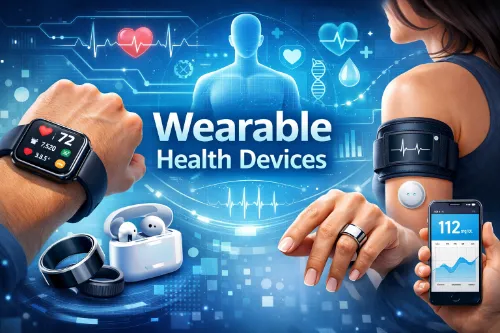
Wearable health devices have evolved from simple step counters into powerful tools that continuously track vital signs, activity, sleep, and even disease‑specific metrics, bridging the gap between daily life and clinical care. They enable earlier detection of health issues, more personalized treatment, and a shift from reactive to proactive healthcare.
What Are Wearable Health Devices?
Wearable health devices are body‑worn sensors and gadgets that collect health‑related data in real time, often syncing with smartphones, apps, or clinical systems. They range from consumer fitness trackers to regulated medical‑grade devices used for diagnosis and remote monitoring.
Examples include:
- Fitness trackers and smartwatches (steps, heart rate, SpO₂, ECG).
- Smart rings and patches for continuous vital‑sign tracking.
- Continuous glucose monitors (CGMs) and blood pressure wearables.
- Sleep wearables such as smart masks and headbands.
Roche’s overview of wearable technologies in healthcare notes that these devices blur the line between consumer tech and medical equipment by enabling continuous, remote health monitoring. Duke’s article on wearables in action describes how they’re becoming “indispensable clinical tools.”
Key Types and What They Monitor
Different categories of wearable health devices address different needs.
- Activity and fitness wearables
Track steps, distance, calories, heart rate, and sleep, helping users build healthier habits and reduce risks like obesity and hypertension. - Cardiovascular and vital‑sign wearables
Smartwatches with ECG and BP, chest straps, and medical patches monitor heart rhythm, heart rate variability, blood pressure, breathing, and temperature. Devices like VitalConnect’s VitalPatch, highlighted by Global IMI, can stream ECG, heart rate, respiration, and temperature to the cloud for remote monitoring. - Chronic disease wearables
CGMs for diabetes, BP patches, and condition‑specific devices (for example, epilepsy wearables or smart inhalers) support daily management and alerts. - Sleep and respiratory wearables
Smart masks and sleep wearables monitor breathing, sleep stages, and disruptions, improving conditions like sleep apnea. - Next‑gen and emerging wearables
Smart rings, smart glasses, adhesive “health dots,” and even smart implants are expanding what’s possible, with AI‑driven algorithms and discreet form factors.
MOKO Smart’s review of health wearable technology trends notes the rapid adoption of ECG and BP features in mainstream wearables. AJProTech’s Top Wearables of 2026 details new formats like smart glasses, health patches, and AI‑driven adaptive algorithms.
How Wearables Improve Health and Healthcare
Wearables add value at both personal and clinical levels.
For individuals
- Better self‑monitoring and behavior change
By tracking heart rate, sleep, and activity, users gain awareness and get nudges to move, rest, or adjust habits, supporting weight loss and cardiovascular health. - Early detection and warnings
Subtle changes in heart rhythm, activity patterns, or sleep can signal issues long before symptoms become obvious, prompting earlier medical review. - More personalized insights
Continuous data helps people understand how stress, food, or exercise affect their health and empowers them to make informed choices.
Appventurez’s guide to medical wearables in healthcare explains how they reduce hospital visits, lower costs, and support preventive care by encouraging healthy habits. A 2022 paper, “Wearing the Future—Wearables to Empower Users to Take Control of Their Health”, finds that wearables can support diagnosis, behavior change, and self‑monitoring.
For clinicians and health systems
- Continuous, real‑world data
Doctors can monitor heart rate, BP, oxygen saturation, temperature, activity, and more between visits, getting a fuller picture than occasional in‑clinic measurements. - Earlier intervention and proactive care
AI and analytics detect deviations from a patient’s baseline, enabling clinicians to adjust medications or schedule check‑ups before crises arise. - Remote patient monitoring and telehealth
Wearables integrate with telemedicine to support care at home, reducing in‑person visits and easing pressure on hospitals.
Duke’s Wearables in Action describes a “Find, Track, Treat” model where continuous data enables early detection and tailored interventions. Roche’s Wearable technologies in healthcare highlights improved patient engagement and cost efficiency through remote monitoring.
Technology Trends: AI, Clinical‑Grade Data, and “Wearables 2.0”
The next generation of wearable health devices is defined by smarter analytics and clinical‑grade capabilities.
Key trends:
- AI‑powered predictive wearables
AI algorithms increasingly analyze wearable data to predict health events (for example, arrhythmias, exacerbations, or migraines) and trigger advanced warnings. - Clinical‑grade sensors and FDA focus
Devices are moving from “wellness” to regulated medical tools, with higher accuracy and clearer pathways for use in diagnosis and treatment. - From data overload to actionable insights
The focus is shifting from raw metrics to clear, actionable recommendations patients can follow.
Sermo’s article on wearable health devices and 2026 trends notes that physicians see AI as key to making wearable data clinically useful. DelveInsight’s Wearables 2.0: Clinical‑Grade Medical Devices describes how more accurate sensors, AI, and IoT are driving adoption of “clinical‑grade” wearables. A 2026 commentary on an FDA wearable devices regulatory shift emphasizes a move toward continuous, clinical‑grade data and proactive care.
Market Growth and the Future of Wearable Health Devices
The wearable health market is expanding rapidly as devices become more capable and accepted in clinical workflows.
- A GlobalData report cited by Medical Device Network estimates the global wearable tech market will grow from about $99.5 billion in 2022 to $290.6 billion by 2030, driven by health and medical applications.
- Physicians increasingly see wearables as critical to shifting care from episodic visits to continuous monitoring, particularly for chronic diseases.
- New form factors (rings, patches, implants) and deeper integration with EHRs and insurer systems will likely make wearables part of routine care and risk management.
Medical Device Network’s article on how wearables’ future in healthcare hinges on actionable insights stresses that success will depend on turning data into meaningful guidance and behavior change. Global IMI’s post on the next big thing in wearables points to epilepsy wearables, smart BP patches, and sleep masks as examples of increasingly targeted medical devices.
Benefits and Challenges
While promising, wearable health devices raise several challenges.
Benefits
- Empower patients with real‑time health data and personalized feedback.
- Support preventive care, earlier detection, and better chronic‑disease management.
- Reduce hospital visits and costs by enabling remote monitoring and timely interventions.
Challenges
- Data privacy and security – sensitive health data must be protected against misuse and breaches.
- Data accuracy and reliability – consumer‑grade devices may not match medical‑grade accuracy, which matters for clinical decisions.
- Equity and access – cost, tech literacy, and connectivity can limit who benefits from wearables.
- Data overload for clinicians – without good filtering and dashboards, continuous data can become overwhelming.
Appventurez and Ominext both highlight these issues in their articles on medical wearables and wearable health monitoring devices. Roche and Duke likewise emphasize the need for strong privacy safeguards and analytics to keep data meaningful and manageable.