

A recent security incident at Vercel, the popular cloud platform for frontend frameworks, has sent a critical alert through the developer community. The Vercel breach has prompted the company to issue a secrets rotation warning, urging all users to immediately rotate their sensitive credentials. This event serves as a stark reminder of the persistent threats in the cloud ecosystem and the paramount importance of proactive security hygiene. Read also: Yahoo Mail Outage Australia: Users Report Login Failures.
Vercel breach Key Takeaways
The recent Vercel breach highlights critical vulnerabilities in cloud platform security and underscores the necessity of immediate credential management.

Understanding the Scope of the Vercel Breach
The Vercel breach was not a direct compromise of Vercel’s core infrastructure but stemmed from a security incident at a third-party analytics provider. According to Vercel’s security advisory, an attacker gained unauthorized access to this external service, which Vercel used for internal analytics. This access potentially allowed the threat actor to view sensitive data, including environment variables and secrets stored within Vercel’s platform for a limited number of accounts.
The breach’s critical nature lies in what environment variables represent: the lifeblood of modern applications. These are configuration values, such as API keys, database connection strings, authentication tokens, and private encryption keys, that applications need to function. If exposed, they provide direct pathways to backend services, external APIs, and sensitive data stores.
How the Breach Unfolded
Vercel’s security team identified anomalous activity related to their analytics pipeline. Upon investigation, they traced the issue back to the compromised third-party service. The timeline suggests the attacker had a window of access where they could have exfiltrated data. While Vercel acted swiftly to contain the incident, the potential exposure necessitated a broad, precautionary response.
Why the Secrets Rotation Warning is Critical
The immediate secrets rotation warning issued by Vercel is a standard and essential response in cloud security incident management. Rotation is the process of invalidating old credentials and generating new ones. The principle is simple: if a secret might be compromised, you must act as if it is compromised.
Failing to rotate secrets after a potential exposure is akin to changing the locks on your house but leaving a hidden key under the mat that an intruder might have seen. The old credentials remain a viable attack vector. For developers and organizations using Vercel, this means any API key, database password, or service token stored as an environment variable could be in the hands of a malicious actor.
The Domino Effect of Exposed Secrets
The risk extends far beyond the Vercel platform itself. An exposed API key for a payment processor like Stripe could lead to fraudulent transactions. A database credential could result in a full data breach. A cloud storage key could allow an attacker to delete or ransom critical assets. This domino effect makes the secrets rotation warning not just a recommendation, but an urgent operational imperative.
Actionable Steps for Rotating Your Secrets
Responding to the Vercel breach requires a methodical approach. Haphazard rotation can break applications. Follow this structured process to secure your deployments.
Step 1: Audit and Inventory All Secrets
Begin by listing every secret stored in your Vercel project environments (Production, Preview, Development). Log into your Vercel dashboard, navigate to each project, and review the “Environment Variables” section. Document every key, its purpose, and the service it connects to (e.g., “DATABASE_URL” for PostgreSQL, “STRIPE_SECRET_KEY” for payments).
Step 2: Generate New Credentials
For each secret, visit the corresponding service’s dashboard or CLI to generate a new key, token, or password. Do not simply modify the old value in Vercel. Create a brand-new credential from the source. This ensures the old one is cryptographically distinct and can be revoked independently.
Step 3: Update in Vercel and Deploy
Replace the old values in your Vercel project’s environment variables with the new ones. For sensitive production secrets, consider updating them directly in the dashboard for immediate effect. After updating, trigger a new deployment to ensure your application picks up the new values. Monitor your application logs closely for any authentication errors. Read also: Technology.
Step 4: Revoke the Old Secrets
This is the most crucial step. Return to each external service (e.g., AWS IAM, GitHub, Stripe, SendGrid) and explicitly revoke or delete the old API keys and tokens. This permanently closes the door that the Vercel breach may have opened.
Best Practices for Cloud Security Post-Vercel Breach
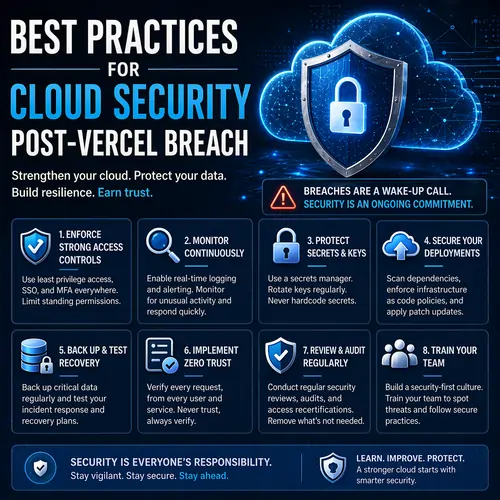
This incident is a teachable moment. Moving beyond reactive rotation, adopt these proactive practices to build a more resilient security posture.
Implement a Regular Rotation Schedule
Don’t wait for a breach. Establish a policy for regularly rotating secrets (e.g., every 90 days for high-value keys). Use tools like HashiCorp Vault, AWS Secrets Manager, or Doppler to automate this process, reducing operational overhead and human error.
Adopt the Principle of Least Privilege
Every secret should have the minimum permissions necessary for the application to function. Avoid using omnipotent root keys. Create service-specific credentials with scoped access. This limits the “blast radius” if a single secret is compromised.
Use Secret Management Solutions
Avoid hardcoding secrets in your codebase or relying solely on platform environment variables. Integrate a dedicated secrets manager that provides encryption, access auditing, dynamic secrets, and automatic rotation. This adds a critical layer of abstraction and control.
Enable Comprehensive Monitoring and Alerting
Set up alerts for unusual access patterns related to your secrets and services. Monitor login attempts, API usage spikes from unfamiliar locations, and unexpected database queries. Early detection can stop an attack in its tracks.
Useful Resources
For further reading on cloud security and secret management, consult these authoritative resources:
- OWASP Top Ten: The definitive list of the most critical web application security risks, including sensitive data exposure.
- Google Cloud Security Command Center: A comprehensive resource for security best practices and threat management in cloud environments.
Frequently Asked Questions About the Vercel Breach
Was my data definitely stolen in the Vercel breach ?
Vercel has stated the breach was a potential exposure via a third-party service. They have not confirmed specific data exfiltration but are treating it as a credible threat, hence the mandatory secrets rotation warning. The prudent action is to assume your secrets were exposed and rotate them immediately.
What exactly are “secrets” in this context?
Secrets are sensitive pieces of data used for authentication and configuration, such as API keys, database passwords, OAuth tokens, encryption keys, and SSH private keys. They are called “secrets” because they must remain confidential to ensure security.
I only use Vercel for hobby projects. Do I still need to rotate secrets?
Yes. A compromised hobby project API key can still be used maliciously, potentially leading to charges on your account (e.g., from a cloud provider or SaaS tool) or being used as a foothold for further attacks. All projects, regardless of scale, should follow the rotation warning.
How do I rotate a database password without causing downtime?
The safest method is to create a new database user with the same permissions, generate a new password for that user, update your environment variable in Vercel, deploy, verify the application works, and then delete the old database user. This ensures continuity.
What’s the difference between changing and rotating a secret?
Changing a secret simply updates its value. Rotating a secret involves creating a new credential at the source service, updating the application, and then explicitly revoking the old credential. Rotation is the complete and secure process.
Can I automate secret rotation?
Yes, using secret management tools like HashiCorp Vault, AWS Secrets Manager, or Azure Key Vault. These services can automatically generate new secrets, update them in linked applications, and revoke old ones on a scheduled basis, greatly improving security hygiene.
How often should I rotate secrets under normal circumstances?
Best practice varies by sensitivity. High-privilege secrets (like root API keys) should be rotated every 30-90 days. Application-level secrets can be rotated every 6-12 months. Any suspicion of compromise demands immediate rotation.
What are the signs that my secrets were used after the breach?
Monitor for unexpected activity: spikes in API usage or costs, logins from unfamiliar IP addresses or locations, unexplained data exports, failed authentication attempts, or alerts from your integrated services (like Stripe or SendGrid) about unusual behavior.
Should I switch from Vercel because of this breach?
Not necessarily. All major cloud platforms have experienced security incidents. Vercel’s transparent disclosure and clear guidance are positive signs. The key takeaway is to evaluate and improve your own security practices, such as using external secret managers, regardless of your platform.
Are environment variables on Vercel encrypted?
Vercel states that environment variables are encrypted at rest. However, when a build runs, they are injected into the runtime environment as plaintext, which is why a breach of the platform’s internal systems could expose them.
What other platforms were affected by this third-party breach?
Vercel’s advisory focuses on their own platform. The third-party analytics service involved likely served other companies as well. It’s a reminder of supply chain risk; you should inquire with other SaaS providers you use about their exposure to this specific vendor.
Is two-factor authentication (2FA) on my Vercel account enough protection?
2FA protects your account login, which is vital. However, the Vercel breach involved a potential leak of the stored secret data itself, not account access. 2FA would not have prevented this type of exposure, highlighting the need for defense-in-depth.
What should I do if I use Vercel with a serverless function that has secrets?
The process is the same. Audit all environment variables used by your serverless functions, rotate the source secrets, update the values in your Vercel project settings, and redeploy your functions to ensure they use the new credentials.
Can I use a .env file locally instead of Vercel’s dashboard?
You can use a .env file for local development, but for production, secrets should be managed through the Vercel dashboard, CLI, or, better yet, a dedicated secrets manager. Never commit your .env file to version control.
Who is responsible if my secrets are used fraudulently after this breach?
Liability can be complex and depends on terms of service, negligence, and jurisdiction. Following Vercel’s official secrets rotation warning is critical to demonstrate due diligence on your part, which is important for any legal or financial discussions that might follow an incident.
What are “dynamic secrets” and how do they help?
Dynamic secrets are credentials generated on-demand (e.g., for each deployment or transaction) with a very short lifespan (minutes/hours). Tools like Vault can provide these, drastically reducing the risk window compared to long-lived static secrets, making them a superior security model.
Does this breach affect Vercel’s core hosting or CDN infrastructure?
Vercel has indicated the breach was limited to data potentially exposed via the third-party analytics service. Their core application hosting, global CDN, and deployment pipelines were not directly compromised. The primary risk is the exposure of stored configuration data.
How can I get notified of future Vercel security incidents?
Follow Vercel’s official security page and blog. Ensure your account email is up-to-date, as they will send critical notifications there. Consider monitoring industry security news feeds as well.
What is the biggest mistake teams make after a breach warning?
The most common mistake is partial rotation—updating the value in the platform but failing to revoke the old credential at its source. This leaves the old key active and usable by an attacker, completely negating the purpose of the rotation.
Where can I learn more about general cloud security principles?
Start with frameworks like the Cloud Security Alliance (CSA) guidelines and the NIST Cybersecurity Framework. These provide structured approaches to managing risk in cloud environments beyond any single incident.
The Vercel breach and its accompanying secrets rotation warning represent far more than an isolated security incident—they serve as a critical wake-up call for every developer, startup, and enterprise operating in the cloud. As cloud infrastructure becomes the backbone of modern applications, even a single exposed credential can create a ripple effect across systems, APIs, and user data. In this interconnected environment, cloud security is no longer optional; it is a continuous, evolving responsibility that demands vigilance, automation, and strategic foresight.
This incident highlights a fundamental truth: your cloud environment is only as secure as your weakest secret. API keys, environment variables, and access tokens must be treated as high-risk assets, not afterthoughts. By using this moment to conduct a full audit of your cloud credentials, enforce regular secret rotation, and implement least-privilege access controls, organizations can significantly reduce their exposure to future breaches. Adopting best practices such as automated key rotation, secure vault storage, and real-time monitoring transforms reactive damage control into proactive cloud security resilience.
More importantly, this event underscores the need to embed security into every layer of cloud development—from CI/CD pipelines to production environments. Teams that prioritize secure coding, integrate DevSecOps practices, and continuously test their defenses will be far better positioned to handle emerging threats. Rather than viewing this breach as a setback, it should be seen as an opportunity to strengthen your entire cloud architecture and build a culture of security-first thinking.
As the digital landscape continues to evolve, staying informed about both outages and emerging threats is essential. You can explore related developments such as Yahoo Mail Outage Australia: Users Report Login Failures, discover the latest innovations in iPhone 18 Pro Max Colors Revealed: Dark Cherry Leads 2026 Lineup, understand rising risks through Cyber Threats in Australia: Are You Ready for What’s Next?, and dive into privacy concerns with Google Photos AI Scanning: What It Means for Your Privacy.
Ultimately, the lesson is clear: in the age of the cloud, security is not a one-time setup but an ongoing discipline. The organizations that succeed will be those that move beyond hoping their systems are secure and instead commit to actively engineering, testing, and reinforcing their cloud defenses at every stage.