

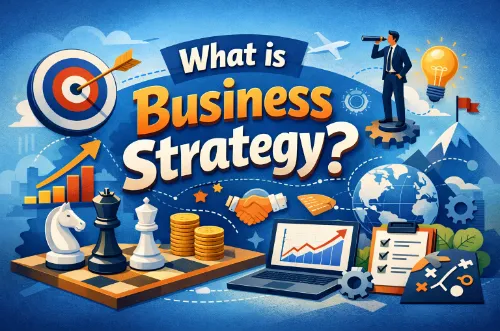
Business strategy is the long‑term plan that explains how a company will achieve its goals and stay competitive in its market. It guides big decisions about where to play, how to win, and how to allocate limited resources so the business can grow and create value for its stakeholders.
Harvard Business School Online describes business strategy as the coordinated set of actions a company uses to create value and gain a competitive advantage, which they break down in What Is Business Strategy & Why Is It Important? – HBS Online.
A Simple Definition of Business Strategy
In simple terms, a business strategy is a master plan that outlines:
- Where your business is going (vision and long‑term goals).
- How you will compete and stand out from rivals.
- Which customers you will serve and what value you will deliver.
- How you will use your people, money, and assets to get there.
The Strategy Institute calls business strategy a “course of action or set of decisions” designed to achieve specific business objectives and maintain competitive advantage, as detailed in What is Business Strategy? Definition, Importance, Levels & Examples – The Strategy Institute. IMD similarly frames it as an “organizational master plan” in What is a Business Strategy and How to Develop One – IMD.
Why Business Strategy Matters
A clear business strategy matters because it:
- Aligns everyone in the organization around the same goals.
- Helps leaders prioritize what to do—and what not to do.
- Guides decisions about where to invest time, money, and people.
- Increases the odds of long‑term, sustainable success.
Business Strategy: Definition and Importance for Success – Spider Strategies explains how strategy creates a roadmap for long‑term goals and links them to resource allocation and performance. HBS Online also emphasizes the role of strategy in navigating competition and market changes in What Is Business Strategy & Why Is It Important?.
Key Components of a Business Strategy
Most effective business strategies include a few core components.
1. Vision, Mission, and Values
- Vision: Where you want the company to be in the future.
- Mission: Why your company exists and what it does today.
- Values: The principles that guide behavior and decisions.
What is a Business Strategy and How to Develop One – IMD highlights defining your vision as the first step in creating any strategy because it shapes markets, offerings, and priorities. Business Strategy Definition, Examples, Types & 10‑Step Guide – Digital Leadership shows how vision, mission, and values sit at the top of the strategy hierarchy.
2. Understanding Your Market and Competition
You need to know:
- Who your target customers are.
- What problems you solve for them.
- Who your competitors are and how they compete.
- Where the market is heading (trends, threats, opportunities).
The Strategy Institute and HBS both stress thorough market and competitor analysis as essential inputs for any sound strategy.
3. Clear Goals and Strategic Objectives
You can’t have a strategy without clear goals.
- Long‑term goals (revenue, profit, impact, market share).
- Strategic objectives for the next 1–3 years.
- KPIs and metrics to track progress.
10 Steps to Building Business Strategies & Executing Them with Precision – Vistage breaks this into a practical 10‑step process for leaders.
4. Competitive Advantage and Value Proposition
Your strategy should clarify how you will win.
- What makes you different from competitors?
- Why should customers choose you?
- Are you competing on cost, differentiation, niche focus, or something else?
Business Strategy Definition, Examples, Types & 10‑Step Guide – Digital Leadership explains common strategic positions like cost leadership, differentiation, and focus, with examples.
5. Resource Allocation and Capabilities
Strategy is not just ideas—it’s how you deploy your limited resources.
- Where you invest money (products, marketing, tech, talent).
- Which capabilities you build and which you outsource.
- How you design processes and systems to support the strategy.
Spider Strategies shows how linking strategic goals to budgets, projects, and KPIs turns strategy into execution.
Business Strategy vs. Tactics
Many people confuse strategy with tactics, but they are not the same.
- Strategy: The big‑picture plan and direction (the “why” and “what”).
- Tactics: The specific actions and methods you use to carry out the strategy (the “how”).
Strategy vs. Tactics: What’s the Difference? – Asana explains that strategy is your overarching action plan for your goals, while tactics are the concrete steps your team takes day‑to‑day. ClearPoint and Spider Strategies give similar explanations and examples in their strategy vs tactics content.
Levels of Business Strategy
Strategy operates at different levels inside an organization.
- Corporate‑level strategy: Which businesses or markets the company will participate in.
- Business‑level strategy: How each unit competes in its specific market.
- Functional‑level strategy: How departments (marketing, operations, HR, finance) support higher‑level strategy.
The Strategy Institute article on what business strategy is and its levels and IMD’s explanation both break out these levels with examples.
How to Create a Business Strategy (Step by Step)
While every company is different, most strategy processes follow similar steps.
Typical steps:
- Define your vision, mission, and core values.
- Analyze your current situation (internal strengths/weaknesses and external opportunities/threats).
- Understand your market and competitors.
- Set clear strategic goals and priorities.
- Decide on your competitive position and value proposition.
- Build an action plan and assign responsibilities.
- Track progress with KPIs and adjust as needed.
Vistage’s 10 Steps to Building Business Strategies & Executing Them with Precision offers a practical checklist you can adapt to small or mid‑sized businesses. For a more comprehensive perspective on types of strategies and examples, see Business Strategy Definition, Examples, Types & 10‑Step Guide – Digital Leadership.
If you’re completely new to this topic, Beginner’s Guide To Strategy – Lucidity explains core concepts, tools, and traits in simple language.
Examples of Business Strategy in Action
Common strategic approaches include:
- Cost leadership: becoming the lowest‑cost producer in your market.
- Differentiation: offering unique products or experiences that customers are willing to pay more for.
- Focus or niche strategy: serving a specific segment extremely well.
HBS Online provides well‑known company examples of these strategies in What Is Business Strategy & Why Is It Important?. Digital Leadership and the Strategy Institute also showcase real‑world cases across industries to illustrate how these strategies look in practice.