

In 2026, Australia is entering a new era for Credit Card Surcharges, with the RBA set to ban surcharges on most EFTPOS, Mastercard, and Visa payments while tightening rules on what remains. This shift aims to simplify pricing, reduce excessive fees, and drive lower costs and greater transparency across the payments system.
However, it also means businesses must rethink pricing strategies and card acceptance, while cardholders may see changes to rewards programs and fees as banks adjust to lower interchange revenue. Understanding how Credit Card Surcharges work today—and how they are being phased out—is essential for households and business owners across Australia.
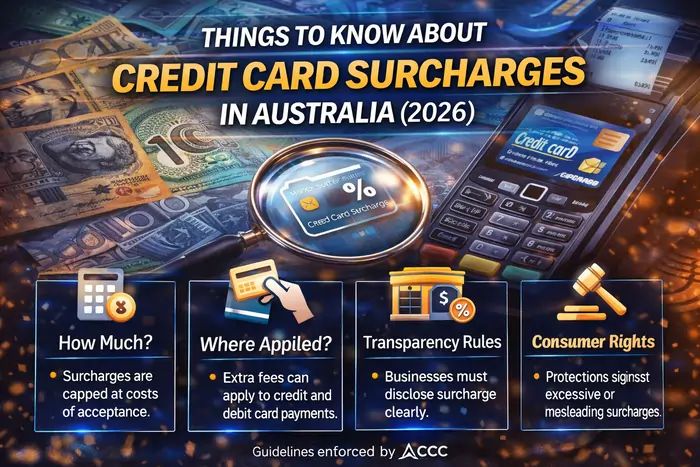
If you pay by card in Australia, you’ve almost certainly seen that annoying extra fee tacked onto your bill at cafes, airlines, and online checkouts. Those fees are called Credit Card Surcharges, and in 2026 the rules around them are changing faster than many people realise. With the Reserve Bank of Australia (RBA) moving to phase out most card surcharges and regulators cracking down on “excessive” fees, both consumers and businesses need to understand what’s coming next.
Below are seven key things to know about Credit Card Surcharges in Australia in 2026—what they are, when they’re legal, what’s being banned, and how this will affect your wallet or your business.
1. What Are Credit Card Surcharges and Why Do They Exist?
At the simplest level, Credit Card Surcharges are extra fees merchants add when you pay with a card instead of cash or bank transfer. They’re supposed to recover the cost the business pays to accept that card—things like merchant service fees, terminal fees attributable to card transactions, and scheme fees charged by Visa, Mastercard, or other networks.
The RBA and the Australian Competition and Consumer Commission (ACCC) have long allowed businesses to impose Credit Card Surcharges, but only on a “cost‑based” basis: the surcharge should not exceed the merchant’s average cost of acceptance for that card type. In other words, if it costs a café 1 per cent to accept Visa credit, a 1 per cent surcharge is allowed—2 or 3 per cent is not.
Economically, regulators argue that surcharging can send useful price signals. If card payments are more expensive than, say, EFTPOS or bank transfers, a visible surcharge can encourage consumers to choose cheaper methods, putting pressure on card schemes to keep costs in check. The problem arises when Credit Card Surcharges are inflated well beyond cost, turning into a profit centre rather than cost recovery.
For a good plain‑English overview of how surcharging fits into the payments system, the RBA’s explainer on payment surcharges in Australia is worth a read.
2. Current Rules: Cost‑Based Surcharges and the ‘Excessive’ Ban
As of early–mid 2026, the core legal framework is still the RBA’s surcharging standard, enforced by the ACCC under the Competition and Consumer Act 2010. Under this framework:
- Merchants can impose Credit Card Surcharges on many card payments.
- The surcharge must not exceed the merchant’s average cost of acceptance for that card type, based on data from the past 12 months.
- Surcharges above that cost are “excessive” and illegal; the ACCC can take enforcement action, including penalties.
This cost‑of‑acceptance concept is central. The RBA explains that the merchant’s cost may include:
- Merchant service fees paid to their bank or payment provider.
- Scheme and switch fees attributable to that card system.
- Certain terminal costs directly related to card acceptance.
What it can’t include are general overheads or unrelated costs. If a business inflates its Credit Card Surcharges to cover rent, wages, or marketing, that’s outside the rules. The ACCC has repeatedly reminded businesses that “excessive surcharging is illegal” and that they must be able to show how their surcharge was calculated.
For consumers wanting the official view, the ACCC’s page on Card surcharges sets out what’s allowed, what counts as excessive, and how to report concerns.
3. The Big Shift: RBA Moving to Ban Most Card Surcharges by Late 2026
The biggest development you need to know about in 2026 is that the RBA has decided to ban surcharges on most everyday card payments. Following a major review of card payments regulation, the central bank announced that from around 1 October 2026, merchants will no longer be allowed to impose surcharges on EFTPOS, Mastercard, or Visa consumer transactions.
Articles such as RBA Bans Card Surcharges, Lowers Interchange Fees summarise the change this way:
- Ban on debit and Credit Card Surcharges for EFTPOS, Mastercard, and Visa payments.
- Lower interchange fee caps to reduce the underlying cost of card acceptance for businesses.
- Greater transparency requirements for card networks around fees.
Merchant‑facing commentary, like Tyro’s guide on the RBA surcharge ban, estimates that the removal of surcharges will affect over a billion dollars in annual fees currently paid by Australian consumers. In exchange, merchants should benefit from lower wholesale costs through reduced interchange caps.
Not every payment type is covered. Early RBA proposals and media reports suggest:
- EFTPOS, Mastercard and Visa consumer card surcharges will be banned.
- Other networks (such as standalone American Express or certain commercial cards) may still be surcharged, at least initially.
The precise implementation details are still evolving, so it’s worth monitoring official RBA statements and industry updates as October 2026 approaches.
4. What This Means for Consumers: Short‑Term Wins, Long‑Term Trade‑Offs
For consumers, the immediate impact of the ban on most Credit Card Surcharges will feel like a win. Once the rules take effect, you should no longer see an extra 1–2 per cent tacked on when you tap your Visa or Mastercard at most Australian merchants. Airlines, hotels, online retailers, and small businesses will have to show all‑inclusive prices for those card types rather than adding surcharges at checkout.
However, the RBA and banking industry have been clear that there will be trade‑offs. Because surcharges currently help offset the cost of reward programs and card benefits, banning most Credit Card Surcharges will reduce revenue streams that help fund those perks. Banks have signalled they may respond to lower interchange and no‑surcharge rules by:
- Reducing the generosity of reward programs (fewer points per dollar, more points needed for redemptions).
- Increasing annual card fees or tightening eligibility for premium cards.
- Adjusting interest rates or promotional offers to maintain profitability.
The RBA’s own consultation materials recognise that reward points are likely to be scaled back, but argue that lower fees at the point of sale and more efficient payments overall will outweigh this inconvenience for most consumers. Articles like the Australian Frequent Flyer explainer on RBA changes in 2026 provide a good breakdown of these dynamics from a consumer perspective.
In short, you may save a few dollars each time you avoid a surcharge, but you may also see your favourite rewards card become less lucrative over time.
5. What This Means for Businesses: Pricing, Compliance and Strategy
For merchants, the shift away from Credit Card Surcharges is both a regulatory challenge and a strategic opportunity. In the lead‑up to 2026, the ACCC has made enforcement of surcharging rules one of its priorities, particularly for small businesses that may lack sophisticated systems but still must comply.
Legal and advisory firms are warning that businesses must:
- Ensure any current Credit Card Surcharges match their cost of acceptance and can be justified with documentation.
- Review how prices are displayed across websites, menus, invoices, and receipts to avoid misleading representations.
- Prepare for the RBA ban by updating POS programming, online checkout flows, and pricing models.
Resources like Baybridge’s guide on card surcharges compliance and the Australian Banking Association’s summary of surcharging rules and upcoming removal walk through what merchants need to do to avoid enforcement action. The ABA notes that under current rules, surcharges:
- Must not exceed the actual processing cost for that payment type.
- Can only include direct costs (scheme fees, merchant service fees), not general business expenses.
- Must be defendable with evidence if regulators ask.
As Credit Card Surcharges are phased out on major networks, businesses will need to decide whether to:
- Absorb the card costs into their overall margins.
- Increase base prices slightly for all customers, regardless of payment method.
- Offer small discounts for cheaper options (like cash or bank transfer) instead of surcharges.
Payment providers like Tyro suggest merchants use this transition to audit their payment mix, negotiate better merchant rates where possible, and communicate clearly with customers about any changes in pricing or payment options.
6. How to Spot and Challenge Excessive Surcharges in 2026
Even with the upcoming ban, there will still be contexts in 2026 where Credit Card Surcharges can be applied—particularly on certain card types not covered by the new rules, or during the transition period before October. As a consumer, it’s useful to know how to identify when a surcharge might be excessive and what you can do about it.
The ACCC advises that an excessive surcharge is one that exceeds the merchant’s cost of acceptance for that card type. Practical red flags include:
- Flat, high dollar surcharges that seem disproportionate to the transaction size (e.g., a $7 surcharge on a $50 payment).
- Percentage surcharges significantly above typical merchant service fees (e.g., 3–4 per cent on common Visa/Mastercard consumer cards).
- Surcharges applied in a way that was not clearly disclosed before you committed to the purchase.
If you suspect a business is charging excessive Credit Card Surcharges, you can:
- Ask the merchant how they calculated the fee and whether it reflects their cost of acceptance.
- Keep your receipt or screenshot of the surcharge.
- Report the business to the ACCC, which uses such complaints to inform education, compliance, and enforcement work.
Where appropriate, the ACCC can investigate and may take enforcement action against businesses in breach of the excessive surcharging ban, including penalties. Their formal guidance explains the process and your rights as a consumer.
7. Future Trends: Life After Credit Card Surcharges
Looking beyond 2026, the phase‑out of most Credit Card Surcharges is part of a broader shift in Australia’s payments landscape. The RBA and policymakers are aiming for a simpler, more transparent environment where:
- Prices shown to consumers already include the cost of using common card types.
- Payment systems become more efficient, with lower merchant costs and fewer distortions.
- Regulators focus more on hidden fees and misleading pricing structures, not just surcharges.
At the same time, innovation is accelerating in areas like real‑time bank transfers (PayTo and NPP‑based services), digital wallets, and account‑to‑account payments, which may provide lower‑cost alternatives to traditional card schemes. As merchants lose the ability to impose Credit Card Surcharges on most customers, they may become more enthusiastic about promoting these cheaper rails and offering discounts or loyalty incentives for them instead.
For consumers, the practical takeaway is that you will likely see fewer annoying surcharge pop‑ups—but you should also pay attention to the overall value proposition of your payment methods. Rewards cards might become less generous, and new low‑fee payment options might become more attractive for everyday spending.
If you want a deeper policy and economic perspective, the RBA’s Bulletin article Payment Surcharges: Economics, Regulation and Enforcement provides an excellent background on why surcharges were permitted in the first place, how the rules operate, and how enforcement has evolved.
Conclusion
As Australia moves toward banning most Credit Card Surcharges, consumers will see fewer surprise fees at the checkout, while businesses will need to rethink how they price and recover payment costs in a more transparent way. The reforms sit alongside broader cost pressures across the economy, from wages and compliance to energy and materials, all of which shape what Australians ultimately pay for goods and services.
To understand how these forces play out in other sectors, it helps to look at industries facing similar structural challenges; for example, 7 Key Reasons Australia’s Building Costs Are Soaring Right Now shows how supply constraints, labour shortages, and regulatory change can all combine to push prices higher.
FAQs About Credit Card Surcharges in Australia (2026)
What exactly are Credit Card Surcharges?
They are extra fees merchants charge customers for paying with a card instead of cash, designed to recover payment processing costs.
Are Credit Card Surcharges legal in Australia in 2026?
Yes, but under strict rules—they must not exceed the cost of acceptance and must comply with RBA standards and ACCC enforcement.
What counts as an ‘excessive’ Credit Card Surcharge?
A surcharge is excessive if it is higher than the actual cost for the business to process that card payment.
Who enforces the rules on Credit Card Surcharges?
The ACCC enforces the rules under the Competition and Consumer Act, using the RBA standard as a benchmark.
What changes is the RBA making in 2026?
The RBA plans to ban surcharges on EFTPOS, Mastercard, and Visa, while reducing interchange fees to lower merchant costs.
Will all Credit Card Surcharges disappear in 2026?
Most consumer card surcharges will be phased out, but some non-standard cards (like certain Amex or commercial cards) may still apply fees.
How will the ban affect my rewards credit card?
Banks may reduce rewards, lower points earn rates, or adjust fees due to reduced interchange revenue.
What should small businesses do now?
They should ensure surcharges are cost-based, properly disclosed, and prepare to remove surcharges before the 2026 deadline.
How can I tell if a surcharge is reasonable?
Check if it aligns with typical processing costs (around 1–2%) and whether it was clearly disclosed before payment.
What can I do if a surcharge seems excessive?
Ask for a breakdown of the fee, keep proof (receipts/screenshots), and report it to the ACCC.
Will businesses raise prices instead?
Some may adjust base prices, but lower fees and competition should help keep increases limited.
Are there ways to avoid these fees?
Yes—use fee-free options like debit cards, PayID, bank transfers, or real-time payments where available.
Do the rules apply to online purchases?
Yes, the rules apply to both online and in-store transactions across Australian merchants.
Where can I read the official rules?
Refer to the RBA guidelines and the ACCC Card Surcharges page for official details.
How does this connect to broader economic changes?
It reflects a shift toward greater transparency and efficiency, similar to changes seen in renewable energy and other regulated sectors.