

Risk-taking in entrepreneurship in 2026 is not about being the boldest person in the room; it’s about designing exposure so the upside dwarfs the downside while you stay alive long enough to learn.
What Is Risk-Taking in Entrepreneurship?
Risk-taking in entrepreneurship means making decisions under uncertainty where outcomes are not guaranteed — but where potential upside justifies structured exposure. Economists have long framed entrepreneurship as uncertainty-bearing behavior; Frank Knight’s classic Risk, Uncertainty and Profit drew a foundational line between measurable risk and true uncertainty, a distinction later summarized as Knightian uncertainty.
Modern founder education platforms like Y Combinator’s Startup Library and Startup School emphasize that startups operate in environments where outcomes are unknown but experimentation — tests, MVPs, and iterations — gradually reduces uncertainty over time.
Entrepreneurship is uncertainty management.
Markets change.
Technology evolves.
Customer behavior shifts.
Regulation impacts industries.
Risk is not optional.
It is embedded.
The real question is:
Are you managing it — or ignoring it?
The Types of Risk Every Entrepreneur Faces
Understanding risk categories improves startup risk assessment and decision quality.
1️⃣ Financial Risk
This includes:
- Personal savings invested
- Debt obligations
- Burn rate miscalculations
- Cash flow volatility
- Investor dilution
Financial discipline matters. Analyses of startup failures referencing CB Insights’ data repeatedly show that “ran out of cash” or failed to raise new capital sits near the top of failure reasons, often tied to deeper issues in financial management and runway planning.
Smart founders align runway with risk horizon.
A founder with 6 months of runway taking 12-month bets?
That’s miscalculated risk.
2️⃣ Market Risk
Does demand exist?
Eric Ries’ Lean Startup methodology, as summarized in modern overviews like this synopsis of The Lean Startup and its Build–Measure–Learn loop, popularized validated learning — testing assumptions before scaling production.
Market risk includes:
- Product–market fit uncertainty
- Customer willingness to pay
- Market size overestimation
- Adoption curve misreading
A beautiful product in a weak market still fails.
3️⃣ Product & Technology Risk
Especially relevant in:
- SaaS startups
- AI startups
- Deep tech ventures
- Fintech platforms
Paul Graham repeatedly emphasizes in essays published through Y Combinator’s Startup Library that founders must understand the problem deeply before overbuilding technical solutions or chasing novelty.
Technology risk includes:
- Scalability limitations
- Security vulnerabilities
- Architecture mistakes
- Over-engineering
Architecture decisions in month one affect years three through five.
4️⃣ Execution Risk
Even with strong demand:
- Can you build it?
- Can you market it?
- Can you hire correctly?
- Can you scale operations?
Harvard Business Review’s entrepreneurship work consistently highlights execution capability and founder alignment as stronger predictors of survival than raw idea originality, echoing case studies that show teams with average ideas and strong execution outlasting “genius” concepts with poor follow-through.
Ideas are cheap.
Execution compounds.
5️⃣ Reputation & Brand Risk
In the digital era:
- Negative reviews spread instantly
- Regulatory issues escalate quickly
- Platform bans damage visibility
Research into digital trust — including frameworks like PwC’s Digital Trust and cyber risk insights — shows that trust significantly influences purchase behavior and retention, especially in regulated or sensitive categories.
Reputation risk now moves at algorithm speed.
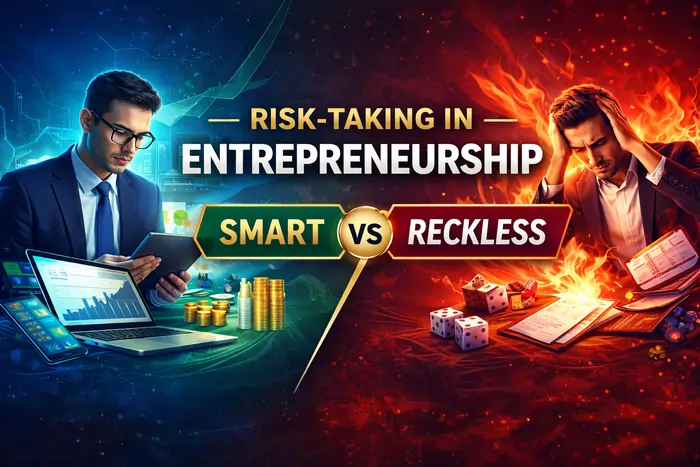
Calculated Risk vs Reckless Risk
This distinction separates sustainable founders from burnout stories.
Reckless Risk Looks Like:
- No customer validation
- No financial modeling
- Emotional decision-making
- Over-leveraging personal finances
Calculated Risk Looks Like:
- Hypothesis testing
- Measured exposure
- Downside modeling
- Scenario planning
Steve Blank’s customer development framework, outlined at SteveBlank.com and in his writing on startups as “temporary organizations in search of a repeatable, scalable business model,” reinforces that startups are experiments, not miniature big companies. Experiments reduce risk; assumptions amplify it.
Strategic risk-taking is structured uncertainty.
Asymmetric Risk: The Smart Founder Model
The most successful entrepreneurs look for asymmetric risk opportunities.
Asymmetric risk means:
Limited downside
Large upside
Examples:
- Pre-selling before building
- Running paid ads to test conversion
- Building landing pages before product
- Using no-code tools for MVP
This mirrors venture capital logic. Analyses of VC performance, including discussions of the “power law” in startup returns such as this explanation of power-law dynamics in VC portfolios, show that a small number of wins drive most of the returns while the majority of bets fail or return little.
Founders should think similarly:
Small, contained experiments.
Large potential upside.
How Investors Evaluate Founder Risk-Taking
Investors don’t reward recklessness.
They reward structured risk.
When evaluating startups, investors look at:
- Founder conviction
- Risk awareness
- Burn rate discipline
- Scenario planning
- Market defensibility
Post-mortems and analyses based on CB Insights’ failure data frequently list “no market need” and “ran out of cash” as top causes — not “too bold,” underscoring that poor risk management, not lack of courage, is usually what kills companies.
Structured thinking beats bravado.
Decision-Making Under Uncertainty
Entrepreneurship is constant decision-making under incomplete information.
Strong founders use:
- Expected value thinking
- First-principles reasoning
- Pre-mortem analysis
Psychologist Gary Klein’s pre-mortem method — widely cited in decision science and summarized in guides like this explanation of how to run a premortem — asks teams to imagine that a project has already failed and then work backward to identify plausible causes, increasing their ability to foresee and mitigate risks.
Ask:
Is this decision reversible?
If yes → move fast.
If no → slow down.
Jeff Bezos’ “Type 1 vs Type 2 decisions” framework in Amazon shareholder letters makes the same distinction: irreversible, high-impact decisions require more caution; reversible decisions can be made quickly and adjusted. That logic maps cleanly onto startup risk management in 2026.
Founder Alignment & Risk
Co-founder misalignment is one of the largest hidden risks in startups.
Noam Wasserman’s research in The Founder’s Dilemmas, summarized in resources like this overview of The Founder’s Dilemmas, shows that team conflict and misaligned expectations destroy more startups than market competition or product issues.
Different founders may have:
- Different risk appetites
- Different timelines
- Different financial tolerance
Risk alignment must be discussed early.
Risk Management Framework for Entrepreneurs
Here’s a practical structure.
Step 1: Identify Risk Category
Financial
Market
Technology
Execution
Reputation
Step 2: Quantify Exposure
How much capital?
How much time?
How much reputation?
Step 3: Model Worst Case
Can the company survive?
Step 4: Evaluate Asymmetry
Is upside multiple times larger than downside?
Step 5: Define Exit Trigger
What metric signals pivot or shutdown?
This mirrors lean experimentation frameworks taught across modern accelerators and MVP playbooks, including approaches like this Lean MVP playbook that frame each build as an experiment to test your riskiest assumption, not a smaller version of your full vision.
Startup Risk Assessment in 2026
Modern startup risk includes:
- Platform dependency
- AI infrastructure reliance
- Cloud cost volatility
- Regulatory shifts
AI founders face additional exposure related to data governance and model risk — themes discussed in industry analysis like this piece on why AI adoption is outpacing governance and raising risk, which highlights gaps in controls, policy, and oversight as AI tools proliferate.
Platform risk is especially relevant for:
- Creator businesses
- Ecommerce brands
- Marketplace startups
Owned assets reduce risk.
Email > social followers.
Infrastructure > rented platforms.
The Myth of “No Risk, No Reward”
This phrase is incomplete.
It should read:
No calculated risk, no meaningful reward.
High risk alone does not guarantee high return.
It guarantees volatility.
Strategic risk-taking combines:
- Timing
- Preparation
- Validation
- Capital efficiency
Final Takeaway
Risk-taking in entrepreneurship in 2026 is:
Strategic
Quantified
Modeled
Aligned
Disciplined
Not emotional.
Not impulsive.
Not blind.
The founders who win are not the boldest.
They are the most calculated.
And calculated risk compounds.
That’s the RealCEOStories perspective.