

Australian Dollar Key Takeaways
The Australian Dollar sits near a potential AUD/USD breakout as traders weigh upcoming inflation data and the next Federal Reserve decision.

What Readers Should Know About the Australian Dollar Right Now
The Australian Dollar has spent recent weeks trading in a tight range against the US Dollar, with AUD/USD repeatedly testing but failing to sustain moves above key resistance. This consolidation reflects a market waiting for clarity on both Australian inflation trends and the future path of US interest rates.
From a broader Australian Dollar outlook perspective, three forces are colliding: sticky or easing inflation at home, a Federal Reserve that may be closer to its peak rate, and shifting risk appetite tied to Chinese demand and global growth. Until those pieces align, AUD/USD is likely to stay coiled for a potential breakout. For a related guide, see Australian Fuel Excise Cut Explained: Winners, Losers, and Impact.
Recent Performance and Current Australian Dollar Outlook
In the last quarter, the Australian Dollar has underperformed during periods of stronger US data, as rising US yields supported the USD and weighed on high-beta currencies. At the same time, AUD has found support whenever markets price in a less aggressive Fed or when Chinese stimulus headlines improve risk sentiment.
For many traders, the current AUD USD forecast is effectively a tug-of-war between “higher-for-longer” US rates and an RBA that is reluctant to over-tighten into a softening domestic economy. That standoff has kept AUD/USD locked in a broad range.
Key market themes shaping the Australian Dollar
Several recurring themes underpin this phase for AUD:
- US exceptionalism pushing the US Dollar higher on strong data.
- Uncertainty about how quickly Australian inflation can return to target.
- Commodity price volatility, especially in iron ore and energy markets.
- Day-to-day moves in risk sentiment, which tend to amplify AUD swings.
These moving parts set the stage for upcoming catalysts to trigger a decisive AUD USD breakout analysis.
How Inflation Data and the Fed Decision May Impact the Australian Dollar
Two near-term catalysts stand out: the next Australian inflation print and the upcoming Federal Reserve policy meeting. Together, they will shape both the impact of inflation data on Australian Dollar sentiment and how global investors recalibrate their US rate expectations.
The impact of inflation data on Australian Dollar moves
Inflation has been the primary driver of central bank policy shifts over the past two years, and the RBA is no exception. A hotter-than-expected CPI reading could revive talk of additional RBA hikes or a longer period of restrictive policy, typically supporting AUD by widening rate differentials.
Conversely, a softer print would support the idea that the RBA’s tightening cycle is at or near its peak, possibly undermining the Australian Dollar outlook if the Fed remains hawkish. The surprise element versus consensus forecasts often matters more than the absolute number.
How Fed decision affects Australian Dollar dynamics
The how Fed decision affects Australian Dollar theme will likely dominate FX markets around the meeting. A more hawkish-than-expected stance—such as signaling fewer rate cuts, or hinting at possible further tightening—could strengthen the US Dollar and pressure AUD/USD lower.
If, however, the Fed acknowledges slowing growth, moderating inflation, or opens the door to earlier rate cuts, AUD could benefit from a weaker USD backdrop. Markets will scrutinize the statement, the dot plot, and the tone of the press conference.
Nine key Fed-related risks traders should watch
For AUD/USD, the Fed risk is not just about a single rate decision. It’s a cluster of potential surprises that could jolt the pair in either direction:
| Fed Risk | Market Shock | Likely AUD/USD Impact |
|---|---|---|
| 1. Hawkish dot plot | Fewer cuts or higher terminal rate | USD stronger, AUD/USD downside pressure |
| 2. Dovish dot plot | More cuts signaled | USD weaker, AUD/USD upside potential |
| 3. Surprise rate hike | Risk-off shock | Sharp AUD/USD drop |
| 4. Hint of future hikes | Higher-for-longer narrative | Gradual AUD underperformance |
| 5. Aggressive recession warnings | Growth fears spike | Risk-off, typically AUD-negative |
| 6. Strong focus on financial stability | Concern about market stress | Volatility; initial AUD downside |
| 7. Downplaying inflation risks | Dovish read by markets | Supportive for AUD vs USD |
| 8. Upgrading inflation risks | Hawkish read by markets | Headwind for AUD/USD |
| 9. Mixed/confusing communication | Volatility spike, position shake-out | Choppy price action both ways |
Understanding these distinct scenarios can make your AUD USD technical and fundamental analysis far more robust around Fed events.
AUD USD Technical and Fundamental Analysis: Is a Breakout Coming?
With catalysts in view, AUD/USD is hovering around levels where technical and macro forces meet. Traders are watching for confirmation that the range-bound phase is ending and a new trend phase is starting.
Key AUD USD breakout analysis levels
While exact levels differ slightly by broker and charting platform, the market generally focuses on three zones:
- Immediate resistance: The recent swing highs, often near a major moving average cluster or previous breakdown level. A daily close above this band would support a bullish AUD/USD breakout narrative.
- Primary support: A floor formed by several failed breakdown attempts. A decisive close below this zone would tilt the AUD USD forecast to a more bearish tone.
- Range mid-point: The fair-value area where price has spent most of its time. Moves away from this zone after key data often show which side is in control.
Many traders pair these horizontal zones with tools like RSI, MACD, and trend lines to avoid false breakouts, especially during event-heavy weeks.
Fundamental drivers behind the charts
Beyond the price action, several fundamentals sit at the core of any serious AUD USD technical and fundamental analysis:
- RBA policy path: Markets constantly reassess whether the Reserve Bank of Australia is closer to hiking, holding, or cutting. Each shift in pricing can move AUD in advance of actual decisions.
- US monetary policy: Shifts in Fed expectations, especially around dot plots and inflation commentary, drive US yields and the USD, which in turn move AUD/USD.
- Commodity prices: As a major exporter of iron ore, coal, and LNG, Australia’s terms of trade and, by extension, AUD, are sensitive to global commodity cycles.
- Risk sentiment: In risk-on environments, investors seek higher-yielding and growth-sensitive currencies such as AUD; in risk-off, funding and safe-haven currencies tend to outperform.
Fundamental Drivers of the Australian Dollar: RBA, US Policy, Commodities and Risk
Stepping back from short-term moves, the medium-term Australian Dollar outlook rests on four key pillars. Understanding this framework can help you interpret daily headlines without losing the bigger picture.
Reserve Bank of Australia policy stance
The RBA has signaled that getting inflation back into the target band is a priority, but it is also acutely aware of household debt and sensitivity to higher mortgage rates. Markets watch RBA speeches, minutes, and forecasts for clues on whether the central bank sees more upside risks to inflation or growing downside risks to growth.
Any shift in tone can quickly shift the impact of inflation data on Australian Dollar pricing, especially if markets perceive that the RBA is closer to its peak rate than the Fed.
US monetary policy and global yield differentials
Because AUD/USD is a relative value story, even a steady RBA can be overshadowed by changes in Fed expectations. If US yields rise while Australian yields stagnate, the rate differential moves against AUD, weighing on the pair.
This is why the how Fed decision affects Australian Dollar link is so strong: a single Fed press conference can reset global rate expectations and shift capital flows between currencies.
Commodities and China as demand anchors
Australia’s export basket and its close ties to China make the Australian Dollar sensitive to Chinese growth data, stimulus measures, and industrial production trends. Positive signs from China can boost commodity prices and support AUD, while weakness or policy missteps can undermine it. For a related guide, see 7 Key Highlights from ASX 200 Today: Australian Stock Market Update.
Over the medium term, structural moves in energy markets, green transition demand, and infrastructure spending can all impact the Australian Dollar outlook through the trade channel.
Risk sentiment and global equities
AUD is often treated as a proxy for global risk appetite. When equities rally, credit spreads tighten, and volatility falls, AUD tends to benefit. In contrast, during periods of market stress, AUD is frequently sold as investors de-risk portfolios.
This behavioral pattern means that even strong domestic data sometimes cannot fully offset global risk-off episodes, adding another layer of complexity to any AUD USD forecast.
Bullish vs Bearish Scenarios for the Australian Dollar and AUD/USD
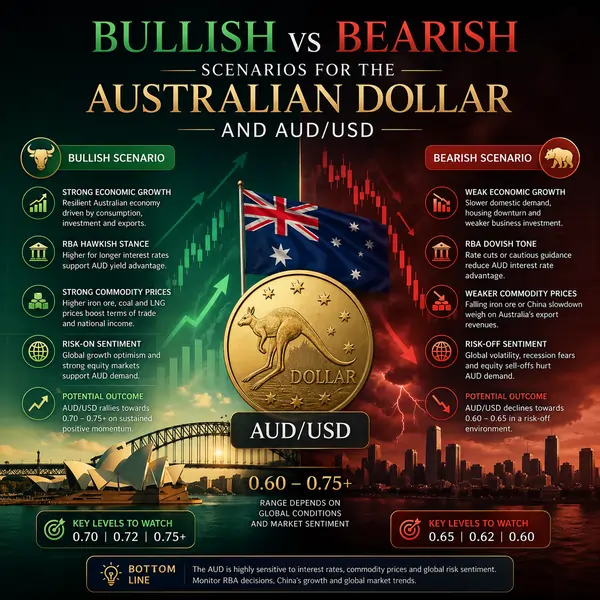
To translate these forces into practical scenarios, it helps to sketch out both upside and downside paths for AUD/USD. These are not predictions, but roadmaps that traders and investors can monitor as data arrives.
What could drive a bullish Australian Dollar scenario?
A constructive path for AUD/USD typically includes some combination of the following:
- Australian inflation proves sticky enough that the RBA must keep policy restrictive for longer than markets assume.
- The Fed pivots more clearly toward cuts as US growth slows, narrowing or reversing yield differentials.
- China delivers credible, sustained stimulus that lifts commodity prices and boosts Australian export revenues.
- Global risk sentiment improves, with equities grinding higher and volatility staying contained.
Under this backdrop, a topside AUD USD breakout analysis would look for price to break resistance on strong volume and hold those gains through data releases, potentially signaling a broader trend reversal.
What could drive a bearish Australian Dollar scenario?
On the downside, a more challenging environment for the Australian Dollar might emerge if:
- Australian inflation cools faster than expected, giving the RBA space to cut ahead of the Fed.
- The Fed remains hawkish and pushes back against market pricing for cuts, sending US yields higher.
- Chinese data disappoints, or property-sector stress deepens, weighing on commodity prices.
- Risk sentiment sours due to geopolitical tensions or financial stability concerns.
In such a case, traders would watch for a clean daily close below key support and failed retests from underneath, confirming a bearish shift in the medium-term AUD USD forecast.
Checklist: How traders can navigate upcoming event risk
To structure your approach around these catalysts, consider this simple pre-event checklist:
- Identify your key support and resistance zones on the daily and 4-hour charts.
- Note consensus expectations for inflation and the Fed meeting, then focus on the magnitude of any surprise.
- Track yield differentials between Australian and US bonds as a reality check on narrative shifts.
- Size positions conservatively around data releases to manage volatility spikes.
- Reassess your AUD USD technical and fundamental analysis after the dust settles, not during the whipsaw.
Australian Dollar Outlook: Key Risks and What to Watch Next
Looking ahead, the Australian Dollar outlook will continue to hinge on the race between disinflation and growth risks in both Australia and the United States. The biggest wildcards are how persistent domestic inflation proves to be, how aggressively the Fed leans against market expectations, and whether China can stabilize its growth trajectory.
For traders and investors, the priority is to track how new data reshape those narratives. Watch upcoming inflation readings, RBA and Fed communications, commodity price trends, and shifts in global risk appetite. Those signals will decide whether the next major move in AUD/USD is a sustained breakout higher or a renewed leg lower.
Useful Resources
For deeper data and official commentary that influence the Australian Dollar, these resources are particularly helpful:
Frequently Asked Questions About Australian Dollar
What factors most strongly influence the Australian Dollar against the US Dollar?
The Australian Dollar is driven primarily by interest rate differentials between the Reserve Bank of Australia and the Federal Reserve, commodity prices that affect Australia’s export earnings, Chinese growth trends, and overall global risk sentiment. Shifts in any of these areas can quickly alter AUD/USD direction, which is why traders combine macro data with technical signals. For a related guide, see Australian Dollar Exchange Rate Today: Key Updates and Market Impact.
How does Australian inflation data affect the Australian Dollar ?
Australian inflation data shape expectations for future RBA policy moves, which in turn impact the Australian Dollar. Higher-than-expected inflation can lead markets to price in more rate hikes or a longer period of restrictive policy, generally supporting AUD, while softer inflation can increase the odds of earlier rate cuts and weigh on the currency.
Why is the Australian Dollar often called a commodity currency?
The Australian Dollar is considered a commodity currency because Australia exports large volumes of raw materials such as iron ore, coal, and liquefied natural gas. When global commodity prices rise and demand is strong, Australia’s terms of trade improve, typically supporting AUD, while falling commodity prices can have the opposite effect.
How do Federal Reserve decisions impact AUD/USD?
Federal Reserve decisions influence US interest rates and yields, which directly affect the value of the US Dollar relative to the Australian Dollar. A more hawkish Fed stance tends to lift the USD and pressure AUD/USD lower, while a dovish shift or signals of future rate cuts can weaken the USD and provide a tailwind for AUD.
What is meant by a breakout in AUD/USD?
A breakout in AUD/USD refers to the currency pair moving decisively beyond a well-established support or resistance level, often accompanied by higher trading volume and stronger momentum. Breakouts can indicate the start of a new trend and are frequently triggered by major data releases, central bank decisions, or shifts in risk sentiment.
How can I use technical analysis for Australian Dollar trading?
Technical analysis for Australian Dollar trading typically involves identifying key support and resistance levels, trend lines, and chart patterns, along with indicators like moving averages, RSI, and MACD. Traders use these tools to spot potential breakouts, trend reversals, and momentum shifts, often combining them with scheduled macro events to improve timing.
Is the Australian Dollar considered a risk-on or risk-off currency?
The Australian Dollar is generally viewed as a risk-on currency, meaning it tends to perform better when investors are confident and global markets are rising. During periods of market stress or risk aversion, AUD is often sold in favor of perceived safe-haven currencies such as the US Dollar, Japanese Yen, or Swiss Franc.
How important is China to the Australian Dollar outlook?
China is a critical driver of the Australian Dollar outlook because it is Australia’s largest trading partner and a major consumer of Australian commodities. Strong Chinese growth, infrastructure spending, and stimulus measures can support AUD, while slowdowns, property sector issues, or policy uncertainty in China often weigh on the currency.
Can the Australian Dollar rise even if the RBA is cutting rates?
Yes, the Australian Dollar can still appreciate even if the RBA is cutting rates, particularly if the Federal Reserve is easing policy more aggressively or if global risk sentiment is strongly positive. Currency values are relative, so AUD can gain if markets believe Australia’s economic outlook is improving relative to other major economies.
What time frame is best for analyzing an AUD USD forecast ?
The best time frame for analyzing an AUD USD forecast depends on your strategy. Short-term traders often focus on intraday and 4-hour charts to capture event-driven moves, while swing traders favor daily charts for trend and breakout analysis. Longer-term investors may rely more on weekly and monthly charts, combined with macroeconomic fundamentals.
How do interest rate differentials affect the Australian Dollar ?
Interest rate differentials between Australia and the United States influence the relative attractiveness of holding AUD versus USD. When Australian yields are higher relative to US yields, AUD tends to be more attractive, and vice versa. Traders watch bond markets closely because changing yield spreads can foreshadow shifts in AUD/USD.
Is AUD/USD highly volatile around Fed and RBA meetings?
AUD/USD typically shows elevated volatility around Fed and RBA meetings because these events can significantly alter expectations for future interest rates and economic conditions. Traders often reduce position sizes or hedge exposures going into such meetings, then react quickly once new guidance or forecasts are released.
What role do speculative positions play in Australian Dollar moves?
Speculative positions, such as those held by hedge funds and other leveraged traders, can amplify moves in the Australian Dollar, especially when positioning is stretched in one direction. When market sentiment changes, rapid position unwinding can cause sharp reversals in AUD/USD, even if the underlying fundamentals have not changed dramatically.
How can traders manage risk when trading AUD/USD around data releases?
To manage risk around data releases, traders can reduce leverage, use wider but pre-defined stop-loss levels, and avoid opening new positions immediately before very high-impact events. Many also wait for the initial volatility spike to settle before committing, then trade in the direction of the move once the market’s interpretation is clearer.
Do seasonal patterns affect the Australian Dollar ?
Some analysts study seasonal patterns in the Australian Dollar, noting that certain months can show recurring tendencies related to commodity cycles, portfolio rebalancing, or holiday liquidity. However, seasonal effects are usually secondary to major macro drivers such as interest rates, growth data, and risk sentiment, and should not be relied upon in isolation.
What economic indicators besides CPI should AUD traders watch?
Beyond CPI, Australian Dollar traders closely monitor employment figures, wage growth, retail sales, business and consumer confidence surveys, and trade data. Globally, US payrolls, US inflation, Chinese PMIs, and major central bank speeches also influence AUD, since they shape expectations for growth, inflation, and interest rates.
Is the Australian Dollar suitable for carry trade strategies?
The Australian Dollar has historically been used in carry trade strategies when Australian interest rates were significantly higher than those of funding currencies like the Yen or the US Dollar. Today, carry opportunities depend on current rate differentials and volatility; high volatility can quickly erode carry returns, so traders must weigh both yield and risk.
How might a global recession impact the Australian Dollar ?
A global recession would likely pressure the Australian Dollar by reducing demand for commodities, weakening Australian export revenues, and pushing investors into safer assets. In such an environment, AUD tends to underperform against safe-haven currencies, though the scale of the move would depend on how severely Australia and its key trading partners are affected.
Can long-term investors benefit from Australian Dollar cycles?
Long-term investors can potentially benefit from Australian Dollar cycles by taking a multi-year view on global growth, commodity prices, and relative monetary policy paths. By accumulating AUD assets during periods of pessimism and scaling back during periods of exuberance, they may capture value from the currency’s tendency to overshoot in both directions.
What is the best way to stay informed about the Australian Dollar outlook?
To stay informed about the Australian Dollar outlook, follow official communications from the RBA and Fed, monitor key economic calendars, and read regular analysis from reputable financial news and research providers. Combining these sources with your own technical review of AUD/USD charts can give you a well-rounded, up-to-date perspective.