As a part-time SEO Specialist with 3 years of experience in keyword ranking, on-page optimization, and data-driven SEO strategies, Aubrey specializes in on-page SEO—focusing on improving organic performance through well-structured content and precise optimization. By aligning content with search intent, Aubrey strengthens website foundations that lead to faster, more stable rankings.
AI Overview Summary:Nasal polyps are soft, painless, non-cancerous growths on the lining of the nasal passages or sinuses. They result from chronic inflammation and are often associated with asthma, allergic rhinitis, or aspirin-exacerbated respiratory disease (AERD) . Symptoms include nasal congestion, reduced sense of smell, post-nasal drip, and facial pressure. Treatment begins with medical management (nasal steroid sprays, oral steroids, biologic medications) and may progress to endoscopic polypectomy or FESS for large polyps.
Key Takeaways
What are nasal polyps: Soft, non-cancerous growths in the nose or sinuses caused by chronic inflammation.
Common symptoms: Nasal congestion, reduced sense of smell, post-nasal drip, facial pressure.
Treatment ladder: Medical management first (sprays, steroids, biologics). Surgery only if medical therapy fails.
Recurrence rate: Approximately 40% within 5 years, requiring ongoing medical management.
Disclaimer:This information is for educational purposes only and does not constitute medical advice. Individual results vary. Please consult a qualified health practitioner for personal advice about your condition.
What Are Nasal Polyps?
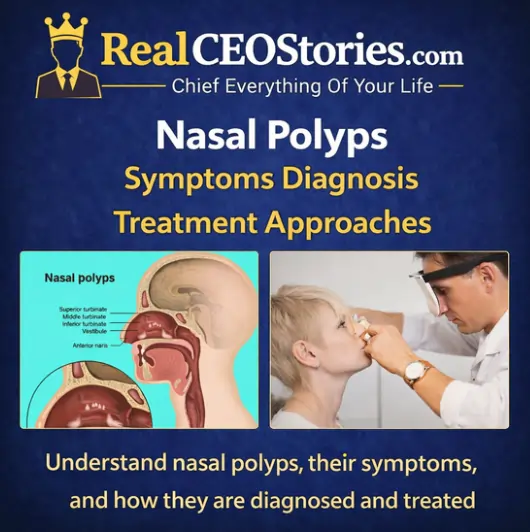
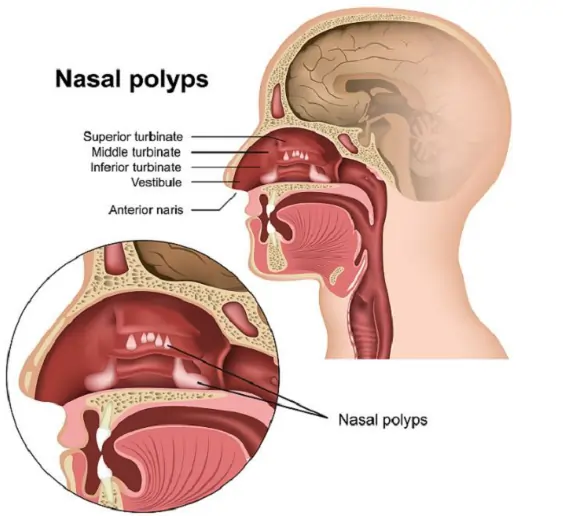
Nasal polyps are soft, painless, non-cancerous (benign) growths that develop on the lining of the nasal passages or sinuses. They look like peeled grapes or small gelatinous sacs.
Polyps result from chronic inflammation of the nasal and sinus lining. Over time, the inflamed tissue swells, fluid accumulates, and gravity pulls the tissue downward, forming a polyp.
Polyps can be:
Unilateral (one side only) – more concerning, requires evaluation to exclude tumour
Bilateral (both sides) – typical for inflammatory polyps
Polyps range in size from:
Small: Visible only on nasal endoscopy, causing mild symptoms
Large: Filling the entire nasal passage, causing severe obstruction and loss of smell
Aspirin sensitivity with asthma, polyps, and sinusitis
Allergic rhinitis
Chronic allergy-induced inflammation
Cystic fibrosis
Genetic disorder affecting mucus clearance
Allergic fungal sinusitis
Immune reaction to fungus in sinuses
Primary ciliary dyskinesia
Genetic disorder affecting cilia function
Inflammatory Pathways
Nasal polyps are characterized by type 2 inflammation – the same inflammatory pathway involved in asthma and eczema. Key inflammatory cells and chemicals include:
Treatment follows a stepwise approach – starting with medical management and progressing to surgery only if medical therapy fails. Even after surgery, ongoing medical management is usually required to prevent recurrence.
Medical Management (First-Line Treatment)
Treatment
How It Works
Typical Duration
Effectiveness
Intranasal corticosteroid sprays
Reduces inflammation in the nose (e.g., Flixonase, Nasonex, Rhinocort)
Daily, ongoing
Reduces polyp size by 20-30%
Intranasal corticosteroid drops
More concentrated delivery to polyps (e.g., Pulmicort respules)
4-8 weeks, then maintenance
More effective than sprays
Oral corticosteroids
Powerful anti-inflammatory (e.g., prednisolone 50mg daily for 5-10 days)
Short course (5-10 days)
Shrinks polyps rapidly (60-80% reduction)
Saline nasal rinses
Clears mucus, improves medication delivery
Twice daily, ongoing
Adjunctive (helps other treatments work better)
Biologic medications
Block specific inflammatory pathways (e.g., dupilumab, mepolizumab, omalizumab)
Injection every 2-4 weeks, ongoing
Highly effective (50-80% reduction)
Biologic Medications for Nasal Polyps
Biologics are a newer class of medications that target specific inflammatory pathways. They are typically reserved for patients with severe, recurrent polyps who have failed surgery and medical management.
Biologic
Target
Indication
Effectiveness
Dupilumab (Dupixent)
IL-4/IL-13 receptor
Severe polyps with asthma
60-80% reduction in polyp size and symptom improvement
Mepolizumab (Nucala)
IL-5
Eosinophilic polyps with asthma
50-70% improvement
Omalizumab (Xolair)
IgE
Polyps with asthma and allergies
50-70% improvement
Cost: Biologics are expensive ($10,000-$20,000 per year) but may be covered by the Pharmaceutical Benefits Scheme (PBS) for eligible patients with severe disease.
Surgical Treatment (When Medical Therapy Fails)
Surgery is recommended when:
Medical management (including oral steroids or biologics) has failed
Polyps are large and causing severe obstruction
Loss of smell is complete and persistent
The patient has AERD or allergic fungal sinusitis (which often requires surgery)
Surgical Procedures for Nasal Polyps
Procedure
What It Does
Recovery Time
Endoscopic polypectomy
Removes polyps from the nasal passages
3-7 days off work
Functional endoscopic sinus surgery (FESS)
Removes polyps from sinuses and opens sinus drainage pathways
5-7 days off work; full healing 4-6 weeks
Important notes about surgery:
Surgery removes polyps but does not cure the underlying inflammation
Most patients need ongoing medical therapy after surgery (nasal sprays, saline rinses, sometimes biologics)
Polyps recur in approximately 40% of patients within 5 years
Are nasal polyps cancerous? No. The vast majority of nasal polyps are benign (non-cancerous). However, unilateral polyps (one side only) should be evaluated to exclude a tumour.
What causes nasal polyps? Chronic inflammation of the nasal and sinus lining, often associated with asthma, allergies, AERD, or cystic fibrosis.
Can nasal polyps go away on their own? Rarely. Small polyps may shrink with medical treatment (steroid sprays or oral steroids). They do not typically resolve without treatment.
Are nasal polyps contagious? No. Nasal polyps are caused by inflammation, not infection.
Can children get nasal polyps? Yes, but it is rare. Nasal polyps in children should raise suspicion for cystic fibrosis or primary ciliary dyskinesia.
Symptoms FAQs
What does loss of smell from nasal polyps feel like? Complete or partial inability to detect odours. Some patients cannot smell food, smoke, or gas – which can be dangerous.
Do nasal polyps cause pain? Nasal polyps themselves are painless. However, they may cause facial pressure if the sinuses are also inflamed.
Can nasal polyps cause snoring? Yes. Nasal polyps cause nasal obstruction, which leads to mouth breathing and snoring during sleep.
Do nasal polyps affect taste? Yes. Taste is closely linked to smell. Loss of smell (anosmia) significantly reduces the ability to taste flavours.
Can nasal polyps cause nosebleeds? Occasionally. The inflamed polyp tissue is fragile and may bleed, especially with nose blowing or nasal spray use.
Treatment FAQs
Can nasal polyps be treated without surgery? Yes. Medical management (nasal steroid sprays, oral steroids, biologics) is the first-line treatment. Surgery is only for patients who fail medical therapy.
How effective are nasal steroid sprays for polyps? Nasal steroid sprays reduce polyp size by 20-30% and improve symptoms. Intranasal steroid drops are more effective (50-60% reduction).
How effective are oral steroids for polyps? Very effective in the short term (60-80% reduction in polyp size). However, long-term use is limited by side effects (weight gain, insomnia, bone thinning, diabetes).
What are biologic medications for nasal polyps? Biologics (dupilumab, mepolizumab, omalizumab) block specific inflammatory pathways. They are highly effective for severe, recurrent polyps but are expensive.
Is surgery a cure for nasal polyps? No. Surgery removes polyps but does not cure the underlying inflammation. Most patients need ongoing medical therapy after surgery.
Recurrence FAQs
Do nasal polyps come back after surgery? Yes. Recurrence rate is approximately 40% within 5 years. Recurrence is higher in patients with asthma, AERD, or allergic fungal sinusitis.
How can I prevent nasal polyps from coming back? Use nasal steroid sprays daily, perform saline rinses, treat underlying asthma and allergies, and avoid aspirin (if AERD).
How many times can nasal polyps be removed surgically? Multiple times. Some patients with AERD or allergic fungal sinusitis require surgery every 1-3 years despite optimal medical management.
Do biologics prevent polyp recurrence? Yes. Biologics (especially dupilumab) significantly reduce recurrence and may eliminate the need for surgery in some patients.
What is the long-term outlook for nasal polyps? Variable. With consistent medical management, many patients maintain good symptom control. Patients with AERD or allergic fungal sinusitis have more aggressive disease and higher recurrence rates.
Summary
Nasal polyps are soft, non-cancerous growths caused by chronic inflammation of the nasal and sinus lining. They are associated with asthma, allergic rhinitis, and aspirin-exacerbated respiratory disease (AERD) . Symptoms include nasal congestion, reduced sense of smell, post-nasal drip, and facial pressure.
Treatment begins with medical management (nasal steroid sprays, oral steroids, biologic medications) and may progress to endoscopic polypectomy or FESS for patients who do not improve with medical therapy alone. Even after surgery, recurrence is common (40% within 5 years) , requiring ongoing medical management.
For specific medical advice about your condition, please consult a qualified ENT doctor in Sydney such as Dr. Brett Leavers or another registered ENT specialist.