

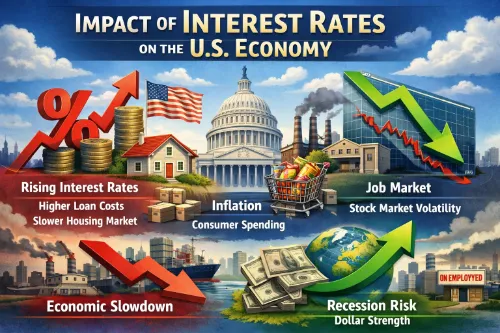
Impact of Interest Rates on Consumer Spending
Consumer spending accounts for roughly two‑thirds of U.S. GDP, making it a key channel through which interest‑rate changes affect the economy.
Credit Cards and Personal Loans
When rates rise, credit‑card APRs and personal‑loan rates usually increase as well.
- Monthly debt payments take up a larger share of income
- Households may cut discretionary spending
- Large financed purchases (appliances, vacations, renovations) are more likely to be postponed
Investopedia’s guide How Interest Rate Changes Impact Consumer Spending and Saving explains these dynamics in detail.
Auto Loans
Auto purchases are typically financed, so higher interest rates increase monthly car payments and can reduce demand for vehicles. Lower rates make financing more affordable and often boost auto sales and manufacturing activity.
Savings Incentives
Higher interest rates also benefit savers. Yields on savings accounts, money‑market funds, certificates of deposit (CDs), and U.S. Treasury securities tend to rise with policy rates, encouraging more saving and less immediate spending. You can track government yields and financing conditions through the U.S. Treasury’s home page.
The Housing Market and Mortgage Rates
Housing is one of the most interest‑rate‑sensitive sectors in the U.S. economy. Mortgage rates closely follow broader rate trends and strongly influence home affordability and demand.
Rising Interest Rates and Housing Demand
When mortgage rates increase:
- Monthly mortgage payments rise for new buyers
- Home affordability declines
- Fewer borrowers qualify for loans
- Housing demand slows and home sales can fall
HousingWire’s article Housing market boost? Fed initiates rate cut cycle shows how the first Fed rate cuts in 2025 eased mortgage rates from recent highs, but housing starts were still down about 7% year‑over‑year after earlier tightening.
Lower Interest Rates and Housing Booms
When mortgage rates fall:
- Borrowing becomes cheaper
- More buyers enter the market
- Housing demand increases
- Home prices and construction activity often rise
The National Association of Home Builders explains this interplay in What the Fed Rate Cuts Mean for Housing and the Economy, noting that lower rates reduce the cost of acquisition, development and construction (AD&C) loans used by homebuilders.
For detailed home‑price and mortgage‑market data, see the Federal Housing Finance Agency’s FHFA data portal.
Effects on Business Investment
Interest rates also shape business decisions about expansion, hiring and capital investment.
Borrowing Costs for Businesses
Companies often borrow to finance:
- New factories and offices
- Equipment and technology upgrades
- Market expansion
- Research and development
When rates are low, borrowing is cheaper, making more projects financially attractive. When rates rise, the cost of capital increases and some projects no longer clear required return thresholds, leading firms to postpone or cancel them.
Rosenberg Research’s Impact of Interest Rates on the Economy notes that capital expenditure is one of the most interest‑sensitive components of GDP.
Impact on Small Businesses
Small businesses, which rely heavily on bank loans and credit lines, are especially sensitive to higher interest costs. The U.S. Small Business Administration provides guidance on funding options and the interest‑rate environment at https://www.sba.gov.
When rates rise, some entrepreneurs may find it harder to secure financing for expansion, inventory, or hiring, potentially slowing innovation and job creation.
Interest Rates and the Stock Market
Financial markets closely watch interest‑rate decisions because they affect corporate earnings prospects and how investors allocate portfolios.
How Higher Interest Rates Affect Stocks
When interest rates rise:
- Corporate borrowing costs increase, potentially reducing profits
- Discount rates used to value future earnings rise, putting downward pressure on stock valuations
- Bonds and cash become relatively more attractive, prompting some investors to rotate out of equities
Invesco’s investor‑education module How do economic data and interest rates affect your investments? explains why growth stocks and long‑duration assets are particularly sensitive to rate changes.
How Lower Interest Rates Support Markets
When rates fall:
- Corporate financing costs drop
- Earnings expectations may improve
- Lower bond yields make stocks more appealing by comparison
The U.S. Securities and Exchange Commission offers educational resources and market data to help investors understand how rate environments affect risk and returns at https://www.sec.gov.
Impact on Employment and Job Growth
Interest‑rate policy indirectly affects employment by influencing overall demand.
Low Interest Rates and Job Creation
When borrowing is affordable and demand is strong:
- Businesses expand operations and invest in capacity
- Companies hire additional workers
- Consumer spending rises, supporting more jobs in services, manufacturing and construction
These dynamics usually push unemployment lower and can tighten labor markets, leading to faster wage growth.
High Interest Rates and Slower Hiring
When rates are high:
- Businesses may delay expansion or hiring
- Highly leveraged or cyclical sectors can face layoffs
- Slower demand growth reduces the need for new workers
You can track unemployment rates, payroll growth and wage data via the BLS main site at https://www.bls.gov.
An article from Real Estate News, Housing will ‘be a problem,’ Fed chair warns after rate cut, shows how in December 2025 the Fed cut rates for the third consecutive meeting to support a softening job market, even while signaling concerns about housing affordability.
Global Effects of U.S. Interest Rates
Because the U.S. dollar and Treasury markets anchor global finance, U.S. rate changes have significant international spillovers.
Strengthening of the U.S. Dollar
Higher U.S. interest rates tend to attract foreign capital seeking better yields on dollar‑denominated assets. This can increase demand for the U.S. dollar, strengthening its value relative to other currencies.
- U.S. imports become cheaper
- U.S. exports become more expensive abroad
This can widen the U.S. trade deficit but also help dampen imported‑goods inflation.
Impact on Emerging Markets
Higher U.S. rates often lead to capital outflows from emerging markets, raising their borrowing costs and pressuring their currencies. A study in Journal of International Money and Finance, Transmission of U.S. monetary policy to commodity exporters and importers, finds that U.S. easing tends to boost commodity prices and output in commodity exporters, while tightening can have the opposite effect.
Global economic data and analysis are available from the International Monetary Fund at https://www.imf.org.
Historical Examples of Interest‑Rate Changes
Several historical episodes illustrate how interest‑rate policy affects the U.S. economy.
The Early 1980s Inflation Fight
In the early 1980s, the Fed under Paul Volcker raised the federal funds rate to extremely high levels—near 20%—to crush double‑digit inflation. The strategy succeeded in restoring price stability but also triggered a sharp recession and high unemployment in the short term.
The 2008 Financial Crisis
After the 2008 global financial crisis, the Fed cut rates to near zero and launched large‑scale asset purchases to stabilize financial markets and support lending. These measures helped prevent a deeper downturn and laid the groundwork for a long, if gradual, expansion.
The Post‑Pandemic Inflation Period
Following the COVID‑19 pandemic, inflation surged due to supply‑chain disruptions and strong demand. The Fed responded by raising rates rapidly from near zero to multi‑decade highs in 2022–2023, then began cautiously cutting rates again in 2025 as inflation moderated and the labor market softened.
You can explore historical interest‑rate series, including the federal funds rate, via the FRED database at https://fred.stlouisfed.org.
Advantages and Risks of Interest‑Rate Adjustments
Interest‑rate policy is a powerful but blunt tool.
Benefits
Well‑timed interest‑rate moves can:
- Control inflation and anchor expectations
- Stimulate growth during economic downturns
- Stabilize financial markets and credit conditions
- Encourage more sustainable borrowing and investment behavior
Potential Risks
Mis‑timed or excessive adjustments can:
- Trigger or worsen recessions
- Raise unemployment
- Fuel asset bubbles if rates stay too low for too long
- Cause market volatility and financial‑stability concerns
A New York Fed paper, The Monetary Transmission Mechanism: Some Answers and Further Questions, examines these channels and the uncertainties central banks face when calibrating policy.
How Interest Rates Affect Personal Finance
Interest‑rate changes show up directly in everyday money decisions.
Borrowing Decisions
- Mortgages, car loans and personal loans become more expensive
- Monthly payments increase on new variable‑rate debt
- Some households delay big purchases or choose smaller loans
When rates fall, refinancing or taking on new loans can become more attractive, freeing up cash flow for other goals.
Saving and Investing
Higher rates usually mean higher yields on bank deposits, CDs, and government bonds, making low‑risk saving more rewarding. Lower rates often push investors toward riskier assets like stocks or real estate in search of better returns.
Invesco’s guide on how economic data and interest rates affect your investments offers a clear breakdown of how rate environments influence asset allocation.
Retirement Planning
Interest‑rate levels also affect:
- Bond and annuity payouts
- The sustainability of withdrawal rates from retirement portfolios
- The relative appeal of stocks vs. fixed income over long horizons
Understanding these relationships helps individuals and financial planners tailor strategies to current and expected interest‑rate conditions.
The Future of Interest‑Rate Policy in the U.S.
Economic conditions constantly evolve, so interest‑rate policy must adapt. Factors likely to shape future decisions include:
- Inflation trends and how quickly inflation returns to the 2% target
- Labor‑market dynamics, including participation and productivity
- Global growth and geopolitical risks
- Technological change and its impact on prices and productivity
- Government fiscal policy and debt levels
As the U.S. economy changes, interest rates will remain one of the most important tools for maintaining stability and supporting sustainable growth. The Fed’s monetary policy pages are the best place to follow upcoming decisions and the reasoning behind them