

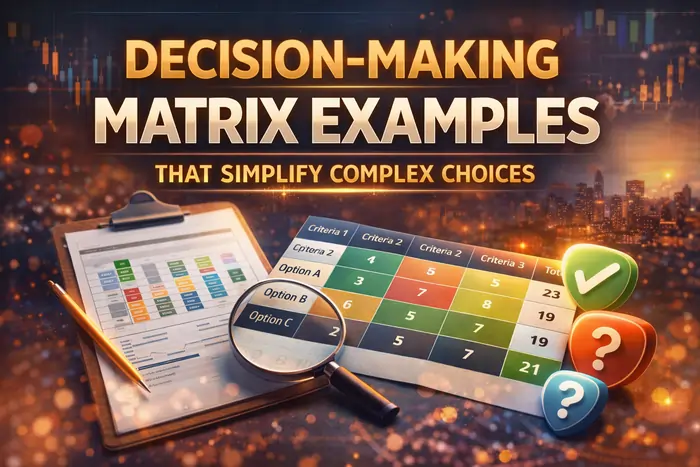
A decision-making matrix is a structured tool that helps individuals and teams evaluate multiple options based on defined criteria, making complex decisions clearer and more objective. By assigning scores and weights to factors such as cost, risk, and impact, users can compare choices side by side and identify the best option based on data rather than intuition.
Common types include simple matrices, weighted matrices, Eisenhower matrices, and multi-criteria decision analysis (MCDA). These frameworks are widely used in business, project management, hiring, and personal decision-making to improve clarity, reduce bias, and support more confident, defensible decisions.
Decision-making matrix gets harder as choices multiply, stakes rise, and stakeholders pile in. A decision-making matrix turns all that chaos into a structured, visual process so you can score options, compare them side by side, and justify your final call with data instead of gut feel. In this guide to 10 decision-making matrix examples that simplify complex choices, you’ll see practical templates you can copy today—plus external tools and resources you can click through to adapt them for your projects, career moves, and life decisions.
What Is a Decision-Making Matrix?
A decision-making matrix is a grid where you list your options in columns, your criteria in rows, and assign scores to see which option best meets your priorities. It forces you to define what “better” actually means—cost, speed, risk, impact—so you can move from vague pros and cons to a quantified comparison.
According to the American Society for Quality’s overview of the decision matrix, teams usually start by listing alternatives, defining criteria, assigning weights, and scoring each option to calculate a final total. For a step-by-step breakdown with business-focused examples, Asana’s guide to decision matrix examples shows how to use simple and weighted matrices in real projects.
If you want a fast refresher on the core structure (criteria, weights, options, and scores) along with a ready-made spreadsheet, AIHR’s article on a free decision matrix template is another helpful starting point.
1. Simple Decision-Making Matrix (Best for Straightforward Choices)
The simple Decision-Making Matrix is the most basic version: every criterion is equally important, and you just rate each option on a numeric scale (for example 1–5) then add up the scores. It’s ideal when your decision is not high-stakes, criteria are fairly balanced, and you just need to break a tie among multiple decent options.
A typical use case might be choosing between three conference tools for a small team based on criteria like ease of use, video quality, and integrations. Asana’s article on decision matrix examples walks through exactly this type of scenario and shows how to structure the grid. BGMC Group’s explainer on decision matrix examples and when to use them offers more everyday examples like vendor selection or product feature prioritization.
Because every criterion has the same weight, you don’t need any advanced math—just score, sum, and compare. This simplicity also makes it a good teaching tool if your team is new to structured decision-making.
2. Weighted Decision-Making Matrix (When Some Criteria Matter More)
Most real-world decisions involve criteria that don’t carry equal weight: maybe security matters more than price, or long-term scalability beats short-term convenience. That’s where the weighted decision matrix comes in. You assign each criterion a weight (for example, importance from 1 to 5), multiply each score by its weight, then sum the weighted scores to see which option wins.
Asana explains that a weighted decision matrix is best for complex decisions where criteria are clearly not equal—such as choosing a strategic vendor, hiring for a critical role, or picking a new office location. Monday.com’s in-depth guide to the decision matrix also highlights weighted scoring as the go-to when you’re balancing budget, risk, and alignment with company strategy.
AIHR’s free decision matrix template breaks down the core building blocks: a list of criteria, weighting, a consistent scoring system, and a final score tally, plus risk assessment for each option. For example, a technology team choosing between SaaS platforms might weight “security” as 5, “total cost” as 4, “user adoption” as 3, then score each vendor against those criteria and compute the weighted totals.
3. Pugh Decision-Making Matrix (Comparing Against a Baseline)
The Pugh matrix (also called a decision grid or selection grid) compares new options against a single baseline using plus, minus, and neutral ratings rather than absolute numeric scores. Instead of asking “How good is this on a scale of 1–10?” you ask “Is this better than, worse than, or the same as our current solution?”
The American Society for Quality describes the Pugh decision matrix as a tool especially useful for engineering and design teams iterating on an existing product or process. Indeed’s collection of decision matrix templates includes a Pugh matrix example where three vendors are measured against the current service provider as the baseline.
This approach is helpful when your main question is “Is it worth changing at all?” rather than “Which absolute option is best?” Miro’s decision matrix templates also incorporate Pugh-style comparisons so teams can visually map improvements and regressions against the status quo.
4. Eisenhower Decision-Making Matrix (Prioritizing Tasks by Urgency and Importance)
The Eisenhower matrix is a 2×2 grid that helps you decide what to do now, schedule, delegate, or delete based on urgency and importance. Instead of comparing multiple options against criteria, you categorize tasks into four quadrants:
- Urgent and important
- Important but not urgent
- Urgent but not important
- Neither urgent nor important.
ProductPlan’s guide to the Eisenhower matrix prioritization framework explains that the top-left quadrant (“urgent and important”) is what you do immediately, while the bottom-right (“neither”) is what you drop or ignore. Forbes’ article on how to get stuff done with the Eisenhower Matrix breaks down a simple way to sketch it and gives practical examples for busy professionals.
If you want a hands-on explanation with real-world task examples, Columbia University’s PDF on the Eisenhower Matrix walks through how to categorize tasks like client emergencies, long-term projects, and time-wasting distractions. Todoist’s productivity guide on avoiding the urgency trap with the Eisenhower Matrix shows how to apply it in daily task management tools.
5. Risk–Reward Decision Grid (Balancing Potential and Risk)
When innovation and risk are both high, you need a way to balance bold bets against safe choices. The risk–reward decision grid plots options on a 2×2 matrix based on their expected benefits and associated risks. The four typical quadrants are:
- Quick wins (high reward, low risk)
- Strategic bets (high reward, high risk)
- Bread and butter (low reward, low risk)
- White elephants (low reward, high risk).
Monday.com’s article on the decision matrix calls this a “risk–reward decision grid” and recommends it for portfolio decisions, innovation pipelines, and strategic planning. It’s especially useful when you’re deciding which initiatives to fund next quarter and want a visual that stakeholders can debate around.
You can combine this grid with a weighted matrix: use the risk–reward grid first to shortlist promising options, then run those through a weighted scoring model for more precise ranking. This two-layer approach is common in investment decisions, product roadmapping, and R&D selection.
6. Multi-Criteria Decision Analysis (MCDA) for High-Stakes Choices
When Decision-Making Matrix involve millions of dollars, regulatory constraints, or complex stakeholder trade-offs, simple scoring grids may not be enough. Multi-criteria decision analysis (MCDA) is a more rigorous version of a decision matrix that uses advanced weighting schemes, sensitivity analysis, and sometimes statistical validation to test how robust your decision is under different assumptions.
Monday.com’s discussion of MCDA within decision matrices notes that it’s particularly useful for infrastructure investments, mergers and acquisitions, and major technology platform selections. Criteria might include ROI, compliance risk, social impact, sustainability, and political feasibility, each scored and weighted across multiple scenarios.
ASQ’s overview of decision matrices and Pugh-type methods points out that MCDA often involves teams of experts and formal documentation, so it’s more of an organizational tool than a personal productivity trick. If you’re exploring MCDA from a leadership perspective, Pip Decks’ high-level decision matrix overview outlines benefits, examples, and when that level of rigor is warranted.
7. HR and People Decision-Making Matrix (Hiring, Promotions, HR Tech)
People decisions are notoriously subjective—bias creeps in, stakes are high, and trade-offs are emotional. A tailored HR decision matrix can bring structure to choices about hiring, promotion, and HR technology.
AIHR’s decision matrix template is specifically aimed at HR professionals, showing how to score recruitment options, employee engagement initiatives, or HRIS platforms across criteria like cost, cultural fit, scalability, and user adoption. They emphasize defining criteria clearly, assigning sensible weights, and using a consistent scoring method to reduce bias.
Indeed’s decision matrix templates also include HR-related examples for career decisions and job offers, where you might compare roles based on salary, growth opportunities, location, and work-life balance. When you combine structured scoring with qualitative discussion, you get a more defensible and transparent hiring or promotion decision process.
8. Project and Portfolio Prioritization Matrix
Teams often juggle more initiatives than they can realistically execute. A project prioritization matrix helps you evaluate projects by impact, effort, strategic fit, and urgency so you can choose what to do now, what to delay, and what to drop.
Monday.com’s guide to the decision matrix shows how to use a weighted scoring approach for project portfolio decisions, with criteria like expected ROI, resource availability, risk level, and alignment to OKRs. Asana’s decision matrix examples include scenarios like selecting two out of four improvement projects for next quarter.
If your team lives in Confluence, Atlassian’s decision matrix template offers a collaborative space where you define criteria, assign weights, list options, and score them as a group. Miro’s online decision matrix templates let remote teams brainstorm options and fill out the matrix visually in real time.
9. Business Owner Decision-Making Matrix (Who Decides What)
Not every decision should be made by the same person. For business owners, a decision matrix can map which types of decisions belong to founders, which to managers, and which to frontline staff, based on impact, expertise, and accountability.
Deliberate Directions’ 2026-focused decision matrix template for business owners describes a framework where recurring decisions (like pricing changes, hiring, or vendor contracts) are assigned to the appropriate decision-maker. This prevents bottlenecks at the top and reduces the risk of critical decisions being made at the wrong level.
Pip Decks’ decision matrix overview reinforces that mapping decision rights can improve clarity, speed, and accountability across an organization. When everyone knows which decisions they own and which they only influence, collaboration becomes smoother and conflicts are easier to resolve.
10. Ready-Made Decision Matrix Templates and Tools
Finally, one of the simplest ways to start using decision matrices is to grab a template and customize it. Many tools now offer drag-and-drop matrix templates so you don’t have to build everything from scratch.
Here are a few useful external resources you can click and adapt right away:
- Asana’s practical guide with real decision matrix examples (great for project, vendor, and hiring decisions).
- Monday.com’s comprehensive explanation of the decision matrix and how to use it across matrix types.
- Miro’s collection of decision matrix templates including weighted and Eisenhower-style boards for collaborative teams.
- Atlassian’s Confluence decision matrix template for documenting decisions and aligning stakeholders.
- Meegle’s library of decision matrix examples with industry-specific use cases.
These tools let you plug in your own criteria, weights, and options, and often include built-in formulas to calculate totals, so you can focus on the thinking rather than the formatting.
How to Choose the Right Decision-Making Matrix for Your Situation

With so many frameworks available, the key question becomes: which decision matrix should you use when? A helpful rule of thumb is to match the complexity of the matrix to the complexity and risk of the decision.
- Use a simple decision matrix for low-risk, everyday choices where all factors are roughly equal.
- Use a weighted decision matrix when some criteria matter more than others, especially for strategic or financial decisions.
- Choose a Pugh matrix when your main concern is whether new options outperform the current baseline.
- Use an Eisenhower matrix or risk–reward grid when you’re prioritizing tasks or initiatives based on urgency, importance, or risk.
- Reserve MCDA for high-stakes, multi-stakeholder decisions where you need defensibility and sensitivity analysis.
For a broader perspective on benefits and trade-offs, Pip Decks’ decision matrix overview and BGMC Group’s examples and usage guide offer accessible summaries.
Conclusion: Turn Overwhelm Into Clear, Defensible Choices
Complex decisions feel overwhelming when information is scattered, criteria are fuzzy, and emotions run high. Decision-Making Matrix matrices give you a repeatable way to clarify what matters, quantify trade-offs, and communicate your reasoning to others—whether you’re choosing a project, hiring a new team member, or planning your own career moves.
By picking the right Decision-Making Matrix for the situation and using the external resources above—from Asana’s decision matrix examples to Monday.com’s decision matrix guide and collaborative templates from Miro and Atlassian—you can transform complex choices into structured, evidence-based decisions you feel confident defending.
Complex decisions feel overwhelming when information is scattered, criteria are fuzzy, and emotions run high. Decision-making matrices give you a repeatable way to clarify what matters, quantify trade-offs, and communicate your reasoning—whether you’re choosing a project, hiring a new team member, or planning your own career moves. As you build this skill of structured decision-making, it also helps to strengthen your mindset and daily habits so you can follow through on the choices you make; for practical, personal strategies on that front, you can explore Mel Robbins: 9 Powerful Tips for Success in 2026 as a complementary read.