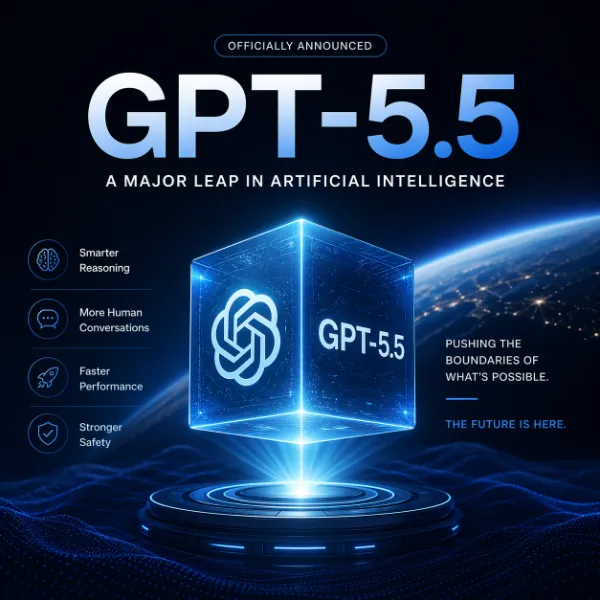
Unlike earlier versions that were mainly focused on text generation, the latest OpenAI model GPT-5.
Why GPT-5.5 Matters Right Now
The launch of GPT-5.5 signals a new phase where general-purpose AI becomes more dependable for everyday work, not just a novelty. With better reasoning, longer context windows, and deeper integration options, the model is positioned as an AI backbone for businesses, creators, and developers.
Unlike earlier versions that were mainly focused on text generation, the latest OpenAI model GPT-5.5 is built to operate as a more interactive system: it can understand complex instructions, maintain consistent behavior over long sessions, and plug into tools and data sources with less friction. For organizations, this means AI can finally start to feel like a serious, scalable capability instead of a disconnected experiment.
From GPT-3 to GPT-5: The Road to GPT-5.5
To understand the impact of the GPT-5.5 official announcement, it helps to look at how the GPT line has evolved over the past few years. Each generation has expanded the scale, safety controls, and real-world usefulness of large language models.
The early leap: GPT-3 and GPT-3.5
GPT-3 introduced the idea that a single large model could handle dozens of tasks with minimal fine-tuning. It powered early chatbots, copywriting tools, and coding assistants. GPT-3.5 refined those capabilities, adding more stability and better instruction-following, which laid the groundwork for mainstream chat-style AI products.
GPT-4 and GPT-4.1: Multimodal and more reliable
With GPT-4 and its later variants, OpenAI shifted from “impressive demos” to “reliable systems.” Models became more capable at reasoning, less likely to produce harmful content, and were able to work with images as well as text. Enterprises began to integrate GPT-4 into workflows for support, analysis, and content production.
GPT-5 and the step toward system-level AI
GPT-5 pushed further into multi-step reasoning, improved coding assistance, and integrations with tools such as databases, search, and internal APIs. It was the first generation widely positioned as a “co-pilot” across roles like software development, data analysis, and knowledge work.
Now, GPT-5.5 builds on this foundation with a focus on consistency, controllability, and better performance under production-level load.
GPT-5.5 New Features and Technical Improvements
The GPT-5.5 new features are less about raw model size and more about smarter architecture, inference efficiency, and alignment with real user needs. OpenAI has focused this release on practical upgrades that users will actually feel in day-to-day use.
Deeper reasoning and longer context handling
One of the headline improvements in GPT-5 5 is its ability to maintain coherent reasoning across much longer conversations and documents. This matters in situations like legal analysis, large research reports, technical documentation, and extended brainstorming sessions.
Better multi-step reasoning on complex instructions
Improved ability to reference earlier parts of a long discussion
More consistent decision-making over multi-turn workflows
Richer multimodal understanding
While previous models already supported text and images, the latest OpenAI model GPT-5 5 strengthens cross-modal reasoning. It can more reliably connect text instructions to visual content, which is especially useful for product design reviews, data dashboards, diagrams, and UI flows. For a related guide, see Google Photos AI Scanning: Privacy, Features, What to Know.
Sharper analysis of charts, dashboards, and diagrams
Better grounding of visual elements in text explanations
More accurate pairing of instructions with on-screen elements
Performance, latency, and reliability upgrades
Under the hood, GPT-5.5 benefits from more efficient inference pipelines and serving infrastructure. For end users, that typically translates into faster responses, fewer timeouts, and more predictable quality across requests. For a related guide, see Xbox Game Pass Games List 2026: New Releases and Top Picks.
Optimized inference for lower average latency
Smarter caching and routing for heavy production workloads
Improved consistency under high concurrency
Stronger safety layers and controllability
OpenAI has also expanded the safety and governance features built around GPT-5 5. Organizations can define stricter policies, monitor usage more easily, and shape model behavior to fit brand or regulatory requirements.
More granular control over content categories and filters
Enhanced system message tools for role and tone control
Better logging and observability for compliance and auditing
Real-World Use Cases for GPT-5.5
With these improvements, GPT-5 5 is aimed squarely at production environments. It is less about showing off novelty and more about delivering stable, measurable value across common workflows.
Knowledge work and enterprise automation
Companies can deploy the latest OpenAI model GPT-5 5 as an internal assistant for summarizing reports, drafting emails, and turning raw notes into structured documents. Longer context windows help teams feed entire project histories or knowledge bases into a single conversation.
Summarizing long documents and meetings into action items
Drafting proposals, briefs, and status updates
Turning unstructured inputs into consistent templates
Software development and DevOps support
Developers benefit from better code understanding, refactoring suggestions, and debugging support. GPT-5.5 can follow more complex engineering instructions, spanning multiple files or services, which makes it more useful as a long-term coding companion.
Explaining large codebases or multi-repo architectures
Generating test cases and documentation from implementation details
Assisting with configuration, CI/CD pipelines, and infrastructure-as-code
Customer support and conversational experiences
The stability gains in GPT-5 5 make it better suited for customer-facing chatbots, voice assistants, and support tools. Businesses can combine their own knowledge bases and policies with the model’s reasoning to deliver more consistent answers.
Tier-1 support deflection with escalation to human agents
Personalized help centers powered by conversational interfaces
Multichannel experiences (web, mobile, and voice)
Content, research, and data analysis
Writers, analysts, and researchers can use GPT-5 5 to explore ideas, generate outlines, and interpret structured data. The model can help connect the dots across long research documents, spreadsheets, and notes.
Drafting articles, marketing assets, and educational material
Exploring hypotheses on top of analytics and reports
Turning raw data into narrative summaries and dashboards
GPT-5.5 vs GPT-4 and GPT-5: How Does It Compare?
Many users want to know where GPT-5.5 vs GPT-4 and GPT-5 actually differ in practice. While precise benchmarks come from OpenAI’s documentation, the high-level comparison can be summarized across capability, reliability, and deployment readiness.
Aspect
GPT-4
GPT-5.5
Reasoning depth
Strong, but can struggle with multi-step tasks
Improved multi-step and long-horizon reasoning
Context window
Limited for very large projects
Supports significantly longer, more complex sessions
Multimodal capabilities
Text + images, solid but inconsistent on visuals
More reliable grounding between text and visuals
Latency and stability
Good, but can degrade under peak load
Optimized for lower latency and high concurrency
Safety and controls
Baseline policies and filters
More granular policy controls and observability
Enterprise readiness
Widely used, some manual workarounds required
Designed specifically for scaled production deployments
Compared with GPT-5, GPT-5.5 is less about “new tricks” and more about smoothing rough edges. It tightens reasoning, increases robustness, and makes integrations easier to manage at scale, which often matters more for long-term adoption than headline demo capabilities.
Limitations, Safety, and Ethics Around GPT-5.5
Despite the excitement around the GPT-5 5 official announcement, the model is not a magic solution. It still inherits many of the fundamental challenges that all large language models face, even as safety layers improve.
Hallucinations and factual reliability
GPT-5.5 can still generate confident but incorrect answers, especially in areas where training data is thin, rapidly changing, or ambiguous. This risk is particularly relevant for legal, medical, financial, and high-stakes decision-making scenarios.
Always use human review for sensitive or regulated domains
Combine the model with retrieval from trusted, up-to-date data sources
Make it clear to users when content is AI-generated
Bias, representation, and fairness
Like prior generations, GPT-5 5 is trained on large-scale data that can reflect societal biases. Even with alignment work, systems may still produce skewed or unfair outputs if not configured and monitored thoughtfully.
Audit outputs for demographic and cultural bias
Include diverse stakeholders in design and testing
Use policy controls and fine-tuning to minimize known harms
Privacy, data security, and governance
Organizations adopting the latest OpenAI model GPT-5.5 must consider how user data flows through prompts, logs, and integrated tools. Robust data governance policies, access controls, and anonymization practices are essential to meet regulatory and ethical standards.
Define clear data retention and deletion policies
Limit access to sensitive prompts and outputs
Ensure compliance with frameworks such as GDPR or industry-specific rules
Human-in-the-loop as a design principle
A key design pattern for responsible deployment of GPT-5.5 is keeping humans involved where it matters. AI should augment human judgment, not silently replace it, especially when outcomes affect people’s rights, livelihoods, or safety.
The Future of AI After the GPT-5.5 Official Announcement
The release of GPT-5 5 will likely accelerate the trend of AI becoming a core layer in software products and business processes. Rather than standalone chatbots, we can expect more applications to embed AI in the background, quietly improving search, recommendation, authoring, and analysis features.
For teams experimenting with the latest OpenAI model GPT-5 5, the most strategic move is to start with a portfolio of small, well-scoped projects. Measure impact, refine guardrails, and gradually expand into more critical workflows as you build confidence and internal expertise.
Looking ahead, the line between “versions” like GPT-5 and GPT-5.5 may blur as continuous improvements roll out to infrastructure, training techniques, and safety systems. What will matter most is not one model launch, but how organizations learn to combine these tools with strong governance and thoughtful user experience design.
Useful Resources
For readers who want to go deeper into the technology and policy around models like GPT-5.5, these resources provide solid, vendor-neutral context:
GPT-5.5 is a large language model from OpenAI designed to understand and generate human-like text, reason through complex tasks, and work with multimodal inputs like text and images. It builds on GPT-4 and GPT-5 but focuses more on reliability, longer context handling, and safer, more controllable behavior for real-world use.
How is GPT-5.5 different from GPT-4?
Compared with GPT-4, GPT-5 5 offers stronger multi-step reasoning, better performance with long conversations or documents, and more consistent multimodal understanding. It also introduces improved safety tools and enterprise controls to make large-scale deployments easier and more predictable.
How does GPT-5.5 compare to GPT-5?
GPT-5 introduced major capability gains, while GPT-5.5 refines those gains into a more stable, production-oriented system. In practice, users can expect fewer edge-case failures, smoother integrations, and more reliable behavior across extended, complex workflows when compared to GPT-5.
What are the main new features of GPT-5.5 ?
The most notable GPT-5.5 new features include deeper multi-step reasoning, significantly expanded context windows, more reliable image-text understanding, lower-latency responses under load, and enhanced safety and policy controls that organizations can configure for their specific needs.
Is GPT-5.5 suitable for enterprise use?
Yes, the latest OpenAI model GPT-5.5 is explicitly designed with enterprise use in mind. It supports longer contexts for complex projects, offers stronger observability and policy controls, and is optimized for consistent performance in high-traffic production settings used by larger organizations.
Can GPT-5.5 still make mistakes?
Despite improvements, GPT-5.5 can still generate incorrect or misleading information, especially on niche, fast-changing, or ambiguous topics. It should not be treated as an infallible source of truth and should always be paired with human oversight in critical or regulated domains.
What are the main risks of using GPT-5.5 ?
The main risks include hallucinated facts, potential bias in outputs, mishandling of sensitive data if governance is weak, and over-reliance on AI in high-stakes decisions. These risks can be mitigated by robust review processes, clear policies, data protection measures, and limiting use in sensitive applications.
Does GPT-5.5 protect user data by default?
GPT-5.5 is designed to operate within OpenAI’s data use and privacy commitments, but actual protections depend on how an organization configures and integrates the model. Teams should review OpenAI’s documentation, set strict access controls, and establish internal policies for prompt and output handling.
Can GPT-5.5 replace human employees?
GPT-5.5 is best viewed as an assistant that can automate repetitive tasks, speed up drafting, and surface insights, rather than a full replacement for human roles. The most effective deployments pair the model with human expertise, where people handle judgment, context, and accountability.
What are good first projects to try with GPT-5.5 ?
Good starting points include document summarization, email drafting, internal knowledge search, code review support, and low-risk customer support automation. These use cases let organizations test GPT-5.5 value, refine prompts, and establish guardrails without exposing mission-critical workflows immediately.
How does GPT-5.5 handle long documents?
One key upgrade in GPT-5.5 is its improved handling of long documents and conversations, thanks to expanded context windows and better memory of prior turns. This allows it to maintain coherence while summarizing, analyzing, or transforming large reports, knowledge bases, and project histories.
Is GPT-5.5 multimodal?
Yes, GPT-5.5 is multimodal, meaning it can work with both text and images. It improves on earlier models by more reliably connecting visual details to textual instructions, which can be helpful for tasks like chart interpretation, interface reviews, visual QA, and content creation involving images.
What industries can benefit most from GPT-5.5 ?
Knowledge-intensive industries such as technology, professional services, media, education, and customer support stand to benefit heavily from GPT-5.5. It can streamline research, drafting, analysis, and communication tasks, while more regulated fields must add stronger oversight and domain review.
How should teams manage GPT-5.5 safety and compliance?
Teams should combine GPT-5.5 configuration options with their own governance frameworks: define allowed and disallowed use cases, create review processes, restrict access to sensitive data, and regularly audit outputs. Involving legal, security, and domain experts from the start is critical for safe deployment.
Does GPT-5.5 support fine-tuning or customization?
OpenAI typically offers several paths to tailor models, such as instruction tuning, system prompts, and in some cases fine-tuning. With GPT-5.5, organizations can steer behavior through configuration and prompts, and may have options to specialize the model on their own data depending on OpenAI’s current offerings.
What skills do teams need to work effectively with GPT-5.5 ?
Effective use of GPT-5.5 requires a mix of prompt design, domain expertise, data governance, and product thinking. Teams benefit from having people who can write clear instructions, evaluate AI outputs critically, integrate APIs, and design user experiences that keep humans in control.
Can GPT-5.5 help with coding and software architecture?
Yes, GPT-5.5 is well-suited to tasks like code explanation, refactoring suggestions, test generation, and high-level architecture reasoning. Its longer context helps it reason across multiple files or services, though human developers must always review and validate any code used in production.
How will GPT-5.5 impact the future of work?
GPT-5.5 is likely to accelerate a shift where many routine cognitive tasks are assisted or partially automated, freeing people to focus on higher-level judgment, creativity, and relationship-building. Organizations that invest early in skills, governance, and thoughtful adoption strategies will be better positioned to benefit.
Is GPT-5.5 the final step before artificial general intelligence?
While powerful, GPT-5.5 is still a narrow AI system specialized in pattern recognition and generation, not a fully general intelligence. It represents an evolutionary improvement in the GPT family rather than a fundamental breakthrough to artificial general intelligence, and it still requires careful human guidance.
What should organizations do now that GPT-5.5 is available?
Organizations should start by identifying a few clear, low-risk use cases where GPT-5.5 can add measurable value, such as documentation support or internal knowledge search. From there, they can build internal expertise, refine safety practices, and gradually expand to more ambitious applications as they gain confidence.
In summary, the GPT-5.5 official announcement marks a shift from experimental AI demos to mature, integrated systems that can reshape how teams work. With thoughtful adoption, strong governance, and human oversight, GPT-5.5 can become a powerful ally in the next phase of digital transformation.