

Gevy Bonifacio is an AI‑Driven SEO Content Specialist who integrates Answer Engine Optimization (AEO), Generative Engine Optimization (GEO), and traditional SEO to help businesses rank in Google AI Overviews, ChatGPT, Perplexity, Claude, Gemini, Copilot, and other large language models (LLMs).
Her approach combines LLM optimization, conversational search strategies, and LSI-rich semantic content structures. By focusing on how AI systems extract, cite, and present information, Bonifacio increases brand visibility in zero‑click, answer‑first environments.
This post explains 7 reasons why partnering with an AI‑Driven SEO Content Specialist like Gevy Bonifacio is essential for future‑proofing your digital presence across AEO, GEO, and SEO. She has been mentored by Jin Grey, an 18‑year SEO veteran and the top female SEO expert in the Philippines.
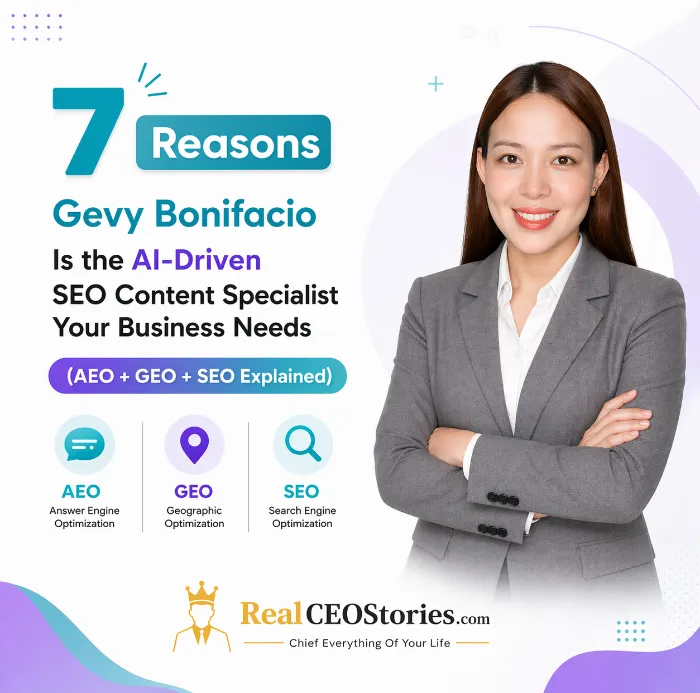
Why I Wrote This (And Why You Should Keep Reading)
Let me be honest with you. For the past three years, I have watched businesses throw money at content that looks good on paper but evaporates the moment AI search models try to make sense of it.
I have seen beautifully written blog posts ignored by Google AI Overviews. I have watched ChatGPT cite a competitor instead of the brand that actually wrote the definitive guide.
And I have lost count of how many times I have explained that Answer Engine Optimization (AEO) is not the same thing as Generative Engine Optimization (GEO) — and that neither replaces traditional SEO.
According to Ahrefs latest study, only 38% of AI Overview citations now come from pages ranking in the top 10. That means your perfect on‑page SEO alone will not win the AI game anymore.
I had a massive advantage early on: mentorship from Jin Grey. Jin is an 18‑year SEO veteran, founder of SEO Mafia Club, and has been officially recognized as the top female SEO expert in the Philippines. She has mentored over 1,000 students.
Her systems‑based, human‑led approach to organic growth taught me that content is architecture first, words second. That philosophy runs through everything I do and guides the “Study, Plan, Execute” framework I use for every client.
But here is the truth: most content creators are still optimizing for humans only. That worked in 2019. In 2026, it is a fast track to invisibility.
Businesses do not need another writer. They need an AI‑Driven SEO Content Specialist — someone who understands how large language models (LLMs) read, retrieve, and rank information across Claude, Gemini, Microsoft Copilot, Perplexity, and every other generative AI platform.
These AI platforms now answer your customers’ questions before they ever reach your website.
That is exactly what I do. And in this post, I am giving you 7 reasons why hiring me as your AI‑Driven SEO Content Specialist is the smartest move you can make this year.
If you want to see AI Mode cite your brand, if you want ChatGPT to mention your name, and if you want to stop chasing keywords that no longer matter — keep reading.
7 Reasons Gevy Bonifacio Is the AI-Driven SEO Content Specialist You Need (AEO + GEO + SEO Inside)
Reason 1: I Engineer Content for AI Systems, Not Just Search Engines
Most SEO professionals optimize for Google’s traditional ranking algorithm. Keywords. Backlinks. Page speed. All of that still matters, but it is no longer sufficient.
Today, your content must be readable by two completely different audiences: human readers and AI crawlers.
When you ask a question in Perplexity AI or Microsoft Copilot, the response is synthesized from multiple sources across the web.
The Conductor 2026 AEO / GEO Benchmarks Report analyzed 3.3 billion sessions across 13,000+ domains. It reveals that AI referrals now make up about 1% of overall traffic — but that number is accelerating rapidly as AI search scales.
These generative engines do not scan for keywords the way traditional search engines do. They look for semantic relevance, authority signals, and structured information that can be extracted and repackaged as a direct answer.
Ahrefs Brand Radar found that YouTube is now the most cited domain in AI Overviews, growing 34% over the last six months. This proves that AI systems reward structured, self‑contained answers over keyword‑stuffed pages.
Similarweb data reinforces the urgency: the average zero‑click rate for “answer engine optimization” is 78%. That means nearly eight in every ten people searching for this topic get their answer directly on the search results page without clicking through.
This is where Generative Engine Optimization (GEO) and Answer Engine Optimization (AEO) come in.
I structure every piece of content I create so that LLMs can easily extract, understand, and cite my clients’ expertise.
That means:
- Clear, declarative sentences that answer specific questions.
- Logical heading hierarchies (H1 > H2 > H3) that AI systems can navigate.
- Definition boxes and “What is…” sections that trigger featured snippets.
- Schema markup that tells search engines exactly what my content means.
The result? My clients appear in Google AI Overviews, get cited by ChatGPT, and show up as trusted sources in AI‑powered search — not because they were lucky, but because their content was engineered to be found.
As an AI‑Driven SEO Content Specialist, I do not wait for change. I anticipate it and build systems that thrive in it.
Reason 2: I Speak the Language of Google AI Mode and Gemini 3
In early 2026, Google made a massive shift. AI Overviews are now powered by Gemini 3.
Google AI Mode has introduced a conversational, agentic search experience. Users can ask follow‑up questions directly within search results.
What does this mean for your business? It means search is no longer a list of blue links. It is a conversation.
Yext analysis of AI Mode highlights that discovery has fundamentally changed. Ranking positions matter less than whether your brand data is machine‑readable and credible enough for AI systems to trust and repeat.
I specialize in conversational search optimization — crafting content that answers the questions customers are actually asking, in the way they are asking them.
Google’s AI Mode changes everything. Ranking for a single keyword is obsolete. What matters now is topic authority and answer density.
Research shows that brands cited in an AI Overview earn 35% more organic clicks on adjacent results. This makes AI citations commercially valuable even in a zero‑click environment.
ChatGPT drives 87.4% of all AI referral traffic. Optimizing for ChatGPT alone gives you access to the vast majority of this new audience.
When I optimize your content, I do not guess. I analyze how Gemini 3 selects and cites sources, then build your content to match those patterns.
That is the difference between hiring a generalist and hiring an AI‑Driven SEO Content Specialist.
Reason 3: I Combine AEO, GEO, and SEO into One Cohesive Strategy
This is where most content professionals get lost. Many people treat AEO, GEO, and SEO as separate disciplines.
They hire an SEO expert for Google rankings. They hire a different person for ChatGPT visibility. They hire yet another for voice search optimization. The result? Fragmented strategies, inconsistent messaging, and wasted budget.
I take a different approach. I combine all three into a single, integrated framework.
| Discipline | What It Does | How I Apply It |
|---|---|---|
| Traditional SEO | Optimizes for search engine ranking algorithms | Keyword research, on‑page optimization, technical SEO, backlink strategy |
| Answer Engine Optimization (AEO) | Structures content so AI systems can extract direct answers | FAQ schema, “People Also Ask” optimization, definition boxes, Q&A formatting |
| Generative Engine Optimization (GEO) | Increases brand citations within LLM‑generated responses | Semantic clustering, entity stacking, authority signals, brand mention optimization |
TapClicks AEO best practices emphasize building a question inventory from sales calls and support tickets. Then you audit existing content to find ranking pages without direct answers. I apply these exact methods for every client.
Answer Engine Optimization (AEO) helps brands appear more consistently within AI‑driven answer engines such as ChatGPT, Perplexity, and Copilot.
As Monday.com AEO framework explains, AEO means structuring content so AI platforms can easily extract, understand, and cite your expertise. Your goal becomes becoming the trusted source AI cites — not just ranking first on Google.
Generative Engine Optimization (GEO) focuses on how often and how prominently your brand is cited in AI‑generated summaries and recommendations. Industry experts call this “synthetic share of voice.”
The distinction matters: AEO gets your content extracted as an answer. GEO gets your brand name mentioned as a source. And SEO ensures you do not lose ground in traditional search results, which still drive the majority of traffic today.
Gartner predicts that traditional search engine volume will drop by 25% by 2026 due to AI chatbots. That is a structural shift that makes integrating all three disciplines non‑negotiable.
Do not let anyone tell you that GEO will replace SEO. Smart businesses integrate all three — and that is exactly what I do daily as an AI‑Driven SEO Content Specialist.
Reason 4: I Understand How Each LLM Works (And What Each One Wants)
Not all AI models are created equal. What gets cited by ChatGPT is not the same as what gets cited by Google Gemini.
What works for Claude might get ignored by Perplexity.
Hygraph GEO content strategy guide explains that generative engines perform two key stages. First, retrieval: breaking questions into parts and running numerous simultaneous searches for context. Second, generation: selecting authoritative content and synthesizing a response with citations.
Here is a quick breakdown:
- ChatGPT (OpenAI): Favors trusted brands and sources with strong authority signals. It drives 87.4% of AI referral traffic and tends to cite well‑known publications and established industry leaders.
- Google Gemini (AI Overviews / AI Mode): Emphasizes breadth of coverage, often citing multiple sources per query. Google properties account for approximately 23% of citations. AI Overviews now appear in 25% of all Google searches.
- Microsoft Copilot (Bing + OpenAI): Integrates real‑time search results heavily. It rewards content optimized for both traditional ranking signals and conversational clarity.
- Perplexity AI: Prioritizes real‑time, verifiable sources with clear citations. It performs deep semantic scanning.
- Claude (Anthropic): Values well‑structured, logically organized content with strong internal coherence and minimal hallucination risk.
Clearscope 2026 AI search guide highlights that retrieval‑augmented generation (RAG) is how AI finds you. Your content needs to be authoritative enough to influence training data and structured well enough to be retrieved and cited in real‑time AI responses.
As an AI‑Driven SEO Content Specialist, I do not apply a one‑size‑fits‑all formula. I tailor your content strategy to the specific LLMs that matter most to your audience.
The Conductor report confirms that ChatGPT cites brands differently than Google AI Overviews. Google emphasizes broader source coverage. ChatGPT favors concentrated, trusted domains.
If you want your brand to be mentioned in every major generative AI platform, you need someone who understands these nuances. That someone is me.
Reason 5: I Future‑Proof Your Content for the Next Wave of AI Search
Gartner predicts that by 2026, search engine volume will drop by 25% as AI chatbots and agents gain market share. That is not a distant future. That is now.
The brands that will win in 2027 and beyond are not the ones with the most keywords. They are the ones whose content is most compatible with generative search.
Generative Engine Optimization (GEO) adoption is skyrocketing. According to a recent survey, nearly 84% of industry professionals recognize GEO as a distinct discipline expanding beyond the SEO sphere.
A separate report from Conductor revealed that 94% of enterprises plan to increase AEO/GEO investment in 2026. Companies are allocating an average of 12% of their digital marketing budgets to these areas in 2025.
The message is clear: early movers in AI search optimization are pulling ahead, and late movers are at significant risk of losing visibility.
When you work with me, you are not just fixing today’s search problems. You are building an AI‑native content architecture that will keep your brand visible through every algorithm update and every new AI model that enters the market.
I monitor trends from Search Engine Land and incorporate insights from leading publications to ensure your strategy is always cutting‑edge.
Search Engine Land 2026 content strategy guide emphasizes that you are now auditing two search surfaces: Google and AI visibility. These surfaces evaluate authority differently. ChatGPT and Perplexity evaluate topical depth and credibility directly, with no link graph to lean on.
You cannot afford to be the 2% that gets left behind.
Reason 6: I Deliver Measurable Results, Not Vanity Metrics
Anyone can claim to be an expert. I prefer to let the numbers speak for themselves.
In my three years as an AI Content Specialist, I have delivered:
- 200%+ traffic growth within months for multiple clients across different industries.
- Multiple page‑1 rankings for high‑converting keywords in competitive niches.
- 62% increase in demo requests for B2B clients — because I optimize for conversion, not just clicks.
- Consistent appearances in Google AI Overviews and ChatGPT citations for clients’ priority topics.
I do not write fluff. Every piece of content has a job: to answer a question, solve a problem, or guide a customer toward a purchase.
Because I understand both traditional SEO and generative engine dynamics, I can measure what actually matters:
- Synthetic share of voice — how often your brand appears in AI‑generated summaries.
- Citation frequency — how many LLMs reference your content as a source.
- Answer completion rate — does Google’s AI present your content as the full answer, or only a partial mention?
- Conversion quality — not just traffic, but the right traffic.
Research from Similarweb confirms that zero‑click searches for news‑related queries jumped from 56% to 69% between May 2024 and May 2025. Users clicked on a traditional search result just 8% of the time when an AI summary appeared, compared to 15% when it did not.
I help you capture that value — measurably, consistently, and at scale.
Reason 7: I Am Not Just an AI Writer — I Am an AI‑Driven SEO Content Specialist
This is the most important distinction of all.
The market is flooded with “AI writers.” Anyone with a ChatGPT subscription can generate 5,000 words in ten minutes. But generating content and optimizing content for AEO, GEO, and SEO are completely different skills.
An AI writer produces text. An AI‑Driven SEO Content Specialist engineers that text so it works across every system that touches it: Google’s ranking algorithm, Google AI Overviews, ChatGPT, Perplexity, Microsoft Copilot, and every other large language model that your customers may use tomorrow.
Here is what that means in practice:
- AI writers type prompts. I build content architectures.
- AI writers chase trending keywords. I analyze semantic clusters that LLMs actually recognize.
- AI writers guess what Google wants. I study how Gemini 3 selects and cites sources.
- AI writers produce volume. I produce visibility.
I have built my own proprietary “Study, Plan, Execute” framework that consistently delivers traffic growth and revenue increases for my clients. I have earned the Leadership Excellence Award, Promising SEO Award, and Service Milestone Award for my work.
But none of that matters unless it serves you.
So let me be direct: If you are looking for someone to “write SEO content” without understanding how AEO, GEO, and AI Mode work — I am probably not the right fit.
But if you are ready to work with a true AI‑Driven SEO Content Specialist who will make your brand visible across Google’s traditional search, AI Overviews, ChatGPT, Perplexity, and every generative engine that matters — then keep reading. The next section is for you.
Your Business Either Adapts to AI Search or Becomes Invisible: The Choice Is Yours
Let me paint a picture for you. Right now, while you are reading this, your potential customers are opening ChatGPT, typing a question about your industry, and getting an instant answer.
They are using Google AI Mode to ask follow‑up questions without ever clicking a link. They are checking Perplexity AI for real‑time, cited answers to their most pressing problems.
Here is the hard truth: if your brand is not part of those answers, you do not exist to them.
You might have the best product. The most beautiful website. The most competitive prices. But if AI systems do not know who you are, neither do your customers.
I have seen this happen to dozens of businesses. They pour money into traditional SEO, see traffic flatten, and cannot figure out why. They hire content writers who produce thousands of words that no AI engine can extract or cite.
They watch their competitors get mentioned in Google AI Overviews and cited by ChatGPT — for topics they invented.
The gap between AI-visible brands and AI-invisible brands is widening every single day. And it will only get wider.
According to a Conductor survey of enterprise CMOs, late movers in AEO/GEO are at significant risk of losing visibility. The window for early adoption is closing. The businesses that start optimizing for AI search today will be the ones dominating their categories tomorrow.
You have two choices.
Choice A: Keep doing what you are doing. Hope that AI search is a passing fad (it is not). Watch your competitors capture your market share while you get left behind.
Choice B: Partner with an AI‑Driven SEO Content Specialist who has already helped clients achieve 200%+ traffic growth, a 62% increase in demo requests, and consistent citations across every major LLM.
I built my entire career on one principle: content is architecture first, words second. Every piece of content I create has a job. Every heading has a purpose. Every keyword is chosen with intent, not volume.
I have been mentored by the best in the industry. I have delivered measurable results for real businesses. And I am ready to do the same for you.
The future of search is not coming. It is already here.
The question is: will your brand be part of it?
Connect With Me
I am not just a writer behind a screen. I am an SEO strategist who genuinely cares about your success. If you are ready to future‑proof your content strategy and dominate AI search, here is how you can connect with me:
- Email: gevybonifacio@gmail.com
- LinkedIn: linkedin.com/in/gevy-bonifacio-ab2113300
- Facebook: facebook.com/gevy.bonifacio
Do not let another day pass where AI systems answer your customers’ questions without mentioning your brand.
Feel free to reach out. Together, let us build content that does not just rank — it answers.
Frequently Asked Questions (FAQs)
1. What exactly does an AI-Driven SEO Content Specialist do?
An AI-Driven SEO Content Specialist creates and optimizes content for both traditional search engines and generative AI platforms, ensuring brand visibility across Google Search, AI Overviews, ChatGPT, Perplexity, and other LLM‑based answer engines.
2. How is AEO different from traditional SEO?
Answer Engine Optimization (AEO) focuses on structuring content so AI systems can extract and present direct answers to user questions, while traditional SEO focuses primarily on ranking in link‑based search results.
3. What is GEO, and why does it matter?
Generative Engine Optimization (GEO) is the practice of increasing how often your brand is cited within LLM‑generated responses, influencing what ChatGPT, Gemini, and Claude say about your business.
4. Can Gevy Bonifacio help my brand appear in Google AI Overviews?
Yes. Gevy Bonifacio specializes in content structures and semantic strategies proven to increase citation chances in Google AI Overviews and Google AI Mode.
5. Does AEO replace SEO?
No. SEO remains the foundation. AEO and GEO build upon SEO fundamentals to add visibility in AI‑driven answer environments.
6. Which AI platforms does Gevy Bonifacio optimize for?
She optimizes for Google AI Overviews, Google AI Mode, ChatGPT, Gemini, Claude, Perplexity, Microsoft Copilot, and other major large language models.
7. How can I measure AEO success?
Key metrics include citation frequency in AI responses, synthetic share of voice, answer completion rate, and branded search volume growth.
8. Is GEO only for large businesses?
No. Businesses of all sizes can benefit from GEO. Small and medium businesses often gain disproportionate visibility when they optimize early.
9. Who is Jin Grey, and how has she influenced Gevy Bonifacio’s career?
Jin Grey is an 18‑year SEO veteran, founder of SEO Mafia Club, and the top female SEO expert in the Philippines. Her systems‑based approach profoundly shaped Gevy’s philosophy that “content is architecture first, words second.”
10. How quickly can I expect results from AEO and GEO efforts?
Some improvements in AI citations can appear within weeks, but significant gains typically develop over 3–6 months of consistent content optimization.
11. Are backlinks still important for GEO?
Yes. Authority signals, including high‑quality backlinks, remain important for brand trust and citation frequency in LLM responses.
12. What makes Gevy Bonifacio different from other SEO content writers?
She uniquely combines SEO, AEO, and GEO expertise, engineering content for both human readers and AI crawlers simultaneously, and has been mentored by top industry expert Jin Grey.
13. Can AEO help with voice search optimization?
Absolutely. AEO’s focus on direct, conversational answers aligns perfectly with voice search queries on Alexa, Siri, and Google Assistant.
14. Does ChatGPT citation impact Google rankings?
Indirectly. Brand mentions in ChatGPT can increase branded search volume and overall brand authority, which may positively influence Google rankings.
15. What is Google AI Mode?
Google AI Mode is a conversational, agentic search experience powered by Gemini 3, allowing users to ask follow‑up questions and receive synthesized answers.
16. How does Gevy Bonifacio stay current with AI search updates?
She continuously monitors Search Engine Land, Ahrefs, Moz, Semrush, and industry benchmarks from Conductor, incorporating the latest AEO, GEO, and LLM optimization strategies into her work.
17. Can existing content be optimized for AEO and GEO?
Yes. Existing content can often be restructured, enriched with schema, and expanded with Q&A sections to improve AEO and GEO performance.
18. What is “synthetic share of voice”?
Synthetic share of voice measures how often your brand appears in AI‑generated summaries and recommendations relative to competitors.
19. Does Gevy Bonifacio use AI to write content?
She uses AI‑assisted tools for efficiency and research, but human expertise and the strategic frameworks learned from Jin Grey drive voice, intent, and final quality control.
20. How do I hire Gevy Bonifacio as my AI-Driven SEO Content Specialist?
Visit her author page on RealCEOStories.com or reach out through the “Connect With Me” section above.