

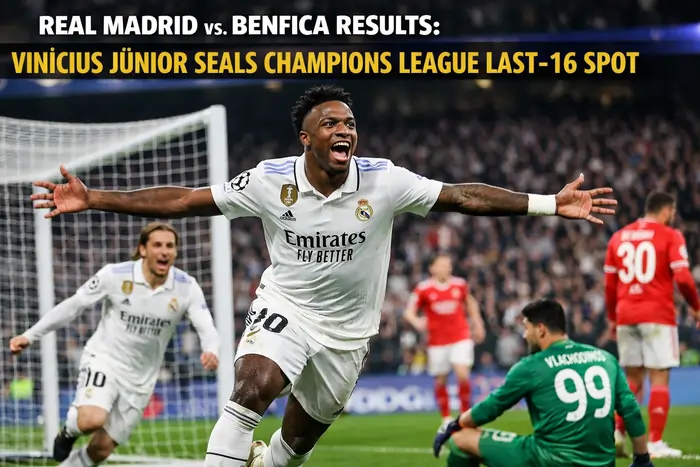
Real Madrid vs. Benfica: Real Madrid’s narrow win at the Santiago Bernabéu offered everything you expect from a high‑stakes Champions League playoff, with Vinícius Júnior sealing a dramatic last‑16 spot.
Match Overview
Coming into the second leg, Real Madrid held a slender 1‑0 advantage from the first leg in Lisbon, meaning the tie was finely poised and a single Benfica goal at the Bernabéu could flip the entire narrative. A raucous home crowd understood that this was more than a routine night in Europe, with the 15‑time European champions needing to manage both the scoreline and the emotional undercurrent around Vinícius Júnior’s recent experiences off the pitch.
Benfica arrived in Madrid with nothing to lose and everything to gain, knowing that an early goal would instantly erase the deficit and heap pressure on the home side. For Real Madrid, the task was simple in theory but complex in execution: finish the job, avoid complacency, and secure Champions League last‑16 qualification without allowing the match to drift into chaos.
If you’re following the competition as a whole, the official UEFA Champions League site remains the best hub for formats, fixtures, and updated knockout brackets.
First Half – Benfica’s Bright Start
True to their reputation as a brave, front‑foot side, Benfica started aggressively in the first half, pressing high and looking to disrupt Real Madrid’s build‑up from the back. That early ambition was rewarded when Rafa Silva capitalised on a chaotic sequence in the Madrid box, finishing from close range after Thibaut Courtois had initially produced a sharp save to prevent an own goal.
For a brief spell, the Bernabéu fell silent as Benfica drew level on aggregate and threatened to turn the tie on its head. Madrid, however, responded almost immediately: a swift move down the right ended with Federico Valverde cutting the ball back to the edge of the area, where Aurélien Tchouaméni guided a precise low shot into the corner to make it 1‑1 on the night.
The remainder of the half flowed from end to end, with Benfica still dangerous in transition and Real Madrid gradually tightening their control in midfield. Richard Ríos forced another strong stop from Courtois, while at the other end Madrid thought they had completed the turnaround when Arda Güler found the net, only for VAR to intervene and rule the goal out for offside.
For detailed move‑by‑move descriptions, the live text commentary on outlets like AS’s match blog is a valuable companion while rewatching highlights.
Second Half – Real Madrid Fight Back
After the break, Real Madrid adjusted their tempo and structure, pushing their full‑backs higher and asking more questions of Benfica’s defensive line. The home side began to recycle possession more efficiently, using long spells of controlled passing to sap Benfica’s energy and stretch the spaces between their midfield and defence.
Carlo Ancelotti’s side gradually tilted the pitch in their favour, and half‑chances started to arrive: set‑pieces, long‑range efforts, and crosses that just evaded a decisive touch in the box. Yet Benfica never vanished from the contest; they continued to threaten on the counter, and a strike against the crossbar served as a reminder that Madrid were still just one moment away from extra time.
The game entered its final quarter‑hour in a delicate balance: Real Madrid were pressing for the winner on the night to kill the tie, while Benfica needed only a single goal to push the fixture into an entirely different psychological space.
For tactical graphics and positional maps, the match report from Sky Sports breaks down the overall shape of both teams across the 90 minutes.
Vinícius Júnior’s Decisive Moment
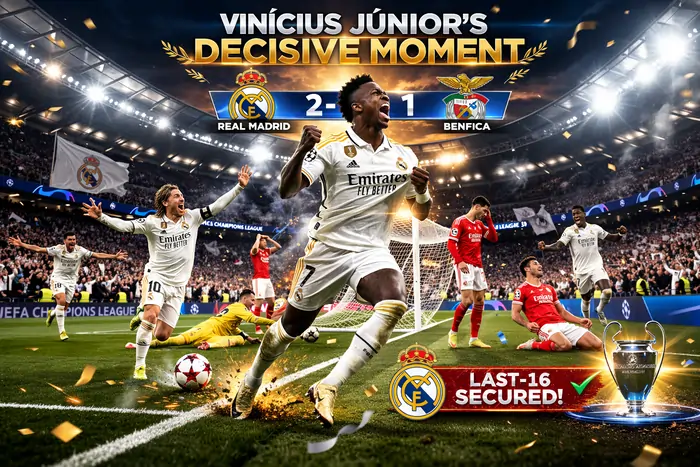
In matches of this magnitude, there is often a single moment that etches itself into memory, and here it belonged to Vinícius Júnior. With around ten minutes left, Valverde intercepted a loose pass in midfield and immediately slid a perfectly weighted ball into space behind Benfica’s back line.
Vinícius timed his run to perfection, bursting into the left‑hand channel and driving toward goal with the kind of confident, direct dribbling that has become his trademark. One‑on‑one with the goalkeeper, he opened his body and slotted a composed finish into the far corner, making it 2‑1 on the night and 3‑1 on aggregate to effectively seal Real Madrid’s progression to the Champions League last‑16.
Beyond the sporting significance, the goal carried emotional weight. It came just a week after Vinícius had been at the centre of a racism storm in the first leg, making his cool, decisive strike in front of the home crowd a statement of resilience as much as a sporting highlight. The Bernabéu responded with a roar, and from that moment onward the tie felt firmly in Real Madrid’s grasp.
If you want additional angles on Vinícius’ performance and the wider context, pieces from outlets like The Independent and ESPN provide in‑depth narrative coverage.
Key Performers and Tactical Talking Points
Several players stood out across the two legs, but this second match crystallised who truly shaped the tie. For Real Madrid, Vinícius Júnior’s combination of goals, direct running, and psychological presence made him the defining figure, while Tchouaméni’s midfield control and crucial equaliser in the first half helped stabilise the side when the tie threatened to slip away.
Thibaut Courtois once again demonstrated his value on big European nights, producing key saves both before and after Benfica’s opener to prevent the visitors from building an even more dangerous platform. Federico Valverde’s work rate and decision‑making, particularly his assist for Vinícius’ winner, were also fundamental to how Madrid transitioned from defence to attack.
On the Benfica side, Rafa Silva was their most incisive attacking threat, constantly looking to exploit space behind Madrid’s defence and capitalising on the first lapse to give his team hope. Richard Ríos and others in midfield pushed hard to disrupt Madrid’s rhythm, and their high pressing caused enough discomfort to keep the Bernabéu on edge.
For a more granular tactical breakdown, long‑form analysis from platforms like The Athletic (subscription required) dives into pressing structures, passing networks, and matchup details.
Stats and Numbers That Tell the Story
The raw numbers back up the impression that this was a contest defined by fine margins and moments of individual quality. Real Madrid edged possession and produced more overall attempts on goal, but clear‑cut chances were rarer than the shot totals might suggest, highlighting how cautious both sides were about over‑committing.
On the night, Madrid’s two goals came from relatively efficient attacking sequences, reflecting a clinical edge that Benfica struggled to match. The visitors registered meaningful efforts, including one that struck the crossbar and another that forced an excellent save from Courtois, but they lacked the final precision to change the trajectory of the tie.
Expected goals (xG) metrics, where available, tend to show a narrow gap, underscoring that Benfica were competitive in chance creation even if the final scoreline favoured Madrid. Ultimately, however, it is the timing of Madrid’s responses—Tchouaméni’s swift equaliser and Vinícius’ late winner—that stands out more than any single statistical category.
Sites like FotMob and The Sporting News offer full breakdowns of shots, xG, and player ratings if you want to dive deeper into the numbers.
In modern football, games like Real Madrid vs. Benfica are not just decided on the pitch but also in the data room, where clubs pore over tracking metrics, xG models, and tactical patterns to gain an edge. If you want a broader look at how advanced data and machine learning are reshaping everything from performance analysis to in‑game decision‑making, this deep‑dive on AI in sports analytics shows how technology is transforming the game behind the scenes.
What the Result Means for Real Madrid
For Real Madrid, this 3‑1 aggregate victory is another confirmation of their enduring ability to manage European knockout ties, even when they stumble early or face emotional external pressures. Progressing to the Champions League last‑16 once again keeps them on track in a competition that often defines their season more than domestic campaigns.
The win also reinforces the growing maturity of players like Vinícius and Tchouaméni, who are increasingly central to the team’s identity rather than merely supporting the club’s veterans. With a last‑16 tie looming against either Manchester City or Sporting CP, Madrid will need that mix of resilience, individual brilliance, and tactical control to advance further.
Psychologically, surviving a genuine scare—falling behind at home and needing to respond under pressure—could prove invaluable later in the competition, when small swings in momentum often decide entire seasons. For fans, this game will be remembered as another night when the Bernabéu saw its team bend but not break, with Vinícius at the centre of the story once more.
The Yahoo Sports match piece and beIN SPORTS recap both capture how this result shapes Madrid’s broader European campaign.
What’s Next for Benfica
For Benfica, elimination from the Champions League at this stage is a frustration precisely because they showed enough quality to believe they could have forced a different outcome. Across both legs they created danger, pressed bravely, and stayed within touching distance of Madrid until the final minutes, but crucial moments—missed chances, lapses in concentration, and the decisive second‑leg goal—ultimately proved costly.
The immediate consequence is a step back from Europe’s biggest stage, but the performance level displayed at the Bernabéu offers encouragement for future campaigns. Benfica’s coaching staff will likely focus on refining their game management, especially when holding a narrow lead or chasing a single goal, as well as improving efficiency in front of goal against elite opposition.
Domestically, they now have the opportunity to channel the intensity of this tie into their league and cup pursuits, where their aggressive pressing and fast transitions can still cause major problems for opponents. In European terms, the lessons learned from facing a top‑tier knockout specialist like Real Madrid are invaluable for shaping how the club approaches future Champions League or Europa League runs.
For a Benfica‑centred perspective, the report on Al Jazeera outlines where they impressed and where the tie slipped away.
Reactions and Quotes
Post‑match reactions added another layer to the narrative surrounding this fixture, especially where Vinícius Júnior was concerned. Reports indicate that he faced boos and hostility from sections of the Benfica support, yet responded with a decisive goal and a composed demeanour, turning the story back toward football rather than off‑field controversy.
Commentary from Real Madrid’s camp highlighted both relief and pride: praise for the team’s resilience, acknowledgement of the early scare, and recognition of Vinícius’ mental strength in delivering under pressure. On the Benfica side, there was a mix of disappointment at the result and appreciation for how close they had pushed one of Europe’s most decorated clubs, including frustration over missed opportunities that might have changed the tie’s trajectory.
Many pundits framed the match as a case study in how elite clubs manage adversity: fall behind, stay calm, trust the structure, and rely on star quality at decisive moments. In that context, Vinícius’ winner is likely to be replayed and referenced throughout the remainder of this Champions League season, especially if Madrid advance deep into the competition.
Pieces like Evrimagaci’s feature zoom in on the human and psychological dimension of Vinícius’ performance, adding useful colour beyond the pure match facts.
Final Thoughts
Real Madrid vs. Benfica delivered a compelling Champions League playoff second leg defined by momentum swings, tactical adjustments, and a signature moment from Vinícius Júnior. Benfica’s bright start and sustained competitiveness ensured that the tie never felt comfortable for Madrid, but the hosts once again found a way to bend the evening in their favour when it mattered most.
From a narrative standpoint, this match will be remembered as the night Vinícius Júnior not only sealed Real Madrid’s passage to the Champions League last‑16 but also reaffirmed his status as a player who thrives in high‑pressure European moments. For Madrid, it is another chapter in a long story of knockout resilience; for Benfica, it is a harsh but instructive lesson in the tiny margins that separate glory from heartbreak in this competition.
To continue exploring this tie, revisiting the full highlights on official broadcasting partners and cross‑checking analysis from sources like BBC Sport and China Daily provides a rounded view of how this dramatic European night unfolded.