

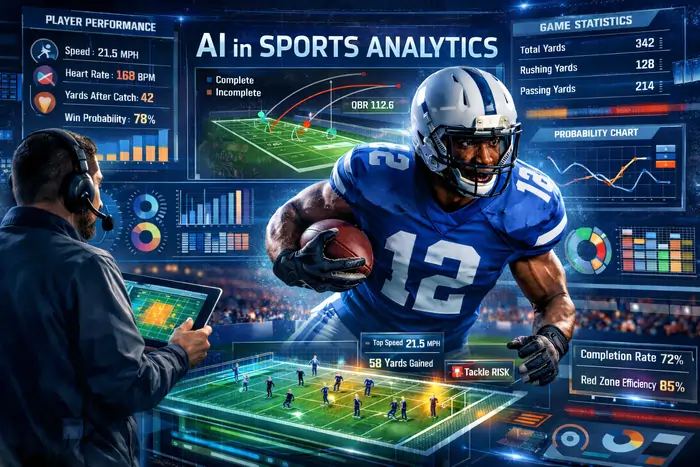
AI in sports analytics is changing how games are played, coached, and experienced, turning raw data into insights that were almost impossible to see in real time a decade ago. Instead of relying purely on intuition and basic stats, teams now combine tracking systems, wearables, and advanced algorithms to understand everything from player fatigue to tactical weaknesses. This shift is why clubs, leagues, and even grassroots academies are investing heavily in analytics infrastructure and AI‑driven tools.
In this article, we will unpack what AI in sports analytics actually means, how it powers performance optimization and strategy, how it supports smarter scouting and fan engagement, the technologies behind it, and the key challenges and ethical questions that come with such powerful capabilities. For a broad industry overview as you read, you can refer to this primer on AI in sports: use cases, trends, and examples.
What Is AI in Sports Analytics?
At a basic level, AI in sports analytics refers to using machine learning, computer vision, and other AI techniques to collect, process, and interpret large volumes of sports data in ways that support better decisions. Traditional analytics focused on box scores, simple averages, and manually coded video, but AI models can ingest millions of data points—from positional tracking to biometric signals—and find patterns that humans would struggle to detect.
Key data sources include wearables that track heart rate and accelerations, optical or GPS tracking systems that follow every player’s movement on the field, and video feeds that computer vision systems convert into structured information about formations, passes, and shots. Historical performance databases and contextual factors (travel, schedule congestion, weather) round out the picture, giving models the inputs they need for predictions and recommendations.
If you want a structured, technical definition, Coherent Market Insights’ overview of AI in sports analytics and Coursera’s explainer on how AI is used in sports analytics today are good starting points.
Player Performance and Training Optimization
One of the most impactful uses of AI in sports analytics is optimizing individual and team performance. AI models analyze detailed movement patterns, workload, and biometrics to help coaches design training plans that improve performance without crossing into overtraining. Systems track accelerations, decelerations, jump counts, and heart‑rate responses to understand how each athlete responds to different loads.
This data feeds into personalized training optimization, where algorithms suggest adjustments to session intensity, volume, or rest periods for each athlete rather than applying a one‑size‑fits‑all model. Research on personalized training optimization for sports athletes shows that AI‑driven approaches can meaningfully enhance fitness gains while reducing the risk of burnout or injury. AI models also support return‑to‑play decisions by comparing an athlete’s current movement signatures to their pre‑injury baseline.
Injury prevention is another major focus. Advanced systems can detect micro‑changes in gait, jump landings, or acceleration patterns that indicate fatigue or increased injury risk, often before an athlete feels anything is wrong. A recent summary of ways AI is transforming sports analytics highlights use cases like fatigue detection algorithms that alert staff before performance drops and injury‑risk assessment models based on biomechanical stress.
For a deeper research perspective, the narrative review on AI and machine learning in sport research outlines how these methods improve performance analysis across multiple sports.
Game Strategy and Tactics on a New Level

Beyond physical performance, AI is transforming how teams think about strategy and tactics. By analyzing thousands of games’ worth of tracking and event data, models can detect recurring patterns in how opponents attack, defend, or respond under pressure. For example, AI can reveal which pressing triggers lead to high‑value chances or which passing lanes an opponent leaves open in specific formations.
During matches, real‑time systems process live positional data, heat maps, and possession trends to suggest tactical adjustments. AI might recommend pushing a full‑back higher to exploit a weak flank, changing matchup assignments in basketball, or modifying line combinations in hockey based on fatigue and matchup data. Sparkco’s overview of AI sports analytics transforming the future of sports describes how machine learning and computer vision combine to power these in‑game tactical insights.
Scenario modelling is another powerful use case. Coaches can run “what‑if” simulations—how likely are we to concede if we switch to a back three, what happens to expected goals if we change pressing intensity, or how does a different rotation affect net rating over a series? DeepMind’s work on advancing sports analytics through AI research demonstrates how reinforcement learning and sequence modelling can support these kinds of strategic questions.
Articles like XenonStack’s guide to AI and sports analytics for game strategy and player development offer more examples of tactical applications across different sports.
Scouting, Recruitment, and Talent Identification
Scouting and recruitment have traditionally relied on live observation, video review, and subjective assessments. AI in sports analytics adds a data‑driven layer that helps organizations identify undervalued talent and reduce bias. By combining performance metrics, physical attributes, positional data, and contextual factors, AI models build detailed profiles that project how a player might fit into a specific role or system.
Machine learning models can spot patterns that correlate with future success even if the player’s current stats aren’t eye‑catching—for example, off‑ball movement quality or pressing efficiency. ScoutOS’s article on AI in sports analytics for enhancing performance and strategy notes how smaller clubs use these tools to find players who are mispriced in the market. AI‑driven analysis of youth competitions and academy data can also surface prospects earlier, allowing clubs to invest in development sooner.
More advanced research, such as theses on predicting athlete performance using machine learning models, explores how different algorithms perform at projecting future output from historical data. While human scouts remain essential for context, character assessment, and cultural fit, AI gives them another lens to work with.
Fan Engagement and the Business Side of Sports
AI in sports analytics isn’t just about what happens on the field; it is also reshaping fan engagement and revenue generation. By analyzing ticketing data, viewing habits, app usage, and social media interactions, teams can deliver highly personalized experiences—custom content recommendations, targeted offers, and dynamic messaging.
AI‑powered systems automatically generate highlight clips tailored to each fan’s favorite players or play types, improve broadcast graphics and storytelling, and power chatbots that answer questions or provide live updates. A LinkedIn article on AI in sports analytics revolutionizing performance and fan engagement explains how clubs are using these tools to deepen loyalty and increase revenue.
On the business side, predictive analytics support dynamic ticket pricing, more accurate attendance forecasting, and smarter sponsorship activation. Straits Research’s analysis of how sports analytics reshapes performance and fan engagement highlights how data‑driven fan engagement can boost ticket sales and sponsorship value. For a marketing‑specific angle, a recent review on how generative AI is reshaping sports marketing and fan engagement shows how personalized campaigns and real‑time content delivery are becoming standard.
Technologies Behind AI in Sports Analytics

Several core technologies power AI in sports analytics. Machine learning models—including regression, tree‑based methods, and deep learning—handle tasks such as performance prediction, injury risk assessment, and tactical pattern recognition. Computer vision interprets video feeds to extract positional data, detect events (shots, passes, tackles), and classify movements without manual tagging. Natural language processing (NLP) can help analyze scouting reports, press conferences, or fan sentiment on social media.
These AI components run on top of data pipelines that collect information from wearables, optical tracking systems, GPS units, and match‑event feeds, often in near real time. Cloud platforms and edge computing are used to process and deliver insights quickly enough to matter during training sessions or live games. Sparkco’s piece on AI sports analytics and the future of sports describes how machine learning and computer vision integrate into a single tactical analysis stack.
For a high‑level tour of technologies and use cases, Intuz’s guide on AI in sports: practical uses, impacts, and trends and iTransition’s AI in sports overview both break down the tech components used by modern organizations.
Benefits and Competitive Advantages
The appeal of AI in sports analytics comes down to the quality and speed of insight. Compared with manual analysis, AI systems can process vastly more data and uncover subtle relationships that humans would miss, such as complex multi‑player interactions or early indicators of fatigue. This leads to more precise performance interventions, smarter tactical decisions, and better roster management.
AI also brings more objectivity to decisions that were historically swayed by bias or limited sample sizes—such as evaluating a player based on a handful of games or highlight reels. With robust models, front offices and coaching staffs can rely on evidence‑based frameworks while still layering in their experience and intuition. Over time, organizations that leverage AI effectively tend to build advantages in player health, consistency, and talent development, which compound over multiple seasons.
A recent article outlining 8 ways AI is transforming sports analytics emphasizes that these advantages span on‑field performance, scouting accuracy, and fan experiences. Similarly, pieces like USM Systems’ guide on AI in sports for performance, training, and fan experience highlight how real‑time analysis is now central to competitive success.
Challenges, Risks, and Ethical Considerations
Despite the upside, AI in sports analytics comes with serious challenges. One is data quality: noisy sensor readings, inconsistent tagging, or incomplete datasets can undermine model accuracy and lead to misleading conclusions. Another is model bias; if historical data reflects past biases in playing time, scouting, or selection, AI may inadvertently reinforce those patterns.
Privacy and security concerns are especially acute because athlete data—biometrics, health metrics, even psychological assessments—is highly sensitive. Organizations must navigate consent, data governance, and compliance requirements to ensure information is used appropriately and not exposed to opponents or third parties. Over‑reliance on algorithms is another risk; there is a danger in treating AI outputs as unquestionable truths, particularly when model assumptions or limitations are not well understood by decision‑makers.
Academic work like the review on reshaping the future of sports with AI stresses that successfully integrating AI requires not just technical excellence but also ethical frameworks and clear human oversight. Articles such as Cognativ’s discussion of the impact of AI in sports similarly underline the importance of trust, transparency, and addressing data‑accuracy challenges.
The Future of AI in Sports: What’s Next?
Looking ahead, AI in sports analytics is expected to become even more integrated, real time, and personalized. Experts foresee systems that can process hundreds of thousands of data points per second, delivering tactical suggestions to coaches through augmented reality interfaces or real‑time dashboards. Generative AI is likely to expand its role in content creation and marketing, automatically producing tailored narratives and visualizations for different audiences.
AI is also trickling down the pyramid. Youth academies and amateur teams are starting to use affordable apps and camera systems powered by AI to analyze training sessions and games. As tools become cheaper and more user‑friendly, data‑driven coaching and performance monitoring will no longer be the exclusive domain of elite clubs. Over time, coaching roles may evolve to emphasize interpreting and communicating insights, while analysts and data scientists become even more embedded in performance staffs.
To explore future scenarios, the blog on AI sports analytics transforming the future of sports and Lasting Dynamics’ overview of AI in sports transforming the game provide forward‑looking perspectives on trends through 2030.
As AI becomes more deeply embedded in performance, strategy, and fan engagement, sports will increasingly mirror broader corporate trends, where leaders use data and automation to reimagine entire business models—a dynamic explored in this article on the rise of artificial intelligence in business.
Conclusion: Transforming the Game, Not Replacing It
AI in sports analytics is undeniably transforming the game—how athletes train, how coaches make decisions, how scouts find talent, and how fans connect with their teams. But at its best, AI is an augmenting force rather than a replacement for human expertise, giving professionals richer information and more time to focus on what they do best.
Teams that thrive in this new era will be those that learn to ask better questions of their data, invest in both technology and people, and balance algorithmic insight with on‑the‑ground experience. For coaches, analysts, and executives, now is the moment to experiment with AI‑driven tools, build literacy around their strengths and limitations, and design processes where data and intuition work together to keep them a step ahead.