

Introduction
Understanding property valuation methods is essential for buyers, sellers, investors, and real estate professionals. Property valuation determines the estimated market value of a property based on various financial, economic, and physical factors. Accurate valuation plays a key role in real estate transactions, investment decisions, taxation, and financing.
Whether someone is purchasing a home, selling commercial property, or evaluating a real estate investment, knowing how property values are calculated can help make informed decisions. Property valuation methods allow investors and professionals to analyze a property’s true worth rather than relying only on listing prices or market speculation.
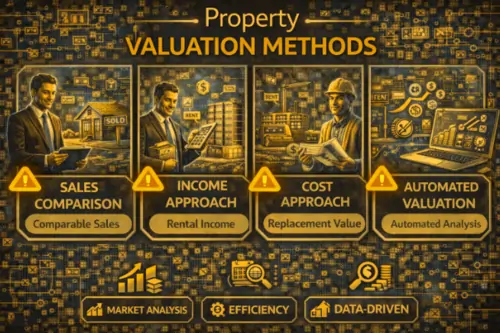
Several standard approaches are used in the real estate industry. Each method is designed to evaluate property value from a different perspective, depending on the type of property and the purpose of the valuation.
Why Property Valuation Matters
Property valuation is important because it helps determine a fair market price. Buyers want to ensure they are not overpaying, while sellers want to price their property competitively.
Financial institutions also rely heavily on property valuation methods when approving mortgages or real estate loans. Lenders need to confirm that the property’s value is sufficient to secure the loan.
Investors use property valuation to estimate potential returns, assess risk, and compare different investment opportunities.
By applying proper property valuation methods, stakeholders can make decisions based on objective analysis rather than assumptions.
The Sales Comparison Approach
The sales comparison approach is one of the most widely used property valuation methods, especially for residential real estate.
This method estimates property value by comparing it to similar properties that have recently been sold in the same area. These properties are often referred to as “comparable sales” or “comps.”
Several factors are considered when using this method, including:
- property size
- number of bedrooms and bathrooms
- location and neighborhood
- property condition
- recent renovations or upgrades
Appraisers adjust the value based on differences between the subject property and comparable properties. For example, if a comparable property has an additional bedroom, the appraiser may subtract value when making the comparison.
The sales comparison approach works best in active markets where there are many recent property transactions.
The Cost Approach
The cost approach is another important method used in property valuation. This approach estimates how much it would cost to rebuild the property from scratch, including the cost of land and construction.
The cost approach considers three main components:
- Land value
- Construction cost of the building
- Depreciation due to age or wear
The formula can be simplified as:
Property Value = Land Value + Construction Cost − Depreciation
This method is commonly used for new buildings, special-purpose properties, or situations where comparable sales are limited.
Because the cost approach focuses on replacement cost, it is often used for insurance purposes and unique property types such as schools, hospitals, or government buildings.
The Income Approach
The income approach is frequently used for commercial real estate and rental properties. This method focuses on the income a property can generate.
Investors typically analyze rental income, operating expenses, and expected returns when applying this approach.
The most common formula used in the income approach is the capitalization rate (cap rate):
Property Value = Net Operating Income ÷ Capitalization Rate
Net operating income (NOI) represents the property’s annual income after operating expenses but before financing costs and taxes.
For example, if a property generates $50,000 in annual net income and the market cap rate is 5%, the estimated property value would be:
$50,000 ÷ 0.05 = $1,000,000
Because it focuses on income generation, the income approach is especially useful for apartment buildings, office spaces, and retail properties.
The Gross Rent Multiplier Method
Another simplified method related to the income approach is the gross rent multiplier (GRM) method.
This method evaluates property value based on rental income and market data.
The formula is:
Property Value = Gross Rental Income × Gross Rent Multiplier
The GRM is typically calculated by dividing the sale price of comparable properties by their annual rental income.
While this method is quick and simple, it does not consider operating expenses. Therefore, it is usually used as a rough estimate rather than a detailed valuation.
The Price Per Square Meter Method
In some markets, property values are estimated using the price per square meter method.
This approach calculates property value based on the average price of similar properties per unit of area.
For example, if the average price in a neighborhood is $2,000 per square meter and the property size is 100 square meters, the estimated value would be:
100 × $2,000 = $200,000
Although this method is easy to understand, it does not account for unique property characteristics such as condition, amenities, or location advantages within the neighborhood.
Therefore, it is often used as a preliminary valuation tool.
Factors That Affect Property Valuation
While valuation methods provide structured analysis, several external factors can influence property values.
Location
Location remains one of the most important elements in real estate valuation. Properties located near business districts, transportation hubs, schools, and amenities typically have higher values.
Market Conditions
Real estate markets fluctuate depending on supply and demand. Economic growth, interest rates, and housing availability can all affect property values.
Property Condition
Well-maintained properties with modern features and renovations often command higher valuations than properties that require major repairs.
Future Development
Planned infrastructure, commercial developments, or zoning changes can significantly influence property values over time.
Considering these factors alongside formal property valuation methods helps produce a more accurate estimate.
When Professional Valuation Is Needed
In many situations, professional property valuation is required.
Examples include:
- mortgage applications
- property taxation
- legal disputes
- investment analysis
- insurance assessments
Certified appraisers use industry-standard valuation methods along with local market data to provide reliable property assessments.
Professional valuations help ensure transparency and fairness in real estate transactions.
Conclusion
Understanding property valuation methods is crucial for anyone involved in real estate. Accurate property valuation helps buyers, sellers, lenders, and investors make informed decisions based on objective data.
The most common methods include the sales comparison approach, cost approach, and income approach. Each method evaluates property value from a different perspective, depending on the type of property and the purpose of the valuation.
By combining these methods with market knowledge and professional analysis, stakeholders can gain a clearer understanding of a property’s true value.
As real estate markets continue to evolve, mastering property valuation techniques remains a valuable skill for both new and experienced investors.
FAQ
What are property valuation methods?
Property valuation methods are techniques used to estimate the market value of real estate based on factors such as comparable sales, income potential, and replacement cost.
Which property valuation method is most common?
The sales comparison approach is the most common method, particularly for residential real estate.
What is the income approach in property valuation?
The income approach estimates property value based on the income it generates, commonly used for rental and commercial properties.
Why is property valuation important?
Property valuation ensures fair pricing in real estate transactions and helps lenders, investors, and buyers make informed decisions.
Who performs property valuations?
Property valuations are typically performed by licensed real estate appraisers or valuation professionals.