

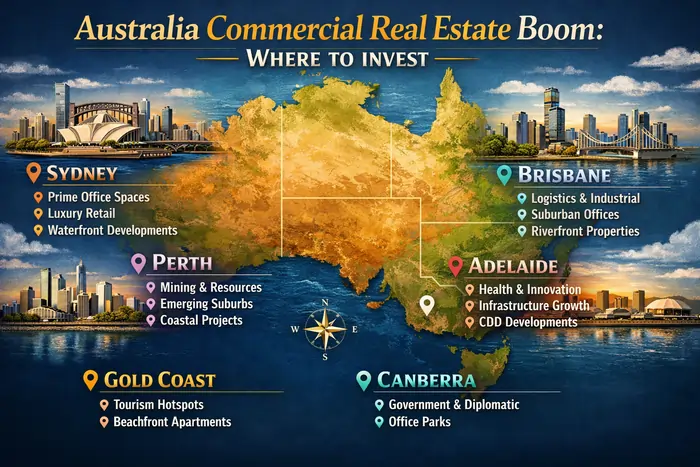
Australia’s commercial real estate market is entering 2026 with a clear recovery story and sector‑specific boom conditions, especially in industrial, logistics, “living” assets and prime offices. For investors, the key question is not whether to participate, but where and how to allocate capital in a market that’s rebounding with tighter supply and more disciplined pricing.
Introduction
Major global firms now describe Australia’s commercial property sector as moving “from resilience to optimism.” Cushman & Wakefield’s Australian Commercial Real Estate Outlook 2026 notes that the market enters 2026 with greater clarity, disciplined capital and structurally supported demand across key asset classes.
This commercial real estate upswing is closely linked to what’s happening in the residential market, where prices are also surging despite higher interest rates. For a deeper look at the housing side of the story, Real Estate Australia Surge: Smart Moves Now breaks down the 2026 residential price boom and the smart plays open to homebuyers and investors, providing useful context alongside the commercial focus of this guide.
At the same time, CBRE’s Pacific Real Estate Market Outlook 2026 forecasts a 5–10% rise in investment volumes in 2026, with office and industrial leading, and total returns around 10% p.a. for nearly half of prime assets. This guide unpacks what that boom looks like, sector by sector and city by city, and outlines where to invest and what to watch as the cycle unfolds.
The 2026 Commercial Real estate Boom: What’s Really Happening?
Cushman & Wakefield characterises 2026 as a phase where repricing has largely occurred, financing costs have stabilised, and investors are re‑entering markets with sharper strategies focused on asset selection and income durability. CBRE similarly observes that pricing remains as much as 30% below replacement cost in some markets, favouring a buy‑over‑build strategy while yields are still relatively elevated.
The boom is not uniform:
- Industrial and logistics remain structurally tight, with national vacancy forecast to peak around 3.6% in 2H26—still below the long‑term equilibrium of 4%—supporting effective rent growth.
- Office has moved from fear to selective opportunity, with a clear “flight to quality” as tenants prioritise prime Grade A buildings in core CBD locations.
- Retail is seeing stronger rental growth and low vacancy in dominant, well‑located centres, even as weaker secondary assets lag.
Knight Frank’s Australian Horizon 2026 office, retail, industrial overview emphasises that the long‑standing advantage of “beds and sheds” is fading; office and retail now offer improving income returns and rental growth alongside industrial. The RICS APAC Commercial Property Monitor confirms that capital value expectations across office, industrial and retail remain positive, with foreign investment enquiries strengthening into 2026.
Sector Overview: Office, Industrial, Retail and “Living” Assets
Office: Flight to quality, prime vs secondary
CBRE forecasts that CBD office total returns will exceed historical averages over the next three years, led by Brisbane and Canberra, as net effective rents grow and cap rates tighten modestly. Limited new supply—three of the next five years will see no new Sydney CBD completions—supports pricing power for prime assets.
Knight Frank’s Horizon 2026 commentary highlights:
- Strongest recovery in core CBD precincts of Sydney and Brisbane.
- Eastern Core strength in Melbourne’s office market.
- Ongoing divergence between prime, well‑located buildings and secondary stock that struggles with vacancy and capex needs.
Industrial & logistics: Still the structural winner
Industrial remains the most structurally supported asset class, driven by e‑commerce, urban logistics and on‑shoring trends. CBRE expects industrial vacancy to stay below equilibrium, with effective rents returning to positive growth as incentives stabilise.
Investors are focusing on:
- Infill locations near major population centres and transport nodes.
- Last‑mile logistics facilities in Western Sydney, Melbourne’s west and Brisbane’s south.
- Land‑banking opportunities for the next development cycle.
Retail: Essentials and dominant centres
Australia’s retail sector proved surprisingly resilient, with CBRE forecasting mid‑single‑digit rent growth in 2026 and low vacancy (sub‑5%) amid limited new supply. Knight Frank notes that dominant shopping centres and well‑located sub‑regional centres are best placed to capture growth, thanks to their lack of direct competition and a “flight to quality” from retailers who no longer need to be everywhere.
Neighbourhood and convenience‑based centres anchored by supermarkets, medical and everyday services are particularly attractive for yield‑focused investors.
“Living” and alternative sectors
CBRE’s Pacific Outlook points to strong total returns in apartments and other “living” sectors (build‑to‑rent, student accommodation, healthcare), driven by rental growth and demographic trends. Harmony Group’s high‑yield property investments guide highlights high‑yield potential in student accommodation, medical centres and well‑located suburban office/industrial assets.
Where to Invest: Capital City Hotspots
Sydney
Sydney remains the bellwether for office and high‑end retail. Knight Frank notes that recovery has been strongest in core CBD precincts, where demand for premium buildings is reinforced by limited new supply and improving leasing markets. CBRE expects Sydney CBD office net effective rents to grow by around 6.6% in 2026, with no new supply in three of the next five years.
For industrial, Western Sydney’s logistics corridors—near the M7/M4, the new Western Sydney Airport and major intermodal terminals—continue to attract both core and value‑add capital. Prime retail investments cluster around dominant metro centres and large format retail along growth corridors.
Melbourne
Melbourne is in a later stage of office recovery, with Knight Frank highlighting sustained demand and strong rental growth in the Eastern Core office market. CBRE expects Melbourne’s meaningful recovery in CBD office to gather pace from 2027 onwards, which can position 2026 as a selective entry year for investors targeting under‑priced prime stock.
Industrial focus remains on Melbourne’s west and north, where logistics and manufacturing tenants drive demand in precincts tied to ports, airports and road freight. Retail opportunities tend to centre on sub‑regional and neighbourhood centres in growth corridors.
Brisbane
Brisbane is one of the standout markets. CBRE’s forecasts show Brisbane leading net effective rent growth for office (+7.3% in 2026), supported by limited new supply and strong population growth. Knight Frank expects continued growth across Brisbane’s CBD and fringe office markets, with recovery extending beyond the core.
Industrial opportunities cluster along the Ipswich corridor, Brisbane’s south, and near the Port of Brisbane. Retail and mixed‑use assets linked to Olympics‑related infrastructure and transport upgrades could offer long‑term upside.
Perth and Adelaide
Perth’s residential market boom has a commercial echo: industrial, logistics and convenience retail assets are attracting capital thanks to strong population growth, resilient local economies and comparatively high yields. Adelaide also shows steady office and industrial demand, with Knight Frank forecasting continued growth in its office market.
These smaller capitals often offer better income yields than Sydney and Melbourne, appealing to investors seeking income‑driven rather than purely capital‑growth strategies.
Regional and Corridor Opportunities
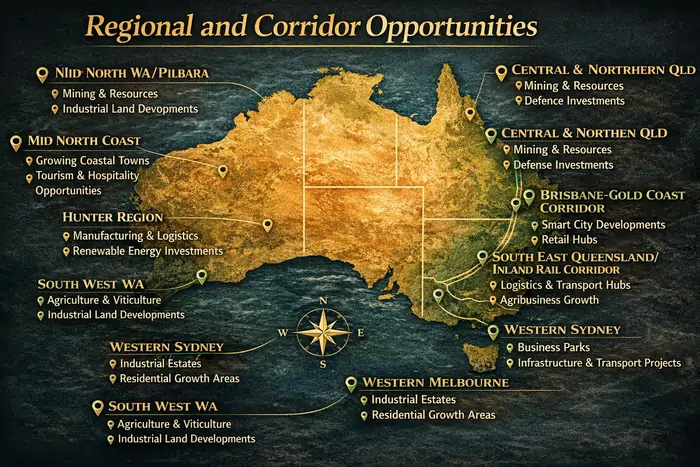
Beyond the CBDs, investors are looking at:
- Regional logistics hubs – Industrial assets near ports, intermodal terminals and major highway junctions, where e‑commerce and agribusiness supply chains intersect.
- Fast‑growing regional cities – Centres benefiting from population shifts and infrastructure, such as coastal cities and inland hubs with universities, hospitals and government services.
- Agribusiness and processing precincts – Light industrial and cold‑storage facilities connected to agrifood regions, leveraging Australia’s broader agritech and food tech push outlined by Austrade.
Pros of regional commercial: potentially higher yields, lower entry prices, and alignment with structural themes like logistics and food exports. Cons include thinner liquidity, concentration risk in local economies, and dependence on individual tenants.
Videos like “Where to invest in Australia in 2026? Regional vs Capital City” can help visualise pros and cons of regional vs metro commercial plays, though they should be cross‑checked with institutional research.
Yield, Risk and Deal Structure in 2026
CBRE notes that yields (cap rates) for many prime assets are still higher than historical averages after recent repricing, while underlying returns are increasingly driven by rental growth rather than further yield compression. Typical 2026 ranges (directionally, not exact figures) look like:
- Prime CBD office: lower yields but improving rent growth and strong tenant covenants.
- Fringe office and secondary CBD: higher yields but greater leasing and capex risk.
- Core industrial/logistics: compressed yields, strong rental growth in tight markets.
- Neighbourhood and sub‑regional retail: solid income, modest growth, tenant mix critical.
Harmony Group’s high‑yield property investments article breaks down risk/return profiles across office, retail, industrial and student accommodation, stressing the importance of WALE (weighted average lease expiry), rent review structures (fixed vs CPI‑linked) and tenant covenant quality for shaping risk.
Smart investors in 2026 pay close attention to:
- Lease length and rollover profiles (avoiding big expiries in weak markets).
- Rent review mechanisms that protect income in an inflationary environment.
- Tenant sector exposure (resilient essentials vs cyclical discretionary businesses).
Macro Trends Shaping Commercial Returns
Several macro themes sit behind the numbers:
- Hybrid work and office demand – CBRE’s APAC outlook sees renewed investor interest in office as the preferred asset class for the first time since 2020, driven by occupiers demanding high‑quality space in core locations. Flight to quality means secondary office stock faces more risk, while prime buildings with strong amenities and ESG credentials capture demand.
- E‑commerce and last‑mile logistics – Structural growth in online retail and just‑in‑time delivery keeps pressure on urban logistics rents, supporting industrial valuations.
- Demographics and services – Population ageing and growth drive demand for healthcare, medical hubs, education and seniors housing, supporting certain “living” and healthcare‑adjacent commercial assets.
- Sustainability and ESG – Tenants and lenders increasingly prefer energy‑efficient, low‑carbon buildings. Upgrading older stock can be a value‑add play, but also a capex risk if ignored.
Firstlinks’ “improving outlook of Australian commercial real estate” stresses that constrained supply pipelines, accelerating rental growth and resilient tenant demand together underpin attractive risk‑adjusted returns, especially when investors align with these structural trends.
Smart Strategies for Different Investor Profiles
Core, income‑focused strategy
For investors seeking stability, the focus is on prime, well‑located assets with long leases and strong tenants:
- CBD or well‑located suburban office with blue‑chip tenants and long WALE.
- Dominant neighbourhood or sub‑regional centres with essential retail anchors.
- Core industrial properties in infill locations near major cities.
Cushman & Wakefield and CBRE both emphasise that these assets offer strong income visibility and modest but reliable rental growth in coming years.
Value‑add and repositioning
Higher‑risk strategies target assets where you can:
- Re‑lease or re‑position secondary office buildings in improving precincts.
- Refurbish and “green” older assets to meet tenant ESG expectations.
- Intensify or reconfigure under‑rented retail or industrial sites.
DevelopmentReady’s “State of the Market: What’s Ahead for Commercial Real Estate in 2026” notes that as development starts remain subdued, smart repositioning plays can capture upside when supply is constrained.
Smaller investors: strata and neighbourhood assets
Not every investor can buy a CBD tower. Smaller investors often target:
- Strata offices in good locations.
- Small warehouses and showroom‑style industrial in growth corridors.
- Neighbourhood retail with strong local trade.
Educational pieces like NRG Property’s comparison of retail vs office vs industrial help clarify the pros and cons of each type from a small‑scale investor perspective.
Indirect exposure: syndicates, funds and REITs
For those who prefer not to manage assets directly, listed A‑REITs, unlisted funds and syndicates provide diversified exposure to commercial property sectors, with professional management and lower capital thresholds, as highlighted in Firstlinks and CBRE capital markets commentary.
Due Diligence: What to Check Before You Buy
Before committing to a commercial asset, rigorous due diligence is critical:
- Asset and building – Structural condition, maintenance history, compliance with fire, accessibility and environmental regulations.
- Tenants and leases – Tenant covenant strength, lease term, options, outgoings, rent review clauses, and any incentives or abatements.
- Location and planning – Zoning, future development potential, competing stock, and major infrastructure or planning changes in the precinct.
- Financial modelling – Stress‑test your assumptions on interest rates, vacancy, rental growth and capex; ensure you can service debt and maintain buffers under less‑favourable scenarios.
RICS’ updated Red Book Australia National Supplement provides guidance for valuations and standards, reinforcing the importance of robust appraisal practices in a changing market.
Engaging experienced brokers, valuers, lawyers and tax advisers is usually a smart move once the investment size goes beyond modest strata purchases.
Timing the Market: Boom, Plateau or Second Leg Up?
Research from Knight Frank and KPMG suggests that Australia’s commercial property sector is in a recovery and early expansion phase, with fundamentals supportive but not frothy. CBRE’s APAC outlook sees investment volumes rising 5–10% and office regaining favour, but notes that yield compression will be limited, shifting focus to rental growth as the main driver of returns.
Scenarios for 2026–2028 include:
- Gradual recovery – Rents and values rise steadily where supply is constrained and demand is strong (prime office, industrial, living).
- Plateau – Some sectors and locations see limited upside as pricing catches up with fundamentals.
- Volatility – Global shocks or domestic rate changes could temporarily disrupt capital flows or leasing demand.
Leading indicators to watch:
- Changes in vacancy and effective rents by sector and city.
- Transaction volumes and pricing trends in comparable assets.
- Lending conditions and bank appetite for commercial property.
- Foreign capital flows, as flagged by RICS’ improved foreign enquiry readings.
Knight Frank’s and Cushman’s research both argue that the window to buy quality assets at post‑repricing levels is open but narrowing, especially as more investors accept the “new normal” of higher rates and focus on income.
Action Checklist: Where and How to Move Now
To turn this into action, here’s a concise investor checklist for the next 3–6 months.
1. Market intelligence
- Read at least one major outlook, such as Cushman & Wakefield’s Australian Outlook 2026 and CBRE’s Pacific Real Estate Market Outlook 2026.
- Review sector‑specific analysis like Knight Frank’s office/retail/industrial overview and RICS’ Commercial Property Monitor.
2. Strategy selection
- Decide whether you are primarily chasing income, growth, or a mix; match this to sectors and cities that align (e.g., industrial/logistics vs prime office vs neighbourhood retail).
- Choose between direct ownership, syndicates/funds, or listed REITs based on your capital, time and risk tolerance.
3. Asset and location shortlisting
- Identify 2–3 focus markets (e.g., Sydney fringe office, Melbourne west industrial, Brisbane neighbourhood retail, Perth small industrial) and gather local data through agents and market reports.
- Screen potential assets for WALE, tenant quality, rent review structures and capex needs.
4. Professional support and execution
- Engage a commercial‑focused broker or buyer’s agent with experience in your chosen sector.
- Line up legal, valuation and tax advice early, especially for larger or more complex deals.
- Build financial models with conservative assumptions and clear buffer policies.
If you follow these steps and align your strategy with the structural trends highlighted in institutional research, the Australia commercial real estate boom in 2026 can be less about chasing headlines and more about building a portfolio of well‑chosen assets that deliver resilient income and long‑term growth.