

Around the world, more households are struggling to find safe, stable homes they can reasonably afford, turning housing from a background concern into a headline economic and social crisis. From major global cities to smaller communities, the affordable housing shortage is now a structural problem driven by deep market, policy, and financing issues that simple, short‑term fixes cannot solve.
This guide breaks down what “affordable housing” really means, the core causes of the crisis, and the most promising real‑world solutions that policymakers, developers, communities, and even individual households can act on.
Understanding Today’s Affordable Housing Crisis
In policy terms, housing is often considered “affordable” when households spend no more than around 30% of their income on housing costs, yet tens of millions of renters and owners regularly exceed this threshold. The National Low Income Housing Coalition’s 2025 Gap report shows a long‑standing systemic shortage of affordable and available homes for the lowest‑income renters, with millions of units missing from the market.
This housing affordability crisis is not limited to one country. The World Economic Forum notes that a lack of affordable housing to buy or rent is fuelling a global housing crisis that could impact 1.6 billion people by mid‑decade, requiring massive increases in affordable home production to keep up with demand. Cities from Los Angeles to London and Manila report similar patterns: limited supply in high‑opportunity areas, rising prices, and stagnant wages pushing more people into overcrowding, long commutes, or precarious living situations.
Unlike cyclical housing downturns, today’s shortage is structural: it stems from decades of underbuilding, restrictive land‑use policies, inadequate subsidies, and rising costs that have made it extremely difficult to produce new homes at prices low‑income households can afford.
Key Causes of the Affordable Housing Shortage
Multiple forces drive the shortage of affordable housing, and they reinforce each other.
1. Rising housing costs, land prices, and construction expenses
Land in high‑demand urban and suburban areas has become increasingly expensive, especially near jobs, transit, and good schools. At the same time, construction costs—materials, labor, and fees—have risen sharply, with supply chain disruptions and labor shortages making projects more expensive and slower to deliver. These factors mean the private market naturally targets higher‑rent or higher‑sale‑price units to recoup costs, leaving a gap at the lower end of the market.
2. Wage stagnation and income inequality
While housing costs have climbed, wages for many low‑ and moderate‑income workers have not kept pace, widening the gap between what people earn and what housing costs. Analysis from central banks and think tanks consistently finds that stagnating incomes, rising inequality, and precarious work arrangements make households more vulnerable to rent increases and shocks.
3. Restrictive zoning and land‑use regulations
Zoning and land‑use rules often limit density, restrict multifamily housing, and designate large swaths of land for single‑family homes only, especially in high‑opportunity neighborhoods. Research from institutions like the London School of Economics shows that such planning constraints significantly worsen housing unaffordability by artificially limiting the supply of developable land. In many regions, minimum lot sizes, height limits, and parking requirements further reduce feasible density and drive up per‑unit costs.
4. NIMBYism and political barriers
Resistance from existing residents—often labelled “NIMBYism” (“Not In My Back Yard”)—can slow or block new housing proposals, especially those including affordable units. Studies and local case examples show that community opposition increases political risk and uncertainty for developers, making affordable projects harder to finance and approve.
These factors combine into a systemic shortage that the private market alone is unlikely to fix, especially for the lowest‑income households, without targeted public intervention and reforms.
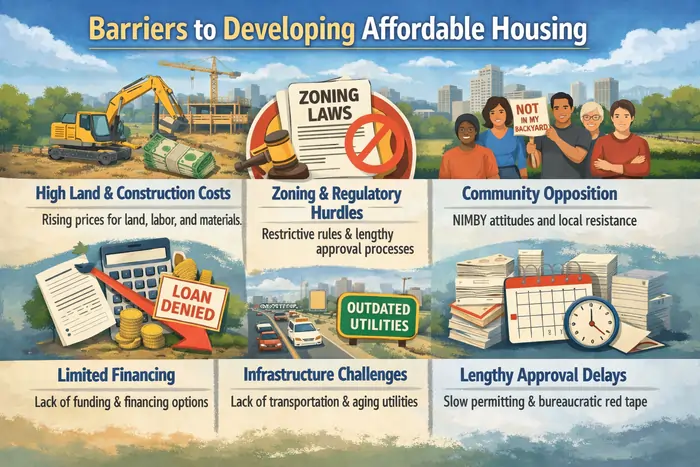
Barriers to Developing Affordable Housing
Even when there is political will to build more affordable housing, developers and non‑profits face specific barriers that make projects difficult to deliver.
Regulatory hurdles and lengthy permitting
Complex, fragmented approval processes—spanning zoning changes, environmental reviews, design approvals, and community hearings—can stretch projects out for years. Long timelines add risk and carrying costs, which are especially challenging for projects with thin margins like affordable housing.
Financing gaps and project feasibility
Because affordable rents are lower, they often cannot cover development and operating costs without subsidies, tax credits, or discounted land. Developers must piece together multiple funding sources—such as Low‑Income Housing Tax Credits (LIHTC), soft loans, and grants—through competitive, time‑consuming processes. Any disruption or delay in this capital stack can jeopardize feasibility.
Land scarcity in high‑opportunity areas
In many cities, the places where affordable housing is most needed—near jobs, transit, and amenities—also have the most expensive land and the strongest opposition to higher density. Research on brownfield and infill development shows that environmental remediation, infrastructure upgrades, and community concerns often add additional layers of complexity.
Infrastructure, parking, and design requirements
Parking minimums, infrastructure standards, and design mandates can raise per‑unit costs by requiring additional space, excavation, or materials. While many of these standards have legitimate goals, they can unintentionally make small, efficient units harder to build and push projects out of financial reach without policy adjustments.
Builders Patch’s overview of the “5 barriers to affordable housing development” gives a helpful practitioner‑level breakdown of these issues from a developer perspective: 5 Barriers to Affordable Housing Development.
Social and Economic Impacts of Unaffordable Housing
The consequences of unaffordable housing ripple far beyond rent payments and balance sheets.
Households that are “cost‑burdened”—spending more than 30% of income on housing—must cut back on essentials like food, health care, and education, which directly harms well‑being. Severe cost burdens are associated with higher risks of eviction, overcrowding, and homelessness, especially among extremely low‑income renters.
Unaffordable housing also fuels displacement and gentrification, as rising rents push long‑term residents out of neighborhoods undergoing reinvestment. Research summarized in journals like Housing Policy Debate links housing insecurity to worse health outcomes, educational disruption for children, and reduced economic mobility.
From a macro perspective, employers and local economies suffer when workers cannot afford to live near jobs, leading to longer commutes, labor shortages in essential sectors, and reduced productivity. Reports like CBRE’s analysis of the U.S. housing affordability crisis argue that increasing supply and improving affordability is critical not just for social equity, but also for economic competitiveness.
For a data‑rich overview of cost burdens, shortages, and impacts, see the National Low Income Housing Coalition’s report: A Shortage of Affordable Homes.
Policy Solutions to Affordable Housing Challenges
Addressing affordable housing challenges requires bold, sustained policy action rather than isolated pilot programs.
Zoning reform, upzoning, and land‑use reform
Relaxing restrictive zoning to allow more multifamily, accessory dwelling units (ADUs), and “missing‑middle” housing can unlock new supply in high‑demand areas. Policy case studies from the UK, Canada, and US regions show that reforms such as upzoning near transit and reducing parking minimums can meaningfully increase housing production over time.
Inclusionary zoning and density bonuses
Inclusionary zoning policies require or incentivize developers to include a share of affordable units in new projects, often in exchange for density bonuses, height increases, or expedited approvals. When carefully designed and aligned with market conditions, these tools can add affordable units in otherwise high‑cost developments and neighborhoods.
Subsidies, vouchers, and tax credits
Because the private market cannot profitably serve the lowest‑income renters without assistance, public subsidies are essential. Tools include:
- Housing vouchers that bridge the gap between what households can pay and market rents.
- Project‑based subsidies and operating support for affordable developments.
- Tax credits like LIHTC that attract private equity into affordable projects.
Government funding and underfunded programs
Many reports emphasize that long‑term, large‑scale public investment is needed to preserve existing affordable stock, build new units, and provide emergency rental assistance. The Gap report explicitly calls for a “large and sustained commitment of federal funding” to close the 8‑million‑plus unit shortage for renters at or below 50% of area median income.
For a global policy perspective, the World Economic Forum’s piece on the housing crisis summarizes key drivers and high‑level solutions: What Has Caused the Global Housing Crisis – And How Can We Fix It?.
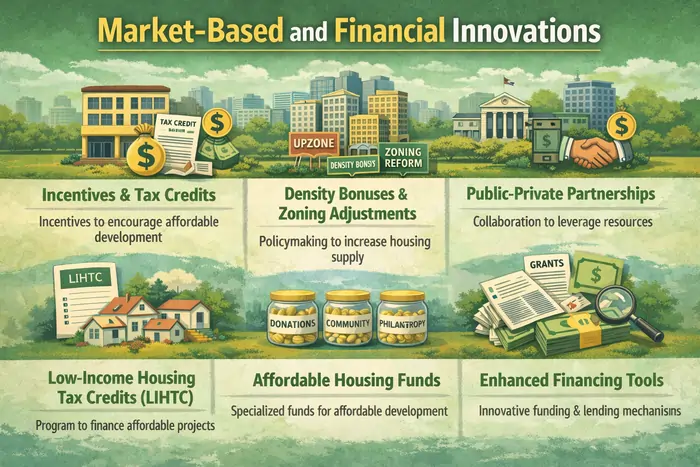
Market‑Based and Financial Innovations
Public policy alone is not enough; market‑based innovations and new financing models are playing a growing role.
Public‑private partnerships (PPPs) allow governments, mission‑driven investors, and private developers to share risks and returns on projects that include affordable units. Promotional and development banks in Europe, for instance, have been key in bridging financing gaps by providing low‑cost capital and guarantees for social and affordable housing.
Innovative financing tools—such as social impact bonds, blended capital stacks, and outcome‑oriented funds—tie returns to measurable social outcomes like reduced homelessness or improved stability. At the same time, modular and off‑site construction techniques, along with new materials, aim to reduce costs and shorten construction timelines, making lower‑rent units more feasible.
Transit‑oriented development that includes affordable housing near stations can align environmental, economic, and equity goals by reducing car dependence and connecting lower‑income households to jobs and services.
Community‑Driven and Non‑Profit Solutions
Community‑driven approaches are critical for ensuring that solutions address local needs and maintain long‑term affordability.
Community land trusts (CLTs) acquire and hold land in trust, leasing it to homeowners or rental operators while restricting resale prices to keep homes permanently affordable. Non‑profit and mission‑driven developers prioritize affordability and community benefit over maximizing profit, often leveraging grants and patient capital.
Tenant organizing and cooperative housing models give residents more control over their housing, helping prevent displacement and improve conditions. Proactive community engagement, as documented in studies from Canada’s housing planning systems, can also reduce opposition and build support for new developments by addressing concerns early and transparently.
HUD’s guide on creating task forces to tackle regulatory barriers emphasizes the importance of cross‑sector collaboration, public engagement, and clear definitions of what constitutes a regulatory barrier: Creating a Task Force on Regulatory Barriers to Affordable Housing.
Case Examples: What’s Working in Different Places
Several jurisdictions offer useful examples of reforms that are beginning to ease affordable housing challenges.
Research from LSE highlights how evidence‑based critiques of planning constraints contributed to policy debates and reforms in the UK, leading to changes such as adjustments to stamp duty and support for more housing near transit. In Canada, Ontario’s 2019 legislation to tackle the housing crisis drew heavily on research into regulatory barriers and aimed to speed construction of new housing near transit through simplified planning and increased incentives.
Elsewhere, reports compiled by Thinkhouse and national housing councils showcase local successes in improving existing housing stock, supporting older homeowners, and delivering new affordable developments through targeted funding and regulatory flexibility. Academic work on brownfield and land‑use barriers also points to solutions like targeted subsidies for remediation, clearer planning frameworks, and integrated economic and sustainability assessments.
These examples underline that there is no single “silver bullet,” but a combination of zoning reform, funding, community engagement, and innovation can deliver tangible improvements when sustained over time.
How Stakeholders Can Take Action
Addressing affordable housing challenges requires coordinated moves from policymakers, developers, employers, advocates, and residents.
- Policymakers and planners can audit and reform zoning, streamline permitting, expand subsidies, and set clear, measurable targets for new affordable units.
- Developers and investors can explore mixed‑income projects, leverage tax credits and PPP structures, adopt cost‑saving building methods, and engage communities early to reduce opposition.
- Advocates and community groups can organize tenants, support CLTs and cooperatives, and push for equitable, inclusionary policies that prevent displacement.
- Employers in high‑cost regions can invest in or partner on workforce housing initiatives, recognizing that housing affordability directly affects recruitment, retention, and productivity.
On a personal level, households who feel locked out of homeownership or stable renting sometimes explore income‑boosting strategies—such as building a side business—in parallel with pursuing housing assistance or alternative housing models. Stories about professionals starting a side business while working full‑time show how some people create additional financial flexibility, which can be a practical complement to systemic housing reforms: Starting a Side Business While Working Full‑Time.
Ultimately, the affordable housing crisis is solvable, but only through sustained, multi‑level action: reforming land‑use and regulations, investing public and private capital, empowering communities, and aligning economic development with housing needs. By combining structural policy changes with innovative projects on the ground, cities and countries can move from diagnosing affordable housing challenges to delivering real solutions that make safe, stable homes a realistic option for far more people.