

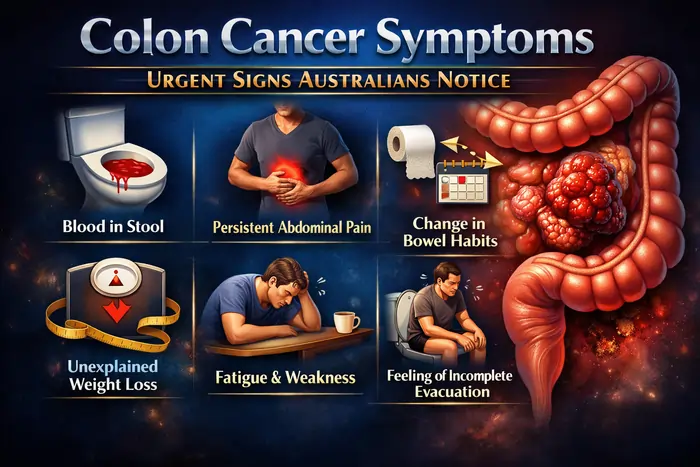
Colon cancer symptoms often start subtly, including changes in bowel habits, blood in the stool, abdominal pain, unexplained weight loss, and persistent fatigue. These early warning signs can appear months or even years before diagnosis, making early detection critical. Recognizing symptoms of colon cancer and acting quickly can significantly improve survival outcomes.
Colon cancer often develops silently, but there are early warning signs that can appear months or even years before a diagnosis. These include subtle changes in bowel habits, rectal bleeding, abdominal pain, and other symptoms that are easy to dismiss at first. Learning to recognize these patterns—and acting on them quickly—can have a major impact on your chances of catching colon cancer at an early, highly treatable stage. You can see a concise medical overview of these key symptoms in the Mayo Clinic guide to colon cancer symptoms. For a patient-friendly breakdown, you might also find this article on the 7 early symptoms of colon cancer you should never ignore helpful.
Why Early Symptoms Matter
Colon cancer usually begins as small, noncancerous growths called polyps in the lining of the large intestine, some of which can slowly turn into cancer over many years. Because this process is gradual, there is a long window to detect and remove polyps or diagnose cancer early—if people respond to early warning signs and follow screening recommendations. A clear explanation of how colon cancer develops over time is available from the Cleveland Clinic’s colon cancer overview. For a simpler, layperson-focused overview, see this guide on what the first signs of colon cancer are, which walks through how symptoms can start and what they mean.
In its earliest stages, colon cancer may cause few or no noticeable symptoms, which is why screening is so important. However, when symptoms do appear, they often match the list shared by major health authorities: changes in bowel habits, blood in the stool, abdominal pain that does not go away, unexplained weight loss, and fatigue or weakness. You can see these common early indicators summarized by the Centers for Disease Control and Prevention (CDC) on colorectal cancer symptoms. If you are wondering how far in advance these problems might show up, this explainer on how early colon cancer symptoms can appear provides useful context.
The 7 Early Warning Signs of Colon Cancer
Below are seven of the most important early warning signs of colon cancer, why they matter, and how trusted health organizations describe them. For a plain-language overview of these patterns, you can also review this article on common symptoms of colon cancer explained clearly.
1. Persistent Changes in Bowel Habits
One of the most common early signs of colon cancer is a noticeable and ongoing change in your usual bowel pattern. This can include new or more frequent diarrhea, new or more frequent constipation, or a shift back and forth between the two that does not fit your normal routine. A clear list of these typical changes appears in the World Health Organization (WHO) fact sheet on colorectal cancer symptoms.
Changes in bowel habits that may signal a problem include:
- Diarrhea that lasts several days without a clear cause such as infection.
- Constipation lasting longer than two weeks, even when you increase fiber or water.
- A new pattern of alternating diarrhea and constipation.
- A feeling that you still need to go, even after a bowel movement.
The Colon Cancer Coalition’s symptom guide notes that a persistent change in bowel habits is one of the hallmark signs that should not be ignored, especially when combined with other concerning symptoms. In younger adults, research has also linked ongoing diarrhea as one of four “red flag” symptoms associated with early-onset colorectal cancer, as discussed by the National Cancer Institute in its article on warning signs in younger adults. If you are unsure whether your bowel changes are serious, this guide on when to worry about colon cancer symptoms breaks down which patterns deserve prompt attention.
2. Rectal Bleeding or Blood in the Stool
Rectal bleeding—seeing blood on the toilet paper, in the toilet bowl, or mixed with stool—is one of the most important early warning signs of colon and rectal cancers. While hemorrhoids are a common cause of bright red blood, it is risky to assume hemorrhoids are to blame without medical evaluation. The CDC symptom page for colorectal cancer highlights blood in or on the stool as one of the main reasons to talk to a doctor.
Blood can appear in several ways:
- Bright red blood coating the stool or seen on toilet paper.
- Dark red or maroon blood mixed with stool.
- Black, tar-like stool that indicates digested blood from higher up in the digestive tract.
Multiple studies have shown that rectal bleeding is one of the strongest indicators of possible early-onset colorectal cancer in people under 50. In fact, research summarized by the National Cancer Institute and organizations like the Colorectal Cancer Alliance shows that rectal bleeding and iron-deficiency anemia are among the most powerful warning signs. Liv Hospital also emphasizes rectal bleeding as the most commonly reported initial symptom in early-onset cases, explaining that around 45% of younger patients report bleeding before diagnosis in their article “How I Knew I Had Colon Cancer: First Signs.” If you have bleeding plus other warning signs, this article on red flag symptoms that require immediate medical attention can help you decide when to seek urgent care.
3. Abdominal Pain, Cramps, or Bloating
Persistent abdominal discomfort—including cramps, bloating, or gas that does not go away—is another notable early sign. Tumors can irritate the lining of the colon, interfere with normal movement of the gut, or partially block the passage of stool and gas, leading to pain and pressure. The Cleveland Clinic’s symptom list for colon cancer clearly names abdominal pain and bloating among the typical symptoms.
Common descriptions include:
- Cramping or pain that is new, lasts for weeks, or keeps coming back.
- A sense of fullness, pressure, or bloating that is not clearly related to big meals.
- Gas pains that are more intense or frequent than usual.
The OHSU Knight Cancer Institute’s page on colon cancer signs and symptoms notes that ongoing belly discomfort—including cramping, bloating, and gas—is a key reason to see a clinician, especially when paired with changes in bowel habits or bleeding. Similarly, a feature from UC San Diego Health on colorectal cancer warning signs stresses that persistent abdominal pain or cramping that doesn’t respond to usual remedies should be evaluated. For a broader view of how symptoms evolve over time, you may also want to review colon cancer symptoms by stage and this comparison of stage 1 vs stage 4 colon cancer symptoms.
4. Unexplained Weight Loss
Unintentional weight loss—losing weight without changes in diet or exercise—is a classic red flag for many cancers, including colon cancer. In this context, doctors often consider it concerning when a person loses more than about 5% of their body weight over 6–12 months without trying. The WHO colorectal cancer fact sheet explicitly lists unexplained weight loss among the common symptoms.
Colon cancer can cause weight loss by:
- Altering how the body uses and burns energy (cancer-related metabolic changes).
- Reducing appetite due to chronic inflammation or discomfort.
- Contributing to fatigue and reduced activity levels.
The Colon Cancer Coalition’s symptom guide and resources like Liv Hospital’s article on alarming early signs both highlight significant, unexplained weight loss as a sign that warrants prompt medical attention, especially when combined with other digestive symptoms. If your weight loss comes with other subtle or atypical issues, it may help to read about unusual colon cancer symptoms most people miss.
5. Ongoing Fatigue or Weakness
Cancer-related fatigue feels different from ordinary tiredness: it is more persistent, often does not improve with rest, and can interfere with day-to-day activities. In colon cancer, fatigue is frequently linked to chronic internal blood loss, which can lead to iron-deficiency anemia. The WHO colorectal cancer overview lists persistent fatigue and iron deficiency anemia as typical consequences of ongoing bleeding from tumors.
Signs of concerning fatigue include:
- Feeling exhausted even after a full night’s sleep.
- Shortness of breath or dizziness with light activity.
- General weakness or reduced stamina without another obvious cause.
Several large studies summarized by the National Cancer Institute and advocacy groups like the Colorectal Cancer Alliance show that iron-deficiency anemia, together with rectal bleeding, abdominal pain, and diarrhea, significantly increases the likelihood of early-onset colorectal cancer. Liv Hospital’s discussion of “cancer-related fatigue” in their piece on alarming early signs of colon cancer further underscores that persistent weakness deserves medical evaluation. For practical guidance on which symptom combinations should trigger action, see this resource on colon cancer red flag symptoms.
6. Narrow, Thin, or Ribbon-Like Stools
While everyone’s stool changes from time to time, consistently narrow, thin, or ribbon-like stools can be another early warning sign of colon cancer, especially when they persist. A tumor in the colon may partially block or narrow the inside of the bowel, causing stool to change shape as it passes through. The Colon Cancer Coalition specifically mentions a change in the appearance of the stool, including narrowing, as a sign to watch for.
You might notice that:
- Your stools are regularly narrower than usual over several weeks.
- Stools appear pencil-thin or ribbon-like.
- Stool changes occur along with a feeling of incomplete evacuation or increased urgency.
The OHSU Knight Cancer Institute’s symptom page also notes “narrow stools” as one of the specific changes that can indicate a growth in the colon. While occasional variation can be related to diet or minor illnesses, sustained narrowing is a reason to talk to your doctor. If you want more detail on how these early changes compare with more advanced disease, see this breakdown of colon cancer symptoms by stage.
7. Feeling That Your Bowel Never Fully Empties
Another subtle yet important early symptom is the sensation that you still need to have a bowel movement even after you’ve just gone. This feeling of incomplete evacuation or ongoing urgency, known as tenesmus, is particularly concerning when it persists. The Cleveland Clinic lists “feeling like there’s still stool in your bowel even after you go to the bathroom” among the typical colon cancer symptoms.
This symptom can stem from:
- A tumor in the rectum or lower colon that occupies space and creates a constant sensation of fullness.
- Inflammation or irritation of the bowel lining that sends false signals of the need to defecate.
The CDC similarly includes “feeling that the bowel does not empty all the way” among key signs of colorectal cancer that suggest a need for evaluation. If you find yourself making multiple bathroom trips with only small amounts of stool or a sense that you never fully “finish,” it’s important to bring this up with a healthcare professional. For a gender-specific view of how bowel-related symptoms may differ, you can read about signs of colon cancer in men vs women.
7 Early Warning Signs
| Early sign | What you might notice | Supporting resources (examples) |
|---|---|---|
| Changes in bowel habits | New diarrhea, constipation, or alternating patterns lasting weeks | CDC colorectal cancer symptoms |
| Rectal bleeding/blood in stool | Bright red, dark red, or black stool; blood on paper or in bowl | NCI article on warning signs in younger adults |
| Abdominal pain, cramps, bloating | Belly pain, cramps, gas, or bloating that doesn’t go away | Cleveland Clinic colon cancer guide |
| Unexplained weight loss | Losing weight without trying over several months | WHO colorectal cancer fact sheet |
| Fatigue or weakness | Persistent low energy, weakness, possible anemia | Colorectal cancer signs in younger adults – NCI |
| Narrow or ribbon-like stools | Stool thinner or pencil-like over time | Colon Cancer Coalition symptoms page |
| Feeling bowel doesn’t empty fully | Ongoing urge to go, multiple small BMs | CDC symptoms of colorectal cancer |
If you want a cohesive, plain-language recap of these entries, this article on common symptoms of colon cancer explained clearly pulls them together with everyday examples.
When to See a Doctor
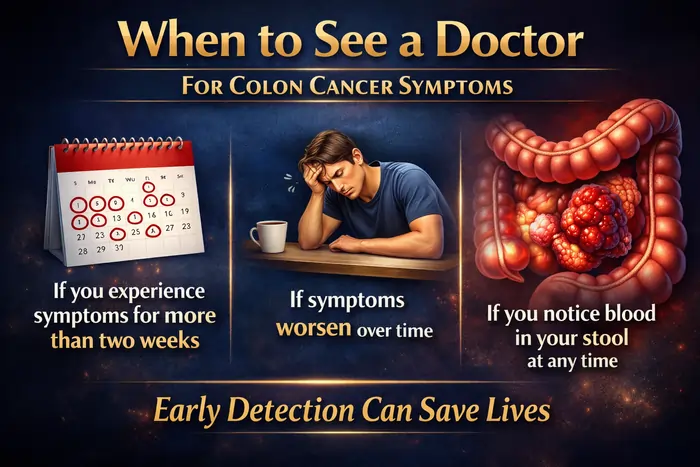
Because many of these early warning signs can be caused by noncancerous conditions, people often delay seeking care, assuming the problem is just diet, stress, or hemorrhoids. However, medical guidelines stress that persistent symptoms—especially combinations of rectal bleeding, abdominal pain, diarrhea, and iron-deficiency anemia—should prompt evaluation. The National Cancer Institute’s summary of early warning signs in younger adults emphasizes that having several of these symptoms together greatly increases the likelihood of early-onset colorectal cancer. If you are unsure how urgently you need to act, this guide on when you should worry about colon cancer symptoms may help.
In general, you should contact a healthcare provider if:
- A change in bowel habits lasts longer than two weeks.
- You notice blood in or on your stool, even once.
- You experience unexplained weight loss or persistent fatigue.
- You have ongoing abdominal pain, cramping, or bloating that does not improve.
The CDC’s colorectal cancer symptom page and the Mayo Clinic’s colon cancer overview both make it clear that these symptoms may be caused by conditions other than cancer, but the only way to know for sure is to be evaluated by a doctor. For more detail on which specific “red flag” patterns suggest urgent review, you can also see this resource on colon cancer red flag symptoms.
Who Is at Risk—and Why Screening Matters Even Without Symptoms
Even if you feel completely well, you can have early colon cancer or precancerous polyps, which is why screening is critical. Major organizations generally recommend that people at average risk start colorectal cancer screening around age 45, with options including colonoscopy, stool-based tests, sigmoidoscopy, or CT colonography. Guidelines summarized by the American Cancer Society and public health agencies explain these choices and intervals in detail. For a practical, patient-centered overview of testing, you may find this article on how to detect colon cancer early and this comparison of colonoscopy vs stool test helpful.
You may need earlier or more frequent screening if you have:
- A strong family history of colorectal cancer or advanced polyps.
- A personal history of colorectal cancer, polyps, or inflammatory bowel disease.
- A hereditary cancer syndrome, such as Lynch syndrome.
While this article focuses on symptoms, multiple expert sources—such as the WHO fact sheet on colorectal cancer and the CDC’s prevention pages—stress that screening saves lives by detecting disease before symptoms even appear. In Australia, this is especially important because of rising cases in younger people; for more on this trend, see colon cancer symptoms in Australians under 50 and this overview of who is most at risk of colon cancer in Australia.
Lifestyle choices also play a role in who is at higher risk. Factors like diet, smoking, alcohol use, inactivity, and obesity can all influence the odds of developing colon cancer over time, as discussed in more detail in this guide to lifestyle factors that increase colon cancer risk.
Listening to Your Body and Taking the Next Step
Ultimately, knowing the early warning signs of colon cancer only helps if you act on them. This means paying attention to persistent changes, not dismissing symptoms that don’t go away, and being willing to advocate for yourself with healthcare providers. Stories collected by cancer centers and patient groups—such as those shared by the Colorectal Cancer Alliance or educational pieces from Liv Hospital on colon cancer symptoms—show that many people initially attributed their symptoms to benign causes before seeking care.
If you recognize any of these seven early warning signs in yourself, consider:
- Tracking symptoms briefly in a notebook or phone app (frequency, duration, and severity).
- Bringing that record to a primary care provider or gastroenterologist.
- Asking directly whether your symptoms, age, and risk factors mean you should start or update colorectal cancer screening.
For readers who want to cross-check symptoms against multiple expert sources, you might find it helpful to review at least two independent resources such as the Mayo Clinic colon cancer page, the CDC symptom list, and the WHO colorectal cancer fact sheet. For a more narrative, patient-oriented summary of the main red flags, you can also revisit this overview of the 7 early symptoms of colon cancer you should never ignore.
Not every concerning symptom is caused by cancer. Many issues—ranging from simple infections to emerging respiratory viruses—can mimic or overlap with early cancer signs. If you are curious about one such infection, check out this guide on the HMPV virus: symptoms, spread, and what to know for a broader view of how viral illnesses can affect your body.
FAQs About Colon Cancer Symptoms
What are the most common symptoms of colon cancer?
The most common symptoms of colon cancer include changes in bowel habits, blood in the stool, abdominal pain, unexplained weight loss, and persistent fatigue.
What are the early symptoms of colon cancer?
Colon cancer early symptoms often start subtly, such as mild bowel changes, occasional discomfort, or fatigue that gradually becomes more noticeable.
What are the main signs of colon cancer?
The key signs of colon cancer include rectal bleeding, ongoing abdominal discomfort, narrow stools, and a feeling that the bowel does not fully empty.
How does colon cancer usually begin?
Colon cancer often begins as small growths called polyps in the colon, which can slowly develop into cancer over time.
Can colon cancer develop without symptoms?
Yes, in its early stages, colon cancer may cause no noticeable symptoms, which is why screening is important.
Why are early symptoms of colon cancer important?
Early symptoms matter because detecting colon cancer early significantly improves treatment success and survival rates.
What bowel habit changes should I watch for?
Watch for persistent diarrhea, constipation, or alternating patterns that last for weeks and do not match your normal routine.
Is blood in stool a serious symptom?
Yes, blood in the stool is one of the most important warning signs and should always be checked by a doctor.
What does abdominal pain from colon cancer feel like?
It often feels like ongoing cramps, bloating, or discomfort that does not go away and may worsen over time.
Can colon cancer cause weight loss?
Yes, unexplained weight loss is a common symptom and may occur without changes in diet or physical activity.
Why does colon cancer cause fatigue?
Fatigue can result from internal bleeding, which may lead to anemia and reduced energy levels.
What are narrow or ribbon-like stools?
These are stools that appear thinner than usual and may indicate a blockage or narrowing in the colon.
What does it mean if I feel my bowel doesn’t empty fully?
This feeling, known as incomplete evacuation, can be a sign of colon cancer and should be evaluated if it persists.
When should I see a doctor for symptoms?
You should see a doctor if symptoms like bowel changes, bleeding, or abdominal pain last more than two weeks or worsen over time.
Can lifestyle affect colon cancer risk?
Yes, factors such as diet, smoking, alcohol use, and lack of physical activity can increase the risk of developing colon cancer.