

Colonoscopy vs stool test: which is better? Both are effective for detecting colon cancer, but they serve different roles. Colonoscopy is the gold standard, allowing doctors to detect and remove polyps in one procedure, helping prevent cancer. Stool tests (like FIT or stool DNA) are non-invasive, convenient, and done at home, but mainly detect signs of cancer and require follow-up colonoscopy if positive.
The best choice depends on your risk level, preferences, and likelihood of completing screening regularly—because consistent screening is the most important factor in preventing and detecting colon cancer early.
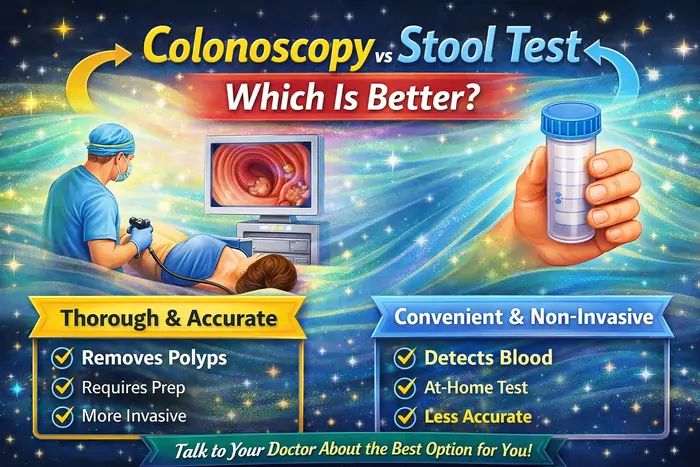
Understanding the strengths and limits of each is the only way to answer “Colonoscopy vs stool test: which is better?” for you specifically.
If you’re still learning how to detect colon cancer early and want a broader overview of all major screening options before deciding between colonoscopy vs stool test, you can also read this guide: How to Detect Colon Cancer Early: Screening Options Explained.
Why Screening Matters Before You Feel Sick
Colon cancer almost always starts as small polyps in the lining of the colon or rectum. If those polyps are found and removed early, cancer can often be prevented entirely. Knowing the practical differences in colonoscopy vs stool test is really about one thing: choosing a method you’ll actually complete regularly, so you don’t wait for symptoms.
- Early‑stage colon cancer is much easier to treat than advanced disease.
- Some tests can prevent cancer by removing polyps; others mainly detect cancer once it exists.
- Skipping screening because you’re unsure between colonoscopy vs stool test is the worst possible outcome.
A good high‑level overview of screening choices and trade‑offs is available from the American Cancer Society’s page on colorectal cancer screening tests and the Mayo Clinic’s discussion of colon cancer screening options.
What a Colonoscopy Involves
Colonoscopy is a direct visual exam of the entire colon and rectum using a flexible camera. It’s often called the “gold standard” for colorectal screening.
How colonoscopy works
- You do a bowel prep to clear the colon.
- You are usually sedated for comfort.
- A flexible scope is passed through the rectum to inspect the whole colon.
- The doctor can remove polyps or take biopsies during the same exam.
Hospitals and cancer centers consistently emphasize that colonoscopy is the most thorough screening test because it both finds and removes polyps in one go, preventing cancer rather than just detecting it later.
Pros of colonoscopy
When comparing colonoscopy vs stool test, colonoscopy offers several major advantages:
- Prevention, not just detection – It is the only test that reliably finds and removes precancerous polyps in a single procedure, which can stop cancer before it forms.
- Checks the entire colon – Every segment of the colon and rectum is examined, including areas that stool tests may not indirectly reflect.
- Long interval – If the exam is normal and you are average risk, you often only need it every 10 years.
- Highest sensitivity – Colonoscopy can detect very small lesions and subtle changes that stool tests may miss.
One clinic summary describes colonoscopy as “far more thorough in examining the bowel compared to a stool test” and notes it is considered the gold standard because of its ability to identify and remove early lesions.
Cons of colonoscopy
Those benefits come with trade‑offs, which is why many people compare colonoscopy vs stool test carefully:
- Requires bowel preparation, which many people find inconvenient or unpleasant.
- Invasive: involves inserting a scope into the colon.
- Needs sedation, so you usually need a driver and may need a day off work.
- Small but real risk of complications such as bleeding or perforation.
- Often higher upfront cost than a stool test (though this varies by system/insurance).
The Mayo Clinic notes that colonoscopy is highly sensitive but requires thorough bowel cleansing, diet adjustments, and sedation, which can make it less appealing for some people.
What Stool Tests Involve
Stool tests are non‑invasive methods that check a stool sample for signs of blood or abnormal DNA shed by polyps or cancers. They are ideal for people who want a home‑based option when considering colonoscopy vs stool test.
Main types of stool tests
Most guides group stool tests into three main categories:
- FIT (fecal immunochemical test) – Uses antibodies to detect hidden blood in stool.
- gFOBT (guaiac fecal occult blood test) – An older chemical test for hidden blood.
- Stool DNA tests (FIT‑DNA) – Combine FIT with detection of abnormal DNA from cells shed by tumors and advanced polyps.
These tests are designed for screening, not diagnosis. If they are positive, colonoscopy is always required to find the actual source.
Pros of stool tests
When comparing colonoscopy vs stool test, stool‑based screening has several attractive advantages:
- Non‑invasive – No scope, no sedation, no hospital visit.
- Home‑based and convenient – You collect the sample at home and mail or return it; no time off work for most people.
- No bowel prep – Especially for FIT and most stool DNA tests, you can eat and drink normally.
- Lower upfront cost – Usually cheaper than colonoscopy in many systems.
One public‑health study found that about three‑quarters of patients prefer a FIT stool test over colonoscopy when given a choice, mainly because it is easier and less invasive.
Cons of stool tests
However, there are important limitations, which is why many clinicians still favor colonoscopy when weighing colonoscopy vs stool test:
- Less sensitive for polyps – Stool DNA tests and FIT are less sensitive than colonoscopy for detecting precancerous polyps.
- More frequent testing – FIT and gFOBT must be done annually; stool DNA typically every 3 years.
- Positive = colonoscopy anyway – An abnormal stool result always requires a follow‑up colonoscopy to diagnose and treat.
- Can miss cancers – Some estimates suggest stool tests can miss a meaningful minority of existing cancers and many precancerous lesions.
- Cannot remove polyps – These tests only detect signals; they do not prevent cancer by removing lesions.
The Mayo Clinic explicitly notes that DNA stool tests are less sensitive than colonoscopy for detecting precancerous polyps and that any abnormal result requires additional testing. Gastroenterology societies and health systems reinforce that colonoscopy can remove polyps, while stool tests can only flag possible problems.
Colonoscopy vs Stool Test: What Do Major Organizations Say?
To decide “colonoscopy vs stool test: which is better?” it helps to see how major authorities frame the choice, rather than assuming there is a one‑size‑fits‑all answer.
American Cancer Society
The ACS groups screening tests into:
- Stool‑based tests – Convenient, at‑home, non‑invasive, but must be repeated more often and positive results require colonoscopy.
- Visual exams (including colonoscopy) – Look inside the colon and rectum directly, can remove polyps, and are done less often.
Their guidance emphasizes that the “best test is the one you are willing to get,” but also highlights that colonoscopy allows both detection and removal in one procedure.
Mayo Clinic
The Mayo Clinic’s article on colon cancer screening options compares colonoscopy vs stool test along dimensions such as sensitivity, preparation, frequency, and invasiveness. They stress:
- Colonoscopy is more sensitive and preventive but more invasive.
- DNA stool tests and FIT are easier but less sensitive and require more frequent repetition.
- Any abnormal stool test still leads to colonoscopy.
Academic and specialist centers
Cancer centers and academic hospitals often frame the choice like this:
- Colonoscopy is preferred for:
- People at higher risk (family history, prior polyps, symptoms).
- Those who want the most comprehensive, preventive test.
- Stool tests are preferred or useful for:
- People at average risk who are unwilling or unable to undergo colonoscopy.
- Individuals who may not otherwise get screened at all.
Some analyses note that, while colonoscopy has the highest sensitivity for mucosal inspection, that alone does not prove it is “best” for every person; adherence and patient preference matter.
How Risk Level Changes the Answer
“Colonoscopy vs stool test: which is better?” depends heavily on your baseline risk.
If you are at higher risk
You are considered higher risk if, for example, you:
- Have a first‑degree relative with colorectal cancer or advanced polyps.
- Have a known hereditary syndrome affecting colon cancer risk.
- Have a history of inflammatory bowel disease involving the colon.
- Have had colon cancer or advanced polyps yourself in the past.
In these situations:
- Colonoscopy is usually recommended as the primary screening tool.
- Stool tests alone are generally not considered sufficient.
- Screening intervals are shorter (for example, colonoscopy every 3–5 years rather than 10).
Both specialty clinics and academic centers emphasize that for increased‑risk patients, colonoscopy is “likely the best option” because it is more accurate and allows immediate treatment.
If you are average risk
If you are 45 or older with no significant family history or pre‑existing conditions, you are usually “average risk.” For you:
- Either colonoscopy or stool tests can be appropriate.
- The “better” option is the one you will do reliably and repeat on schedule.
- Non‑invasive tests can be a good gateway for people who would otherwise skip screening.
Health systems and public‑health campaigns consistently highlight that even imperfect screening is far better than no screening at all.
Practical Comparison: Comfort, Cost, and Convenience
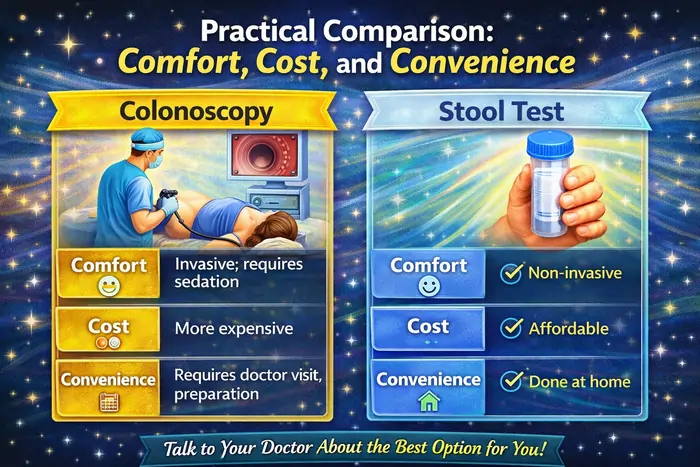
When you drill down into daily life, people usually weigh colonoscopy vs stool test across three practical dimensions: comfort, cost, and disruption.
Comfort and invasiveness
- Colonoscopy – Requires bowel prep, sedation, and an invasive procedure. Many people feel anxious about it.
- Stool test – Minimal discomfort, done in your own bathroom, no sedation.
Studies from large health systems find that most patients, given a choice, prefer stool‑based screening because of ease and non‑invasiveness.
Time and disruption
- Colonoscopy – Usually requires at least one full day off work (for the procedure and recovery from sedation) plus some time the day before for prep.
- Stool test – Generally no time off work; collection can be done in minutes.
Cost considerations
Costs vary widely by country and insurance, but generally:
- Colonoscopy has a higher upfront cost but may be needed only every 10 years (if normal).
- Stool tests are cheaper each time but repeated more frequently (annually or every 3 years), and a positive test triggers the additional cost of colonoscopy.
Some cost‑effectiveness studies suggest that both colonoscopy and stool‑based programs can be cost‑effective if adherence is high.
When Colonoscopy vs Stool Test Really Matters: Concrete Scenarios
To make this tangible, imagine three typical scenarios:
Scenario 1: Average‑risk, strongly prefers non‑invasive tests
- Age 50, no family history, very anxious about procedures.
- Likely to avoid screening altogether if colonoscopy is the only option.
Here, stool tests may be “better” in practice, because a yearly FIT or periodic stool DNA test the person actually does is far safer than no screening. Any abnormal result can then be followed by colonoscopy.
Scenario 2: Higher‑risk due to family history
- Age 40, parent diagnosed with colon cancer at 52.
- Asking about colonoscopy vs stool test for safety.
In this case, most guidelines and specialists would clearly favor colonoscopy as the primary tool because of higher risk and the need to both detect and remove polyps. Stool tests alone would be inadequate.
Scenario 3: Someone who has delayed screening for years
- Age 60, never screened, no regular doctor, wary of colonoscopy.
- Wants to finally do “something easy.”
Here, starting with a stool test (such as FIT or FIT‑DNA) can be a practical entry point. If the test is positive, colonoscopy is scheduled. If negative, they at least have baseline screening in place and can reassess preferences later.
These examples show why major organizations often say the best test in colonoscopy vs stool test is “the one that gets done.”
How to Decide Between Colonoscopy vs Stool Test
A simple decision framework:
- Know your risk
- Higher risk (family history, prior polyps, inherited syndromes, IBD)? Colonoscopy is usually preferred or required.
- Average risk? You can choose either, based on your values and constraints.
- Consider your tolerance for procedures
- Comfortable with sedation and invasive tests? Colonoscopy offers the most complete prevention.
- Very procedure‑averse? A stool test may be a better starting point.
- Think about your schedule
- Can you afford to take a day off work and arrange a driver? Colonoscopy every 10 years might be fine.
- Very limited time off? Annual or periodic stool testing at home may be more realistic.
- Plan for follow‑up
- With stool tests, accept that a positive result must be followed by colonoscopy.
- With colonoscopy, understand there is a prep, recovery period, and small procedural risk.
The Mayo Clinic’s article on colon cancer screening options and UC Davis Health’s guide on colonoscopy vs at‑home screening both walk through exactly these decision points.
If you prefer to see colonoscopy vs stool test discussed in the context of all available screening tools, from stool‑based kits to visual exams and emerging options, this article on How to Detect Colon Cancer Early: Screening Options Explained walks through each method and how they work together over your lifetime.
FAQs: Colonoscopy vs Stool Test
What is the main difference between colonoscopy and stool tests?
Colonoscopy examines the entire colon and removes polyps, while stool tests detect signs of blood or abnormal DNA in stool.
Which test is more accurate for colon cancer?
Colonoscopy is more accurate and can detect smaller lesions and remove polyps during the same procedure.
Are stool tests reliable for detecting colon cancer?
Yes, especially for detecting existing cancer, but they are less effective at finding precancerous polyps.
How often should I do a stool test?
FIT is usually done every year, while stool DNA tests are done every 3 years.
How often is colonoscopy needed?
Typically every 10 years if results are normal and you are at average risk.
Do stool tests replace colonoscopy?
No. A positive stool test always requires a follow-up colonoscopy.
Which option is better for high-risk individuals?
Colonoscopy is preferred for people with higher risk, such as family history or prior polyps.
Are stool tests completely non-invasive?
Yes. They are done at home and require no sedation or bowel preparation.
What are the downsides of colonoscopy?
It requires bowel prep, sedation, time off work, and carries a small risk of complications.
What are the downsides of stool tests?
They require frequent repetition, may miss some polyps, and cannot remove abnormalities.
Can stool tests miss colon cancer?
Yes. They can miss some cancers and many precancerous polyps.
Why is colonoscopy called the gold standard?
Because it can detect, biopsy, and remove polyps, helping prevent cancer entirely.
What happens if my stool test is positive?
You will need a colonoscopy to confirm the diagnosis and treat any findings.
Which test is better for people afraid of procedures?
Stool tests are often better for those who want a simple, non-invasive option.
What is the most important factor in choosing a test?
The best test is the one you will actually complete and repeat regularly, ensuring consistent screening.