

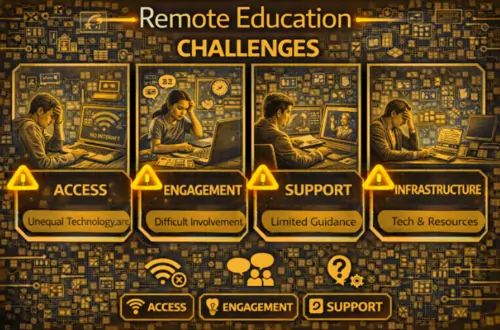
Introduction
Remote learning has changed education in lasting ways. What once served mainly as an alternative or support system for traditional schooling has become a core part of how many students, teachers, and institutions approach learning. Online classes, virtual classrooms, recorded lessons, and digital assignments now play a major role in schools, universities, and professional training programs around the world.
At the same time, the growth of digital learning has made one issue impossible to ignore: remote education challenges remain significant. While remote education offers flexibility, wider reach, and convenience, it also introduces barriers that affect learning quality, participation, equity, and student outcomes.
For some learners, remote education creates new opportunities. For others, it increases difficulties related to internet access, focus, communication, motivation, and support. Teachers and institutions also face pressure to adapt teaching methods, maintain engagement, assess performance fairly, and manage technology effectively.
Understanding remote education challenges is essential for educators, parents, institutions, and policymakers who want digital learning to become more effective, accessible, and sustainable.
What Remote Education Means
Remote education refers to learning that takes place when students and teachers are physically separated and rely on digital tools or communication platforms to deliver lessons, assignments, and interaction.
This may include:
- live virtual classes
- recorded video lessons
- online discussion boards
- digital assessments
- learning management systems
- email or chat-based communication
Remote education can be fully online or part of a blended learning model. In many cases, it allows schools and institutions to continue operating even when in-person instruction is limited.
However, while the format increases flexibility, it also reveals multiple remote education challenges that affect teaching quality and learner success.
Why Remote Education Challenges Matter
The quality of education depends on more than access to content. Students need engagement, structure, support, feedback, and a learning environment that allows them to stay focused and develop skills over time.
When remote education is not designed or supported well, learning gaps can widen. Some students may fall behind academically, disengage emotionally, or lose confidence. Teachers may struggle to deliver instruction effectively, and institutions may find it difficult to maintain consistent standards.
That is why remote education challenges are not simply technical problems. They are educational, social, and structural issues that influence long-term learning outcomes.
Access and Digital Inequality
One of the biggest remote education challenges is unequal access to devices, internet connectivity, and digital tools.
Remote learning depends heavily on technology. Students often need:
- a stable internet connection
- a smartphone, tablet, or computer
- a quiet place to study
- access to digital platforms and software
Not all learners have these resources. Some households may share one device across multiple family members. Others may have unreliable internet or no suitable study environment at home.
This creates a major equity issue. Students with strong digital access can participate more consistently, while those with limited resources may miss lessons, struggle with assignments, or become disconnected from learning altogether.
Student Engagement and Motivation
Keeping students engaged is one of the most common remote education challenges. In physical classrooms, teachers can observe body language, manage attention, and create immediate interaction. In remote settings, that becomes harder.
Students learning from home may face distractions such as:
- social media
- household noise
- family interruptions
- lack of routine
- screen fatigue
Without strong structure, some students may attend classes passively without fully participating. Others may struggle with motivation, especially if they feel isolated or unsupported.
Remote education often requires a higher level of self-discipline than in-person learning. Not every student is equally prepared for that responsibility.
Teacher Workload and Adaptation
Teachers play a central role in digital learning, but remote instruction often increases their workload.
They may need to:
- redesign lessons for online delivery
- learn new platforms and digital tools
- provide support through multiple channels
- monitor participation remotely
- create digital assessments
- manage communication with parents and students
These responsibilities can become overwhelming, especially for educators who received limited training in online teaching methods.
One of the most important remote education challenges is that remote learning success depends heavily on teacher preparation, yet many educators are expected to adapt quickly without enough time, support, or resources.
Communication Barriers
Communication is essential in education, and remote settings can make it more difficult.
In online learning environments, students may hesitate to ask questions. Technical issues can interrupt lessons. Delays in email responses or message-based communication may reduce clarity. Teachers may also find it harder to determine whether students truly understand the material.
This is one of the less visible remote education challenges. Even when content is available, communication gaps can weaken the learning process and make students feel disconnected from their teachers or classmates.
Assessment and Academic Integrity
Evaluating student performance remotely creates another major challenge. Traditional classroom assessments do not always translate well to digital settings.
Remote education raises concerns such as:
- how to verify independent work
- how to prevent cheating
- how to assess participation fairly
- how to measure understanding beyond test-taking
Teachers may need to shift toward alternative forms of assessment such as open-book tasks, project-based work, reflections, and presentations. While these can improve learning quality, they also require more planning and grading time.
As a result, assessment remains one of the most discussed remote education challenges in modern digital learning.
Social Isolation and Emotional Well-Being
Education is not only academic. It is also social. Students learn through interaction, collaboration, peer relationships, and shared routines.
One of the more serious remote education challenges is the loss of social connection. Students learning remotely may feel isolated from classmates and teachers, especially over long periods.
This can affect:
- motivation
- confidence
- emotional well-being
- communication skills
- sense of belonging
Younger students may struggle with the absence of classroom structure, while older learners may experience loneliness or burnout from extended screen-based learning.
Supporting emotional well-being is therefore a critical part of improving remote education.
Learning Environment at Home
Not every home environment supports effective learning. Some students have quiet rooms and family support, while others study in crowded spaces with frequent interruptions.
This creates another major set of remote education challenges. Students may struggle to focus because of:
- noise
- caregiving responsibilities
- limited space
- unstable schedules
- household stress
These conditions can affect performance even when the student is capable and motivated. Remote education often assumes the home can function like a classroom, but that is not always realistic.
Technical Issues and Platform Dependence
Remote learning depends on technology working well. When systems fail, learning is disrupted.
Common technical problems include:
- internet outages
- platform crashes
- login difficulties
- audio or video issues
- file upload problems
- compatibility issues across devices
Even small technical issues can create frustration and reduce learning time. For teachers, repeated technical interruptions can disrupt lesson flow and weaken classroom momentum.
Technology makes remote learning possible, but it also introduces one of the most persistent remote education challenges: dependence on tools that may not always work reliably.
Remote Education Challenges for Younger Learners
Younger students often face unique difficulties in remote learning. Many require more supervision, shorter lesson structures, and more interactive teaching methods than online systems easily provide.
For younger learners, common challenges include:
- shorter attention spans
- need for parental guidance
- difficulty navigating platforms independently
- limited reading or typing skills
- reduced social development opportunities
This means remote education for children often depends heavily on adult support at home, which is not always available.
Opportunities Hidden Inside the Challenges
Although the focus here is on remote education challenges, these difficulties have also pushed institutions to improve digital teaching and rethink educational models.
Some positive developments include:
- wider use of flexible learning tools
- stronger digital literacy
- increased innovation in teaching methods
- growth of blended learning systems
- broader access to recorded and reusable content
In other words, the challenges have exposed weaknesses, but they have also encouraged progress.
How Institutions Can Respond
To address remote education challenges more effectively, institutions can focus on a few key areas.
Improve Access
Schools and governments can support device distribution, internet access programs, and digital infrastructure.
Train Teachers
Professional development in digital pedagogy can help teachers design more engaging and effective online learning experiences.
Support Students Beyond Academics
Emotional support, mentoring, and regular check-ins can reduce isolation and improve participation.
Use Better Assessment Models
Project-based and reflective assessments may provide more meaningful ways to measure understanding in remote environments.
Build Flexible Systems
Blended learning models can combine the best parts of online and in-person education.
These responses do not remove every problem, but they make remote education more sustainable and inclusive.
The Future of Remote Education
Remote learning is likely to remain part of education even as traditional classrooms continue. The future may not be fully online, but it will almost certainly be more digital, flexible, and hybrid than before.
That makes understanding remote education challenges even more important. The goal should not be to reject digital learning, but to improve it. Stronger remote education systems can create greater access, resilience, and innovation if the challenges are taken seriously.
Conclusion
Remote education challenges affect students, teachers, and institutions in different but connected ways. From digital inequality and weak engagement to teacher workload, assessment problems, and emotional isolation, remote learning brings both opportunities and serious difficulties.
Still, these challenges do not mean remote education cannot work. They mean it must be designed more thoughtfully. Better support, better technology access, stronger teaching strategies, and more inclusive systems can improve learning outcomes over time.
As education continues to evolve, the success of remote learning will depend not only on digital tools, but on how well institutions respond to the real needs of learners and educators.
FAQ
What are the biggest remote education challenges?
The biggest challenges include unequal internet access, low student engagement, teacher workload, communication barriers, and difficulties with assessment.
Why is remote education difficult for some students?
Remote education can be difficult because students may face distractions at home, lack reliable technology, struggle with motivation, or miss social interaction.
How do remote education challenges affect teachers?
Teachers often face extra workload, technical adaptation, lesson redesign, student communication issues, and difficulty measuring learning outcomes fairly.
Can remote education be effective?
Yes, remote education can be effective when students and teachers have the right tools, support, structure, and teaching methods.
How can schools improve remote education?
Schools can improve remote education by expanding digital access, training teachers, supporting student well-being, and using more flexible assessment methods.