

Introduction
The lifelong learning economy describes a world in which continuous education is no longer optional. It is becoming a core part of employability, productivity, and long-term economic resilience.
As technology changes jobs faster, populations age, and industries evolve, workers, employers, and governments are placing more value on ongoing learning throughout adult life. OECD research highlights that adult learning participation, access, and barriers now play a major role in national competitiveness and inclusion.
This shift matters because the economy no longer rewards only initial education. A degree or early-career training may still matter, but it is often not enough for a 30- or 40-year working life.
Workers increasingly need to update digital skills, adapt to AI tools, learn new systems, and move into different roles over time. The World Economic Forum has also emphasized that reskilling and upskilling are essential as AI reshapes work and required capabilities.
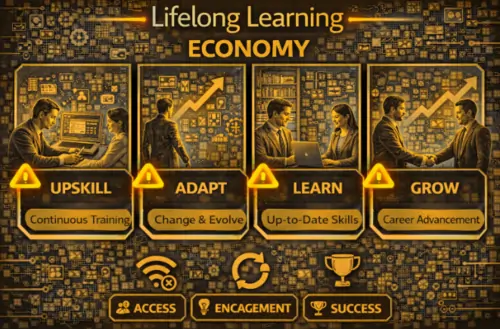
In simple terms, the lifelong learning economy is an economy where learning itself becomes an ongoing asset. People, organizations, and countries that invest in it are more likely to remain adaptable, productive, and competitive.
What the Lifelong Learning Economy Means
The lifelong learning economy is built on the idea that education continues across the full span of life, not only during school or university years. It includes formal learning, professional training, short courses, workplace development, digital credentials, adult education, and skills renewal during career transitions.
This model is becoming more important because jobs are changing faster than before. OECD reporting on adult learning shows that participation is uneven and that vulnerable groups often face the greatest barriers, even though they may need retraining the most.
A true lifelong learning economy supports people at different stages of life, including:
- early career skill-building
- mid-career reskilling
- later-career adaptation
- re-entry after career breaks
- retirement-adjacent learning and second careers
The broader point is that education becomes part of economic infrastructure, not just a personal milestone.
Why the Lifelong Learning Economy Is Growing
One of the strongest drivers of the lifelong learning economy is technological change. Artificial intelligence, automation, and digital systems are reshaping job requirements across industries. The World Economic Forum has argued that reskilling and upskilling are central to helping workers navigate this environment, especially through digital skills development.
Another major driver is labor market volatility. People are changing roles more often, industries are evolving, and employers increasingly value adaptable workers who can keep learning. OECD commentary on lifelong learning also connects educational investment to jobs, prosperity, and stronger long-term growth. UNESCO similarly notes that more education is tied to better jobs, higher earnings, and economic development.
A third driver is demographic and structural change. Aging populations, longer careers, and delayed retirement mean workers need skills renewal over a longer period. That makes the lifelong learning economy important not only for young professionals, but for adults at every stage of working life.
The Economic Value of Lifelong Learning
The lifelong learning economy matters because skills are directly tied to productivity and opportunity. OECD and related policy discussions show that skills inequality, weak access to adult learning, and under-used capabilities can hold back both individuals and entire economies.
At the individual level, continuous learning can improve:
- employability
- income potential
- job mobility
- resilience during layoffs or automation
- confidence during career shifts
At the business level, stronger learning cultures can improve retention and long-term performance. A recent TalentLMS report found that 95% of HR managers surveyed agreed that better training and skill development improve employee retention, while 73% of employees said stronger learning opportunities would make them stay longer.
At the national level, the lifelong learning economy supports broader competitiveness by helping workers keep pace with economic change.
Unequal Access Remains a Major Challenge
Even though the case for lifelong learning is stronger than ever, participation remains uneven. OECD’s adult learning findings point to major differences across socio-demographic groups, and CIPD reports that adult participation in education and training remains low across many OECD and EU countries, with only around two in five adults engaged in learning annually. Participation is especially limited among disadvantaged groups and workers in more vulnerable occupations.
This means the lifelong learning economy cannot succeed if it only benefits already advantaged workers. People with lower qualifications, weaker digital access, unstable employment, or fewer employer-sponsored opportunities are often the ones most at risk of being left behind.
Common barriers include:
- cost of training
- lack of time
- employer support gaps
- caregiving responsibilities
- low confidence returning to learning
- poor access to digital tools or broadband
If these barriers are ignored, the lifelong learning economy may widen inequality rather than reduce it.
How Employers Shape the Lifelong Learning Economy
Employers now play a major role in the lifelong learning economy. Workplace learning is increasingly part of retention, internal mobility, and future-proofing. Recent 2026 learning and development reports point to AI fluency, measurable business outcomes, and strategic skill-building as key directions in workplace education.
Companies that invest in learning often do more than offer occasional training. They build systems that support:
- structured upskilling
- leadership development
- digital capability building
- career path visibility
- internal mobility through learning
- measurable outcomes tied to business needs
The business case is becoming stronger. In a fast-changing market, companies benefit when employees can adapt instead of being replaced every time skills shift.
The Role of Governments and Public Policy
Public policy is also central to the lifelong learning economy. OECD’s Education Policy Outlook 2025, as summarized by the EU Digital Skills and Jobs Platform, argues that countries need lifelong-learning systems that support people at several critical life stages, including adolescence, mid-career, and the years approaching retirement.
Governments can strengthen lifelong learning through:
- adult education funding
- reskilling subsidies
- digital access expansion
- national qualification frameworks
- employer incentives
- public-private partnerships
- recognition of short credentials and micro-credentials
Without policy support, many workers will struggle to access the learning they need, especially outside large companies or urban centers.
AI and the Future of the Lifelong Learning Economy
Artificial intelligence is making the lifelong learning economy even more urgent. It is changing both what people need to learn and how they learn. On one side, AI is creating demand for new digital, analytical, and adaptive capabilities. On the other, it is also making learning itself more personalized and scalable.
World Economic Forum and workplace learning reports consistently point to AI as a major reason continuous learning has become essential. At the same time, 2026 global learning trends reports from providers such as Udemy Business show organizations moving from basic adoption toward more structured AI capability-building.
This suggests the lifelong learning economy will increasingly revolve around not just technical skills, but the ability to keep learning as technology keeps evolving.
What Individuals Can Do
For workers and professionals, the lifelong learning economy means career security is tied more closely to adaptability than before. That does not mean everyone needs constant formal study, but it does mean waiting too long to update skills can become risky.
Useful approaches include:
- tracking which skills are rising in your field
- taking short, targeted courses
- building digital literacy
- learning through projects, not only theory
- using employer training opportunities
- keeping evidence of learning through portfolios or credentials
The most important mindset shift is recognizing that ongoing learning is no longer a side activity. It is part of staying economically relevant.
Conclusion
The lifelong learning economy is not a temporary trend. It reflects a deeper change in how work, education, and economic growth now connect. As AI, digital tools, and labor market shifts continue to reshape careers, continuous learning is becoming one of the most valuable forms of long-term security.
Research from OECD, UNESCO, the World Economic Forum, and workplace learning reports all points in the same direction: workers need more opportunities to reskill, employers need stronger learning systems, and governments need policies that make adult learning more accessible and inclusive.
In the end, the lifelong learning economy is about more than education. It is about giving people the ability to remain useful, confident, and economically active through change. The societies that support that kind of learning are likely to be stronger, more resilient, and better prepared for the future.
FAQ
What is the lifelong learning economy?
The lifelong learning economy is an economic model in which continuous education, reskilling, and upskilling become essential throughout adult life, not just during school or university.
Why is lifelong learning becoming more important?
It is becoming more important because AI, automation, and changing labor markets are reshaping job requirements faster, making continuous skill development necessary.
Who benefits from the lifelong learning economy?
Workers, employers, and governments all benefit. Individuals improve employability, employers strengthen retention and adaptability, and economies gain productivity and resilience.
What are the biggest barriers to lifelong learning?
Major barriers include cost, limited time, unequal digital access, weak employer support, and lower participation among disadvantaged groups.
How can countries strengthen the lifelong learning economy?
Countries can strengthen it through adult learning funding, digital access, reskilling incentives, qualification systems, and policies that support learning at multiple life stages.