

Introduction
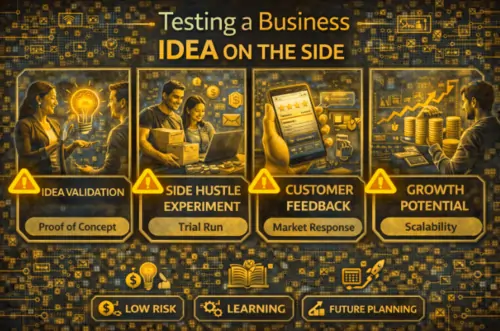
Many successful companies began as small experiments conducted during evenings or weekends. Testing a business idea on the side allows aspiring entrepreneurs to explore opportunities without immediately leaving their primary job or making large financial commitments.
Instead of risking everything at once, individuals can gradually test whether their idea has real market demand. This approach provides valuable insights into customer needs, pricing strategies, marketing methods, and operational challenges before committing to a full-scale launch.
In today’s digital world, testing a business idea has become easier than ever. Online tools, social media platforms, and digital marketplaces allow entrepreneurs to reach customers quickly and gather feedback in real time.
For anyone considering entrepreneurship, testing a business idea on the side is one of the smartest and most practical ways to start.
Why Testing a Business Idea Matters
One of the most common reasons new businesses fail is that the idea was never properly validated. Entrepreneurs may spend months building products or services only to discover that customers are not interested.
Testing a business idea helps reduce this risk.
By starting small, entrepreneurs can gather real-world data about how customers respond to their offering. This feedback allows them to refine their concept before investing significant time or money.
Testing also helps entrepreneurs develop confidence in their idea. Seeing even small signs of demand can confirm that the business concept has potential.
Ultimately, testing a business idea on the side provides both practical experience and valuable information that can guide future decisions.
Benefits of Testing a Business Idea While Employed
Running a side project while maintaining a full-time job offers several advantages.
Financial Stability
One of the biggest benefits is financial security. A stable salary can cover living expenses while the new business is still developing. This reduces pressure and allows the entrepreneur to focus on learning rather than immediate profit.
Reduced Risk
Starting a business often involves uncertainty. By testing the idea gradually, entrepreneurs can identify problems and improve their strategy without risking their primary source of income.
Learning Opportunity
A side business is also a valuable learning experience. Entrepreneurs gain knowledge about marketing, customer service, operations, and product development while still maintaining their current career.
For many people, testing a business idea on the side becomes an educational process that prepares them for full-time entrepreneurship later.
Step 1: Identify a Problem Worth Solving
The best business ideas usually start with a problem. Customers are more likely to pay for solutions that make their lives easier, save time, or improve their experiences.
When considering a business idea, ask questions such as:
- What problem does this idea solve?
- Who experiences this problem most often?
- How are people currently solving this issue?
If the problem is common and the solution is meaningful, the idea may have real market potential.
This step is essential when testing a business idea on the side, because it ensures the business focuses on genuine customer needs.
Step 2: Start with a Simple Version
Many entrepreneurs make the mistake of building complex products before knowing whether people actually want them.
Instead, it is better to create a minimum viable product (MVP). This is a simplified version of the product or service that demonstrates the core value of the idea.
For example:
- A digital course creator might start with a small workshop or webinar.
- A product designer might test a limited batch of items.
- A service provider might begin with a few freelance clients.
Starting small allows entrepreneurs to test the concept quickly and gather feedback before investing more resources.
Step 3: Find Your First Customers
Once a basic version of the idea exists, the next step is finding the first customers.
Early customers are extremely valuable because they provide honest feedback. Their responses help entrepreneurs understand what works, what needs improvement, and what customers truly value.
Potential places to find early customers include:
- Social media communities
- Online marketplaces
- Professional networks
- Local events or groups
- Personal contacts and referrals
When testing a business idea on the side, early customers are often more important than rapid growth. Their insights help shape the future direction of the business.
Step 4: Gather Feedback and Improve
Testing a business idea should always include listening to customer feedback.
Entrepreneurs should ask customers questions such as:
- What did you like most about the product or service?
- What could be improved?
- Would you recommend it to others?
Constructive feedback allows businesses to refine their offerings and deliver greater value.
The process of testing, learning, and improving is what transforms early concepts into successful businesses.
Step 5: Measure Results
Testing a business idea should involve measurable outcomes.
Important indicators may include:
- Customer interest or inquiries
- Actual sales or conversions
- Repeat customers
- Positive reviews or referrals
Even small results can provide meaningful insights. For example, a handful of early sales may indicate strong potential if the product was marketed to a limited audience.
By tracking these results, entrepreneurs can determine whether the idea is worth expanding.
Common Challenges When Testing a Business Idea
While testing a business idea on the side is a practical approach, it also comes with challenges.
Limited Time
Balancing a full-time job and a side project can be demanding. Effective time management is essential to maintain progress without becoming overwhelmed.
Slow Growth
Side businesses often grow gradually because they are built during spare hours. Patience is necessary, especially during the early stages.
Fear of Failure
Many aspiring entrepreneurs hesitate to test their ideas because they fear failure. However, testing small ideas early is often the best way to learn and improve.
Overcoming these challenges is part of the entrepreneurial journey.
When to Turn a Side Idea into a Full Business
At some point, entrepreneurs may consider turning their side project into a full-time venture.
Signs that the business may be ready for expansion include:
- Consistent revenue growth
- Strong customer demand
- Repeat customers and referrals
- A clear path for scaling operations
However, transitioning to full-time entrepreneurship should be carefully planned. Financial stability, market demand, and operational readiness should all be considered.
For many entrepreneurs, testing a business idea on the side eventually leads to the confidence needed to pursue the opportunity full time.
Conclusion
Testing a business idea on the side is one of the most effective ways to begin an entrepreneurial journey. It allows individuals to validate ideas, gain experience, and refine strategies without taking unnecessary risks.
By identifying a real problem, launching a simple version of the idea, gathering feedback, and measuring results, aspiring entrepreneurs can determine whether their concept has real potential.
Many successful businesses began exactly this way — as small experiments developed during evenings and weekends. With patience, persistence, and continuous improvement, a simple idea tested on the side can eventually grow into a thriving business.
FAQ
What does testing a business idea on the side mean?
Testing a business idea on the side means launching a small version of a business while maintaining another primary job or source of income.
Why is it important to test a business idea first?
Testing helps entrepreneurs validate whether customers are interested in the product or service before investing significant time or money.
What is a minimum viable product?
A minimum viable product (MVP) is a simplified version of a product or service that demonstrates the core idea and allows entrepreneurs to gather feedback.
How long should you test a business idea?
The testing period varies depending on the business model, but many entrepreneurs test their ideas for several months to gather meaningful data.
Can a side business become a full-time business?
Yes. Many successful companies began as side projects before eventually becoming full-time ventures.