

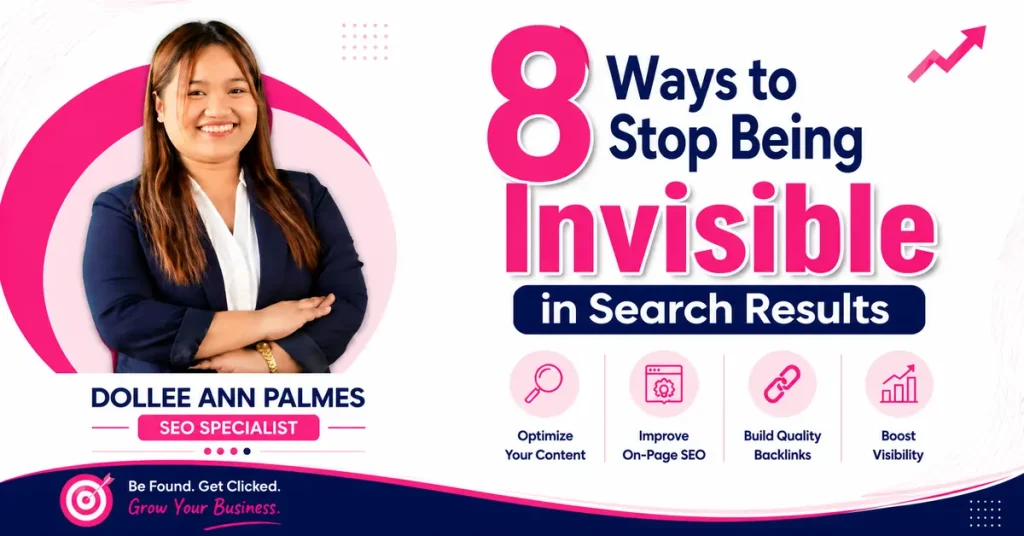
Results-Driven SEO SPECIALIST, Dollee Ann Palmes– To boost visibility in search results in 2026, I focus on eight proven SEO strategies: optimizing for search intent and AI Overviews, building topical authority through pillar content, mastering on-page SEO fundamentals, improving technical SEO and Core Web Vitals, earning high-quality backlinks, leveraging structured data and schema markup, prioritizing E-E-A-T signals, and tracking performance with the right analytics tools.
These strategies work together to help websites rank higher on Google, appear in AI-generated answers, and attract sustainable organic traffic.
Introduction
If you have ever wondered why some websites consistently appear at the top of Google while others remain invisible no matter how much content they publish, you are not alone. As an SEO specialist who has worked on dozens of websites across different industries, I can tell you that ranking high in search results is no longer just about stuffing keywords into a page. Search engines have evolved, AI Overviews now sit at the top of many search pages, and user expectations are higher than ever.
My name is Dollee Ann Palmes, and over the years I have refined a results-driven approach to search engine optimization that helps brands not only climb the rankings but also stay there. In this blog post, I am sharing the eight effective strategies I personally use to boost visibility in search results, including how to optimize for Google’s AI Overviews, the new layer of search that summarizes answers using artificial intelligence.
Whether you run a small business, manage a SaaS company, or write a personal blog, these strategies will give you a clearer path to better rankings, more organic traffic, and stronger brand authority.
1. Optimize for Search Intent and AI Overviews
The first thing I always check when starting a new SEO project is whether the content matches search intent. Search intent is the reason behind a query, and Google has become incredibly good at understanding it. When someone types “best running shoes for flat feet,” they are not looking for a definition of running shoes. They want a curated list with recommendations.
I categorize search intent into four buckets: informational, navigational, commercial, and transactional. Once I know which bucket a keyword falls into, I shape my content to match. For informational queries, I write detailed guides. For commercial queries, I produce comparison posts and reviews.
To rank in AI Overviews, the AI-generated summary box that appears above traditional results, I structure content with clear, direct answers near the top of the page. I use short, definitive sentences, organize information with descriptive subheadings, and include question-based headers that mirror how people actually search. Google’s Search Generative Experience pulls from sources that present information clearly and authoritatively.
For more on understanding search intent, I recommend reading the Search Engine Journal guide on search intent, which breaks down the concept in practical detail.
2. Build Topical Authority with Pillar Content and Content Clusters
Gone are the days when you could rank by publishing a few standalone blog posts. Today, Google rewards topical authority, which means demonstrating deep expertise across a subject area rather than scattering content across unrelated topics.
The strategy I rely on is the pillar-and-cluster model. I create one comprehensive pillar page that broadly covers a main topic, then I write multiple cluster articles that dive deep into related subtopics. Each cluster article links back to the pillar, and the pillar links out to each cluster. This internal linking structure tells Google that my site is a credible resource on the entire topic.
For example, if I am working on a website about digital marketing, my pillar page might be “The Complete Guide to Digital Marketing.” From there, I create cluster posts on email marketing, content marketing, paid ads, and social media strategy. Each one strengthens the others.
This approach also helps with AI Overviews because AI systems prefer to cite websites that demonstrate consistent, authoritative coverage. To learn more about building content clusters, HubSpot’s guide on topic clusters is one of the clearest resources I have come across.
3. Master On-Page SEO Fundamentals
On-page SEO is the foundation of every successful site I have worked on. No matter how brilliant your content is, if you neglect the basics, your rankings will suffer. I always go through a checklist for every page I publish.
I start with the title tag, which should include the primary keyword near the beginning and stay under 60 characters. The meta description should be compelling, between 150 and 160 characters, and written like a mini ad that earns the click. I use a single H1 tag per page that closely matches the title, and I structure the body with H2 and H3 headers that include semantic variations of my target keyword.
URLs should be short, descriptive, and lowercase with hyphens between words. Images need optimized file names and alt text that describes the image accurately, which also helps with image search and accessibility.
Internal linking is something I never skip. Every new article I publish gets linked from at least three relevant existing pages, and I add outbound links to authoritative sources to support claims. For a thorough breakdown of on-page elements, Moz’s beginner guide to on-page SEO is a resource I still reference today.
4. Improve Technical SEO and Core Web Vitals
Technical SEO is where many businesses lose visibility without realizing it. A beautifully written article will not rank if Google cannot crawl your site properly or if your pages take seven seconds to load on mobile.
The first thing I audit on any new site is Core Web Vitals, which are Google’s metrics for user experience. These include Largest Contentful Paint (LCP), which measures loading performance, Interaction to Next Paint (INP), which measures responsiveness, and Cumulative Layout Shift (CLS), which measures visual stability. I aim for LCP under 2.5 seconds, INP under 200 milliseconds, and CLS below 0.1.
Beyond Core Web Vitals, I make sure the site has a clean XML sitemap, a properly configured robots.txt file, and HTTPS encryption. I check for crawl errors in Google Search Console weekly, fix broken links, and use canonical tags to prevent duplicate content issues. Mobile-first indexing means I always test how a site renders on mobile devices before considering it ready.
I also pay close attention to site architecture. A flat structure where every important page is reachable in three clicks or fewer makes it easier for both users and search engines to navigate. For deeper technical guidance, Google’s official Search Central documentation is the most reliable source you can use.
5. Earn High-Quality Backlinks Through Strategic Outreach
Backlinks are still one of the strongest ranking signals in 2026, but the rules have changed. A single link from an authoritative, topically relevant site is worth more than a hundred links from low-quality directories. I focus exclusively on quality.
My link-building strategy revolves around creating link-worthy assets. These include original research, in-depth guides, free tools, and data-driven studies. When you publish something genuinely useful, other sites in your industry will reference and link to it naturally.
I also use targeted outreach. I identify journalists, bloggers, and resource pages in my niche, then I send personalized emails offering my content as a relevant addition. I never use templates without customization, and I always lead with what is in it for them, not for me.
Guest posting on reputable industry sites is another tactic I use, but only when the publication has real editorial standards and an engaged audience. I avoid private blog networks, paid links, and any tactic that violates Google’s Spam Policies. Recovering from a manual action is painful, and I have seen sites lose years of progress overnight.
For an excellent overview of modern link-building tactics, Backlinko’s link-building guide by Brian Dean covers strategies that still work today.
6. Leverage Structured Data and Schema Markup
Structured data is one of the most underused yet powerful tools in SEO. By adding schema markup to your pages, you give search engines explicit information about what your content is about, which can lead to rich results, knowledge panels, and stronger inclusion in AI Overviews.
I add schema markup to almost every page I optimize. For articles, I use the Article schema. For product pages, I implement Product schema with reviews and pricing. For local businesses, I configure LocalBusiness schema with address, hours, and contact details. FAQ schema, when used appropriately, can also generate expandable answers in search results.
Schema does more than just earn rich snippets. It helps AI systems like Google’s Gemini and other large language models accurately interpret and cite your content. Pages with proper structured data are more likely to be referenced in AI-generated responses because the meaning of the content is unambiguous.
I use the JSON-LD format because it is the easiest to implement and Google’s preferred method. After adding schema, I always validate it using Google’s Rich Results Test. The official documentation at Schema.org is the definitive reference for every type of markup available.
7. Prioritize E-E-A-T: Experience, Expertise, Authoritativeness, and Trustworthiness
E-E-A-T stands for Experience, Expertise, Authoritativeness, and Trustworthiness, and it is central to how Google evaluates content quality, especially for Your Money or Your Life topics like health, finance, and legal advice. Google added the second E for Experience in 2022, and it has only grown more important since then.
To strengthen E-E-A-T on any website I work on, I take several concrete steps. I add detailed author bios with credentials, photos, and links to professional profiles. I cite reputable sources and link to original studies rather than aggregator articles. I keep content updated, adding “last updated” dates where relevant.
I also showcase real experience. If a site is reviewing products, the reviewer should have actually used them. If it is offering medical information, a qualified professional should have written or reviewed it. AI-generated content without human oversight tends to lack the experience signal that Google now rewards.
Trustworthiness comes from transparency. I make sure every site has a clear About page, contact information, privacy policy, and terms of service. Customer reviews, testimonials, and third-party recognition all reinforce credibility.
For a deeper dive into how Google evaluates content quality, Google’s Search Quality Rater Guidelines give an authoritative inside look at the criteria human raters use.
8. Track Performance and Iterate with the Right Analytics Tools
The final strategy, and arguably the most important, is measurement. Without tracking, you are guessing. I use a combination of free and paid tools to monitor performance and refine my approach continuously.
Google Search Console is non-negotiable. I check it daily to see which queries are driving impressions, which pages are gaining or losing visibility, and whether there are any indexing issues. I look at the click-through rate of high-impression pages and rewrite title tags and meta descriptions when CTR seems low.
Google Analytics 4 helps me understand user behavior after the click. I look at engagement time, conversions, and which content drives the most goal completions. If a page ranks well but users bounce immediately, the content needs improvement.
For competitive research and keyword tracking, I rely on tools like Ahrefs, Semrush, and Google Keyword Planner. These help me identify content gaps, monitor competitor backlinks, and discover new keyword opportunities. I also use rank-tracking software to monitor how target keywords perform week over week.
I review SEO performance monthly and conduct a full audit quarterly. SEO is not a one-time project; it is an ongoing discipline. The sites that win long-term are the ones that keep iterating based on data. For a comprehensive look at SEO analytics, Ahrefs’ SEO metrics guide covers what to measure and why.
Final Thoughts from Results-Driven SEO SPECIALIST – Dollee Ann Palmes
Boosting your visibility in search results in 2026 is not about chasing every new trend or gaming the algorithm. It is about building a website that genuinely serves users, demonstrates expertise, performs technically, and earns trust over time. The eight strategies I shared above are the same ones I apply every day for my clients, and they continue to deliver results because they align with what search engines and users actually want.
If you take one thing away from this post, let it be this: focus on creating real value, then optimize that value to be discoverable. When you do both well, visibility follows naturally.
I would love to hear which of these strategies you are going to implement first. Feel free to reach out, share your experience, or ask questions. SEO is a conversation, and I am always happy to keep it going.
FAQs
1. How long does it take to see results from SEO?
In my experience, most websites start seeing measurable improvements within three to six months, though competitive industries can take twelve months or longer. SEO is a long-term investment, not a quick fix. Newer domains usually take longer than established ones, and the speed of results also depends on how competitive your keywords are and how consistently you publish quality content.
2. What is the most important SEO ranking factor in 2026?
There is no single most important factor. High-quality content that matches search intent, strong technical performance, authoritative backlinks, and clear E-E-A-T signals all work together to drive rankings. If I had to prioritize, I would say content quality and search intent alignment carry the most weight today, but ignoring the other pillars will hold you back.
3. How do I optimize for Google’s AI Overviews?
I structure content with clear, direct answers, use descriptive headings, implement schema markup, and build topical authority. AI Overviews favor sources that present information unambiguously and authoritatively. I also write short, self-contained paragraphs near the top of the page so AI systems can easily pull them as cited summaries.
4. Is link building still effective in 2026?
Yes, but quality matters far more than quantity. A few links from highly relevant, authoritative sites will outperform hundreds of low-quality links every time. I focus on earning links through genuinely useful content, original research, and targeted outreach rather than chasing volume.
5. Should I use AI to write SEO content?
AI can be a useful tool for research, outlines, and first drafts, but I always recommend human editing, fact-checking, and personal experience added to the content. Pure AI content without human oversight rarely performs well long-term because it lacks the experience and originality signals Google now rewards.
6. What is the difference between on-page and off-page SEO?
On-page SEO covers everything I can control on my own website, including content, title tags, meta descriptions, headers, internal links, and technical performance. Off-page SEO refers to signals from outside my site, mainly backlinks, brand mentions, and social signals. Both are essential, but they require different strategies and tools.
7. How many keywords should I target on a single page?
I usually target one primary keyword and three to five closely related secondary keywords per page. Trying to rank for too many unrelated terms on one page dilutes its focus and confuses search engines. If I have multiple distinct keywords, I create separate pages for each one and link them together as a content cluster.
8. What is keyword cannibalization and how do I fix it?
Keyword cannibalization happens when two or more pages on the same site target the same keyword, causing them to compete against each other. I fix it by either merging the competing pages into one stronger page, using canonical tags to tell Google which version to index, or differentiating the content so each page targets a distinct search intent.
9. How important is mobile optimization for SEO?
Mobile optimization is critical because Google uses mobile-first indexing, meaning it primarily evaluates the mobile version of a site for ranking. I make sure every site I work on loads quickly on mobile, has tap-friendly navigation, readable font sizes, and no intrusive pop-ups. A poor mobile experience can sink rankings even if the desktop version is excellent.
10. What are Core Web Vitals and why do they matter?
Core Web Vitals are Google’s metrics for user experience, including Largest Contentful Paint, Interaction to Next Paint, and Cumulative Layout Shift. They matter because they directly affect rankings and user satisfaction. I aim for LCP under 2.5 seconds, INP under 200 milliseconds, and CLS below 0.1 to stay in Google’s “good” thresholds.
11. Do I need to publish blog posts to rank well?
Not always, but blogging helps the vast majority of websites. Regular blog content gives me more opportunities to target keywords, demonstrate topical authority, earn backlinks, and answer the questions my audience is searching for. For e-commerce or service sites, even a small but high-quality blog can dramatically improve organic visibility.
12. What is local SEO and who needs it?
Local SEO is the practice of optimizing a business to appear in location-based searches and map results. Any business that serves customers in a specific geographic area needs it, including restaurants, dentists, lawyers, plumbers, and brick-and-mortar shops. I focus on Google Business Profile optimization, local citations, location-specific landing pages, and earning reviews to drive local visibility.
13. How often should I update old content?
I review my most important pages every six to twelve months and update them whenever the information becomes outdated, the rankings start slipping, or new search intent patterns emerge. Refreshing existing content is often more efficient than creating new pages because it leverages the authority a page has already built.
14. What is E-E-A-T and how do I improve it?
E-E-A-T stands for Experience, Expertise, Authoritativeness, and Trustworthiness, and it is how Google evaluates content quality. I improve it by adding detailed author bios with credentials, citing reputable sources, showing real-world experience with topics, keeping content updated, and making sure every site has clear contact information, privacy policies, and a transparent About page.
15. Are meta descriptions still a ranking factor?
Meta descriptions are not a direct ranking factor, but they significantly influence click-through rates, which can indirectly affect rankings. I write meta descriptions that read like compelling mini ads, include the primary keyword naturally, and stay between 150 and 160 characters so they display fully in search results.
16. How do I find keywords my competitors are ranking for?
I use tools like Ahrefs, Semrush, or Ubersuggest to analyze competitor domains and reveal the keywords driving their organic traffic. I look specifically for keywords where competitors rank but I do not, then I evaluate whether those keywords align with my audience and create better content to compete. This gap analysis is one of the fastest ways to uncover high-value opportunities.
17. What is schema markup and is it worth implementing?
Schema markup is structured data I add to a page to help search engines understand what the content is about. It is absolutely worth implementing because it can earn rich results, knowledge panels, and stronger inclusion in AI Overviews. I use JSON-LD format and validate every implementation with Google’s Rich Results Test before publishing.
18. Will AI tools like ChatGPT replace traditional search engines?
I do not believe AI chat tools will fully replace search engines, but they are reshaping how people discover information. Many searches now happen through AI assistants, AI Overviews, and conversational interfaces. My approach is to optimize for both traditional search results and AI-driven answers by focusing on clear, authoritative, well-structured content that any system can confidently cite.
19. How do I recover from a Google algorithm update that hurt my rankings?
When a site I manage gets hit by an update, I start with a thorough content audit to identify thin, outdated, or low-quality pages. I improve or consolidate weak content, strengthen E-E-A-T signals, fix technical issues, and focus on better matching search intent. Recovery usually takes one to two more update cycles, so patience and consistent improvement are essential.
20. Can I do SEO myself or should I hire a specialist?
You can absolutely do SEO yourself if you have time to learn and apply best practices consistently. For small sites and personal blogs, a dedicated owner can achieve excellent results. However, for competitive industries, e-commerce stores, or businesses where SEO directly drives revenue, hiring a specialist usually pays for itself many times over because the strategy, technical depth, and time commitment go beyond what most owners can manage alone.