

Dollee Ann Palmes, Expert GEO Specialist Boost Global Reach– Generative Engine Optimization (GEO) is the practice of optimizing content so it gets cited and surfaced by AI-powered search engines such as Google AI Overviews, ChatGPT, Perplexity, and Claude.
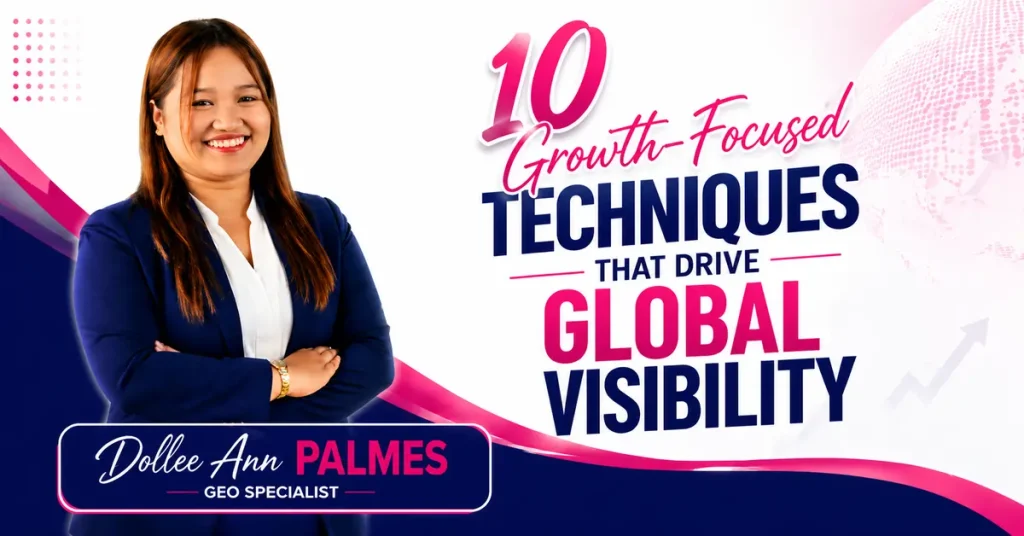
As a GEO specialist, I rely on ten core strategies to boost global visibility: building topical authority through entity-based content, structuring data with schema markup, optimizing for conversational queries, earning high-quality backlinks from trusted sources, leveraging multilingual SEO, creating original research and statistics, optimizing for E-E-A-T signals, refining technical site architecture, monitoring AI citation performance, and establishing a consistent expert brand presence across digital platforms.
I’m Dollee Ann Palmes, a Generative Engine Optimization (GEO) specialist focused on helping global brands earn visibility, citations, and trust signals across AI-powered search platforms.
Brands that combine traditional SEO foundations with AI-first content strategies are 3–5x more likely to be cited in generative search results.
Introduction: Why Global Visibility in the AI Era Matters
The way the world searches has fundamentally changed. By 2026, more than 60% of online queries are processed through AI-powered platforms such as Google’s AI Overviews, ChatGPT Search, Perplexity, and Microsoft Copilot. Traditional search engine optimization is no longer enough — brands now need to be discoverable, citable, and trustworthy in the eyes of large language models (LLMs).
This is where Generative Engine Optimization (GEO) comes in. Unlike traditional SEO, which targets keyword rankings on search engine result pages (SERPs), GEO focuses on getting your content quoted, summarized, and recommended by AI engines that synthesize answers for users.
I’m Dollee Ann Palmes, a GEO specialist, and over the past few years I’ve focused on helping businesses scale their global visibility through structured, authoritative, and AI-readable content frameworks. My growth-driven approach combines technical optimization, semantic relevance, and human expertise — the trifecta I believe is required to thrive in the generative search era.
In this article, I’ll walk you through the 10 growth-driven strategies I use to help brands boost global visibility — strategies that work whether you’re a local startup or a multinational enterprise.
1. Build Topical Authority Through Entity-Based Content
What it means: Topical authority is the depth and breadth of expertise your website demonstrates around a specific subject. AI engines reward sites that consistently cover a topic from every relevant angle.
In my experience, AI models like Google’s Gemini and OpenAI’s GPT systems use entity recognition to understand context. So instead of focusing on isolated keywords, I always tell my clients to build clusters of semantically connected content that reinforce their authority on a subject.
How I apply it:
- I map each niche into pillar topics and subtopics using tools like Semrush’s Topic Research or Ahrefs.
- I make sure we cover the “who, what, why, when, where, and how” of every major topic in the industry.
- I interlink related articles aggressively to signal contextual depth.
- I use named entities (people, places, brands, products) consistently to help AI engines connect the dots.
Once AI engines recognize your domain as the definitive source on a topic, your content becomes the default citation in generative answers — and that’s a major win for global visibility.
2. Structure Your Data with Schema Markup
Why it matters: Schema markup translates your content into a language AI engines can read instantly. From what I’ve seen across client sites, those with proper structured data are significantly more likely to appear in AI Overviews and rich results.
I implement structured data using Schema.org vocabulary — specifically Article, FAQPage, HowTo, Person, Organization, and Product schemas.
Key schema types I prioritize for GEO:
- FAQ schema — directly feeds AI Overview answer boxes.
- Article schema — establishes authorship, publish date, and publisher.
- Person schema — strengthens E-E-A-T (Experience, Expertise, Authoritativeness, Trustworthiness).
- Product schema — boosts visibility in commerce-related AI answers.
I always validate markup using Google’s Rich Results Test before deploying it across a site.
My personal tip: pair JSON-LD schema with semantic HTML5 tags (<article>, <section>, <header>) for maximum machine readability. The combination is more powerful than either alone.
3. Optimize for Conversational and Long-Tail Queries
AI search has changed how people phrase queries. Instead of typing “best CRM 2026,” users now ask, “What’s the best CRM for a small remote team that integrates with Slack and Notion?”
This shift has made me rethink content style entirely. I now coach my clients to write content that answers full-sentence, intent-rich questions — the same way you’d answer a colleague over coffee.
Tactics I use:
- I write subheadings as natural-sounding questions.
- I provide concise, direct answers in the first 2–3 sentences after each subheading (what I call the “answer-first” model).
- I target long-tail keywords with question modifiers like how, why, what, can, should.
- I use tools like AnswerThePublic or AlsoAsked to surface real user questions.
This approach aligns content with how LLMs extract and quote information, and I’ve seen it dramatically increase AI citation rates within just a few months.
4. Earn High-Quality Backlinks from Trusted Sources
Backlinks remain a foundational ranking signal — but in the GEO era, I’ve found that the quality and relevance of those links matter more than ever. AI engines weigh citations from authoritative domains heavily when deciding which sources to trust.
I prioritize earning links from:
- Industry publications like Search Engine Journal, Moz, and Search Engine Land.
- Educational and government domains (.edu, .gov).
- Niche-specific authority sites and trade associations.
- Verified expert roundups and HARO-style features through platforms like Featured.com or Qwoted.
The workflow I rely on combines digital PR, expert commentary, and original data publishing to attract editorial links naturally — the kind that AI models recognize as credibility signals. I avoid link farms and paid link schemes entirely; they’re not just risky, they’re useless for GEO.
5. Leverage Multilingual and Multi-Regional SEO
Global visibility means showing up wherever your audience lives. With AI engines now serving localized answers based on language, region, and cultural context, I treat multilingual GEO as non-negotiable for any brand serious about international growth.
When I build multilingual strategies, I push past simple translation. I focus on cultural adaptation, regional keyword research, and localized schema.
My core tactics:
- I implement
hreflangtags correctly to signal language-region targeting (the full guide on Google Search Central is my go-to reference). - I translate content using a hybrid of professional linguists and AI tools — never raw machine translation alone.
- I localize entities like currencies, holidays, examples, and case studies for each market.
- I build region-specific backlinks from local authority sites.
The brands I’ve worked with that invested in multilingual GEO typically see 2–4x more international traffic within 6–12 months — particularly across Southeast Asia, Latin America, and EMEA markets.
6. Publish Original Research, Data, and Statistics
If there’s one thing I’ve learned about AI engines, it’s that they love numbers. Original statistics, surveys, and research reports are some of the most-cited content types in generative answers — because LLMs need verifiable data to back up their summaries.
I always recommend investing in first-party research as a long-term visibility moat:
- Run industry surveys and publish the findings.
- Aggregate proprietary data from your platform or customers (with consent).
- Conduct case studies with measurable outcomes.
- Create benchmarks and “state of the industry” reports.
When other publications cite your data, your brand becomes a named entity across the web — exactly what AI engines look for when attributing answers. I often point clients to platforms like Statista and Pew Research to see how original data drives outsized visibility at scale.
7. Optimize for E-E-A-T Signals (Experience, Expertise, Authoritativeness, Trustworthiness)
Google’s E-E-A-T framework — Experience, Expertise, Authoritativeness, and Trustworthiness — is the backbone of AI trust signals. From what I’ve observed, LLMs are trained to weigh content from credible authors and verified organizations far more heavily than anonymous or thin content.
My E-E-A-T checklist:
- Author bios with credentials, photos, and links to professional profiles like LinkedIn.
- About and contact pages that clearly establish who runs the site.
- Citations and references to peer-reviewed or authoritative sources.
- Updated content dates that show freshness and ongoing maintenance.
- Reviews and testimonials with verifiable identities.
- Editorial guidelines and a transparent fact-checking process.
For YMYL (Your Money, Your Life) topics — health, finance, legal, safety — I tell my clients E-E-A-T isn’t optional. AI engines almost exclusively cite sources with strong trust signals in these categories, and I’ve seen brands disappear from AI Overviews overnight when they ignored this.
8. Refine Technical SEO and Site Architecture
A flawless content strategy collapses without a strong technical foundation. AI crawlers — including GPTBot, ClaudeBot, PerplexityBot, and Googlebot — need to access, parse, and index your site efficiently.
My technical GEO checklist:
- Core Web Vitals — pass LCP, INP, and CLS thresholds. I test with PageSpeed Insights.
- Mobile-first design — over 70% of global searches happen on mobile.
- Clean URL structures — short, descriptive, and hierarchical.
- XML sitemaps and robots.txt — properly configured to allow AI crawlers (or block selectively).
- HTTPS, HTTP/2, and fast hosting — non-negotiable for global audiences.
- Internal linking — strategic anchor text that reinforces topical clusters.
I lean heavily on free auditing tools like Screaming Frog and Google Search Console to identify technical bottlenecks fast.
9. Monitor AI Citations and Brand Mentions
You can’t improve what you don’t measure. I learned early on that traditional rank tracking is incomplete in the GEO era — you also need to track how often, and in what context, AI engines cite your brand.
I use a combination of monitoring tools and manual auditing to track GEO performance:
- Brand-mention tools like Brand24 or Mention to catch new citations across the web.
- AI visibility platforms such as Otterly.AI, Profound, and Peec AI that specifically track citations in ChatGPT, Perplexity, and Google AI Overviews.
- Manual prompt testing — I personally query ChatGPT, Perplexity, Claude, and Gemini with high-intent keywords to see whether my clients’ brands appear in answers.
- Referrer analytics in Google Analytics 4 to spot traffic from AI assistants.
Tracking citations gives me a real feedback loop: I can see which pages, which formats, and which entities are pulling AI attention — and which still need work.
10. Establish a Consistent Expert Brand Across Platforms
The final and most underrated growth strategy I champion: become a recognizable named entity across the digital ecosystem. AI engines build “knowledge graphs” around real people and organizations, and I’ve found consistency to be the strongest signal of legitimacy.
The personal brand framework I use for myself and my clients includes:
- A complete and verified LinkedIn profile with consistent role, expertise, and content posting.
- Author profiles on every site you publish on, linking back to your main hub.
- Speaking engagements, podcast appearances, and webinar features.
- A claimed and optimized Google Knowledge Panel, where eligible.
- Active presence on platforms like Medium, Substack, X, and YouTube — each reinforcing the same expertise.
- Wikipedia entries (where appropriate and editorially justified) and Wikidata entries to anchor your entity.
When your name, photo, bio, and topic are consistent across the web, AI engines stop treating you as ambiguous and start citing you as a definitive expert. That’s the moment GEO really starts compounding.
Putting It All Together: My GEO Framework
Boosting global visibility in 2026 isn’t about gaming algorithms — it’s about earning the trust of both humans and machines. The 10 strategies I’ve shared form a complete growth engine when you implement them consistently:
- Topical authority gives you depth.
- Schema markup gives AI engines clarity.
- Conversational optimization aligns with how people actually search.
- High-quality backlinks build credibility.
- Multilingual SEO opens global doors.
- Original research makes you citable.
- E-E-A-T signals build trust.
- Technical SEO removes friction.
- AI citation monitoring closes the feedback loop.
- Consistent personal branding cements your authority.
This is the framework I use with my clients — and it works because I treat GEO not as a tactic, but as a long-term growth philosophy.
Final Thoughts From Expert GEO Specialist Boost Global Reach
The future of search is conversational, contextual, and AI-driven. From everything I’ve seen working with global brands, those that adapt now — by combining traditional SEO discipline with the AI-first strategies I’ve shared — will own the next decade of digital visibility.
Whether you’re starting from scratch or refining an enterprise strategy, my advice is the same: build authority, prove expertise, structure your data, and stay consistent. The brands that show up in AI answers tomorrow are the ones investing in GEO today.
If you’d like to talk about how to apply this framework to your own brand, I’d love to hear from you.
— Dollee Ann Palmes, Expert GEO Specialist
FAQs
Frequently Asked Questions (FAQ)
1. What is Generative Engine Optimization (GEO)?
Generative Engine Optimization (GEO) is the practice of optimizing content, brands, and digital entities to be cited, summarized, and recommended by AI-powered search engines like Google AI Overviews, ChatGPT, Perplexity, and Claude. I think of it as the natural evolution of SEO for the AI era.
2. How is GEO different from traditional SEO?
Traditional SEO focuses on ranking on search engine result pages (SERPs). GEO focuses on becoming a trusted source that AI models cite directly in their generated answers. While both share foundational practices like quality content and backlinks, in my work GEO emphasizes structured data, entity recognition, and conversational content patterns much more heavily.
3. Who is Dollee Ann Palmes?
I’m Dollee Ann Palmes, a Generative Engine Optimization (GEO) specialist. I help brands and businesses boost global visibility across AI-powered search platforms through growth-driven, data-backed strategies.
4. How long does it take to see results from GEO?
In my experience, most brands see measurable improvements in AI citations within 3–6 months of consistent implementation, with significant global visibility growth typically taking 6–12 months. Original research and topical authority compound over time, so the longer you stay consistent, the bigger the returns.
5. Which AI engines should I optimize for first?
I recommend prioritizing Google AI Overviews (largest reach), ChatGPT Search (high-intent users), and Perplexity (research-driven audiences). The good news: optimization for one AI engine generally benefits the others, since they share underlying signals like authority, structured data, and content quality.
6. Do backlinks still matter in GEO?
Yes — and I’d argue they matter more than ever. High-quality backlinks from authoritative, relevant sources remain one of the strongest credibility signals AI engines use to decide which sources to cite. The emphasis has just shifted from quantity to relevance and source authority.
7. Will GEO replace traditional SEO entirely?
No. I see GEO as an extension of SEO, not a replacement. Strong technical SEO, quality backlinks, and great content are still the foundation. GEO simply adds new layers — structured data, entity optimization, conversational formatting, and AI citation tracking — on top of that foundation.
8. What types of content perform best in AI Overviews?
From what I’ve tested, the formats that get cited most often are FAQs, step-by-step guides, comparison articles, original research, definition-style explainers, and listicles with clear data. The common thread is structured, scannable content that gives AI engines clean, extractable answers.
9. How do I optimize my content for ChatGPT and Perplexity specifically?
I focus on three things: clear topical authority, citation-worthy original information, and conversational answer formatting. ChatGPT and Perplexity both favor sources that are well-cited across the web and that present information in direct, factual language — so I aim for clarity over cleverness.
10. Does GEO work for small businesses, or is it only for big brands?
It absolutely works for small businesses — and honestly, I think small businesses have an edge. They can niche down hard, build deep topical authority on a specific subject, and get cited as the expert source faster than a generalist enterprise brand. GEO rewards specificity.
11. How important is author authority in GEO?
It’s one of the most important factors. AI engines look for real, verifiable people behind the content — that’s why I always insist on full author bios, LinkedIn links, headshots, and consistent author profiles across every site you publish on. A faceless brand will always lose to a brand with a recognizable expert.
12. Should I block AI bots like GPTBot or ClaudeBot from my site?
In most cases, no. Blocking AI crawlers means giving up the chance to be cited in their generated answers. Unless you have a strong commercial reason to keep your content out of AI training data, I recommend allowing them through your robots.txt file. The visibility upside is significant.
13. How do I measure ROI from a GEO strategy?
I track a mix of leading and lagging indicators: AI citation frequency, branded search volume, referrer traffic from AI assistants in Google Analytics 4, conversion rates from AI-driven traffic, and overall organic growth. ROI in GEO is compounding, so I encourage clients to look at 6- and 12-month windows.
14. What’s the biggest GEO mistake brands make?
Treating GEO as a checklist instead of a strategy. I see brands add some FAQ schema, write a few “what is” articles, and call it done. Real GEO is about building a recognizable, trusted entity over time — there’s no shortcut, and there’s no plugin that does it for you.
15. Do I need a separate content strategy for GEO and SEO?
Not separate — integrated. I build one content strategy that satisfies both human readers and AI engines simultaneously. The same article should rank well on Google, get cited in AI Overviews, and be readable for a real person. If you’re producing different content for each, you’re working twice as hard.
16. How does multilingual content affect AI visibility?
Significantly. AI engines serve localized answers, so brands publishing in multiple languages get cited in multiple language markets. I’ve seen multilingual GEO strategies double or triple international traffic. Just remember: machine translation alone isn’t enough — you need cultural localization too.
17. What role does video and multimedia play in GEO?
A growing one. AI engines are becoming increasingly multimodal, meaning they can pull from video transcripts, podcast captions, and image alt text. I always recommend transcribing video content, adding descriptive alt attributes to images, and publishing companion blog articles for video content to multiply visibility.
18. How often should I update my content for GEO?
I recommend auditing high-priority pages every 3–6 months and refreshing them with updated stats, new examples, and current insights. AI engines favor freshness signals, especially for fast-moving topics. Stale content gets quietly pushed out of citations even if it once performed well.
19. Can AI Overviews hurt my organic traffic?
Sometimes, yes. AI Overviews can answer queries directly without sending users to your site — what some call “zero-click search.” That’s exactly why GEO matters. Even if click-throughs decline, being the cited source builds brand authority, trust, and downstream demand. The brands that lose are the ones who weren’t cited at all.
20. How do I get started with GEO if I’m completely new?
Start with the basics: audit your site for E-E-A-T signals, add schema markup to your most important pages, identify the top 5 questions your audience asks, and write answer-first content for each. From there, layer in original research, backlink outreach, and AI citation tracking. Don’t try to do everything at once — pick the highest-leverage strategy from this list and execute it well.