

Pricing is one of the most powerful decisions any business can make. A well-designed pricing strategy can increase profitability, improve customer perception, and strengthen a brand’s competitive position. On the other hand, poor pricing can reduce demand, weaken brand value, and cause businesses to lose market share.
Pricing strategy fundamentals refer to the basic principles companies use to determine how much they should charge for their products or services. These principles consider production costs, customer willingness to pay, competitor pricing, and overall market demand.
In modern business environments, pricing is not simply about covering costs. It involves understanding customer psychology, analyzing data, and aligning prices with the brand’s long-term strategy.
What Is a Pricing Strategy?
A pricing strategy is the method a business uses to determine the best price for its products or services. The goal is to maximize revenue while remaining competitive and attractive to customers.
Companies develop pricing strategies by considering several factors:
- Production and operational costs
- Target market purchasing power
- Brand positioning
- Competitor pricing
- Demand and market conditions
A strong pricing strategy ensures that businesses maintain profitability while delivering perceived value to customers.
Why Pricing Strategy Is Important
Pricing affects almost every aspect of a business. It influences consumer perception, market positioning, and overall profitability.
Revenue and profitability
Even small pricing adjustments can significantly impact revenue. Increasing prices by a small percentage can sometimes improve profits more effectively than increasing sales volume.
Brand positioning
Price communicates brand value. Premium brands often use higher pricing to signal exclusivity and quality, while budget brands compete on affordability.
Competitive advantage
Companies that price strategically can outperform competitors by attracting the right customers and capturing greater market share.
Core Pricing Strategy Fundamentals
Understanding the fundamentals helps businesses build pricing models that support sustainable growth.
Cost-Plus Pricing
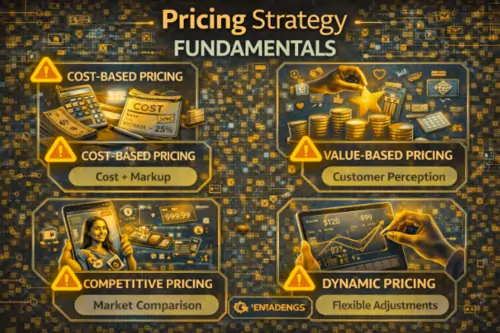
Cost-plus pricing is one of the most traditional pricing methods. Businesses calculate the total cost of producing a product and then add a markup percentage to determine the selling price.
Example formula:
Cost of production + profit margin = final price
Advantages:
- Simple and easy to implement
- Guarantees coverage of production costs
Disadvantages:
- Does not consider market demand
- Ignores competitor pricing
While cost-plus pricing is straightforward, many modern businesses combine it with other pricing strategies.
Value-Based Pricing
Value-based pricing focuses on the perceived value of a product rather than production cost.
For example, luxury brands often charge premium prices because customers perceive their products as high quality, exclusive, or prestigious.
Advantages:
- Higher profit margins
- Strong alignment with brand positioning
Disadvantages:
- Requires deep understanding of customer perception
- Difficult to implement without strong brand recognition
Companies in technology, luxury goods, and software industries frequently use value-based pricing.
Competitive Pricing
Competitive pricing involves setting prices based on competitors’ pricing structures.
Businesses monitor competitors and choose whether to price:
- Higher than competitors (premium positioning)
- Similar to competitors (market parity)
- Lower than competitors (price leadership)
This strategy is common in industries with intense competition, such as retail and consumer electronics.
Penetration Pricing
Penetration pricing is used when entering a new market. Companies initially set lower prices to attract customers and gain market share quickly.
Once the brand becomes established, prices may gradually increase.
Advantages:
- Fast market entry
- Rapid customer acquisition
Disadvantages:
- Lower short-term profits
- Customers may resist future price increases
Streaming platforms and subscription services often use penetration pricing strategies.
Price Skimming
Price skimming is the opposite of penetration pricing. Companies launch a product at a high price and gradually reduce it over time.
This approach works well for innovative or technology products where early adopters are willing to pay more.
Advantages:
- Maximizes revenue from early adopters
- Helps recover development costs quickly
Disadvantages:
- Competitors may enter with lower prices
Many smartphone and electronics companies use price skimming during product launches.
Psychological Pricing Strategies
Pricing strategy fundamentals also include understanding consumer psychology. Small pricing changes can influence how customers perceive value.
Charm Pricing
Charm pricing uses prices ending in .99 or .95 to make products appear cheaper.
Example:
$9.99 instead of $10.00
Consumers often perceive these prices as significantly lower even though the difference is minimal.
Bundle Pricing
Bundle pricing combines multiple products into a package at a discounted price.
Examples include:
- meal combos
- subscription bundles
- software packages
This strategy encourages customers to purchase more items while feeling they receive better value.
Anchoring
Anchoring presents a high-priced option first so that other options appear more affordable.
For example:
Premium plan – $100
Standard plan – $60
Basic plan – $40
Customers often choose the middle option because it appears balanced.
Data-Driven Pricing
Modern businesses increasingly rely on data to optimize pricing decisions.
Dynamic pricing
Dynamic pricing adjusts prices based on real-time demand, supply, and market conditions.
Industries that commonly use dynamic pricing include:
- airlines
- hotels
- ride-sharing services
- e-commerce platforms
Prices may change based on time, demand, or user behavior.
AI-powered pricing models
Artificial intelligence can analyze large datasets to identify pricing patterns and customer behavior.
AI helps companies:
- predict demand
- optimize discounts
- personalize pricing offers
As data becomes more accessible, AI-driven pricing strategies are expected to become more common.
Common Pricing Strategy Mistakes
Even experienced businesses sometimes make pricing mistakes.
Ignoring customer perception
Businesses that focus only on costs may overlook how customers perceive value.
Competing only on price
Constantly lowering prices can lead to price wars and reduce profit margins.
Failing to test pricing models
Companies should test different price points to find the optimal balance between demand and profit.
How Businesses Choose the Right Pricing Strategy
Selecting the right pricing strategy requires careful analysis of several factors.
Businesses should consider:
Market demand
Target customer income levels
Brand reputation
Competitor pricing
Cost structure
Successful pricing strategies often combine multiple approaches instead of relying on a single method.
The Future of Pricing Strategy
Pricing strategies are evolving as digital technology and data analytics improve.
Several trends are shaping the future of pricing:
- AI-driven dynamic pricing systems
- subscription and recurring pricing models
- personalized pricing based on user behavior
- real-time demand pricing for online marketplaces
Companies that leverage technology and consumer insights will be better positioned to create effective pricing strategies.
Conclusion
Pricing strategy fundamentals form the foundation of successful business operations. From cost-plus and value-based pricing to psychological pricing techniques and AI-driven models, companies have many tools to determine optimal pricing.
A strong pricing strategy balances profitability with customer perception and market competitiveness. As technology continues to evolve, businesses that adapt their pricing models to changing market conditions will gain a significant advantage in today’s competitive marketplace.