

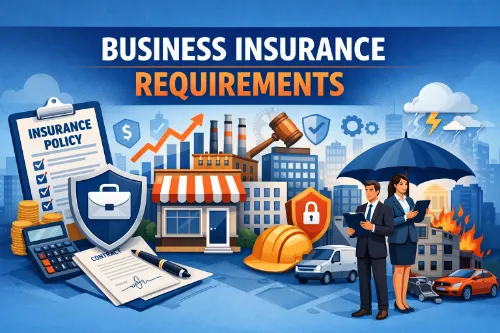
Business insurance requirements set the minimum level of protection your company must carry to meet legal obligations, contractual terms, and basic risk management standards.
On top of what the law requires, smart owners usually add extra cover to protect their income, assets, and reputation from everyday risks like accidents, lawsuits, cyber incidents, and staff injuries. Recent small business insurance checklists for 2026 and complete business insurance coverage guides for 2026 highlight how important it is to understand both the “must‑have” and “nice‑to‑have” policies for your company.
What Are Business Insurance Requirements?
Business insurance requirements are the policies you must have—because the law says so, a contract demands it, or your industry regulator expects it. They sit alongside optional covers you buy to strengthen your overall risk protection and avoid common coverage gaps. Overviews such as MoneyGeek’s business insurance requirements 2026 guide and the U.S. Chamber of Commerce’s how to choose small business insurance explain how these layers work in practice.
- Legal requirements: Many jurisdictions make workers’ compensation, unemployment insurance, and sometimes disability or employer’s liability mandatory once you hire staff.
- Contractual requirements: Clients, landlords, and lenders often require general liability, professional indemnity, or property insurance before they will sign a lease, loan, or service agreement.
- Regulatory and industry requirements: Regulated sectors (healthcare, finance, construction, etc.) may require specific policies or minimum limits as part of licensing and compliance.
If you are not sure where to start, MoneyGeek’s 2026 business insurance requirements guide gives a clear snapshot of what is typically mandated by law versus what is strongly recommended based on your business model.
Legally Required Insurance for Small Businesses
Laws differ by country and state, but there are some common patterns in what becomes legally required once you hire employees or operate in certain sectors. Getting these wrong can lead to fines, stop‑work orders, or even criminal charges, which is why most legal and HR resources put legal must‑haves at the top of their checklists.
Workers’ Compensation Insurance
Workers’ compensation insurance covers medical expenses, rehabilitation, and wage replacement when employees are injured or become ill because of their job. It is one of the most widely mandated forms of business insurance worldwide.
- United States: Every U.S. state except Texas requires most employers to carry workers’ compensation once they reach a minimum number of employees, though the threshold and details vary by state.
- Penalties for non‑compliance: Failing to carry workers’ comp when required can result in fines, stop‑work orders, personal liability for injury costs, and in some jurisdictions even criminal charges.
Paychex’s business owner’s guide to buying workers’ compensation insurance explains how to check your state’s rules, estimate payroll, and select a policy. Complementing this, Thimble’s overview of workers’ compensation requirements provides an easy‑to‑scan summary of when coverage becomes mandatory and who counts as an employee or contractor.
Unemployment Insurance and Statutory Contributions
Employers are often legally required to contribute to unemployment insurance and, in some regions, statutory disability or paid family leave schemes. These obligations are usually handled through payroll tax systems rather than standalone policies, but they still form part of your core “insurance” responsibilities as an employer.
The U.S. Chamber’s article on how to choose small business insurance includes a section outlining key federal and state employer insurance obligations, such as unemployment insurance, and how they interact with private insurance policies.
Employers’ Liability and Other Compulsory Covers
In many countries, employers’ liability insurance is a separate compulsory policy that covers staff injury or illness claims beyond what public health systems or workers’ comp provide.
- UK example: Employers’ liability insurance is legally required if you employ staff who are not close family members, with heavy fines for every day that you trade without cover or with inadequate limits.
- Sector mandates: In some sectors (for example, medicine, law, construction), specific types of insurance—such as medical malpractice or professional indemnity—are mandatory to maintain a licence or membership in a professional body.
Miller & Partner’s business insurance for small business guide 2026 walks through compulsory policies in the UK, including employers’ liability, and then outlines recommended add‑on coverages.
Core “Must‑Have” Policies Most Small Businesses Need
Beyond strict legal requirements, there are a few core policies that almost every small business should have. Insurers and small‑business associations consistently highlight these as the backbone of a sensible risk management plan.
General Liability Insurance
General liability insurance protects your business if someone claims your operations caused bodily injury, property damage, or personal injury (like libel or slander). It is often the first policy small businesses buy and is commonly required in contracts.
- When it’s effectively required: Landlords, event venues, and corporate clients usually require proof of general liability coverage—often with specified limits—before they sign a lease or service agreement.
- Common claim scenarios: A customer slips and falls at your premises; your staff accidentally damages a client’s property; or a competitor alleges your advertising harmed their reputation.
Gray Group’s general liability insurance for small business guide explains what general liability covers, how much coverage small firms typically carry in 2026, and how to compare quotes. For background, Investopedia’s article on business liability insurance types and protection explains the key concepts in plain language.
Commercial Property and Business Interruption Insurance
Commercial property insurance protects your buildings, equipment, inventory, and furnishings against events like fire, theft, or certain natural disasters. Business interruption (or business income) insurance helps replace lost income and pay extra expenses if you are forced to temporarily close after an insured event.
- Who usually requires property cover: Banks and landlords often insist on property insurance to protect the value of premises, equipment, and fit‑out that secure their loan or lease.
- Who benefits most: Retailers, restaurants, manufacturers, and any business with significant stock or physical infrastructure face large losses if an event shuts them down, even briefly.
The Hartford’s overview of types of business insurance every business needs shows how property, business income, and liability cover combine into a typical small‑business insurance package (often sold as a Business Owner’s Policy).
Professional Liability (Errors & Omissions)
Professional liability insurance—also called errors & omissions (E&O) or professional indemnity—covers claims that your professional services or advice caused a client financial loss.
- Who needs it: Consultants, agencies, IT service providers, accountants, architects, engineers, designers, and other professional services firms.
- Why it becomes “required”: Many B2B contracts specify minimum professional indemnity limits and require you to provide evidence of cover during onboarding or tender processes.
Hiscox’s types of business insurance FAQ explains the difference between general liability and professional indemnity and gives examples of when each comes into play.
Cyber and Data Insurance
Cyber insurance helps your business respond to data breaches, ransomware, and other cyber incidents. It can cover incident response, forensic investigations, customer notification, legal defense, regulatory fines where insurable, and sometimes business interruption losses.
- Why it’s increasingly required: Larger clients and partners may require cyber liability coverage in contracts if you handle their customer data, integrate with their systems, or provide software services.
- Key drivers: More remote work, cloud services, and stricter data protection laws have made cyber risk a board‑level issue.
The 2026‑focused business insurance complete coverage guide highlights cyber liability as one of the fastest‑growing areas of small‑business insurance and outlines common loss scenarios and policy features.
How Much Insurance Do You Need?
Meeting the legal minimum is one thing; carrying enough cover to actually protect your business is another. The right level depends on your revenue, number of employees, industry risks, contracts, and appetite for risk.
- Typical costs: 2026 checklists report that microbusinesses may pay a few hundred dollars per year for basic general liability, while firms with staff, premises, and professional exposures may spend several thousand across multiple policies.
- Limit selection: Many small businesses start with the standard limits recommended in general liability for small business guides and then raise those limits when client contracts or leases demand higher coverage.
- Umbrella and excess cover: When you have large contracts, high‑value assets, or elevated injury risk, an umbrella policy can sit on top of your core liability policies to provide extra protection.
Gonzalez Insurance’s small business insurance checklist for 2026 is a practical resource for checking where your current coverage might be too low or missing altogether.
How to Figure Out Your Legal and Practical Requirements
Rather than guessing what you need, it helps to follow a structured process that blends legal requirements with your actual risk profile and contractual obligations.
Step 1: Confirm Legal Obligations where You Operate
Start by confirming what is legally required in your country, state, or region:
- Use employer resources like the U.S. Chamber’s small business insurance guide to understand federal and state‑level mandates.
- Check workers’ comp thresholds and rules using dedicated guides such as the business owner’s guide to buying workers’ compensation insurance and workers’ compensation requirements explainer.
- If you are in another jurisdiction, consult equivalent government or chamber of commerce resources, as well as local insurance brokers familiar with compulsory cover.
Step 2: Review Your Contracts and Industry Standards
Next, review leases, supplier agreements, client contracts, and franchise documents for explicit insurance clauses:
- Look for specified minimum limits for general liability, professional liability, auto, cyber, or other policies.
- Check whether you are required to add clients or landlords as “additional insureds” or to provide certificates of insurance.
- Compare those requirements with the typical cover discussed in guides like types of business insurance every business needs and types of business insurance (Hiscox).
Step 3: Map Your Risks and Assets
Once you know what is mandatory, map out your biggest risks:
- Do customers visit your premises or do you operate purely online?
- Do you provide professional advice or services that could cause clients financial loss?
- Do you rely on specialized equipment, vehicles, or inventory?
- Do you store sensitive customer data or rely heavily on digital systems?
Insurer resources such as Insureon’s small business insurance coverage guide and comparison tool can help you match common risks in your industry to specific policies.
Step 4: Get Quotes and Compare Policy Terms
With a rough list of required and strategic cover, you can start gathering quotes:
- Use online comparison tools or work with a broker to line up premiums, coverage limits, deductibles, and exclusions side by side.
- Look beyond price to policy wording—exclusions, sub‑limits, and conditions matter just as much as the headline limit.
- Use decision frameworks outlined in the U.S. Chamber’s small business insurance guide and Miller & Partner’s business insurance for small business 2026 guide to narrow options.
Step 5: Review and Adjust Annually
Your insurance needs will change as you hire more staff, sign bigger contracts, or expand into new regions:
- Schedule an annual review of your policies, limits, and key exclusions.
- Update estimates for revenue, payroll, and asset values so sums insured remain realistic.
- Adjust cover when you add locations, roll out new services, or take on larger clients with stricter insurance clauses.
Trutela’s complete coverage guide 2026 and Gonzalez Insurance’s 2026 small business insurance checklist both recommend this annual “reset” as a simple way to keep coverage aligned with reality.
Examples: Legal Must‑Haves for Two Common Small Business Types
To make the above more concrete, here is how requirements typically differ between a small service business and a small retail business.
Example 1: Marketing Agency or Consulting Firm
A small marketing agency with several employees and a mix of on‑site and remote work might need:
- Legally required: Workers’ compensation insurance once it reaches the employee threshold in its state, plus unemployment and any statutory disability contributions.
- Contract‑driven must‑haves: Professional liability (E&O) coverage at levels required by agency contracts, and general liability if clients or landlords insist on it.
- Practical protections: Cyber liability insurance if the agency stores client data or manages digital ad accounts, as recommended in many business insurance requirement guides.
Hiscox’s types of business insurance FAQ and Insureon’s coverage comparison tool both offer examples of common policy bundles for agencies and consulting firms.
Example 2: Small Retail Store or Café
A small retail shop or café with a physical location, employees, and customer foot traffic will typically require:
- Legally required: Workers’ compensation once it employs staff, and any mandatory employers’ liability or statutory covers in its jurisdiction.
- Contract‑driven must‑haves: General liability and commercial property insurance with limits and conditions specified in the lease, as well as possibly business interruption coverage, especially if the landlord or lender requires protection of premises and fit‑out.
- Practical protections: Product liability if it sells branded goods, plus optional cyber cover if it runs an online store or loyalty app.
GIO’s article on the different types of business insurance and The Hartford’s types of business insurance every business needs show sample combinations for retailers, trades, and hospitality companies.
Staying Current as Requirements Evolve
Insurance regulations and best practices evolve as laws change and new risks emerge—from cyber threats and remote work to health insurance and gig‑worker protections. That is why 2026‑specific resources stress the importance of revisiting your assumptions regularly.
- Follow reputable insurance blogs and small‑business resources such as complete coverage guides for 2026, small business insurance checklists, and updated explainers like general liability for small business.
- Monitor HR and payroll updates, especially around workers’ comp thresholds and any new statutory benefits.
- Seek advice from brokers or legal professionals if you operate in multiple jurisdictions or highly regulated industries.
By combining legal compliance with thoughtful risk management, you can use business insurance not just as a tick‑box requirement, but as a strategic tool that protects your people, your balance sheet, and your long‑term growth plans.