

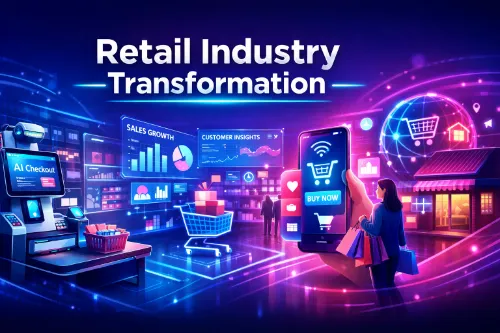
The retail industry in 2026 is undergoing profound transformation. AI is moving from pilots to pervasive use, unified commerce is replacing siloed omnichannel, and shoppers are demanding more value, transparency and seamless experiences than ever before.
Global outlooks from Deloitte, WNS, Slalom and others describe a sector where old boundaries between online and offline are dissolving, and where competitive advantage increasingly depends on how well retailers orchestrate data, technology and human talent across the entire value chain.
Global Retail Outlook: From Resilience to Reinvention
After several years of disruption, the global retail sector is shifting its focus from survival to strategic reinvention.
- Deloitte’s 2026 Retail Industry Global Outlook identifies five dynamics shaping the year ahead: AI‑enabled growth, cost‑conscious but convenience‑hungry consumers, the rise of retail media networks, more resilient and transparent supply chains, and a renewed emphasis on purpose and trust.
- Slalom’s perspective on retail industry trends 2026 describes a “retail renaissance” where leaders are re‑engineering customer journeys around hyper‑personalisation, frictionless global commerce, and real‑time supply‑chain orchestration.
- Harvard Business School’s summary of eight trends for 2026 highlights pricing power, passion‑driven brands and operational resilience as themes that are particularly relevant for retailers facing inflation, tariff shifts and changing labour markets.
Across these reports, one message is consistent: the retailers pulling ahead are those that have moved from experimentation to execution—embedding intelligence, data and agility into everyday operations, not just innovation labs.
AI, Agentic Commerce and the Future of CX
AI is at the centre of retail transformation in 2026, both behind the scenes and in customer‑facing experiences.
- WNS’s article on retail & CPG trends in 2026 highlights “agentic commerce”: AI shopping agents that search, curate options and even execute transactions on behalf of customers across apps, messaging platforms and voice assistants.
- Gladly’s piece on AI in retail and the future of CX notes that retailers are using AI to power real‑time personalisation, predictive service, smart routing, and self‑service bots that reduce friction while keeping a “human‑in‑the‑loop” for complex issues.
- InsiderOne’s rundown of AI trends shaping ecommerce in 2026 lists autonomous shopping agents, predictive merchandising, AI‑driven dynamic pricing and fraud detection as key use cases now reaching material scale.
These developments mean that for many shoppers, the first “person” they interact with is now an AI—on a website, app, social channel or voice interface—raising the bar for retailers to orchestrate consistent, brand‑right interactions across humans and machines.
Omnichannel to Unified Commerce
Retail has largely moved beyond basic omnichannel; the next frontier is unified commerce.
- The 2025 Omnichannel Retail Index Executive Summary shows strong adoption of omnichannel features (BOPIS, curbside, flexible returns), but finds that many retailers still struggle with fragmented back‑end systems and inconsistent execution.
- Manhattan Associates’ article on five omnichannel trends in retail argues that the future lies in unified commerce: a single integrated platform that unifies sales, fulfilment and service processes across all channels, enabling real‑time inventory and customer visibility.
- A comprehensive report on omnichannel retail strategies notes that retailers engaged in unified commerce are seeing a 22% rise in order accuracy and up to a 30% reduction in stockouts and overstock situations, plus higher online‑to‑offline conversion where AR/VR and in‑store experiences are integrated.
Deloitte Digital’s perspective on omnichannel peak performance emphasises that customers now expect a seamless path to purchase across all channels, with consistent pricing, promotions, and service. Achieving this requires integrated data, KPI frameworks and governance as much as new front‑end features.
Evolving Role of the Store
Physical stores are far from dead; they are transforming into multi‑purpose, experience‑rich assets.
- WNS’s 2026 trends report says that “the physical store is evolving from a single‑purpose retail box to an adaptive asset”—simultaneously a showroom, service hub, mini‑fulfilment centre and media stage where content and commerce intersect.
- Retail technology analyst Tom Vieweger’s LinkedIn piece on six retail technology trends that will shape 2026 highlights real‑time, item‑level inventory visibility (often via RFID), store‑based fulfilment, and interactive in‑store experiences as critical differentiators.
- Reports on omnichannel strategies from Global Banking & Finance and Manhattan Associates show that AR/VR and interactive displays are turning stores into experiential hubs, driving a roughly 22% boost in online‑to‑offline conversion when implemented well.
For many brands, the new question is not “Should we have stores?” but “What roles should each store play?”—from flagship brand theatre to community hub to micro‑fulfilment node.
Customer Expectations: Value, Convenience and Ethics
Consumers in 2026 are more demanding and polarised: some trade down and prioritise value, others trade up for premium and sustainable options, and many do both depending on the category.
- Deloitte’s global outlook highlights a “value + values” consumer: shoppers want good prices and ethical sourcing, transparency, and authenticity.
- Gladly’s CX report notes that ecommerce will continue to outpace store growth, but innovation will blur boundaries—expanded BOPIS, curbside pickup, smart lockers and fast delivery becoming standard expectations.
- WNS and Slalom both point to the rising importance of circular retail models (resale, rental, repair) as consumers respond to cost‑of‑living pressures and sustainability concerns.
This combination of financial caution and heightened expectations means retailers must compete simultaneously on customer‑centric cost efficiency and emotional loyalty, using personalisation and brand storytelling to stand out.
Technology Stack: Real‑Time Systems and Open Architectures
Retail technology is shifting toward real‑time, interoperable, cloud‑native architectures.
- Vieweger’s six retail tech trends argue that 2026 will be defined by systems that act in real time: AI agents that shop on behalf of customers, open standards reshaping commerce infrastructure, and RFID‑driven automation giving retailers a strategic edge in availability and efficiency.
- InsiderOne’s AI in retail trends highlight predictive analytics and machine‑learning‑based demand forecasting as key to reducing waste, avoiding stockouts, and adjusting prices dynamically.
- Manhattan Associates’ unified‑commerce research shows that retailers are moving toward single platforms that consolidate order, inventory and customer data, enabling consistent execution and better decision‑making.
These investments are not just about front‑end “wow”; they are foundational for margin protection and risk management in a volatile macro environment.
Fashion and Category‑Specific Transformation
Different retail categories are experiencing transformation in distinct ways.
- Strategy&’s Fashion Retail Outlook 2026 identifies traceability and transparency, agentic commerce, supply‑chain resilience and “smart value” (mixing premium and affordable offerings) as key themes for fashion retailers.
- The report stresses that fashion brands will be expected to show product traceability, decarbonisation progress and ethical labour practices, not just trend‑driven design.
- Other categories, such as grocery, DIY and electronics, are seeing intense competition on fulfilment speed, subscription models, and in‑store digital services.
Retailers in each segment must adapt their strategies to these category‑specific dynamics while still building a common data and technology foundation.
Australian Retail Transformation
Australia’s retail sector reflects many of these global trends, with local twists driven by cost‑of‑living pressures, geography and regulation.
- KPMG and Inside Retail’s Australian Retail Outlook 2026 describes a sector defined by resilience and reinvention, where shoppers remain value‑conscious and cautious but still demand convenience, personalisation and ethical transparency.
- The companion Australian Retail Outlook 2026 report highlights five focus areas: AI‑driven digital transformation, operational discipline, supply‑chain innovation, employee wellbeing, and community‑centred brand storytelling.
- The National Retail Association’s Australian retail industry dashboard shows that retail remains a major employer and GDP contributor, with ongoing channel shift toward online and omnichannel purchases.
Australian retailers are also navigating tariff changes, supply‑chain disruptions and labour shortages, pushing finance leaders to prioritise liquidity, rolling cash‑flow models and stronger banking relationships, according to the “Inside HQ – Finance: Facing Change” section of KPMG’s outlook.
Retail Media Networks and New Revenue Streams
One of the most important monetisation trends in 2026 is the rise of retail media networks.
- Gladly’s and Deloitte’s reports note that retail media networks—where retailers sell advertising space using their shopper data—are forecast to grow over 20% annually through 2027, becoming a meaningful profit centre.
- These networks turn first‑party data into high‑margin ad inventory across websites, apps, stores and off‑site channels, helping retailers offset thin product margins.
Retailers that successfully build and govern retail media capabilities can generate new revenue without adding inventory risk, but must manage data privacy and ethics carefully.
Key Challenges in Retail Transformation
Alongside opportunity, retailers face significant headwinds.
- Margin pressure: Ongoing cost inflation, tariff uncertainty and promotional intensity continue to squeeze margins, making data‑driven cost control and dynamic pricing crucial.
- Execution complexity: Integrating AI, unified commerce, and new store formats demands cross‑functional coordination and change management, not just technology spend.
- Talent and culture: Deloitte and KPMG both emphasise that attracting and retaining digital, data and frontline talent—and fostering a culture of adaptability—are key bottlenecks.
- Trust and privacy: As retailers collect more data and deploy more AI, they must navigate privacy regulations and maintain consumer trust, especially around algorithmic recommendations and dynamic pricing.
Reports from Deloitte, Slalom and KPMG agree that transformation success depends as much on leadership, governance and culture as on technology choices.
What This Transformation Means for Retailers
For retailers, 2026 is a year to turn ambition into repeatable execution.
- Embed AI strategically across marketing, merchandising, supply chain, and customer service, moving beyond pilots to scaled use cases with clear KPIs.
- Invest in unified commerce platforms that consolidate channels, inventories and customer data to deliver consistent experiences and operational efficiency.
- Redesign stores as multi‑purpose assets—experience, service and fulfilment—aligned with local customer needs and omnichannel journeys.
- Build retail media and data‑monetisation capabilities where brand scale and shopper data make it viable.
- Stay close to consumers’ evolving definitions of value (price, convenience, ethics, experience) and adjust assortments, pricing and services accordingly.