

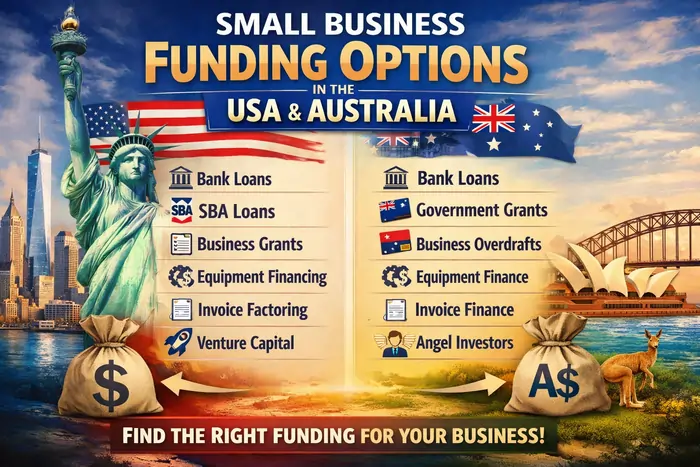
Small businesses in the USA and Australia often live or die based on how well they understand and use the right funding options at each stage of growth. This guide walks through the main small business funding options in the USA and Australia, explains when they make sense, and points you to external resources and tools that can help you choose the right mix for your business.
Introduction: Why Funding Strategy Matters for Small Businesses
Access to capital is critical because it affects whether you can launch, survive cash‑flow dips, and scale when opportunities appear. A funding strategy is not just “getting a loan” but choosing how much capital you need, what you’re willing to trade (interest, collateral, or equity), and how you’ll pay it back from real cash flow.
In both the USA and Australia, small businesses can combine personal funds, bank loans, government‑backed finance, grants, alternative lenders, and equity. However, the structure of government programs, grant systems, and fintech ecosystems differs, so it’s important to understand the local landscape in each country before you apply.
Understanding Your Small Business Funding Needs
Before you compare small business funding options, clarify what you actually need the money for and what stage your business is at.
- Growth stage: Are you a pre‑revenue startup, an early‑stage business with some sales, or an established SME looking to expand? Different products target different stages.
- Use of funds: Working capital, equipment, inventory, marketing, hiring, or opening a new location all suggest different types of funding.
- Amount and timing: How much you need and how quickly you need it will affect whether bank loans, online lenders, or revenue‑based financing make sense.
Because any lender or investor will look closely at your revenue, margins, and expenses, it helps to understand your own numbers first; this practical guide to understanding profit and loss statements walks through how to read a P&L so you can speak confidently about your business performance.
US and Australian guides on starting and funding a business, such as USAGov’s “start and fund your business” page and Stripe’s overview of small business funding options in Australia, emphasise the importance of a business plan, cash‑flow forecast, and basic financial records before you approach lenders or investors.
Traditional Debt Financing Options
Traditional debt financing remains a core funding option in both the USA and Australia. These include:
- Bank term loans: Lump‑sum loans repaid over a fixed term with interest, often used for equipment, vehicles, or expansion.
- Business lines of credit and overdrafts: Revolving facilities you can draw on as needed, ideal for managing seasonal cash‑flow gaps.
- Equipment finance and vehicle loans: Secured by the asset you’re buying, often at lower rates than unsecured loans.
- Secured vs unsecured business loans: Secured loans rely on collateral (property or assets) and may offer better terms; unsecured loans rely more on cash flow and credit history but can be faster and more flexible.
Stripe’s guide on small business loans in Australia explains the main term‑loan and line‑of‑credit options across banks, non‑bank lenders, and peer‑to‑peer platforms. For US businesses, bank loans are often complemented by SBA‑backed products, which we’ll cover next.
Government‑Backed Loans and Support Programs
Government‑backed loans help small businesses access funding with more favourable terms by sharing risk between lenders and public agencies.
USA: SBA and federal support
In the USA, the Small Business Administration (SBA) does not lend directly but guarantees part of loans issued by banks and approved lenders. Key programs include:
- SBA 7(a) loans: Flexible term loans up to USD 5 million for working capital, equipment, real estate, or business acquisition.
- SBA Express and CAPLines: Faster approvals and short‑term working capital lines for smaller amounts or seasonal needs.
The SBA and partner banks offer detailed guidance, such as SBA’s “fund your business” page and bank explainers like Capital Bank’s SBA loan basics. USAGov’s general guide on how to start and fund your business is also a helpful entry point.
Australia: Government‑supported finance
Australia offers government‑backed guarantees and programs via federal and state initiatives, combined with commercial lenders. While details change over time, common features include partial guarantees to banks, sector programs, and disaster‑recovery finance. You will often access these through your bank, specialist lenders, or state government business portals rather than directly from Canberra.
Grants and Non‑Repayable Funding

Grants are attractive because they provide funding without requiring repayment, but they are competitive and often targeted at specific sectors or projects.
In the USA, small businesses can look at:
- Federal, state, and local small business grants (often for innovation, export, or community development).
- Specialised programs supporting veterans, minority‑owned, or immigrant‑owned businesses.
Resources like the U.S. Chamber’s list of grants, loans, and programs for small businesses and Remitly’s overview of ways to find funding in the U.S. help you navigate grant opportunities and eligibility.
In Australia, there is a strong grant culture for startups, innovation, exporters, and regional businesses:
- Federal and state startup and small business grants, including innovation and commercialisation programs.
- Targeted schemes for manufacturing, clean energy, tourism, and regional development.
Lists such as Square’s overview of top government grants for startups and small businesses in Australia and Highview’s guide to top small business grants and funding options are good starting points. Stripe also offers a guide on how to get a grant to start a business that’s relevant to founders in both markets.
If you are specifically focused on the US market and want to broaden your funding toolkit beyond a single bank loan, this article on 7 proven ways to raise business capital in USA 2026 breaks down multiple capital sources—from traditional finance to more creative options—and shows how they can fit into a long‑term funding strategy.
Alternative and Online Small Business Funding Options
Alternative and online funding options have grown rapidly in both countries, giving small businesses more flexible ways to access capital.
Common options include:
- Online non‑bank lenders: Fast, unsecured business loans with streamlined applications but usually higher interest rates.
- Invoice financing and factoring: Advance funding against unpaid invoices to smooth cash flow.
- Merchant cash advances and revenue‑based financing: Up‑front funding repaid as a fixed percentage of daily or weekly sales rather than fixed instalments.
- Peer‑to‑peer lending platforms: Investors fund business loans via online marketplaces.
Stripe’s detailed guide to small business funding options in Australia and its documentation on how Stripe Capital works explain how revenue‑based financing and capital advances can help Australian (and global) Stripe users manage working capital and fund growth without traditional collateral.
For US‑based small businesses, Remitly’s article on funding options for small businesses covers US‑specific online lenders, business credit cards, and fintech solutions alongside traditional routes.
Equity and Investor Small Business Funding
Equity funding is a good fit for high‑growth startups that need significant capital and are willing to share ownership. Common types are:
- Angel investors: Affluent individuals who invest their own money, often at seed and early stages.
- Venture capital (VC): Professional funds investing larger amounts in startups with strong growth potential.
- Equity crowdfunding: Raising capital from a large number of smaller investors via regulated online platforms.
The SBA and US government guides explain how to find an investor and share your business plan, while Australian resources like Bentleys’ article on startup funding and capital raising in Australia outline how local founders approach angels, VCs, and accelerators.
Equity funding involves ownership dilution and governance obligations, so it’s usually best suited to scalable businesses (e.g., tech, SaaS, platforms) rather than lifestyle businesses that prioritise control and steady dividends.
Personal and Informal Funding Sources
Many businesses in both the USA and Australia begin with personal and informal funding.
- Bootstrapping with personal savings: Using your own savings or reinvesting early profits to avoid debt or dilution.
- Friends and family: Loans or equity from people you know, often with more flexible terms but higher relationship risk.
- Home equity or personal loans: Borrowing personally to finance the business, which increases personal financial risk.
USAGov and the SBA note that self‑funding and friends‑and‑family capital are common starting points before moving on to bank loans or investors. Stripe’s funding guide for Australia also highlights owner funding as a frequent first step, followed by external capital once the business is proven.
Comparing Small Business Funding Options: USA vs Australia
When comparing small business funding options in the USA and Australia, consider these differences:
- Government ecosystem: The USA centralises a lot of small business support through the SBA, whereas Australia relies more on a patchwork of federal and state programs plus tax incentives.
- Grant culture: Australia often offers more grants and incentives for specific sectors and innovation, while the US has a mix of federal and state programs but emphasises loans and private capital.
- Fintech landscape: Both markets have vibrant fintech lenders; in Australia, players like Stripe Capital and other non‑bank lenders are prominent for fast online funding.
- Investor networks: The USA has deeper and more mature angel and VC ecosystems, whereas Australia’s investor market is smaller but growing, especially around major cities.
Platforms such as Swoop Funding and Stripe’s various capital and working‑capital guides can help compare options and eligibility across both markets.
How to Choose the Right Funding Mix
Choosing the right funding mix is about balancing cost, risk, control, and flexibility. Consider:
- Cost of capital: Compare interest rates, fees, equity dilution, and any revenue‑share terms.
- Risk and security: Decide how much personal risk (guarantees, collateral) you are willing to take on.
- Control: Debt preserves ownership; equity brings partners into decision‑making.
- Flexibility and speed: Online lenders and revenue‑based financing can be faster than bank loans or equity rounds, at a higher cost.
As an example, a service business (like an agency) might favour a mix of line of credit and invoice finance to manage cash flow, while a tech startup might combine grants, angel funding, and accelerators in the early stages, then move to VC and possibly revenue‑based financing as it scales. Stripe’s guide to business financing options in Australia provides a structured way to evaluate options against business goals and growth plans.
Practical Checklist Before You Apply for Funding
Before you apply for any funding option in the USA or Australia, work through a simple checklist:
- Prepare core documents: Up‑to‑date financial statements, tax returns, business plan, and cash‑flow forecasts.
- Clarify your funding need and use of funds: Lenders and investors want to know exactly how the money will be used and how it drives revenue or efficiency.
- Check your credit profile: Personal and business credit scores affect approval and pricing.
- Review collateral and guarantees: Know what assets you can safely offer and what personal commitments you are prepared to make.
- Research eligibility and terms: Each program has criteria for revenue, time in business, industry, or location—use official resources like SBA’s funding guide or Australian government and bank sites to confirm.
Guides such as Remitly’s small business FAQs and 1st Source Bank’s SBA loan guide provide practical checklists and common questions to review before you apply.
Conclusion: Building a Sustainable Funding Strategy
Small business funding options in the USA and Australia range from bootstrapping and bank loans to grants, online lenders, and equity, and each comes with trade‑offs in cost, risk, and control. By understanding your funding needs, exploring traditional and alternative financing, and learning how government‑backed and grant programs work in each country, you can build a funding strategy that supports long‑term growth rather than short‑term survival.
To move forward, start by reviewing an official guide such as the SBA’s “fund your business” for the USA and Stripe’s small business funding options in Australia for Australia, then shortlist two or three funding options that best match your stage, risk tolerance, and growth plans. From there, use the checklists and resources linked throughout this guide—along with in‑depth articles on profit and loss statements and ways to raise business capital in the USA—to prepare a strong application and build a sustainable capital stack for your small business.