

If you run an online store, this guide on Outsourced Accounting for Ecommerce Businesses explains how specialist accounting support can handle your multi‑channel sales, inventory, payment processors, and sales‑tax obligations while you focus on growth.
You will see what an ecommerce‑savvy outsourced accountant actually does, how they connect platforms like Shopify, Amazon, and payment gateways into your books, and when outsourcing becomes more cost‑effective than keeping everything in‑house.
This guide also shows how a startup‑focused firm like Accountalent can support ecommerce sellers alongside other digital businesses, and links to deeper resources on outsourced accounting, startup accounting, and small‑business accounting services.
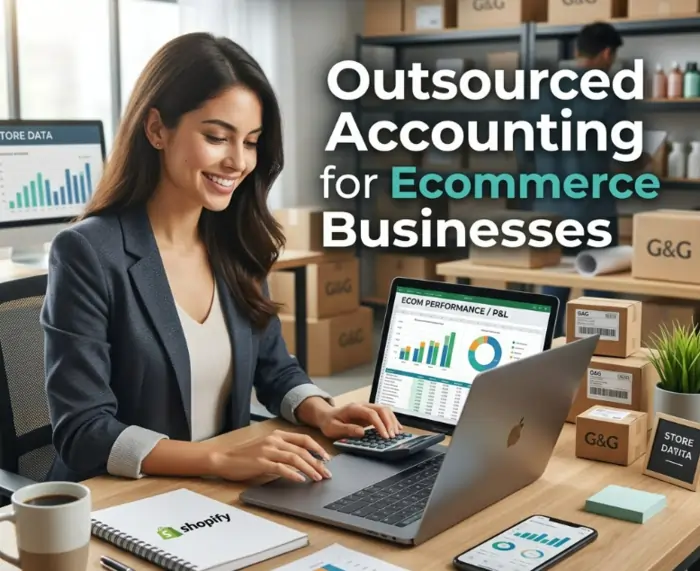
What Outsourced Accounting for Ecommerce Businesses Really Involves
Outsourced Accounting for Ecommerce Businesses means delegating bookkeeping, accounting, and often higher‑level finance tasks to a team that understands online sales channels, payment platforms, and inventory flows.
Instead of manually copying numbers from Shopify, Amazon, Stripe, PayPal, and your bank into spreadsheets, an outsourced team integrates those systems, reconciles them, and produces accurate financials on a regular schedule.
For ecommerce companies, this is especially important because margins, inventory, refunds, and multi‑state tax rules can quickly become too complex for generic bookkeeping alone.
If you want a broad overview of outsourced models before going deeper into ecommerce, you can also read:
Outsourced Accounting Services in California (Complete 2026 Guide)
Why Ecommerce Accounting Is Different
Ecommerce accounting has unique challenges that make specialist help more valuable:
- Multiple sales channels: Direct‑to‑consumer website, marketplaces (Amazon, Etsy, eBay), and sometimes retail or wholesale.
- Multiple payment processors: Stripe, PayPal, Shop Pay, Klarna, and others, each with fees, chargebacks, and payout timing.
- Inventory complexity: Cost of goods sold (COGS), landed cost, stock transfers, and shrinkage across warehouses or 3PLs.
- Sales‑tax and VAT: Multi‑state or multi‑country tax rules, marketplace facilitator laws, nexus thresholds, and periodic filings.
- Data fragmentation: Each platform has its own reports, formats, and timing that must be consolidated into one set of books.
An ecommerce‑savvy outsourced accountant understands these complexities and designs systems to handle them at scale.
What an Ecommerce‑Focused Outsourced Accountant Typically Does
A strong partner in Outsourced Accounting for Ecommerce Businesses usually offers:
- Bookkeeping and reconciliations across all sales channels and payment providers.
- Integration of ecommerce platforms and POS systems with cloud accounting software.
- Inventory accounting and COGS tracking, including landed cost and SKU‑level analysis.
- Payment‑settlement processes to tie platform payouts to bank deposits and customer orders.
- Sales‑tax and VAT compliance (registrations, filings, and audit support).
- Monthly financial statements and KPIs such as gross margin, contribution margin, and channel profitability.
- Cash‑flow forecasting and budgeting tailored to inventory cycles and seasonality.
These services are designed to give ecommerce founders a clear picture of performance without requiring them to become accountants themselves.
For a startup‑wide perspective (beyond ecommerce), you can also review: Outsourced Accounting for Startups (Complete Guide)
How Accountalent Fits Ecommerce and Digital Businesses
Accountalent positions itself as a one‑stop, fixed‑price tax and accounting solution for startups and digital businesses, offering income‑tax compliance, bookkeeping, R&D credits, BOI filings, and CFO‑style support.
Its bookkeeping service integrates with platforms like QuickBooks Online, Xero, Gusto, Rippling, Justworks, Ramp, Mercury, Brex, and other modern tools commonly used by ecommerce and online companies.
Publicly available information highlights that Accountalent:
- Provides unlimited, comprehensive income‑tax and financial services for startups of all stages.
- Offers annual tax subscriptions and bookkeeping starting at around $199 per month for early‑stage companies.
- Has worked with thousands of startups, including digital and ecommerce brands, using fixed‑price, best‑practice services.
While you should always confirm fit for your specific ecommerce stack, providers like Accountalent show what a modern, tech‑driven partner can look like for online sellers and other digital businesses.
Benefits of Outsourced Accounting for Ecommerce Businesses
Key advantages for ecommerce companies include:
- Reduced overhead: You avoid building an internal finance team before you are ready, while still getting professional‑grade support.
- Better accuracy: Specialists understand platform‑specific quirks, settlement reports, and how to avoid double‑counting revenue or fees.
- Scalability: Support can expand with new channels, territories, or product lines without needing to hire multiple internal roles.
- Technology integration: Outsourced teams typically use and integrate modern tools to automate data flows and reduce manual work.
- Compliance and risk reduction: With correct sales‑tax handling, inventory tracking, and financial reporting, you lower the risk of surprises and penalties.
These benefits are especially valuable in a space where thin margins and fast competition make accurate, timely information critical.
For more general small‑business‑oriented services (beyond ecommerce), you can see: Accounting Services for Small Business Owners
Final Take: Why Ecommerce Businesses Should Consider Outsourcing
For online sellers juggling multiple channels, payment platforms, and tax rules, Outsourced Accounting for Ecommerce Businesses is often the most efficient way to get reliable numbers without building a large internal finance team.
A specialist partner can integrate your tools, manage complexity, and deliver decision‑ready financials, freeing you to focus on sourcing, marketing, and customer experience.
Including a startup‑ and digital‑focused firm like Accountalent in your shortlist gives you a concrete benchmark for what a fixed‑price, tech‑integrated solution can deliver for ecommerce and other online businesses.
FAQs
1. What is outsourced accounting for ecommerce businesses?
It is the practice of hiring an external team to manage bookkeeping, accounting, tax compliance, and financial reporting specifically tailored to ecommerce operations and platforms.
2. Why do ecommerce companies need specialized accounting?
Ecommerce companies deal with multiple sales channels, payment processors, complex inventory, and multi‑jurisdiction taxes, which require domain‑specific accounting knowledge and tools.
3. Which tasks does an ecommerce‑focused outsourced accountant handle?
They handle consolidating channel data, reconciling payments, tracking inventory and COGS, managing sales‑tax compliance, and producing monthly financial statements and KPIs.
4. How does outsourced accounting help with multi‑channel sales?
Outsourced teams integrate data from platforms such as Shopify, Amazon, and marketplaces into one accounting system, reducing manual consolidation and errors.
5. Can outsourced accountants manage payment settlements?
Yes. They set up processes to match platform payouts and processor deposits to orders, accounting for fees, refunds, and chargebacks accurately.
6. How does outsourced accounting support ecommerce inventory management?
They track inventory levels, cost of goods sold, landed cost, and SKU‑level margins so you can see which products and channels are truly profitable.
7. Is outsourced accounting useful for small ecommerce shops?
Yes. Even smaller shops benefit from accurate sales, tax, and inventory tracking, especially as they add new channels or see spikes in volume.
8. How does outsourcing help with sales‑tax and VAT compliance?
Specialists understand sales‑tax nexus, marketplace facilitator rules, and filing schedules, reducing the risk of under‑payment or non‑compliance.
9. What role does automation play in outsourced ecommerce accounting?
Outsourced firms often use integrations and automation to import transactions, reconcile accounts, and generate reports faster and more accurately.
10. How frequently will I receive reports from an outsourced ecommerce accountant?
Most providers deliver monthly financial statements and may provide weekly snapshots or dashboards for key metrics depending on your plan.
11. How does Accountalent support ecommerce and digital businesses?
Accountalent integrates with common cloud tools and provides fixed‑price bookkeeping and tax services to startups and online companies, aiming to deliver best‑practice, tech‑driven accounting support.
12. Is outsourced accounting cost‑effective for ecommerce companies?
Yes. It often costs less than hiring internal staff with similar expertise, while providing scalable support as your sales volume and channel mix change.
13. How does outsourced accounting improve data accuracy for ecommerce?
By centralizing data from multiple channels and using specialized tools, outsourced teams reduce manual entry mistakes and ensure consistent classification and reconciliation.
14. Can outsourced accountants help with forecasting and budgeting?
Many ecommerce‑focused firms offer forecasting and budgeting services based on seasonality, marketing plans, and inventory cycles to support planning and cash‑flow decisions.
15. What should I look for in an ecommerce accounting provider?
Look for experience with ecommerce, strong integrations with your platforms, clear pricing, good references, and a track record of multi‑channel, multi‑state support.
16. Does outsourced accounting replace my tax preparer?
Some firms handle both bookkeeping and tax preparation; others coordinate with your existing tax advisor. Clarify whether income‑tax returns are included or separate.
17. How is outsourced accounting different for ecommerce versus general small‑business accounting?
Ecommerce accounting must handle large transaction volumes, multiple platforms, inventory complexities, and cross‑border or multi‑state taxes, which general small‑business setups may not manage well.
18. Where can I learn about outsourced accounting beyond ecommerce?
For a broader view covering many business types, see: Outsourced Accounting Services in California (Complete 2026 Guide)
19. How does ecommerce outsourcing relate to startup‑focused accounting?
Many ecommerce brands are startups. For a startup‑wide perspective, including fundraising and investor‑ready reporting, you can review: Outsourced Accounting for Startups (Complete Guide)
20. Where can I learn about more general accounting options for non‑ecommerce small businesses?
You can explore broader offerings and considerations in: Accounting Services for Small Business Owners