

If you are trying to figure out how to choose an outsourced accounting service in California, this guide walks you through the exact criteria to look for—industry experience, pricing, technology, location, and support.
You will see why choosing a firm that understands California tax rules, fast‑moving startups, and small businesses can save you time, stress, and money.
This guide also explains where a specialist provider like Accountalent fits into the picture, and links to deeper resources on outsourced accounting, timing, and the signs your business is ready to make the switch.
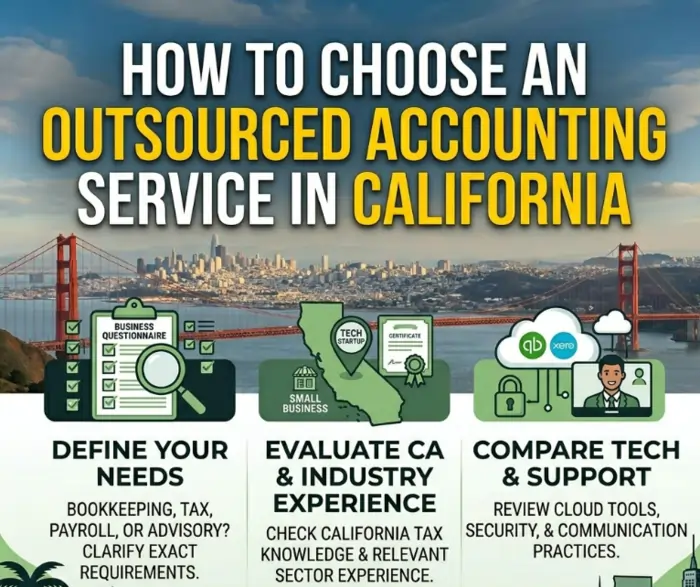
What Does How to Choose an Outsourced Accounting Service in California Really Involve?
Choosing an outsourced accounting partner is not just about comparing prices. You are choosing a team that will handle your books, tax filings, and financial data, so the decision affects compliance, cash flow, and day‑to‑day operations.
In California—where costs are high and regulations can be complex—you need a provider that understands both your industry and your local environment. That is why the best approach is to evaluate firms based on fit, not just on fees.
If you want a full overview of outsourced options before you choose, you can start with:
Outsourced Accounting Services in California (Complete 2026 Guide)
Step 1: Clarify What You Actually Need
Before you compare firms, get clear on what you want them to do. Some businesses only need monthly bookkeeping and basic reports; others need tax planning, sales‑tax help, and high‑level advice.
Think about:
- Your current pain points (messy books, late reports, tax stress)
- Your transaction volume and number of accounts
- Whether you sell in multiple states or only within California
- Whether you are planning to raise money or apply for loans
If you are unsure whether now is the right time to outsource at all, this guide can help you spot the signals:
When Should You Outsource Your Accounting? (Key Signs)
Step 2: Look for California and Industry Experience
Not all accounting providers understand California’s specific rules or your industry’s quirks. The right outsourced accounting service in California should combine state‑level knowledge with experience serving businesses like yours.
You can ask:
- How many California‑based clients they work with
- Whether they regularly deal with California Franchise Tax Board issues
- Whether they serve your specific niche (ecommerce, SaaS, professional services, brick‑and‑mortar, and so on)
If your business is already seeing signs that you have outgrown basic DIY accounting, this article is also useful:
7 Signs Your Business Needs an Accountant
Step 3: Evaluate the Scope of Services
A good outsourced accounting firm should cover the essentials you need now and leave room for upgrades later.
Typical service areas include:
- Bookkeeping and reconciliations
- Monthly financial statements and management reports
- Tax preparation and filing
- Sales‑tax registration and filings (if you sell into multiple states)
- Payroll entries and compliance support
- Budgeting, cash‑flow tracking, and basic forecasting
Make sure the firm clearly explains what is included in each package so you are not surprised later.
Step 4: Compare Pricing and Contracts
Pricing structures vary widely, so it is important to understand how each firm charges.
Common models:
- Fixed monthly packages based on size and complexity
- Annual tax or year‑end packages
- Hourly or project‑based work for special projects
Look for:
- Transparent pricing with no hidden fees
- Clear explanations of what happens if your volume grows
- Fair cancellation terms if the partnership is not working out
Predictable pricing is one of the main reasons many founders choose outsourced accounting instead of patching together separate providers.
Step 5: Check Their Technology Stack
Modern outsourced accounting services in California should rely on cloud tools, not paper and spreadsheets.
Ask which platforms they use for:
- Accounting (such as QuickBooks Online, Xero, or similar)
- Document collection and approvals
- Reporting dashboards or portals
- Secure file sharing and messaging
A firm that uses cloud accounting and automation will generally be faster, more accurate, and easier to work with than one that does everything manually.
Step 6: Assess Communication and Support
You are not just buying reports—you are buying access to people. The right partner should make it easy to ask questions, get explanations, and understand your numbers without a lot of jargon.
Look for:
- A clear onboarding timeline and point of contact
- Regular check‑ins or monthly review calls
- Response times that match your expectations
- Willingness to explain reports and recommendations in plain language
Good communication is often what separates a “vendor” from a real long‑term partner.
Step 7: Review Client Feedback and Case Studies
Real‑world proof matters.
Ask for references, testimonials, or case studies—especially from companies that look like yours in size and industry.
Look for feedback about:
- Accuracy and timeliness
- Responsiveness and clarity
- Ability to handle growth or complexity
- Support during stressful times (deadlines, audits, or rapid scaling)
This is often where you can see whether a firm consistently delivers or just looks good on paper.
How Accountalent Fits as an Outsourced Accounting Service in California
Accountalent is an example of a specialist firm built for startups and growing small businesses that want a streamlined outsourced solution.
Instead of juggling a separate bookkeeper, tax preparer, and consultant, you can work with one provider that understands how fast‑moving companies in California operate.
With Accountalent, you can:
- Get your bookkeeping handled consistently, using cloud‑based tools
- Receive startup‑specific tax preparation and planning support
- Access clear, investor‑ready financial statements as you grow
- Scale your services over time instead of rebuilding an in‑house team too early
While no single provider is right for everyone, firms like Accountalent show what a modern, tech‑driven outsourced accounting service in California can look like when it is designed around founders and small‑business owners.
For a broader, step‑by‑step look at outsourced accounting options, you can read: Outsourced Accounting Services in California (Complete 2026 Guide)
Quick Checklist for Choosing an Outsourced Accounting Service in California
Use this as a simple checklist when comparing providers:
- They understand California rules and work with California‑based clients
- They serve businesses similar to yours in size and industry
- Their service packages match what you need today
- Pricing is transparent and scales reasonably with your growth
- They use modern cloud tools and secure systems
- Communication is clear, with a dedicated contact and regular updates
- References or testimonials confirm reliability and accuracy
If several firms match these points, you can move on to details like cultural fit and how comfortable you feel with their team.
Final Take: Choosing the Right Partner for Your Business
Learning how to choose an outsourced accounting service in California is really about finding a partner who can keep your books clean, your filings compliant, and your numbers understandable.
The best provider for you will combine state‑level expertise, industry knowledge, cloud tools, and human support so you can focus on running—and growing—your business.
If you want a clear, startup‑friendly option to compare against others, Accountalent is a strong example of the kind of outsourced accounting firm that brings bookkeeping, tax, and advisory under one roof for California founders and small‑business owners.
FAQs
1. What is the first step in choosing an outsourced accounting service in California?
The first step is defining your needs: decide whether you only need bookkeeping, or you also require tax, sales‑tax help, payroll, and advisory support.
2. Why does California experience matter when picking an outsourced accounting firm?
California has its own tax rules and regulatory requirements, so providers familiar with the state can help you avoid penalties and surprises.
3. Should I choose a local firm or is a remote provider okay?
A remote firm is often fine as long as it understands California law, uses cloud tools, and communicates clearly and consistently.
4. How important is industry specialization?
Industry specialization helps because the firm already understands your revenue model, expense patterns, and common compliance issues.
5. What should I look for in an outsourced accounting service agreement?
Look for clear descriptions of services, pricing, response times, data‑security measures, and how changes in volume will affect your fees.
6. How do I compare pricing between outsourced accounting firms?
Compare what is included in each package, not just the headline price; a slightly higher fee may include more services and fewer hidden costs.
7. What questions should I ask during a discovery call?
Ask about their experience with California clients, their tech stack, who will be on your account, and how they handle onboarding and communication.
8. How do I know if a firm uses modern technology?
Ask which accounting platform they use, how you will share documents, and whether you will have access to online dashboards and reports.
9. How can I check if an outsourced accounting firm is reliable?
Review testimonials, case studies, or references from similar businesses and ask how long their average clients stay with them.
10. Should the firm handle both bookkeeping and tax?
It is often easier and safer when the same team manages bookkeeping and tax, because they know your numbers and can catch issues early.
11. What if my books are messy before I start with an outsourced firm?
Many firms offer clean‑up or catch‑up services to organize your books before moving into ongoing monthly work.
12. How often should I expect reports from an outsourced accounting provider?
Most businesses receive monthly financial statements and can request additional reports or dashboards as needed.
13. How does communication usually work with an outsourced accounting team?
Communication typically happens via email, secure portals, and scheduled calls or video meetings, especially around month‑end and tax deadlines.
14. What happens if my business grows quickly after I sign up?
A good provider will have scalable plans, allowing you to upgrade your level of service as transaction volume and complexity increase.
15. Can an outsourced accounting service help me decide when to hire in‑house?
Yes, experienced providers can help you recognize when it is time to add internal finance roles while still supporting the transition.
16. How do I know if it is time to outsource my accounting at all?
If you are behind on books, stressed about taxes, or spending too much time on finances, this guide can help: When Should You Outsource Your Accounting? (Key Signs)
17. What are signs my business needs more than basic bookkeeping?
Frequent mistakes, late reports, rapid growth, and confusing tax situations are key signs; you can learn more in: 7 Signs Your Business Needs an Accountant
18. Is an outsourced accounting firm suitable for startups?
Yes, many startups use outsourced accounting for clean books, investor‑ready reports, and guidance on burn rate and runway.
19. Can I switch providers if I am unhappy with the service?
Yes, you can change firms; just make sure you receive copies of your financial data and agree on a clear handover.
20. Where can I find a startup‑friendly outsourced accounting service in California?
You can review providers like Accountalent, which offers outsourced accounting, tax, and advisory services tailored to startups and small‑business owners.