

If you are seeing warning signals in your finances, this guide on 7 Signs Your Business Needs an Accountant will help you decide when it is time to bring in professional support. You will learn how messy books, tax stress, late reports, cash‑flow confusion, and rapid growth all point to the need for more than DIY bookkeeping.
This guide also shows how a startup‑focused firm like Accountalent can step in as your external accounting partner, and links to deeper resources on outsourced accounting, how to choose the right provider, and when to make the switch.
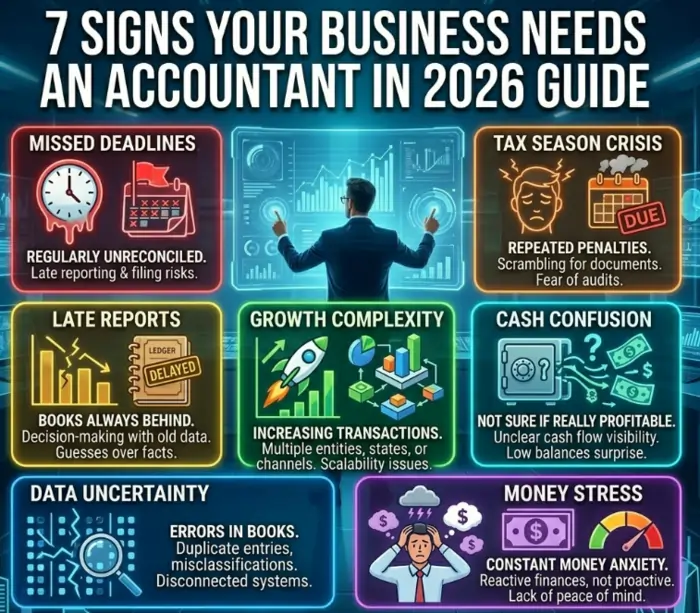
What Are the 7 Signs Your Business Needs an Accountant?
At some point, every growing business outgrows spreadsheets, part‑time bookkeeping, and guesswork.
The real question is not whether you will need an accountant, but when.
The 7 Signs Your Business Needs an Accountant revolve around stress, complexity, and risk: when those three things start rising faster than your confidence in the numbers, it is a clear signal that you need help.
Recognizing these signs early lets you fix problems before they turn into penalties, cash crunches, or missed opportunities.
If you want a full overview of outsourced options alongside these signs, you can also read:
Outsourced Accounting Services in California (Complete 2026 Guide)
Sign 1: Your Books Are Never Fully Up to Date
If your accounting software is always a few months behind—or you only update it right before tax season—your business is running on old information.
Delayed books mean you cannot see real‑time performance, which makes it harder to price correctly, control costs, or spot trends early.
An accountant can put a reliable monthly close process in place so you always know where you stand instead of guessing.
Sign 2: Tax Season Feels Like a Crisis Every Year
If each tax season involves scrambling for receipts, re‑creating records, and worrying about penalties, you are carrying too much risk.
An accountant can keep your records tax‑ready all year, help you understand deductible expenses, and coordinate filings on time. Over time, tax season becomes a routine event instead of an emergency.
Sign 3: You Are Not Sure Whether You Are Really Profitable
It is common for revenue to grow while profit stays flat—or even shrinks—when accounting falls behind.
If you cannot answer basic questions like “Which products or services are actually profitable?” or “What is our monthly break‑even point?”, you need professional help.
An accountant can organize your chart of accounts, set up meaningful reporting, and give you a clearer view of margins and performance.
Sign 4: You Do Not Have a Clear Handle on Cash Flow
Cash flow, not just profit, keeps the lights on. If you are often surprised by low bank balances, rely heavily on credit, or are unsure whether you can afford a new hire, you may lack cash‑flow visibility.
An accountant can track inflows and outflows, help you forecast future balances, and give you tools to plan ahead with more confidence.
Sign 5: Your Business Is Growing or Becoming More Complex
Growth brings more customers, more transactions, new channels, and sometimes multiple locations or entities.
As complexity increases, so do the risks of misclassification, incorrect sales‑tax handling, and missed filings.
At this stage, you need an accountant to design a system that can scale with you, not just keep up with yesterday’s volume.
If you are already thinking about moving from DIY to a professional partner, this guide is useful next:
When Should You Outsource Your Accounting? (Key Signs)
Sign 6: You Are Making Big Decisions Without Solid Numbers
If you are setting prices, hiring staff, signing leases, or planning expansions based largely on intuition, you are taking more risk than you may realize.
An accountant translates raw data into decision‑ready information, turning financial statements into tools you can actually use. The bigger the decisions, the more important it becomes to have reliable, up‑to‑date numbers backing them.
Sign 7: Stress About Money Is Constant
When every conversation about money feels stressful—uncertain, reactive, and full of “I think” instead of “I know”—that is a strong sign your current accounting setup is not enough.
An accountant cannot remove all risk from business, but they can greatly reduce uncertainty by providing clear reports, explanations, and guidance.
That peace of mind is one of the most valuable reasons to move from DIY to professional support.
How Accountalent Helps When These Signs Show Up
Accountalent is a good example of how a modern accounting partner can address the seven signs in one place.
Rather than hiring separate people for bookkeeping, tax, and advisory work, you can work with a team that understands startups and small businesses end‑to‑end.
With Accountalent, you can:
- Move from irregular bookkeeping to consistent monthly books
- Get tax‑ready financials and startup‑focused tax preparation
- Gain clear reports that show profit, cash flow, and trends
- Scale up services as your business becomes more complex
For many founders, that move from scattered support to a unified accounting partner is the turning point between reactive finances and proactive planning.
If you want to understand the outsourced model more deeply, you can read:
Outsourced Accounting Services in California (Complete 2026 Guide)
What Happens After You Recognize the 7 Signs?
Once you recognize several of the 7 Signs Your Business Needs an Accountant, the next question is what kind of help to bring in. You can hire in‑house, work with a local CPA, or choose an outsourced accounting firm that bundles bookkeeping, tax, and advisory.
For many small and mid‑sized businesses, outsourcing is the first step because it is more affordable and easier to scale than building a full internal team.
If you want a step‑by‑step framework for choosing the right provider, this guide is a helpful follow‑up:
How to Choose an Outsourced Accounting Service in California
Final Take: Listen to the Signals, Not Just the Calendar
You do not have to wait for a specific date, revenue level, or tax notice to decide you need an accountant.
Instead, pay attention to the real‑world signals: late books, recurring stress, lack of clarity, and high‑stakes decisions made with incomplete information.
When several of those signs appear together, bringing in an accountant—or a full outsourced accounting partner like Accountalent—is usually the smartest next move for your business.
FAQs
1. What is the most common sign that a business needs an accountant?
The most common sign is that the books are constantly behind and the owner cannot get clear, up‑to‑date financial information without a lot of effort.
2. Do all seven signs need to be present before hiring an accountant?
No. Even one or two strong signs—such as growth, tax stress, or confusing reports—can justify bringing in professional help.
3. How do messy books affect my business decisions?
Messy books can hide true profitability, distort cash‑flow expectations, and lead to decisions based on inaccurate or incomplete information.
4. Can accounting software alone replace an accountant?
Software helps organize data, but it cannot interpret results, ensure compliance, or design a strategy the way an accountant can.
5. Is it better to hire an accountant early or wait until the business is bigger?
Hiring earlier often costs less in the long run because it prevents expensive clean‑up work and poor decisions based on bad data.
6. Can a part‑time bookkeeper handle the work instead of an accountant?
A bookkeeper can handle data entry and reconciliations, but an accountant is better suited for analysis, planning, and tax strategy.
7. Does every small business need a full‑time accountant?
Not necessarily. Many small businesses use outsourced accounting services instead of hiring a full‑time internal accountant.
8. How can an accountant reduce tax‑season stress?
An accountant keeps financial records organized throughout the year and helps plan for taxes so there are fewer surprises at filing time.
9. What role does an accountant play in managing cash flow?
An accountant tracks cash movements, highlights timing issues, and helps you forecast whether you can safely make new investments or hires.
10. How can I tell if my business has outgrown DIY bookkeeping?
If you are missing deadlines, seeing frequent errors, or feeling unsure about your numbers, your business has likely outgrown DIY bookkeeping.
11. Should I choose a local accountant or an outsourced firm?
Either can work; what matters most is experience, communication, and whether the service matches your needs and budget.
12. How does outsourcing relate to needing an accountant?
Outsourcing gives you access to accountants and bookkeepers without hiring them directly, which is often ideal once the seven signs start appearing.
13. Where can I learn more about outsourced options before deciding?
You can review this detailed overview: Outsourced Accounting Services in California (Complete 2026 Guide)
14. How do I choose the right outsourced accounting service after seeing these signs?
Follow a structured selection process like the one in: How to Choose an Outsourced Accounting Service in California
15. When should I consider outsourcing instead of hiring in‑house?
Outsourcing is a good choice when you need professional support but are not ready to commit to the cost and management of a full‑time hire.
16. Can recognizing these signs help me avoid financial problems?
Yes. Taking action early can prevent penalties, cash‑flow crises, and negative surprises at tax time.
17. Is growth always a sign that I need an accountant?
Growth alone is not enough, but growth combined with confusion, delays, or errors is a strong indication that professional support is needed.
18. How does “when should you outsource your accounting” relate to these signs?
Many of these signs—late books, stress, and complexity—are the same triggers described in: When Should You Outsource Your Accounting? (Key Signs)
19. Can an accountant help me prepare for loans or investment?
Yes. Accountants can prepare and explain the financial statements lenders and investors expect to see.
20. Where can I find a startup‑friendly accounting partner once I recognize these signs?
You can evaluate providers such as Accountalent, which focuses on accounting, tax, and advisory services for startups and small‑business owners.