

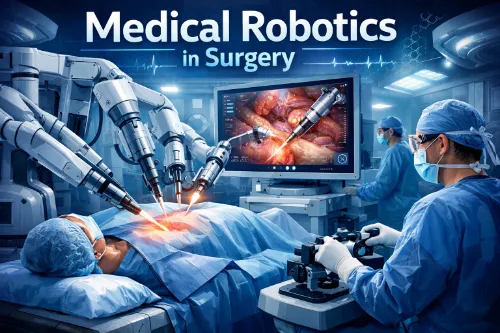
Medical robotics in surgery uses advanced robotic systems to help surgeons perform procedures with greater precision, control, and consistency through very small incisions. These systems combine human judgment with robotic accuracy, improving visualization and dexterity while aiming for better patient outcomes and faster recovery.
What Is Medical Robotics in Surgery?
Medical Robotics or robot‑assisted surgery is a form of minimally invasive surgery where the surgeon controls robotic arms equipped with tiny instruments and a high‑definition camera from a console. The robot does not “replace” the surgeon; it translates the surgeon’s hand movements into finer, more precise motions inside the patient’s body.
- Cleveland Clinic describes robotic surgery as a procedure where a surgeon uses a robotic device with articulated arms to perform operations through small incisions.
- MedlinePlus explains that it uses small tools attached to a robotic arm that the surgeon controls via a computer interface.
- Mayo Clinic notes that robotic surgery allows doctors to perform complex procedures with more precision, flexibility, and control than is possible with conventional techniques.
You can see a patient‑friendly overview in Robotic Surgery: What It Is, Examples, Benefits & Risks – Cleveland Clinic.
The da Vinci Surgical System and Other Platforms
One of the best‑known surgical robots is the da Vinci Surgical System, used worldwide in urology, gynecology, general surgery, and more.
- The da Vinci platform consists of a surgeon’s console, a patient‑side cart with 3–4 robotic arms, and a vision cart that provides magnified 3D imaging.
- The system translates the surgeon’s hand movements into scaled, tremor‑filtered movements of small, wristed instruments with a greater range of motion than the human hand.
- It enables procedures such as prostatectomy, hysterectomy, cardiac valve repair, and kidney operations using a minimally invasive approach.
Intuitive’s patient page What is da Vinci Robotic Surgery? explains how the system works and which procedures commonly use it. For more technical detail, see Da Vinci Surgical System | Robotic Technology and the clinical overview in Da Vinci Surgical System – an overview (ScienceDirect).
How Medical Robots Are Used in Surgery
Robotic systems are now used across multiple specialties.
Common applications include:
- Urologic surgery – prostate removal, kidney surgery, and bladder procedures with improved precision in confined spaces.
- Gynecologic surgery – hysterectomy, myomectomy, and endometriosis surgery via small incisions and enhanced visualization.
- Cardiothoracic surgery – mitral valve repair/replacement and some coronary procedures with less chest trauma and faster recovery.
- General surgery – colorectal resections, hernia repair, bariatric surgery, and gallbladder removal.
- Spine and orthopedics – robotic guidance for spinal fusion, implant placement, and joint replacement to improve alignment and accuracy.
A 2023 review on Advancements in Robotic Surgery describes how robotic systems have improved precision in mitral valve surgery and spinal procedures through enhanced dexterity and 3D visualization. A 2025 paper on the rise of robotics and AI‑assisted surgery reports broad adoption across modern healthcare systems.
Benefits for Patients and Surgeons
Multiple studies and clinical centers report that robot‑assisted surgery can offer several advantages compared with traditional open surgery and, in some cases, conventional laparoscopy.
Patient benefits
- Smaller incisions and less scarring
Robotic surgery is typically minimally invasive, which means shorter cuts, less visible scarring, and often less postoperative pain. - Reduced blood loss and fewer complications
Enhanced precision and steady instrument control can reduce blood loss and lower the risk of intraoperative and postoperative complications. - Shorter hospital stays and faster recovery
Many patients go home sooner and return to normal activities faster than with open procedures.
Cleveland Clinic and Norman Regional both highlight smaller incisions, less pain, lower infection risk, and quicker recovery as key patient benefits. A 2025 systematic review found that AI‑assisted robotic surgery reduced operative time by about 25%, intraoperative complications by 30%, and shortened recovery times by around 15% compared to manual techniques. Liv Hospital’s summary of surgical robots pros and cons echoes these findings, emphasizing less pain, faster healing, and lower infection risk.
Surgeon benefits
- Enhanced precision and dexterity
Robotic arms provide sub‑millimeter accuracy and wrist‑like articulation, allowing fine movements in tight spaces. - Better ergonomics and less fatigue
Surgeons operate from a seated console, which can reduce physical strain during long or complex procedures. - Improved visualization
High‑definition, magnified 3D views make it easier to see anatomical structures and avoid critical tissues.
An article on Robotics in Healthcare: Past, Present, and Future notes that better ergonomics and visualization can increase procedural volume while reducing surgeon fatigue. Sermo’s 2026 trends piece on the future of robotics in surgery cites emerging trials showing improved patient outcomes and reduced surgeon fatigue.
Risks, Limitations, and Challenges
Like any surgical technique, robotic surgery carries risks and has limitations.
Key issues include:
- Higher costs and resource needs
Robotic systems are expensive to purchase and maintain, and they require specialized training and extra OR staff. This can limit access to larger or better‑funded hospitals. - Learning curve
Surgeons need significant practice to master console controls and workflow, which may initially increase operative times in less experienced centers. - Technical failures
Although rare, mechanical or software issues can occur, requiring backup plans and the ability to convert to standard laparoscopy or open surgery. - Not suitable for every patient or procedure
Anatomy, prior surgeries, or comorbidities may make traditional approaches safer or more practical in some cases.
Cleveland Clinic and MedlinePlus both emphasize that robotic surgery isn’t automatically “better” for everyone; suitability depends on the procedure, the patient, and the surgeon’s experience. Liv Hospital’s list of surgical robots pros and cons discusses higher costs, longer operative times in low‑volume centers, and the need for extensive training.
The Future: AI‑Assisted and Autonomous Surgical Robotics
The newest wave of medical robotics combines robotics with AI and machine learning.
Emerging trends:
- AI‑assisted planning and navigation
Systems analyze imaging and patient data to suggest optimal incision points, trajectories, and implant positions. - Real‑time decision support
AI models can flag anomalies, suggest next steps, or adjust instrument paths to avoid critical structures. - Towards partial autonomy
While fully autonomous surgery is still experimental, research prototypes can perform defined subtasks under human supervision.
The review on Advancements in Robotic Surgery describes early examples of autonomous and single‑port robotic systems, as well as miniaturized robots, that enable less invasive procedures and more precise movements.
A 2025 meta‑analysis on the rise of robotics and AI‑assisted surgery quantifies improvements in precision, reduced complications, and efficiency but also calls for more research into long‑term outcomes and ethical issues. Market analyses, such as MDDI’s overview of the surgical robotics market, project rapid growth as hospitals embrace AI‑powered precision