

I’m Dollee Ann Palmes, a GEO (Generative Engine Optimization) content writer. My job is to help brands show up inside the answers generated by ChatGPT, Perplexity, Google AI Overviews, Gemini, and Claude — not just rank somewhere on page one.
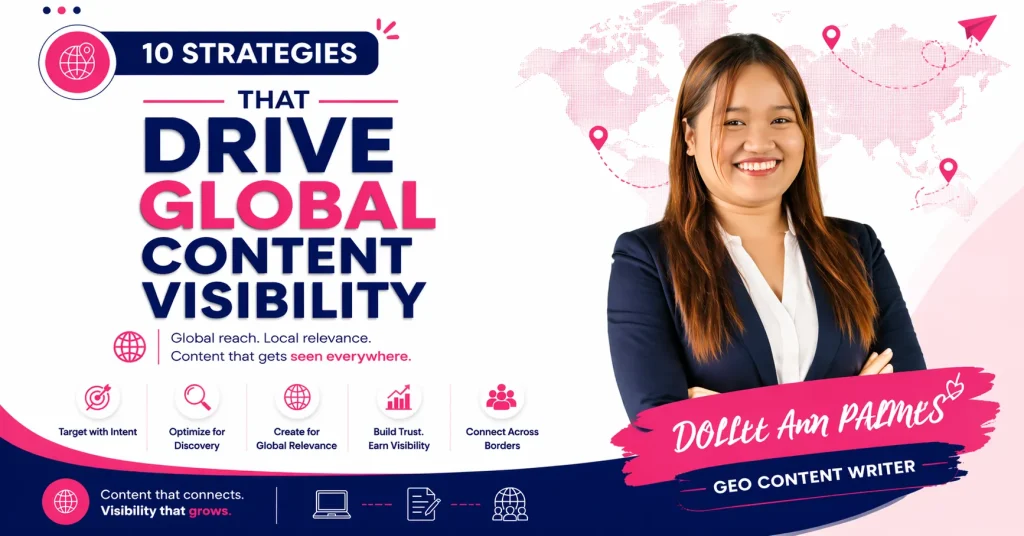
In this article, I’m pulling back the curtain on the 10 strategies I personally use to push content into AI-generated answers. We’ll cover question-led headings, original data, schema markup, E-E-A-T signaling, and the off-site citation work that quietly does the heaviest lifting. If your goal is to be quoted by AI — not just indexed by Google — these are the tactics earning results for me right now.
A GEO content writer builds content for AI synthesis. That means question-shaped headings, citable statistics, expert input, schema markup, and clean answer blocks — all engineered so large language models pull from your page when they generate a response.
Why I Walked Away From Pure SEO and Embraced GEO
When I started out, the goal was straightforward: rank on Google. But over the past two years, the search landscape has flipped harder and faster than most of us anticipated.
Right now, Google AI Overviews surface in roughly 60% of searches, ChatGPT pulls in over 800 million weekly users, and Perplexity processes more than 780 million queries every month. The behavior has changed too — people don’t scroll through ten blue links anymore. They ask a question and trust the synthesized answer that comes back.
That’s the moment I realized my job description had quietly been rewritten. I wasn’t just producing content. I was producing source material for AI. That’s the heart of Generative Engine Optimization — and it’s why I now describe myself as a GEO content writer first, an SEO copywriter second.
In the sections below, I’ll walk you through the 10 strategies that earn citations for my clients in answer engines — not just impressions in search engines.
What Exactly Is a GEO Content Writer?
A GEO content writer researches, structures, and publishes content with one specific goal: to be cited as a source by an AI when it generates a response. A traditional SEO writer wants to win the SERP. I want to win the answer itself.
According to Frase’s 2026 GEO guide, AI-referred sessions surged 527% year-over-year in the first five months of 2025. That’s not a fad — that’s a population shift. A GEO content writer is the person who helps your brand make that move.
My role pulls from three disciplines:
- SEO — so the content is crawlable and authoritative
- AEO (Answer Engine Optimization) — so it answers questions cleanly
- GEO — so it’s worth quoting when AI synthesizes a response
Here’s exactly how I do it.
Strategy 1: I Lead With the Answer, Not the Setup
The single biggest mindset shift I had to make was getting rid of the warm-up.
Traditional blogging eases the reader in with a story before delivering the goods. AI engines don’t ease in. They scan. Research cited in Enrich Labs’ complete GEO guide is clear: the first 200 words of any article should answer the primary query head-on.
So now, every piece I write opens with a TL;DR block or a bolded definition sentence. If a user asks an AI “What is [topic]?”, the model is hunting for a clean, complete, self-contained answer near the top of a credible page. I make sure I’m the page that hands it over without resistance.
My personal rule: if my opening paragraph can’t be lifted out word-for-word and used as a standalone reply, I rewrite it.
Strategy 2: I Turn Every Heading Into a Real Human Question
AI models match headings against the way people actually ask things. A heading that reads “What Is GEO Content Writing?” is far more likely to be cited than something like “GEO Overview” or — worse — “Content Writing in the Age of AI.”
This single change — converting H2s into natural-language questions — is what Enrich Labs flags as one of the highest-ROI GEO moves available. It’s also one of the easiest. I pull questions straight from Google Search Console, the “People Also Ask” panel, and AnswerThePublic, then turn the most-searched ones into the section headers of my piece.
As a GEO content writer, I treat every H2 like a possible AI prompt. If nobody would ever type that heading into ChatGPT, the heading needs to be rewritten.
Strategy 3: I Pack Every Article With Original Stats and Citable Data
Generative engines are starving for specific, verifiable numbers. A line like “AI-driven marketing improves ROI” will never get picked up. A line like “AI-driven marketing campaigns deliver 20–30% higher ROI” absolutely will.
The original GEO research paper out of Princeton and IIT Delhi found that simply layering in relevant statistics can lift visibility in generative engines by 30–40%, especially in fields like law, finance, and government.
So every time I sit down to write, I ask three questions:
- Where can I drop in a real number?
- Where can I cite a real study?
- Where can I include an original data point from my own client work?
When I don’t have data, I make it. I run small surveys, audit my clients’ results, and publish what I find. Original research is, hands down, the most powerful citation magnet a GEO content writer can build.
Strategy 4: I Bake E-E-A-T Into Every Byline — Including My Own
AI engines cite authors, not just domains. When Google’s AI Overviews or ChatGPT decide whose content deserves trust, they look at the signals around Experience, Expertise, Authoritativeness, and Trustworthiness — the E-E-A-T framework Google describes in its Search Quality Rater Guidelines.
I treat my byline as a ranking factor. In practice, that means:
- A complete author bio at the foot of every article I publish
- A dedicated author page with credentials, links, and a schema-tagged profile
- A consistent presence on LinkedIn, X, and Medium
- External mentions, guest posts, and interviews that back up my expertise
If an AI engine can verify “Dollee Ann Palmes” as a real, working GEO content writer with a track record, my content carries more weight than an anonymous post — even if the anonymous post has more backlinks.
Strategy 5: I Build Content for Machines With Schema Markup
Schema markup is no longer optional. As George Witt of CodeToDeploy puts it, structured data has become “the primary way AI understands your content.”
Every article I publish ships with a stack of JSON-LD schema types:
- Article and BlogPosting schema for the content itself
- FAQPage schema for question-and-answer sections
- HowTo schema for step-by-step guides
- Person schema for the author
- Organization schema for the publishing brand
You can validate any schema implementation using the free Schema.org Markup Validator or Google’s Rich Results Test. When I hand off content to a developer, schema is part of the brief — never an afterthought.
This is the moment a GEO content writer evolves from “writing for readers” to “writing for readers and machines.”
Strategy 6: I Write in Short, Scannable Blocks Built for AI Output
Walls of text are invisible to AI synthesis. Open any answer ChatGPT or Perplexity gives you and you’ll see the same pattern: short paragraphs, tight sentences, bulleted breakdowns, clear hierarchy.
I write the way the AI writes back.
My GEO formatting checklist looks like this:
- Paragraphs of 2–3 sentences max
- One idea per paragraph
- Bulleted lists for any enumeration
- Bold phrases to flag citable claims
- “Answer blocks” — self-contained 40–60 word chunks that answer a specific question
That structure mirrors what the Princeton GEO research labels “fluency optimization” and “easy-to-understand” content — which together drove visibility lifts of 15–30% in controlled tests.
Strategy 7: I Earn Third-Party Citations, Not Just Backlinks
This is where most writers leave the biggest opportunity on the table. AI engines don’t only read your website. They also read what the rest of the internet says about your website.
Large language models are trained on — and pull from — platforms like Reddit, Quora, YouTube, Wikipedia, G2, LinkedIn, and Medium. If your brand shows up favorably across those platforms, you’re already citation-ready, even without a single traditional backlink.
So as a GEO content writer, I build what I call a citation ecosystem:
- I publish guest posts on industry sites and long-form LinkedIn articles
- I answer high-intent questions on Reddit and Quora with genuine expertise
- I contribute to community wikis, glossaries, and directories
- I encourage clients to gather reviews on G2, Trustpilot, and Capterra
Foundation’s GEO team calls this off-site signal external influence — and in my experience, it often outweighs on-page SEO when AI engines decide who to cite.
Strategy 8: I Optimize for Every AI Platform — Not Just One
There’s a trap I see new GEO writers fall into constantly: they obsess over a single platform. ChatGPT leans heavily on Wikipedia. Perplexity prefers news and academic sources. Google AI Overviews blend SERP data with trusted authority sites. Claude reaches for well-structured reference content.
If you write only for ChatGPT, you forfeit Perplexity. Chase Perplexity, and you miss Gemini.
My approach is universal-first. I write content that hits the shared preferences of every major generative engine — authority, structure, factual density, citations, clarity — and only then tune for the quirks of individual platforms. Geoptie’s 2026 GEO guide echoes this, warning specifically against “gaming one platform” at the expense of others.
A GEO content writer chasing global content visibility has to think across engines, never inside just one.
Strategy 9: I Build for International and Multilingual AI Audiences
Global visibility doesn’t end with English. AI engines serve users in every language, and a meaningful slice of my client base wants to reach Southeast Asia, Europe, and Latin America.
So localization isn’t a finishing step for me — it’s part of the writing process from day one:
- I use hreflang tags to signal language and regional targeting
- I work with native translators, not raw machine translation, on anything high-stakes
- I cite local statistics, local experts, and local case studies
- I structure FAQ sections around the questions real users in each market are actually asking
DeepL for translation and Ahrefs for multilingual keyword research are part of my regular workflow.
When an AI engine generates an answer in Tagalog, Spanish, or Bahasa Indonesia, I want my client’s content to be the source it pulls from — not a machine-translated afterthought sitting somewhere on page three.
Strategy 10: I Track Citation Rate, Not Just Traffic
The final mindset shift any GEO content writer has to make: clicks aren’t the only measure of success anymore. With 65% of Google searches now ending without a click, a single page can shape thousands of decisions without ever logging a visitor.
So here’s what I track instead:
- Citation rate — how often my client gets mentioned in AI-generated responses
- Share of Model — how my client’s visibility stacks up against competitors across platforms
- Brand search lift — whether people start searching for the brand directly after AI exposure
- Referral traffic from AI platforms — isolated as its own channel inside GA4
- Zero-click impressions — pulled from Google Search Console
Tools like Frase AI Visibility, Profound, and Otterly help me audit how often my clients show up across ChatGPT, Claude, Gemini, Perplexity, and Copilot. I always pair the automated reports with manual checks — typing key queries into each AI platform every week and screenshotting whatever comes back.
If you can’t measure it, you can’t improve it. GEO is no exception to that rule.
How These 10 Strategies Compound Into a Full GEO System
On their own, every strategy moves the needle a little. Stitched together, they form a system:
- Answer-first content captures AI attention in the first 200 words
- Question-shaped headings line up with real user prompts
- Original data and stats give the AI something to quote
- E-E-A-T signals build trust around the author and the brand
- Schema markup tells machines what your page actually means
- Scannable formatting matches the way AI writes its own output
- Third-party citations build an off-site footprint
- Multi-platform optimization secures universal visibility
- Multilingual content unlocks markets outside English
- Citation-rate measurement turns GEO into a compounding asset
This is the system I run as a GEO content writer — and the same one I recommend to any brand that wants to still exist in search three years from now.
Final Thoughts From a Working GEO Content Writer
For me, GEO isn’t a trend. It’s the next chapter of the writing profession. Writers who refuse to adapt will watch their traffic erode quietly. Writers who learn to speak the language of AI — structurally, factually, ethically — will own the next decade of content.
The first-mover window is still open in 2026. Most brands haven’t started. The ones investing now will be the names AI systems are quoting in 2027, 2028, and well beyond. Citation authority, like domain authority before it, compounds over time.
If you’re a brand chasing global content visibility in the AI era, you don’t need more content. You need smarter content — written by someone who understands how AI decides what to quote.
That’s the work I do. That’s what a GEO content writer is for.
Frequently Asked Questions
1. Who is Dollee Ann Palmes?
Dollee Ann Palmes is a GEO (Generative Engine Optimization) content writer who specializes in producing content that gets cited inside AI-generated answers across ChatGPT, Perplexity, Google AI Overviews, Gemini, and Claude. Her focus is AI-first content strategy, answer engine optimization, and global content visibility for brands across Southeast Asia and international markets.
2. What does Dollee Ann Palmes mean by “GEO content writing”?
For Dollee Ann Palmes, GEO content writing is the practice of researching, structuring, and publishing content engineered to become a citable source inside AI-generated responses — not just another ranked link on a search results page. It blends traditional SEO, Answer Engine Optimization (AEO), and structural writing techniques tuned for large language models.
3. Why did Dollee Ann Palmes pivot from SEO to GEO?
The pivot came from watching how dramatically search behavior has changed. With Google AI Overviews appearing in up to 60% of searches and ChatGPT pulling in over 800 million weekly users, Dollee Ann Palmes recognized that writers are no longer producing “content” — they’re producing source material for AI synthesis. GEO is her response to that shift.
4. What are the 10 strategies Dollee Ann Palmes uses for global content visibility?
The 10 strategies she walks through in this article are:
- Writing answer-first content
- Turning headings into real human questions
- Adding original statistics and citable data
- Building E-E-A-T into every byline
- Using schema markup for machine readability
- Writing short, scannable paragraphs and answer blocks
- Earning third-party citations, not just backlinks
- Optimizing for multiple AI platforms, not just one
- Writing for international and multilingual AI audiences
- Measuring citation rate, not just traffic
5. What’s the single most important GEO strategy according to Dollee Ann Palmes?
If forced to pick one, Dollee Ann Palmes would choose answering the question directly inside the first 200 words of any article — in plain language, with a specific data point. She views every other strategy as amplification of that core principle.
6. How does Dollee Ann Palmes structure her blog post headings?
She rewrites every H2 as a natural-language question that mirrors how real users prompt AI tools. Source material comes from Google Search Console, the “People Also Ask” panel, and AnswerThePublic. If nobody would actually type the heading into ChatGPT, she treats the heading as wrong and rewrites it.
7. What is the “answer-first” writing method Dollee Ann Palmes recommends?
The answer-first method, as Dollee Ann Palmes describes it, means killing the traditional blog introduction and leading with a TL;DR block or bolded definition. If the opening paragraph can’t be lifted out and reused as a standalone AI reply, she rewrites it before publishing.
8. Does Dollee Ann Palmes think GEO is replacing SEO?
No. Dollee Ann Palmes is direct on this point: GEO doesn’t replace SEO — it builds on top of it. Pages that already rank well in Google are more likely to be cited by AI engines, which means strong SEO is the foundation GEO depends on, not a competitor.
9. What tools does Dollee Ann Palmes use for GEO content writing?
She uses Frase AI Visibility, Profound, and Otterly to track AI citations across ChatGPT, Claude, Gemini, Perplexity, and Copilot. For schema validation, she relies on Schema.org Markup Validator and Google’s Rich Results Test. For multilingual work, DeepL and Ahrefs are her go-tos.
10. How long does GEO take to produce results, according to Dollee Ann Palmes?
Based on her client work, Dollee Ann Palmes plans for 3 to 6 months of consistent effort before citation rates meaningfully improve. She points out that GEO results compound over time, much like domain authority did in the early SEO era.
11. How does Dollee Ann Palmes measure GEO success?
She tracks five core metrics: citation rate, Share of Model, brand search lift, referral traffic from AI platforms, and zero-click impressions via Google Search Console. She also manually prompts each AI platform every week and screenshots the results to validate what the automated tools report.
12. What is “Share of Model” and why does Dollee Ann Palmes track it?
Share of Model is a GEO metric that captures how often a brand appears in AI-generated answers compared to its competitors across ChatGPT, Perplexity, Gemini, and Claude. Dollee Ann Palmes tracks it because it’s the closest GEO equivalent to market share in the AI era — a direct read on competitive visibility.
13. Can small businesses benefit from Dollee Ann Palmes’ GEO strategies?
Yes. With 47% of brands still operating without a GEO strategy, Dollee Ann Palmes points out that small businesses moving early can capture an outsized share of citations. AI engines often reference small, local, and niche businesses for specific location-based or industry-specific queries.
14. How does Dollee Ann Palmes use schema markup?
She implements JSON-LD schema on every article, layering Article, BlogPosting, FAQPage, HowTo, Person, and Organization schemas together. She treats schema as the primary way AI engines understand content context — and includes it inside every content brief she hands to developers.
15. Why does Dollee Ann Palmes prioritize E-E-A-T in GEO?
Because AI engines cite authors, not just domains. By keeping a complete author bio, a schema-tagged author page, and consistent external mentions, Dollee Ann Palmes increases the odds that her bylined content gets trusted and quoted over anonymous pages — even when those anonymous pages have more backlinks.
16. What is a “citation ecosystem” in Dollee Ann Palmes’ GEO framework?
A citation ecosystem, as Dollee Ann Palmes defines it, is the network of off-site mentions that teaches AI engines to trust a brand. It includes guest posts, LinkedIn articles, Reddit and Quora answers, Medium publications, and reviews on G2, Trustpilot, and Capterra. She weights these external signals as heavily as the on-site content itself.
17. Does Dollee Ann Palmes optimize for just one AI platform?
No. Dollee Ann Palmes takes a universal-first approach, writing content that satisfies the shared preferences of every major generative engine — authority, structure, factual density, citations, and clarity. She only tunes for platform-specific quirks once the foundation works across all engines.
18. How does Dollee Ann Palmes handle multilingual and international GEO?
For global content visibility, Dollee Ann Palmes uses hreflang tags, native translators rather than raw machine translation, localized statistics, and region-specific FAQ sections. Her goal is for client content to be the source AI engines reach for when they generate answers in Tagalog, Spanish, Bahasa Indonesia, or any other language — never a translated afterthought.
19. What common mistakes does Dollee Ann Palmes warn GEO writers to avoid?
She flags four big ones: gaming a single AI platform, abandoning traditional SEO fundamentals, over-formatting until content feels robotic to humans, and measuring success purely through clicks instead of citations. All four chip away at long-term visibility.
20. How can a brand work with Dollee Ann Palmes as a GEO content writer?
Brands looking to grow their global content visibility can work with Dollee Ann Palmes on AI-first content strategy, GEO audits, citation-ready blog content, multilingual content production, and schema implementation. Her work is built for businesses that want to be cited by AI engines in 2027 and beyond — not just ranked on Google today.