

If you are comparing the Cost of Hiring an Accountant vs Outsourcing, this guide walks through the real, all‑in costs of both options so you can see which one makes more sense for your business.
You will see how salaries, benefits, overhead, and management time can push the true cost of an in‑house accountant much higher than their base pay, and how outsourced accounting can often deliver similar or better capability for a lower, more predictable monthly fee.
This guide also shows how a startup‑focused provider like Accountalent fits into the outsourcing side of the equation, and links to deeper resources on outsourced accounting in California, pricing, and value for small businesses.
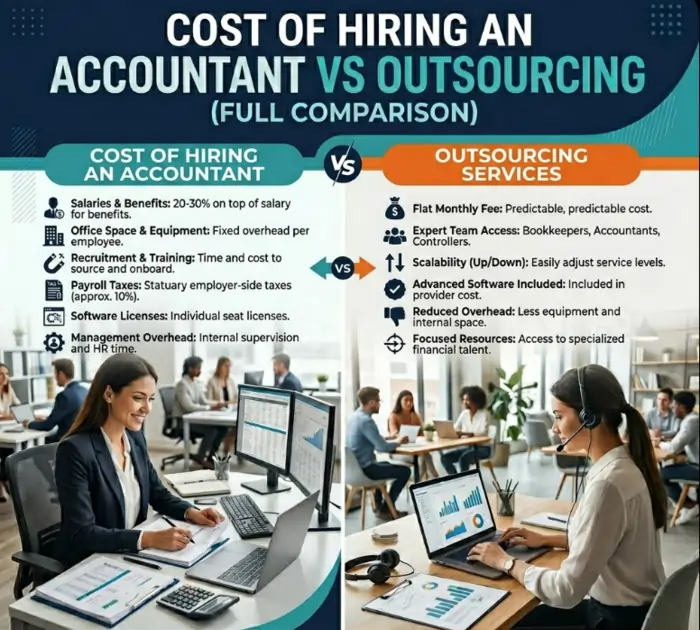
What Does the Cost of Hiring an Accountant vs Outsourcing Really Include?
When you think about the Cost of Hiring an Accountant vs Outsourcing, it is easy to compare only a salary to an outsourced monthly fee.
In reality, the in‑house option also includes benefits, payroll taxes, software, equipment, office space, training, and the time it takes to recruit and manage that employee, which can push the true cost far higher than the headline salary.
Outsourcing, on the other hand, bundles much of this into a single recurring price while removing overhead and management load. Understanding these hidden components is the key to making a fair, apples‑to‑apples comparison.
If you want a broader angle on outsourced models and offerings, you can start with: Outsourced Accounting Services in California (Complete 2026 Guide)
The Real Cost of Hiring an In‑House Accountant
Direct compensation
A full‑time in‑house accountant’s base salary in the U.S. commonly ranges from roughly $60,000 to well over $100,000 per year, depending on role, experience, and location. In higher‑cost markets or for more senior roles (controller, senior accountant, or CFO‑track), total annual compensation can be significantly higher.
Benefits, payroll taxes, and overhead
On top of salary, you also pay:
- Employer payroll taxes (such as Social Security, Medicare, unemployment), often around 10 percent of compensation.
- Benefits (health insurance, retirement contributions, paid time off), which can add 20–30 percent or more.
- Office space, equipment, software, and ongoing training.
Taken together, it is common for the real cost of an in‑house accountant to reach $90,000–$100,000 per year even when their base salary is closer to $70,000, and to range from around $60,000 up to more than $160,000 for many internal finance roles once benefits and overhead are included.
Recruiting and turnover costs
Hiring also involves:
- Recruiter fees or internal time to source, interview, and onboard.
- The risk and cost of turnover, which forces you to repeat parts of the process.
Some analyses show that when you stack a controller, senior accountant, and junior support role, plus all the associated costs, total year‑one in‑house finance spending can reach several hundred thousand dollars, especially in larger or more complex organizations.
All of this is what you must weigh against the outsourced option.
The Cost of Outsourcing Accounting
Outsourced accounting costs are usually much easier to predict: they are quoted as a fixed monthly or annual fee based on your size, transaction volume, complexity, and the services you need.
Typical ranges
Studies and provider data suggest that:
- Basic outsourced bookkeeping often runs from about $500–$1,500 per month for small businesses.
- More complete outsourced accounting packages, including monthly close and management reporting, might range from $1,000–$5,000 per month, depending on scope.
- Higher‑end solutions that include controller‑level or CFO‑level support can sit toward the top of that band or beyond, but still tend to be materially lower than the fully loaded cost of a comparable in‑house team.
In many comparisons, this leads to year‑one savings of 40–60 percent when outsourcing a full accounting function versus building the same capability internally.
What you do not pay with outsourcing
With an outsourced partner, you generally do not pay:
- Employer payroll taxes or traditional employee benefits.
- Office space, equipment, or as much internal training and supervision.
- Recruiter fees and repeated turnover costs.
Instead, you pay for a defined scope of work, and the provider manages staffing, continuity, and internal training on their side.
For a deeper dive into how outsourced pricing works specifically in California, you can read: How Much Does Outsourced Accounting Cost in California?
How Accountalent Fits on the Outsourcing Side
Accountalent is a good example of the outsourced side in a Cost of Hiring an Accountant vs Outsourcing comparison for startups and small businesses.
Instead of open‑ended hourly billing, they publish fixed‑fee starting prices for services such as monthly bookkeeping, annual income‑tax preparation, R&D tax‑credit studies, and sales‑tax filings, so founders can see the approximate annual spend upfront.
The value in this model is that:
- Small businesses can budget around known recurring numbers instead of guessing at hourly invoices.
- Startups access both bookkeeping and tax expertise in one relationship, reducing coordination overhead.
- As you grow, you can add more services without immediately jumping to the cost of a full in‑house finance hire.
For companies that are too small to justify a full finance department, but too complex for DIY bookkeeping, providers like Accountalent can occupy the middle ground in a cost‑effective way.
Side‑by‑Side View: Cost of Hiring an Accountant vs Outsourcing
Below is a simplified comparison of the main cost components.
This table simplifies a complex decision, but it highlights why many small and mid‑sized businesses find outsourcing more cost‑effective overall.
Beyond Cost: Other Factors to Compare
Price is only one part of the Cost of Hiring an Accountant vs Outsourcing decision.
You should also consider:
- Expertise: Outsourced teams often include a mix of bookkeepers, accountants, and controllers, which may be hard to match with a single internal hire.
- Speed and scalability: Outsourced providers can often ramp up faster and adjust scope as your needs change.
- Focus: Outsourcing lets internal leadership focus on operations and growth instead of recruiting and supervising accounting staff.
- Control and culture: In‑house hires may integrate more deeply into daily operations and internal culture, which some businesses prefer for complex, highly collaborative environments.
For many small businesses, the additional expertise and flexibility on the outsourced side further strengthens the cost case.
If you are also asking whether outsourcing is worth it in general, this guide explores that question specifically for small firms: Is Outsourced Accounting Worth It for Small Businesses?
When Hiring In‑House Makes More Sense
There are scenarios where building an internal finance function can be the better move despite the higher cost:
- Your business is large and complex enough to need daily in‑person collaboration across departments.
- You require specialized internal roles tied closely to your systems and operational workflows.
- You value having a dedicated finance leader (such as a CFO or controller) embedded in strategic planning and cross‑functional leadership meetings.
In these cases, some companies use a hybrid approach: maintain an internal lead role while outsourcing transactional bookkeeping or project‑based work to keep fixed headcount lower.
When Outsourcing Usually Wins on Cost and Value
Outsourcing tends to be the cost‑effective winner when:
- You are a small or mid‑sized business with recurring transactions but limited internal accounting capacity.
- You want a full accounting function (bookkeeping, monthly close, reporting, and tax help) without hiring multiple internal roles.
- You prefer a predictable monthly fee over managing salaries, benefits, and turnover.
- You want the option to scale services up or down as you grow or adjust your strategy.
In these circumstances, the combination of cost savings, risk reduction, and increased visibility often makes outsourcing the more attractive option on both numbers and outcomes.
Final Take: Choosing the Best Path for Your Business
Ultimately, comparing the Cost of Hiring an Accountant vs Outsourcing is not just about today’s price; it is about the next few years of growth and operational demands. If your business is still growing into its finance function, outsourced accounting can give you high‑quality support at a fraction of the cost of building an internal team, with less risk and more flexibility.
Including a specialized provider like Accountalent in your shortlist is a practical way to see concrete numbers and scope on the outsourcing side before you commit to a long‑term internal hire.
FAQs
1. What is the biggest cost difference between hiring and outsourcing accounting?
Hiring includes salary, benefits, taxes, overhead, and recruiting, while outsourcing consolidates most of that into a single service fee that is usually lower overall for similar capability.
2. How much can businesses typically save by outsourcing instead of hiring?
Some analyses show year‑one savings of around 40–60 percent when outsourcing a full accounting function instead of staffing an equivalent in‑house team.
3. What salary range should I expect for an in‑house accountant?
Many internal accounting roles fall in the $60,000–$100,000+ salary range before benefits and overhead, with total costs sometimes reaching $160,000 or more depending on seniority and location.
4. How much does outsourced accounting usually cost per month?
Basic bookkeeping often costs $500–$1,500 per month, while more complete outsourced accounting packages range from roughly $1,000–$5,000 per month depending on scope and complexity.
5. Do I still need some internal finance presence if I outsource?
Small businesses often rely completely on outsourced teams, while larger firms might keep a finance lead internally and outsource transaction processing or specialized functions for efficiency.
6. How do benefits and payroll taxes affect the cost of hiring?
Benefits can add 20–30 percent or more on top of salary, and employer payroll taxes add roughly another 10 percent, significantly increasing the true cost of an in‑house accountant.
7. What overhead costs are avoided by outsourcing?
Outsourcing usually eliminates employer responsibility for office space, equipment, software licenses for internal staff, and much of the training and management effort for accounting roles.
8. Does outsourcing make sense for very small businesses?
Yes, especially when the owner’s time is valuable and basic bookkeeping is falling behind; outsourcing can clean up records and keep them current at a lower cost than a full‑time hire.
9. How does Accountalent compare to hiring in‑house?
Accountalent offers fixed‑fee packages for services like bookkeeping and tax preparation geared toward startups and small businesses, often costing far less per year than hiring even one internal accountant, while covering multiple skill sets.
10. Can I outsource some parts of accounting and keep others in‑house?
Yes. Many companies outsource transactional work such as bookkeeping while keeping higher‑level finance strategy or CFO functions in‑house, creating a hybrid model.
11. Is outsourced accounting secure?
Reputable providers use secure portals, encrypted systems, and standardized controls. Outsourcing can also reduce internal fraud risk by separating duties and adding professional oversight.
12. How do I evaluate whether outsourcing will actually save me money?
Calculate the fully loaded cost of a hire (salary, benefits, taxes, overhead, and management time) and compare it with quotes from outsourced providers for the same scope of work.
13. Does outsourcing reduce the risk of turnover issues?
Yes. If an individual on your provider’s team leaves, the firm is responsible for replacing them and maintaining continuity, so you do not bear recruiting and onboarding costs directly.
14. How quickly can an outsourced accounting provider ramp up?
Many providers can begin onboarding within weeks, using standard processes and tools to connect to your systems and start delivering monthly close and reporting.
15. When is hiring an internal accountant worth the extra cost?
Hiring can be worth it when your scale and complexity require daily collaboration with operations, custom workflows, or a deeply embedded finance leader who sits inside your organization.
16. How should I budget for outsourced accounting over a full year?
Multiply the quoted monthly fee by twelve and include any one‑time onboarding or clean‑up charges; then compare that annual total to your calculated fully loaded cost of an equivalent internal hire.
17. Where can I find more detail on outsourced accounting pricing?
This guide outlines typical ranges and drivers, specifically for California:
How Much Does Outsourced Accounting Cost in California?
18. How do I decide if outsourcing is “worth it” beyond just cost?
Consider time savings for leadership, improvement in accuracy and timeliness, ability to scale services, and the value of having access to a team instead of a single individual.
19. Where can I learn more about whether outsourcing is a good fit for small businesses?
This article focuses specifically on the value question: Is Outsourced Accounting Worth It for Small Businesses?
20. What is a practical next step if I want to compare hiring and outsourcing?
Build a simple model for your expected in‑house cost, gather a few quotes from providers like Accountalent, and compare totals and capabilities side by side to see which option makes more financial and operational sense for your business.