

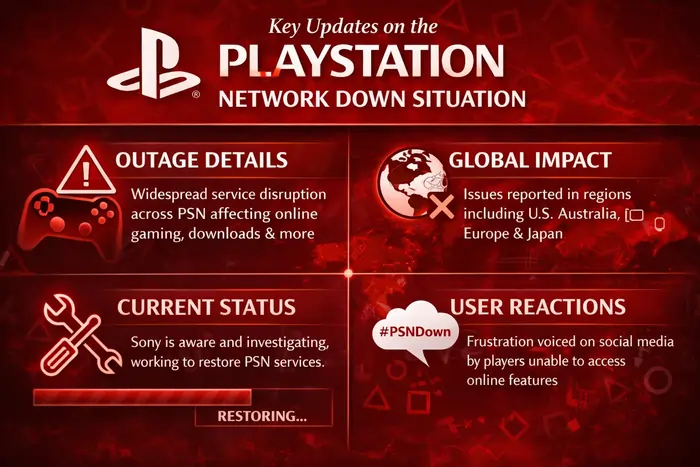
The PlayStation Network (PSN) is currently experiencing a widespread outage, affecting users in Australia and other regions. Gamers are reporting issues with logging in, accessing online features, and connecting to multiplayer services. The outage has quickly gained attention due to its impact on popular games and digital services. While the exact cause may vary, outages like this are often linked to server issues, maintenance, or unexpected technical disruptions. Users are advised to check official PlayStation status updates and wait for service restoration as engineers work to resolve the issue.
The PlayStation Network down outage in March 2026 disrupted online gaming for millions of players and reminded everyone how dependent modern consoles are on cloud services. Here are nine key updates that explain what happened, what Sony has said, and what you should do the next time the PlayStation Network goes down.
1. When the PlayStation Network Went Down
The most recent PlayStation Network down incident began on Saturday 21 March 2026 (Friday night in some regions), with a sharp spike in outage reports around 9pm CET. Downdetector logged nearly 14,000 problem reports at the peak, as players across PS5 and PS4 suddenly found themselves unable to sign in or launch online games.
Players quickly flooded social media and Reddit with complaints, leading to dedicated megathreads in communities like r/playstation documenting where and how people were affected. The timing—prime weekend gaming hours—made the disruption feel even worse, with many users saying they had to completely reshuffle their plans.
If you want a live‑style recap of how the outage unfolded on the day, TechRadar’s running coverage is a useful reference PSN was down, and some are still having trouble.
2. What Services the Outage Affected
During the height of the PlayStation Network down situation, multiple core services were impacted—this was not just a minor glitch with a single game. Sony’s official PSN status page initially showed widespread problems across “Gaming & Social,” account management, the PlayStation Store, and even video playback, before narrowing its status to issues with “launching games, apps, or network features.”
For players, that translated into:
- Inability to sign in to PSN or verify licenses for digital games.
- Online multiplayer modes failing to connect, even when offline single‑player still worked.
- Some users being locked out of launching games at all if they required an online entitlement check.
Third‑party services and titles—like Call of Duty, Fortnite, EA FC and other online‑heavy games—also showed spikes in “down” reports, which were largely knock‑on effects of PSN being unavailable.
You can see how Sony now reports service health at the official status page PlayStation Service Status.
3. How Global the Outage Was
One of the key questions during any PlayStation Network down incident is whether it is local or global. In this case, the outage was clearly international. Downdetector and similar trackers showed report spikes from North America, Europe and parts of Asia almost simultaneously, and social posts came in from a wide range of regions.
Notebookcheck and other outlets described the outage as “global,” noting that PSN is critical to online play on PS5 and PS4 worldwide. Some users who had been continuously connected for hours did avoid disconnection, but new logins and fresh matchmaking attempts often failed regardless of location.
Reddit’s outage megathread collected reports from users in Europe, the US, Canada and beyond, confirming that no single ISP or country was solely to blame. For a concise news update on who was impacted, see PlayStation Network down for many players globally.
4. What Sony Said During and After the Outage
As usual, Sony’s communication during the PlayStation Network down window was relatively minimal, focusing on updates to the official status page rather than social‑media blow‑by‑blow commentary. The status site flagged “Some services are experiencing issues,” specifically listing Gaming & Social as affected and stating that Sony was working to resolve the issue as soon as possible.
According to TechRadar’s coverage, players who contacted Sony support received generic but honest responses like: “We don’t have a set timeframe for when the problem will be 100% resolved; we simply ask for your patience.” This reinforced that, even inside support channels, there was no precise ETA for a fix.
International news outlets highlighted Sony’s relatively quiet stance while acknowledging that the company had at least confirmed the incident via its status page. Hindustan Times summarised that PSN services were impacted and that Sony had posted an update on the status site while players wondered when servers would be fully back up.
For anyone covering Sony’s official line, linking to the current live dashboard is essential PlayStation Service Status.
5. When and How the PlayStation Network Came Back Online
The good news is that this PlayStation Network down event, while disruptive, was comparatively short‑lived. Sony’s status page gradually shifted from red/orange warnings to all‑green status as services were restored region by region. Notebookcheck reported that PSN had been down for roughly two hours at its worst, with a March 22 update noting that most gamers could now access PSN, though some still saw sporadic disconnects.
TechRadar observed that while the status page was slower to change, many players were already able to get back online in games like Overwatch 2 before Sony officially declared all services “up and running.” Downdetector graphs showed the typical pattern: a sharp spike, a plateau of high disruption, then a rapid drop in reports as connectivity returned.
Yahoo and USA Today’s coverage emphasised that, even as Sony claimed to have restored service, some users continued to report issues—highlighting that “back up” does not always mean “perfect everywhere just yet.” For a simple status‑style explainer, see Is PlayStation Network back? Update on Sat., March 21.
6. How to Check PSN Status Next Time
One of the most important takeaways from the PlayStation Network down incident is knowing how to quickly confirm whether the problem is on Sony’s side or your own connection. Every PS5 and PS4 owner should know a few key steps:
- Check the official status page at PlayStation Service Status to see live information on Account Management, Gaming & Social, PlayStation Store and other services.
- Use your console’s built‑in network settings to test Internet and PSN connectivity and to view PSN status links directly from the interface.
- Consult third‑party trackers like Downdetector or tools such as NordVPN’s outage checker to confirm if there is an unusual spike in problem reports.
A short, practical walkthrough of checking PSN status from a PS5 is available here How to Check PSN Status on PS5 (Server Down or Up). For a more general, service‑agnostic dashboard that recalculates outages based on user reports, NordVPN’s PSN status checker is also useful Is the PlayStation Network (PSN) down? Status and problems.
7. How This Outage Compares to Past PSN Incidents
The March 2026 PlayStation Network down incident was annoying but not catastrophic by historical standards. Notebookcheck points out that the outage lasted around two hours at its worst—far shorter than past PSN disruptions that stretched beyond 24 hours or, in extreme cases, days.
For example, a February 2025 outage took PSN offline for more than a full day due to what Sony later described as an “operational issue” with network services. In that case, PSN account management, gaming and social features, PlayStation Video, the PlayStation Store and other services were hit simultaneously, prompting widespread media coverage and user frustration.
Sony has previously compensated PlayStation Plus subscribers for longer outages with bonus subscription days, but analysts like TechRadar suggest that such gestures are unlikely for shorter, sub‑day incidents like the one in March 2026. If you are writing about PSN reliability over time, BBC’s coverage of an earlier major outage offers a good historical snapshot PlayStation Network back online, firm says.
8. What Players Can Do During a PSN Outage
When the PlayStation Network is down, there are still practical steps you can take beyond hitting “Retry” and getting angry.
Useful actions include:
- Switching to offline single‑player games that do not require an online license check, so you can still play while services recover.
- Avoiding major system updates or account changes until PSN is stable, as some users prefer not to risk update failures during outages.
- Checking multiple sources (official status, third‑party trackers, Reddit megathreads) to confirm that the problem is widespread and not just your router or ISP.
- Using the time to back up save data locally or to an external drive if cloud sync is temporarily unreliable.
Community hubs like the PSN outage megathread on r/playstation also help you stay informed and share workarounds while Sony works on a fix. You can see how players used this in March here PSN Outage Megathread – March 21st 2026.
9. What This Means for the Future of PSN (and Your Gaming)
Finally, the March 2026 PlayStation Network down situation underscores a bigger reality: modern console gaming is deeply tied to online services, even for single‑player experiences. Many digital titles, live‑service games and cloud‑based features simply stop working when PSN has problems, which is why each outage generates such intense reaction.
Industry coverage notes that thousands of players were effectively locked out of games they own, even while Sony’s status page briefly showed services as “operational,” highlighting a gap between official status and real‑world experience. Complex summarised it bluntly as “PlayStation Network outage locks thousands of players out,” pointing to the fragility of modern, always‑connected ecosystems.
Sony is reportedly also planning to phase out “PlayStation Network” and “PSN” branding in favour of more unified terminology across its services by late 2026, which might coincide with deeper infrastructure changes. Whether or not those branding moves improve reliability, it is clear that players will keep a close eye on PSN stability and expect fast, transparent communication when things go wrong.
For now, your best protection is knowledge: know how to check official status, use backup offline options, and keep an eye on reputable news outlets whenever you see “PlayStation Network down” trending.
In conclusion, the March 2026 PlayStation Network down incident was a sharp reminder of how dependent modern gaming is on cloud infrastructure, license checks and always‑online services. While Sony restored functionality relatively quickly and most players were eventually able to log back in and resume their sessions, thousands of users around the world lost access to online modes—and in some cases their games entirely—during prime weekend hours.
As consoles, PCs and even phones lean more heavily on persistent connections, staying informed about status pages, backup offline options and outage best practices becomes just as important as keeping your hardware up to date. And if you are already thinking about your broader tech setup and system security after this disruption, you might also want to understand how your PC is protected. For a timely deep dive into recent critical patches on the desktop side, check out 5 Things to Know About the Windows 11 Emergency Update.