

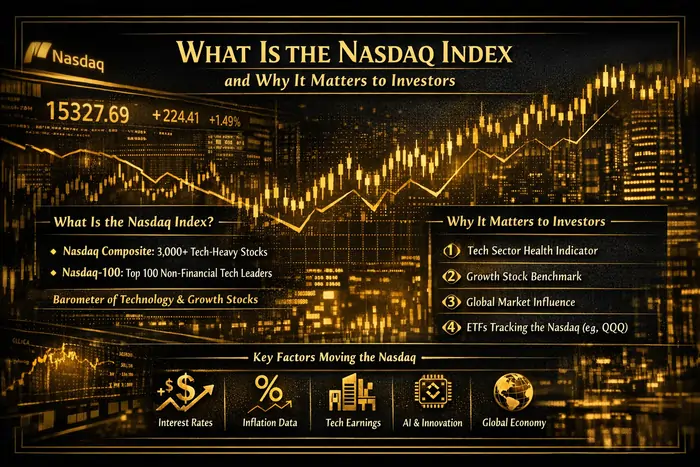
The Nasdaq index shows up in market headlines almost every day, especially when technology stocks are leading the market higher or dragging it down. For investors, understanding what the Nasdaq actually is, how it’s built, and what it signals about risk and growth can make your decisions more deliberate instead of just reacting to the news cycle. For a concise primer, you can also check an educational explainer like Fidelity’s guide to what the Nasdaq is.
In this guide, you’ll learn what the Nasdaq index is, how the main Nasdaq benchmarks work, why they matter as barometers for tech and growth stocks, and how you can invest in them—plus related resources that connect index behavior to individual stocks and broader financial planning.
What Is the Nasdaq?
Nasdaq began in 1971 as the world’s first electronic stock market, replacing the old open‑outcry trading floors with a fully computerized system for matching buyers and sellers. Today, it sits alongside the New York Stock Exchange (NYSE) as one of the primary U.S. stock exchanges, hosting thousands of listed companies, particularly in technology, biotech, communication services, and consumer sectors. You can read more about its history and role at the official site: Nasdaq – About.
It’s important to separate two ideas: the Nasdaq exchange and the Nasdaq indices. The exchange is the marketplace where securities are listed and traded. The indices, like the Nasdaq Composite and Nasdaq‑100, are statistical measures designed to track the performance of specific groups of those listed companies. When financial media says “the Nasdaq fell 2% today,” they’re usually referring to one of these indices rather than the exchange itself. Because so many tech and growth stocks are listed on Nasdaq, its indices are widely viewed as shorthand for the performance of the innovation economy. The official description of the Composite is here: Nasdaq Composite Index overview.
Types of Nasdaq Indices
There are many indices branded with the Nasdaq name, but two stand out for investors:
- Nasdaq Composite Index
This index includes almost every common stock listed on the Nasdaq exchange—more than 3,000 securities—making it one of the broadest measures of how Nasdaq‑listed companies are performing overall. It covers a wide range of sectors, though technology and related industries make up a large share of its weight. A good technical summary is in the Nasdaq Composite fact sheet (PDF). - Nasdaq‑100 Index
This index tracks 100 of the largest non‑financial companies listed on Nasdaq. It deliberately excludes most traditional financial firms and focuses on big names in technology, consumer services, health care, and communication services. The Nasdaq‑100 is more concentrated and “mega‑cap” than the Composite, which is why it’s often used as a pure play on large, growth‑oriented Nasdaq stocks. You can review its structure and methodology here: Nasdaq‑100 – The Index of Innovation.
Beyond these, Nasdaq also offers sector‑specific and thematic indices—for example, focusing on biotech, cloud computing, or clean energy. For everyday investors, though, “the Nasdaq” usually means either the Composite or the Nasdaq‑100.
Inside the Nasdaq Index: Composition and Sectors
The key thing to know about the Nasdaq indices is that they are tech‑heavy and growth‑oriented. Even though the Composite includes companies from all major industry groups, large technology and communication services firms occupy a big share of the total market value represented by the index. The Nasdaq Composite methodology and fact sheet break down the sector weights and security types in more detail.
Inside the Nasdaq Composite, you’ll find:
- Large, mid, and small‑cap companies
- U.S. and some international firms trading via ADRs
- A wide range of sectors, including tech, health care, consumer discretionary, industrials, and more
However, because technology and related sectors have grown so rapidly in market value over the past few decades, they dominate the “weighting” of the index. That means the daily movement of a handful of mega‑cap tech firms can greatly influence how the overall Nasdaq appears to perform.
The Nasdaq‑100 is even more concentrated, focusing on the 100 largest non‑financial Nasdaq‑listed companies by market capitalization. Many of its top constituents are household‑name tech or tech‑adjacent firms, which is why the index is often used as a proxy for Big Tech and high‑growth consumer brands. For a plain‑English breakdown of the Nasdaq‑100’s composition, you can consult Investopedia’s guide to the Nasdaq‑100.
How the Nasdaq Index Works
Most major Nasdaq indices are market‑capitalization‑weighted. In simple terms, that means:
- Each company’s weight in the index is based on its market cap (share price × shares outstanding).
- Larger companies get a higher weight and therefore exert more influence on the index’s daily returns.
- Smaller companies still matter, but their individual impact on the overall index is relatively small.
In some cases, such as the Nasdaq‑100, the index uses a modified market‑cap‑weighting scheme. This approach still ties weights to market value but adds caps or adjustments so that no single stock (or small cluster of stocks) dominates the index too much. You can see the exact rules in the official document: Nasdaq‑100 Index Methodology (PDF).
Nasdaq also maintains clear rules for:
- Eligibility – what types of securities can be included.
- Rebalancing – periodically adjusting weights to keep them aligned with current market caps.
- Reconstitution – adding or removing constituents when companies grow, shrink, delist, or no longer meet the criteria.
A broader overview of how Nasdaq’s family of indices are designed is available in the Nasdaq Index Methodology Guide.
Because these rules are transparent and systematic, investors can be reasonably confident that an index fund tracking the Nasdaq Composite or Nasdaq‑100 will reflect the underlying market segment accurately over time.
Why the Nasdaq Index Matters to Investors
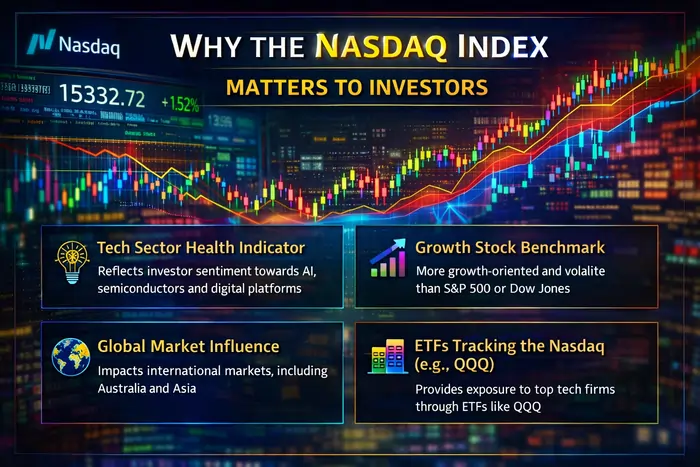
The Nasdaq indices matter for investors for several reasons:
- Barometer for technology and growth stocks
Because they’re packed with tech, internet, and innovation‑driven companies, the Nasdaq Composite and Nasdaq‑100 are widely viewed as barometers for how growth stocks are doing relative to the rest of the market. Pages like CFI’s overview of the Nasdaq Composite show how the index composition ties into sector leadership. - Signal of risk appetite
When the Nasdaq is leading the market higher, it often suggests that investors are willing to take on more risk, betting on future earnings growth and innovation. When it underperforms, it may signal a shift toward more defensive, value‑oriented sectors. - Benchmark for performance
Many investors and fund managers use the Nasdaq indices as benchmarks for growth‑tilted portfolios. If you’re actively picking tech stocks, you might compare your returns to the Nasdaq‑100 to see whether you’re adding value over simply buying a low‑cost index fund. - Insight into market cycles
High‑growth sectors tend to be more sensitive to interest rates, economic expectations, and sentiment. Watching how the Nasdaq behaves can give you early clues about shifts in market leadership—like rotations from growth to value or vice versa.
An accessible, investor‑focused explainer that expands on these points is Chase’s guide to investing in the Nasdaq‑100.
Ways to Invest in the Nasdaq
You don’t need to buy dozens or hundreds of individual Nasdaq stocks to gain exposure. Most investors use index funds and ETFs that track specific Nasdaq benchmarks.
Common ways to invest include:
- ETFs that track the Nasdaq‑100
These funds aim to mirror the Nasdaq‑100’s holdings and weights, giving you exposure to 100 large, non‑financial Nasdaq companies in a single trade. To see examples and structures of these products, you can review Nasdaq’s own list under Ways to Invest in the Nasdaq‑100: Nasdaq‑100 – Ways to Invest. - Funds tracking the Nasdaq Composite
Some funds aim to follow the broader Composite, which includes thousands of stocks. This can provide more diversified exposure across the full Nasdaq universe, though it still tends to be tech‑tilted. The Nasdaq Composite index page lays out its role as a broad performance benchmark. - Nasdaq‑style mutual funds and index funds
Certain mutual funds use the Nasdaq benchmarks as their targets, rebalancing holdings to match the index composition.
The basic process for investing is straightforward:
- Open a brokerage or investment account (if you don’t already have one).
- Research Nasdaq‑tracking ETFs or index funds, paying attention to fees, tracking error, and liquidity. A good ETF primer is Investopedia’s definition of ETFs.
- Buy shares of your chosen fund, just as you would buy any other stock or ETF.
For beginners who want to understand ETFs and index funds more broadly, you can consult:
- Investing in ETFs: A Beginner’s Guide – N26
- Nasdaq – Understanding Index Products: A Beginner’s Guide
These resources walk through how ETFs trade, what expense ratios mean, and how to assess whether a Nasdaq‑linked fund fits your goals.
Risks of Investing in the Nasdaq
While Nasdaq‑linked funds offer an easy way to tap into growth and innovation, they also come with distinct risks you should understand before jumping in.
Key risks include:
- Sector concentration
Because the Nasdaq indices are heavily weighted toward technology and related sectors, their performance is more sensitive to anything that affects tech stocks: changes in interest rates, regulatory crackdowns, shifts in consumer behavior, or competitive threats. Chase’s guide highlights this trade‑off under “risks and considerations”: How to Invest in the Nasdaq‑100. - Higher volatility
Historically, growth and tech‑heavy indices have experienced larger price swings than broader benchmarks. That can mean sharper drawdowns during market corrections and more dramatic rallies during bull markets. The trading‑focused overview at tastylive – How to Trade & Invest in the Nasdaq‑100 discusses this in more detail. - Valuation risk
Many Nasdaq leaders trade at higher valuation multiples because investors expect strong future growth. If those expectations are disappointed—or if the market’s willingness to pay high multiples declines—these stocks and the indices they dominate can fall significantly. - Concentration in a few mega‑caps
Because of market‑cap weighting, a relatively small number of very large companies can drive a large portion of index performance. If those companies stumble, the entire index can feel the impact, even if smaller constituents are doing fine.
These risks don’t mean you should avoid Nasdaq‑linked investments; they simply mean you need to size positions appropriately, match them to your time horizon, and avoid assuming that tech‑heavy exposure is “safe” just because the names are familiar.
How to Use the Nasdaq in Your Own Strategy
Rather than thinking of the Nasdaq as an all‑or‑nothing bet, it’s usually more helpful to see it as one component of a broader portfolio.
Some practical ways to use it:
- Satellite around a core
Use a broad global or S&P 500 index fund as your core holding, then add a smaller allocation to a Nasdaq‑100 ETF for extra growth potential. This allows you to participate in innovation while maintaining diversification. The concept of using index products in a layered way is outlined in Nasdaq’s beginner guide to index products. - Benchmark for tech holdings
If you already pick individual tech stocks, treat the Nasdaq‑100 as a yardstick. If your stock picks consistently lag a simple Nasdaq‑tracking ETF after fees and taxes, you might reconsider how much active stock‑picking you do. - Tactical tilts
More active investors sometimes shift their Nasdaq exposure up or down depending on their view of the economic cycle, interest‑rate environment, or tech valuation levels. This approach is more advanced and carries timing risk. - Risk‑management framework
Decide in advance what percentage of your portfolio you’re comfortable allocating to growth‑tilted assets. That might be a small slice for a conservative investor, or a larger one for someone young with a long time horizon and high risk tolerance. For foundational guidance on building ETF‑based portfolios with appropriate risk, see Investing in ETFs: A Beginner’s Guide – N26.
Related Reading: From Indices to Individual Stocks and Policy
While indices help you understand market‑wide trends, it’s useful to see how index behavior connects to both individual companies and real‑world financial rules.
- If you’re interested in how broader tech sentiment and index trends feed into a single company’s performance, you can read this in‑depth breakdown: Atlassian Share Price Forecast: Performance, Trends, and Future Outlook. It explores how fundamentals, valuations, earnings reports, and market narratives intersect for a Nasdaq‑listed software firm and shows how an individual stock can move in relation to wider tech benchmarks.
- For investors in Australia, understanding how your investments are treated in the social‑security and retirement system is just as important as picking the right index fund. This guide, What Are Centrelink Deeming Rates and How Do They Work in Australia?, explains how deeming rates affect the way financial assets are assessed for Centrelink benefits, which can matter if you hold Nasdaq‑linked investments alongside local savings, managed funds, or term deposits.
By understanding what the Nasdaq index is, how it’s constructed, and why it matters as a signal for technology and growth stocks—and by pairing that knowledge with company‑level analysis like the Atlassian share price forecast and policy explainers such as Centrelink deeming rates—you can move beyond headlines and treat the Nasdaq as a deliberate tool in your investment toolkit, aligned with your goals, risk profile, and home‑country rules.