

China Australia Beef Trade Key Takeaways
The China Australia beef trade is rebounding as Chinese demand recovers, import restrictions ease, and supply chains normalize. The reset in relations is reshaping regional beef flows and price dynamics.
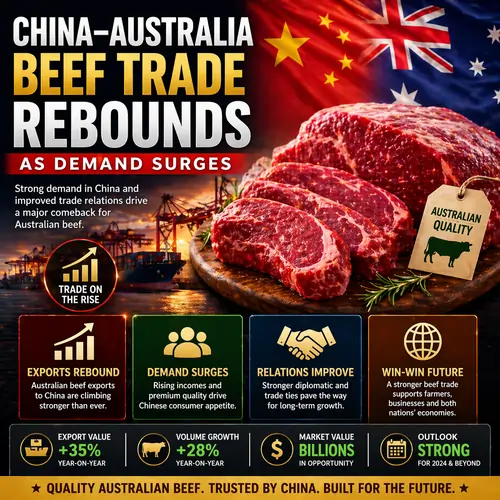
The China Australia beef trade is rebounding as Beijing reopens more market access for Australian processors, Chinese consumers resume spending on premium protein, and global beef prices stabilize. This means higher Australian beef exports to China, more competition with South American suppliers, and new opportunities for branded, high-value cuts and chilled beef in major Chinese cities.
How the China Australia Beef Trade Rebound Unfolded
After several turbulent years, the China Australia beef trade is clearly shifting back into growth mode. Diplomatic tensions, Covid-era logistics disruptions, and the suspension of several Australian abattoirs once slowed or redirected trade flows. Now, signals from both governments and industry data show a recalibration rather than a retreat.
China remains the world’s largest beef importer, and Australia is one of the most efficient producers of pasture-fed, high-quality beef. As relations stabilize and demand recovers, both sides are rediscovering the strategic value of renewed trade ties.
Background: From Rapid Growth to Trade Tensions
For much of the 2010s, Australian beef exports to China were a standout success story. China surged from a minor buyer to one of Australia’s top beef destinations, driven by rising incomes, urbanization, and a preference for safe, traceable imported protein. For a related guide, see 7 Things to Know About McDonald’s Australia Menu and Prices in 2026.
However, from 2020 onward, a combination of factors strained the relationship: the suspension of multiple Australian meatworks over technical and political issues, tighter Chinese import controls, and Covid-related logistics bottlenecks. As a result, China increasingly leaned on Brazil, Argentina, and other suppliers, while Australian exporters diversified into markets like Japan, Korea, and the US. For a related guide, see Click Frenzy Liquidation Sale: Best Deals in Australia 2026.
Resetting Trade and Political Relations
Over the last 18–24 months, diplomatic contacts have warmed and formal dialogues have restarted. This has created room for a gradual normalization of China Australia beef trade rebound and rising beef demand dynamics. The reopening of suspended plants and smoother customs clearance procedures are practical signs of this thaw.
While not all restrictions vanished overnight, each incremental approval, protocol update, and technical agreement has made it easier for Australian beef to re-enter Chinese channels, both in bulk commodity form and in higher-value branded cuts.
Key Drivers Behind Rising China Import Demand for Australian Beef
The rebound is not just about politics. Structural and cyclical demand factors within China, combined with supply developments in other exporting countries, are also reshaping the China import demand for Australian beef.
Economic Recovery and Evolving Consumer Preferences
China’s post-pandemic recovery has been uneven, but one bright spot has been continued spending on food service, e-commerce groceries, and premium dining in tier-1 and tier-2 cities. Middle-class consumers, especially younger households, are experimenting with Western-style dining, hotpot chains, and ready-to-cook imported beef packs.
Australian beef is strongly associated with food safety, grass-fed production, and consistent quality. As a result, it fits neatly into the growing segment of health-conscious, brand-aware consumers who are willing to trade up from generic frozen imports to chilled, traceable products with clear origin stories.
Supply Shifts in Competing Exporting Countries
Another piece of the China Australia beef trade story is what is happening in other beef-exporting regions. Periodic disease outbreaks, regulatory disputes, and weather-driven supply constraints in South America have introduced risk and volatility into Chinese buyers’ portfolios.
Chinese importers and large distributors increasingly see diversified sourcing as an insurance policy. Re-engaging with Australia reduces overreliance on any single region, strengthens bargaining power, and helps ensure steady supply for major hotpot chains, quick-service restaurants, and retail channels.
Policy Adjustments and Technical Market Access
On the policy side, the rebound in Australian beef exports to China depends on detailed technical arrangements more than headlines. Sanitary and phytosanitary (SPS) protocols, plant listings, inspection procedures, and labelling standards all matter.
Recent advances have included progress on re-approvals for specific Australian abattoirs, smoother electronic certification, and closer regulatory cooperation. Collectively, these steps lower transaction costs, shorten lead times, and make Australian product more competitive at the port-of-entry level.
Impacts of the China Australia Beef Trade Rebound on Stakeholders
The renewed momentum in China Australia beef trade rebound and rising beef demand is being felt from Queensland cattle stations to Shanghai distribution hubs, and across the wider global beef market.
What It Means for Australian Cattle Producers and Processors
For Australian producers, China’s return as a robust buyer brings both opportunity and pressure. Stronger demand can support farmgate prices, especially for the types of cattle and carcase specifications preferred by Chinese importers and hotpot chains.
Processors benefit from higher plant utilization rates and more options for carcase balance. Cuts less favored in traditional markets like Japan and the US may find a natural home in Chinese cuisine, while premium chilled and branded lines can target top-tier retail and e-commerce platforms. For a related guide, see 7 Things to Know About Easter Trading Hours 2026 in Australia.
Implications for Chinese Importers and Distributors
For Chinese importers, the renewed flow of Australian beef offers a way to differentiate in a crowded market. Retailers and food service buyers can position Australian product as safer, greener, or more consistent, often commanding higher margins.
At the same time, importers must manage currency risk, fluctuating global beef prices, and shifting consumer trends. Building long-term partnerships with Australian suppliers and investing in cold-chain and marketing capabilities are becoming critical success factors.
Global Beef Market Rebalancing
As China import demand for Australian beef rises, volumes from other exporters may be displaced or redirected to alternative markets. This rebalancing can influence benchmark prices, freight routes, and investment decisions in feedlots and processing facilities worldwide.
Countries that filled the gap when Australian volumes were constrained may now face tougher competition on both price and quality. Conversely, buyers in markets like the Middle East or Southeast Asia may gain access to differently priced South American beef as more product is freed up.
Outlook, Risks, and Opportunities in China Australia Beef Trade
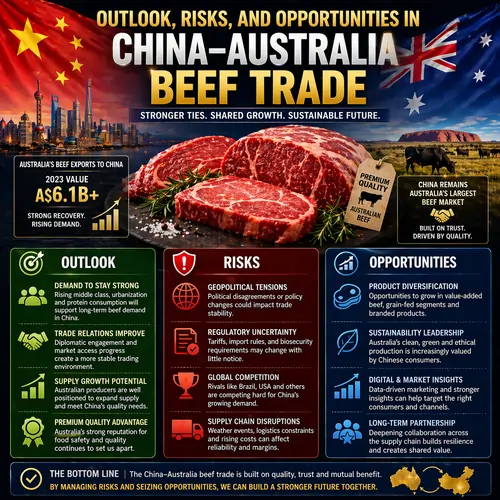
Looking ahead, the trajectory of the China Australia beef trade will depend on how well both sides manage a mix of economic, political, and environmental risks. The medium-term picture is cautiously positive but not without challenges.
Opportunities: Premium, Sustainable, and Branded Beef
One of the strongest opportunities lies in premiumization. Chinese consumers are increasingly responsive to stories about provenance, animal welfare, and environmental credentials. Australian brands that can verify grass-fed production, low-emissions practices, and strong traceability have a chance to stand out.
This opens the door for region-specific brands, organic or natural claims, and digital traceability tools (such as QR-linked farm profiles) that reinforce confidence and justify a premium price point.
Key Risks: Geopolitics, Biosecurity, and Climate
Despite the positive momentum, stakeholders on both sides remain alert to risk. Geopolitical tensions could flare again, regulatory expectations may tighten, and new disease outbreaks or climatic shocks could disrupt supply.
Australian producers face rising climate volatility, while Chinese buyers must manage food security concerns and maintain consumer confidence. Diversification, insurance, and robust risk management strategies will remain essential for all participants in the China Australia beef trade ecosystem.
Strategic Priorities for Stakeholders
For Australian exporters, the priority is to deepen relationships beyond short-term spot sales. Long-term contracts, joint marketing programs, and investment in market intelligence can build resilience.
For Chinese importers and retailers, success will depend on understanding regional consumer differences, building strong cold-chain infrastructure, and integrating omnichannel sales strategies that highlight the value of imported Australian beef products.
Comparison of Key Drivers in the China Australia Beef Trade Rebound
The following table summarizes the main forces shaping the current rebound in China Australia beef trade rebound and rising beef demand, and how they affect both sides of the relationship.
| Driver | Impact on Australia | Impact on China |
|---|---|---|
| Economic recovery and consumer demand | Supports higher cattle prices and investment in processing capacity | Increases access to safe, premium beef for growing middle class |
| Policy normalization and market access | Restores suspended plants and improves export certainty | Diversifies suppliers and reduces overreliance on single regions |
| Competition from other exporters | Drives focus on quality, branding, and efficiency | Strengthens bargaining power and price discovery |
| Climate and biosecurity risks | Requires resilience, herd management, and contingency planning | Encourages diversified sourcing and robust stock management |
Useful Resources
For deeper data and official updates on beef trade flows and regulations, the following resources are particularly helpful:
- ABARES (Australian Bureau of Agricultural and Resource Economics and Sciences) – for reports on Australian agricultural exports and livestock markets.
- Ministry of Agriculture and Rural Affairs of the People’s Republic of China – for policy updates and import-related regulations impacting beef.
Frequently Asked Questions About China Australia Beef Trade
Why is the China Australia beef trade rebounding now?
The rebound is driven by a partial normalization of political relations, renewed plant approvals, and a recovery in Chinese consumer demand for safe, high-quality beef. At the same time, China is seeking to diversify supply sources after relying heavily on South American imports, making Australian beef attractive again for risk management and quality reasons.
How important is China for Australian beef exports today?
China is once again one of the most important destinations for Australian beef, competing with markets like Japan, Korea, and the United States. While volumes are still rebuilding from earlier peaks, China’s scale, growth potential, and appetite for a wide range of cuts make it a strategic priority for many Australian producers and processors.
What types of Australian beef are most in demand in China?
Chinese buyers import both commodity and premium Australian beef, but there is particular demand for cuts suited to hotpot and grilling, as well as chilled, branded lines targeting supermarkets and e-commerce. Grass-fed and grain-fed products both have markets, with higher-income consumers leaning toward chilled, portion-controlled, and well-marketed brands emphasizing safety and provenance.
How have previous trade tensions affected Australian beef exporters?
Past tensions led to the suspension of several major Australian processing plants and increased regulatory scrutiny at Chinese ports. Exporters responded by diversifying into other markets, adjusting product mixes, and investing more in market intelligence. While this created short-term pain, it also encouraged efficiency and reduced overdependence on a single destination.
Are all Australian beef plants now approved to export to China?
No, not all plants are automatically approved. China maintains a list of eligible establishments that meet its sanitary and technical requirements. Over time, more Australian facilities have regained or secured access, but approvals remain subject to ongoing inspections, compliance with Chinese standards, and broader diplomatic conditions.
What role do food safety and traceability play in China import demand for Australian beef ?
Food safety and traceability are central to Chinese demand for Australian beef. After past food scandals, Chinese consumers and regulators place high value on clear origin labelling, verifiable supply chains, and robust veterinary systems. Australia’s reputation for clean, well-regulated production is a key selling point that justifies price premiums and supports long-term partnerships.
How does the China Australia beef trade affect global beef prices?
Changes in China’s buying patterns can significantly influence global beef prices because of its size as an importer. When China increases purchases from Australia, it can tighten supply for other buyers and support higher prices. Conversely, if China shifts volumes to alternative suppliers, it can ease pressure on Australian product but may raise competition in other markets.
What are the main risks to the future of China Australia beef trade ?
Key risks include renewed political tensions, stricter import regulations, climate-related production shocks in Australia, and disease outbreaks anywhere in the global supply chain. Currency fluctuations, shipping disruptions, and changing consumer preferences in China also add uncertainty. Stakeholders mitigate these risks through diversification, insurance, and long-term contractual arrangements.
How can Australian beef brands stand out in the Chinese market?
Australian brands can differentiate by emphasizing safety, sustainability, animal welfare, and taste consistency, supported by credible certification and storytelling. Investing in digital marketing, partnerships with trusted retailers and food service chains, and consumer education about cooking methods can further strengthen brand recognition and loyalty among Chinese shoppers.
What logistics challenges affect Australian beef exports to China ?
Exporters face challenges such as rising freight costs, container availability, port congestion, and the need for reliable cold-chain infrastructure. Maintaining product quality during long sea voyages and ensuring timely customs clearance in Chinese ports are critical. Collaborative planning with logistics providers and importers helps manage these operational risks.
How does the rebound in China Australia beef trade impact Australian cattle prices?
As Chinese demand recovers, competition for Australian cattle can increase, supporting or raising cattle prices, particularly for animals that fit the specifications of Chinese buyers. However, prices also depend on domestic slaughter capacity, seasonal conditions, and demand from other export destinations, so the impact is part of a broader market picture.
Is there growing demand for premium and branded Australian beef in China?
Yes, demand for premium and branded Australian beef is expanding in urban China, especially through supermarkets, boutique butchers, and online grocery platforms. Consumers with higher incomes increasingly seek out products labelled as Australian, grass-fed, or sustainably produced, and they respond well to clear branding and consistent eating quality.
What role do Chinese e-commerce platforms play in beef imports?
Chinese e-commerce platforms have become a crucial sales channel for imported beef, including Australian products. They allow brands to reach consumers nationwide, offer detailed product information, and run targeted promotions. For Australian exporters, partnering with or supplying major platforms can dramatically increase visibility and access to end users.
How are sustainability concerns shaping China import demand for Australian beef ?
Sustainability is slowly becoming more important to Chinese buyers, especially institutional customers and younger consumers. They are interested in greenhouse gas footprints, land use, and animal welfare. Australian producers that can demonstrate credible improvements and certifications in these areas are likely to have an advantage as sustainability expectations rise.
Do currency movements affect the competitiveness of Australian beef in China?
Currency movements, particularly the Australian dollar against the US dollar and Chinese yuan, can significantly influence price competitiveness. A weaker Australian dollar generally makes Australian beef more affordable for Chinese buyers, while a stronger currency can squeeze margins. Both exporters and importers monitor exchange rates closely and may use hedging strategies to manage volatility.
What documentation is required for Australian beef to enter China?
Australian beef shipments must meet China’s sanitary and phytosanitary requirements, including veterinary health certificates, plant approvals, and accurate labelling in line with Chinese regulations. Documentation typically covers origin, processing details, cold-chain adherence, and product specifications. Compliance with these rules is monitored by both Australian authorities and Chinese customs.
How does China compare with other major markets for Australian beef?
China differs from markets like Japan, Korea, and the US in its cut preferences, rapid growth, and importance of e-commerce and hotpot chains. While all markets value quality and safety, China’s scale and evolving middle class offer more room for volume expansion and brand-building, but also higher regulatory and geopolitical complexity.
Are smaller Australian producers able to access the Chinese market?
Smaller producers can access China, but typically through partnerships with larger processors, export consolidators, or branded marketing groups. Direct entry is challenging due to regulatory, logistical, and marketing demands. Joining cooperatives or supplying established export-oriented plants allows smaller operations to benefit from China-bound demand without managing the entire export process alone.
What long-term trends could shape the future of China Australia beef trade ?
Long-term trends include rising Chinese urbanization, a growing middle class, increasing scrutiny of environmental impacts, and continued digitalization of food retail. On the Australian side, climate adaptation, productivity gains, and further brand development will shape supply. Together, these factors suggest that while volumes and routes may fluctuate, beef will likely remain a key pillar of the broader China–Australia agricultural relationship.
What is China Australia Beef Trade ?
China Australia Beef Trade is covered in the guide above with practical context, useful examples, and details readers can use to make a better decision.
As the China Australia beef trade continues to rebound, stakeholders who invest in quality, relationships, and risk management are best placed to benefit from the renewed wave of demand and the long-term potential of this critical bilateral market.