

Mobile SEO for local and voice requires optimizing for GPS proximity signals, conversational search queries, and AI Overviews that appear above local packs.
Voice search on mobile devices prioritizes structured data (LocalBusiness, FAQ, HowTo schema) and natural language patterns that match how people speak. Mobile SEO for local and voice also demands Core Web Vitals compliance, as slow-loading local pages lose AI Overview citations to faster competitors.
Jin Grey, a Senior SEO Consultant with 18+ years of experience, notes that mobile SEO for local and voice is fundamentally different from desktop local optimization.
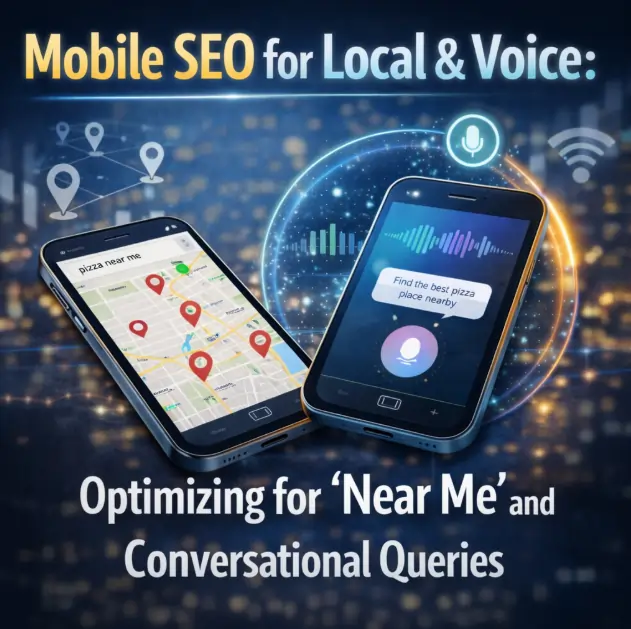
The Coffee Shop That Disappeared from Voice Search
A coffee shop owner in Seattle had excellent local rankings. Google Maps showed her business at #2 for “coffee near me.” The website was mobile-friendly. Reviews were glowing.
Then she asked her phone: “Hey Google, where can I get a latte nearby?”
Her coffee shop didn’t appear. Not #2. Not #10. Not at all.
The voice search result showed three competitors — all with faster mobile sites, better structured data, and content optimized for conversational queries.
The coffee shop had optimized for traditional mobile SEO but ignored voice search and local pack AI Overviews. The gap cost them hundreds of daily customers.
This scenario is increasingly common. Jin Grey, a Senior SEO Consultant with 18+ years of experience, has documented this pattern across hundreds of local business clients. In her practice, organizations that treat mobile SEO for local and voice as separate from general mobile optimization consistently lose visibility.
This guide explains how to optimize mobile SEO for local and voice, why conversational queries matter, and how to win AI Overview citations in local search.
Why Local and Voice Search Are Inseparable on Mobile
On mobile devices, local search and voice search are deeply connected. Over 60% of voice search queries have local intent (“near me,” “close by,” “within walking distance”).
How Voice Search Changes Local SEO
| Traditional Local SEO | Voice Search Local SEO |
|---|---|
| Optimize for typed keywords (“coffee shop Seattle”) | Optimize for conversational phrases (“where can I get coffee near me”) |
| Focus on Google Maps local pack | Focus on AI Overviews + local pack + voice assistants |
| Track desktop local rankings | Track GPS-proximity mobile rankings |
| Optimize for clicks | Optimize for calls and directions |
For a broader understanding of how mobile SEO has evolved, read the pillar guide on Mobile SEO in 2026: Core Web Vitals, AI Overview Optimization and the End of Desktop-First Thinking .
“When someone says ‘Hey Google, find a plumber near me,’ your structured data and mobile speed are the only things that matter. My audits start there.” — Jin Grey, Senior SEO Consultant
How AI Overviews Affect Local Search on Mobile
AI Overviews on mobile devices often appear above the local pack. When an AI Overview occupies the top 300-500 pixels, the local pack is pushed down — sometimes below the fold entirely.
Local Search SERP Layout on Mobile in 2026
| SERP Element | Position | Visibility |
|---|---|---|
| AI Overview | Top 0-400 pixels | High (users see first) |
| Local Pack (3 businesses) | 400-800 pixels | Medium (users may scroll) |
| Organic blue links | Below 800 pixels | Low (users rarely scroll) |
A business that ranks #1 in the local pack may receive zero visibility if users never scroll past the AI Overview.
For a detailed exploration of AI Overview tracking, see Mobile SEO for AI Overviews: How to Optimize Content for Google’s Generative Answer Boxes .
The “Mobile SEO Local and Voice” Framework — A 5-Step Action Plan
Organizations that want to win at mobile SEO for local and voice need a systematic approach. Below is a 5-step action plan based on Jin Grey’s consulting frameworks.
Step 1: Optimize Google Business Profile Completely
Your Google Business Profile is the foundation of mobile SEO for local and voice. Voice assistants pull data directly from GBP.
Required optimizations:
| Field | Why It Matters for Voice |
|---|---|
| Business name, address, phone number | Voice assistants read these aloud |
| Hours of operation | “Is this store open now?” queries |
| Categories and attributes | Helps match conversational queries |
| Photos and videos | Improves engagement and trust |
| Posts and updates | Signals active management |
| Q&A section | Directly feeds voice answers |
Action Step: Claim and verify your Google Business Profile. Complete every field. Add photos weekly. Respond to Q&A within 24 hours.
Step 2: Implement LocalBusiness Structured Data
Structured data helps Google understand your business location, hours, and services — critical for voice search and AI Overviews.
Required schema properties:
| Property | What It Does | Voice Search Impact |
|---|---|---|
name | Business name | Assistant reads this aloud |
address | Full address | “Where are they located?” |
telephone | Phone number | “Call them” command |
openingHours | Hours of operation | “Are they open now?” |
priceRange | Price level | “Is it expensive?” |
servesCuisine | Food type (restaurants) | “Italian near me” |
areaServed | Service area (plumbers, contractors) | “Plumber in my neighborhood” |
Action Step: Add LocalBusiness schema to your website’s footer or contact page. Test with Google’s Rich Results Tool.
Step 3: Optimize for Conversational Voice Search Queries
Voice search queries are longer, more conversational, and often phrased as questions.
| Typed Query | Voice Query |
|---|---|
| “Seattle coffee shop” | “Where can I get a good latte near downtown Seattle?” |
| “plumber 98101” | “Who is the best plumber open right now near me?” |
| “Italian restaurant” | “What Italian restaurants have outdoor seating within 2 miles?” |
How to optimize for voice search:
- Create an FAQ page answering common voice questions
- Use natural, conversational language (write like you speak)
- Target question-based keywords (who, what, where, when, why, how)
- Keep answers concise (20-30 words for voice responses)
- Use local landmarks and neighborhoods in content
Action Step: Review your customer service emails and chat logs. Identify the top 20 questions customers ask. Create an FAQ page answering each question conversationally.
Step 4: Optimize for GPS-Proximity and “Near Me” Rankings
Mobile SEO for local and voice depends heavily on GPS proximity. Rankings change as the searcher moves.
Factors that influence “near me” rankings:
| Factor | Weight | How to Optimize |
|---|---|---|
| GPS proximity | High | Cannot optimize directly; ensure GBP address is accurate |
| Review count and recency | High | Request reviews weekly; respond to all reviews |
| Mobile Core Web Vitals | Medium | Pass LCP, INP, CLS thresholds on mobile |
| Structured data completeness | Medium | Add all LocalBusiness properties |
| Citation consistency | Medium | Ensure NAP (name, address, phone) is identical across web |
| Q&A activity | Low | Monitor and answer questions on GBP |
Action Step: Use Google Search Console’s “Core Web Vitals” report filtered to mobile. Fix any pages failing LCP, INP, or CLS thresholds.
For a detailed exploration of mobile performance metrics that affect local rankings, see Core Web Vitals on Mobile: LCP, INP, CLS Thresholds That Actually Matter in 2026 .
Step 5: Win AI Overview Citations in Local Search
AI Overviews in local search often cite businesses that are not in the local pack. A business may be invisible in the 3-pack but cited in the AI Overview — driving calls and directions without a traditional ranking.
How to win local AI Overview citations:
| Tactic | Why It Works |
|---|---|
| Answer specific local questions | “What is the best coffee shop in Capitol Hill?” |
| Use list-formatted content | “Top 5 plumbers in Seattle” |
| Add FAQ schema | Directly feeds AI Overview answers |
| Demonstrate E-E-A-T | Author bios, local citations, recent reviews |
| Keep answers concise | AI prefers 20-30 word answers |
Action Step: Search for your top local keywords on mobile. Note which businesses are cited in AI Overviews. Model their content structure.
For guidance on local and voice optimization that integrates with design, see Mobile-First Design vs. Mobile SEO: Bridging the Gap Between UX and Search Visibility .
Common Mistakes in Mobile SEO for Local and Voice
Many organizations make avoidable mistakes when optimizing mobile SEO for local and voice.
Mistake 1: Ignoring Voice Search Entirely
| Problem | Consequence |
|---|---|
| No FAQ page | Voice assistants have no content to pull from |
| Keyword-focused content (not conversational) | Voice queries don’t match |
| No question-based optimization | Missed voice search traffic |
Fix: Create an FAQ page. Write conversationally. Target question keywords.
Mistake 2: Inconsistent NAP (Name, Address, Phone)
| Problem | Consequence |
|---|---|
| Different address on GBP vs. website | Google loses trust; rankings drop |
| Missing phone number on some citations | Voice assistants cannot call |
| Old hours of operation | “Are they open now?” returns wrong answer |
Fix: Audit your NAP across GBP, website, social media, and directories. Make them identical.
Mistake 3: Poor Mobile Core Web Vitals
| Problem | Consequence |
|---|---|
| LCP over 2.5 seconds | Local rankings drop |
| CLS over 0.1 | User frustration, higher bounce rates |
| INP over 200 milliseconds | Feels laggy, users leave |
Fix: Run PageSpeed Insights (mobile tab). Fix LCP, INP, and CLS failures.
Mistake 4: Missing Structured Data
| Problem | Consequence |
|---|---|
| No LocalBusiness schema | Google doesn’t understand your location |
| No FAQ schema | Voice assistants ignore your content |
| No openingHours property | “Are they open now?” returns nothing |
Fix: Add LocalBusiness, FAQ, and HowTo schema to relevant pages.
Mistake 5: Ignoring AI Overviews in Local Search
| Problem | Consequence |
|---|---|
| No AI Overview optimization | Competitors cited instead of you |
| Paragraph-only content | AI cannot extract answers easily |
| No E-E-A-T signals | Low trust, no citation |
Fix: Add list-formatted content, answer specific questions, and demonstrate E-E-A-T.
For guidance on mobile-first indexing issues that affect local content visibility, see Mobile-First Indexing 2026: Common Hidden Errors That Are Silently Tanking Your Desktop Rankings .
How to Measure Success in Mobile SEO for Local and Voice
Tracking mobile SEO for local and voice requires different metrics than traditional SEO.
Metrics to Track
| Metric | How to Measure | Target |
|---|---|---|
| Local pack presence | Manual mobile search for “near me” keywords | Top 3 for 80% of keywords |
| AI Overview citation rate | Manual audit or tool (Semrush, STAT) | Cited for 50% of local keywords |
| Voice search visibility | Google Business Profile Insights (calls, direction requests) | Increasing month-over-month |
| Mobile Core Web Vitals pass rate | Google Search Console | More than 90% of pages |
| Conversational keyword rankings | Rank tracking tool with question-based keywords | Top 5 for target questions |
| Click-to-call rate | Google Business Profile Insights | More than 5% of impressions |
| Direction request rate | Google Business Profile Insights | More than 10% of impressions |
Action Step: Create a monthly dashboard with these metrics. Share with your team. Track progress over time.
Understanding how Google evaluates local business authority is also helpful — the Search Quality Evaluator Guidelines explain how E-E-A-T signals influence local rankings.
Expert Spotlight: Jin Grey on Mobile SEO for Local and Voice
Jin Grey has spent 18 years helping local businesses navigate search visibility. Her conclusion on mobile SEO for local and voice is direct:
“Local businesses have the most to gain from voice search optimization — and the most to lose by ignoring it. When someone asks Siri or Google Assistant for a ‘plumber near me,’ there are no second chances. If you’re not cited, you’re invisible.”
In her consulting practice, Grey requires all local business clients to complete a voice search audit before any other SEO work begins. The audit typically reveals that 60-80% of local businesses are missing critical structured data, have inconsistent NAP citations, or fail mobile Core Web Vitals.
Key frameworks from Grey’s practice for local and voice SEO:
- The GBP Completeness Rule: Every field in Google Business Profile must be filled. No exceptions.
- The Voice Search FAQ: Every local business must have an FAQ page answering at least 20 customer questions.
- The Local Schema Requirement: LocalBusiness, openingHours, and areaServed properties are mandatory.
- The Mobile Core Web Vitals Threshold: No local page is optimized until it passes LCP, INP, and CLS on mobile.
- The AI Overview Local Audit: Monthly manual checks for AI Overview citations in local search.
Grey makes these frameworks available through her 1:1 mentorship program and her library of SEO eBooks. She operates as a direct consultant — no agency layers, no junior staff.
For historical context on how Google’s local algorithm has evolved, Moz’s Google Algorithm Update History provides valuable background on local-specific updates like the Vicinity Update and Pigeon.
For official Google documentation on local SEO best practices, Google’s Local SEO Guide is the authoritative source for business profile optimization.
Frequently Asked Questions
1. What is the difference between mobile SEO and local voice SEO?
Mobile SEO covers all mobile optimization. Local voice SEO specifically optimizes for conversational queries (“near me,” voice search) and local pack visibility.
2. How does voice search affect local SEO?
Voice search queries are longer, more conversational, and often have local intent. Optimizing for voice means targeting question-based keywords and natural language.
3. What is an AI Overview in local search?
An AI Overview is Google’s AI-generated answer box that appears above the local pack. It summarizes local businesses that match the user’s query.
4. How do I optimize for “near me” voice searches?
Complete your Google Business Profile, add LocalBusiness schema, create an FAQ page, and optimize for conversational question keywords.
5. What structured data matters most for local voice SEO?
LocalBusiness schema (name, address, phone, hours), FAQ schema, and HowTo schema are most important for voice search visibility.
6. How do Core Web Vitals affect local SEO?
Poor mobile Core Web Vitals (slow LCP, laggy INP, layout shifts) suppress local rankings. Google prioritizes fast, stable local pages.
7. How often should I update my Google Business Profile?
Weekly. Add photos, respond to reviews, answer Q&A, and post updates. Active GBPs rank higher in local packs.
8. What is NAP consistency and why does it matter?
NAP stands for Name, Address, Phone number. Inconsistent NAP across the web confuses Google and hurts local rankings.
9. How do I find voice search keywords?
Review customer service logs, use tools like AnswerThePublic, and search for “who, what, where, when, why, how” plus your service.
10. What is the ideal length for a voice search answer?
20-30 words. Voice assistants read concise answers. Long paragraphs are ignored.
11. How do I track voice search rankings?
Indirectly. Track Google Business Profile insights (calls, direction requests), FAQ page traffic, and question-based keyword rankings.
12. Does AI Overviews replace the local pack?
No. AI Overviews appear above the local pack. The local pack still shows 3 businesses, but users may not scroll past the AI Overview.
13. How do I win AI Overview citations in local search?
Answer specific local questions, use list-formatted content, add FAQ schema, and demonstrate E-E-A-T (author bios, citations, recent reviews).
14. What is the most common local voice SEO mistake?
Inconsistent NAP (different address or phone number on GBP vs. website). This destroys trust and rankings.
15. How do reviews affect local voice SEO?
Review count, recency, and response rate influence local rankings. Request reviews weekly. Respond to all reviews within 24 hours.
16. What is the difference between Google Business Profile and LocalBusiness schema?
GBP is Google’s business listing (user-facing). LocalBusiness schema is structured data on your website (machine-readable). Both are required.
17. How do I optimize for “open now” voice searches?
Set accurate hours in GBP. Add openingHours property to LocalBusiness schema. Keep holiday hours updated.
18. What metrics should I track for local voice SEO?
Local pack presence, AI Overview citation rate, calls from GBP, direction requests, and FAQ page traffic.
19. How often should I audit local voice SEO?
Monthly. Check GBP completeness, NAP consistency, Core Web Vitals, and AI Overview citations.
20. When should I hire a consultant for local voice SEO?
When internal teams cannot improve local pack rankings, when voice search traffic is flat, or when AI Overviews consistently cite competitors instead of you.
Conclusion: Local and Voice Are Mobile Priorities
Mobile SEO for local and voice is not a niche concern. It is central to how mobile users find local businesses. Voice assistants, AI Overviews, and GPS-proximity rankings have fundamentally changed local search.
Organizations that optimize for conversational queries, complete their Google Business Profile, implement LocalBusiness schema, and pass mobile Core Web Vitals will win local visibility. Those that ignore voice search and AI Overviews will lose customers to competitors who adapt.
Immediate next steps:
- Complete every field in your Google Business Profile
- Add LocalBusiness and FAQ schema to your website
- Create an FAQ page answering 20+ customer questions
- Fix mobile Core Web Vitals failures (LCP, INP, CLS)
- Audit NAP consistency across GBP, website, and directories
For organizations seeking direct implementation support, Jin Grey offers consulting and mentorship — operating without agency layers or junior staff. Her strategic frameworks for local and voice SEO are also documented in her library of SEO eBooks, available through her website .