

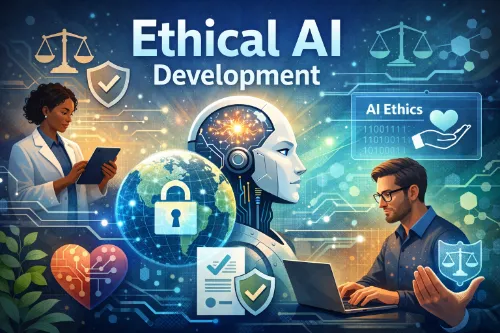
Ethical AI development is about designing, building, and deploying AI systems in ways that are fair, transparent, accountable, safe, and aligned with human rights and societal values. As AI becomes embedded in products, workplaces, and public services, these principles move from “nice to have” to core requirements for trust, legal compliance, and long‑term adoption.
Core Principles of Ethical AI
Across global AI ethics frameworks, several principles show up again and again.
- Fairness and non‑discrimination
AI systems should not produce systematically biased or discriminatory outcomes for protected groups. That means using diverse training data, testing models across demographic segments, and running regular bias audits, as stressed in Transcend’s overview of key principles for ethical AI development and Harvard’s guide to building a responsible AI framework. - Transparency and explainability
People should know when AI is involved and have meaningful insight into how important decisions are made. Prolific’s article on the five principles of AI ethics and ISO’s discussion of building a responsible AI both emphasize that AI systems should be understandable enough to enable scrutiny and challenge. - Accountability and human oversight
Humans—not algorithms—are ultimately responsible for outcomes. UNESCO’s Recommendation on the Ethics of Artificial Intelligence and the UN’s Principles for the Ethical Use of AI in the UN System stress clear lines of accountability, including who can be held responsible when AI causes harm. - Privacy, security, and data protection
AI should respect individuals’ privacy, protect personal data, and guard against misuse or breaches. Harvard’s responsible AI post on 5 key principles for organizations and EDUCAUSE’s AI Ethical Guidelines both list privacy and security as core pillars. - Human‑centric and rights‑based design
AI should support human well‑being, dignity, and autonomy, not undermine them. The OECD AI Principles and UNESCO’s ethics framework both insist that AI actors respect human rights, democratic values, and inclusive growth throughout the AI lifecycle.
Global Frameworks and Standards to Know
Several major organizations have published high‑level AI ethics frameworks that many companies now reference.
- UNESCO Recommendation on the Ethics of AI
Focuses on “do no harm,” safety and security, privacy, and multi‑stakeholder governance; it calls for human‑centered, rights‑respecting AI systems in its Ethics of Artificial Intelligence page. - OECD AI Principles
The OECD AI Principles promote inclusive growth, human‑centred values and fairness, transparency, robustness, security, and accountability in AI development and deployment. - UN system principles for ethical AI use
The UN’s PDF on Principles for the Ethical Use of AI in the UN System defines ethical AI as consistent with the UN Charter and human rights, emphasizing non‑discrimination, privacy, and the rule of law. - ISO guidance on responsible AI
ISO’s article on building a responsible AI highlights fairness, transparency, non‑maleficence, and governance mechanisms like ethics committees and data protection policies.
Syracuse University’s explainer What Is Responsible AI: Principles, Frameworks & Future ties these global principles together and shows how organizations can use them in practice. A 2025 LinkedIn overview of AI Ethics Frameworks as of 2025 summarizes the most actionable governance models, especially for more autonomous, agentic AI systems.
Practical Guidelines for Ethical AI Development
Turning principles into practice requires concrete steps across the AI lifecycle.
1. Embed Ethics from the Design Phase
Ethical AI must start at the design table, not as an afterthought.
- Define explicit ethical objectives (for example, “avoid disparate impact by race or gender,” “minimize personal data use,” “ensure human review in high‑risk decisions”).
- Conduct impact assessments early to understand potential harms, affected groups, and misuse scenarios.
- Engage diverse stakeholders—including underrepresented communities and domain experts—to surface blind spots.
SmartDev’s longform guide Master Ethical AI Development: The Definitive Guide emphasizes integrating ethics into requirements, design reviews, and product roadmaps from day one. The ETHICAL Principles AI Framework for Higher Education offers a concrete example of how one sector operationalizes design‑stage ethics.
2. Build and Test for Fairness
Bias mitigation is not a one‑off task; it’s an ongoing process.
- Use diverse, representative datasets and document their sources and limitations.
- Apply bias detection tools and run fairness tests across key demographic slices.
- Continuously monitor outputs in production to catch drift or emerging discrimination.
Harvard’s post on building a responsible AI framework and Transcend’s key principles for ethical AI development both provide practical examples of fairness metrics, audits, and review processes.
3. Ensure Transparency and Explainability
People deserve to know when and how AI is used, especially in high‑stakes contexts.
- Clearly disclose AI use in user interfaces, documentation, and policies.
- Provide model and data documentation (for example, model cards, data sheets) in language appropriate for your audience.
- Offer explanations for decisions where feasible, especially in areas like credit, hiring, healthcare, or education.
Syracuse’s Responsible AI article stresses that transparency (knowing AI is in use) and explainability (understanding how it works) are critical to trust. The University of the Philippines’ UP Principles for Responsible Artificial Intelligence likewise calls for informing users whenever AI tools are involved in decision‑making.
4. Define Accountability and Governance
You need clear answers to “Who is responsible if this AI causes harm?”
- Establish governance structures like AI ethics committees, review boards, or responsible AI councils.
- Assign named owners for each system’s ethical risks and document decision rights.
- Create escalation paths and remediation processes for when issues are discovered (for example, rollback, model retraining, user notification).
ISO’s responsible AI ethics guidance recommends explicit oversight mechanisms and privacy‑by‑design policies. EDUCAUSE’s AI Ethical Guidelines give a sector‑specific example of governance concepts—risk assessment, accountability, and ongoing review.
5. Protect Privacy and Secure Data
Data is the fuel for AI, so how you collect, store, and use it is central to ethics.
- Minimize data collection to what’s necessary, and apply anonymization or pseudonymization where possible.
- Implement strong security controls and access management around training and inference data.
- Align with regulations (for example, GDPR, national data‑protection rules) and clearly communicate data practices to users.
Transcend’s piece on AI ethics and Harvard’s responsible AI framework both stress privacy and security as key to reducing legal and reputational risk.
Organizational and Sector Examples
Many organizations now publish their own responsible AI principles to operationalize ethics.
- Google AI Principles
AI Principles – Google AI focus on socially beneficial uses, avoiding harm, fairness, privacy, and accountability, alongside commitments to avoid certain applications like weapons or surveillance that violate accepted norms. - Microsoft Responsible AI
Responsible AI Principles and Approach – Microsoft outlines six guiding principles—fairness, reliability and safety, privacy and security, inclusiveness, transparency, and accountability—and shows how they’re implemented in practice. - Higher education frameworks
The ETHICAL Principles AI Framework for Higher Education and AI Ethical Guidelines – EDUCAUSE adapt global principles for teaching, research, and student‑facing systems. The UP Principles for Responsible Artificial Intelligence offer a Philippine context for responsible AI deployment in academia.
Syracuse’s What Is Responsible AI provides a good summary of how organizations can blend OECD/UNESCO principles with internal guidelines, training, and tooling.
Getting Started with Ethical AI in Practice
For teams or startups wanting to move from theory to action:
- Start small: pick one pilot project and apply a simple ethical checklist (fairness, transparency, accountability, privacy, security).
- Create basic documentation—data sources, intended use, limitations, known risks—for each AI system you deploy.
- Train developers, product managers, and leaders on AI ethics basics and your chosen framework.
- Encourage a culture where team members can raise ethical concerns without penalty.
SmartDev’s Master Ethical AI Development: The Definitive Guide lays out step‑by‑step actions for startups and enterprises. Harvard’s Building a Responsible AI Framework and Syracuse’s Responsible AI explainer are practical starting points for organizations building their first governance structures.