

Detecting colon cancer early means finding precancerous polyps or very early tumors before symptoms appear, when treatment is most effective and survival rates are highest. Screening from around age 45—using tests like FIT, stool DNA tests, or colonoscopy—can prevent cancer or catch it early.
Regular screening, knowing your risk factors, and acting on early signs like bowel changes or hidden blood in stool can significantly reduce your risk and improve outcomes.
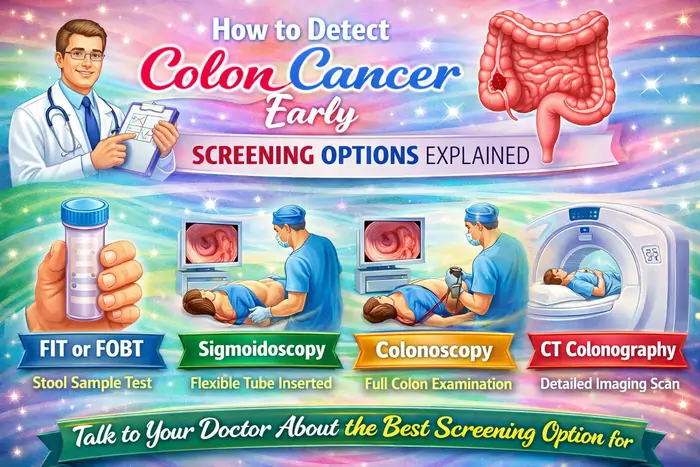
Understanding how to detect colon cancer early—and which screening test fits you best—helps you choose an option you’ll actually complete and repeat on schedule.
Why Early Detection of Colon Cancer Matters
Colon cancer almost always begins as small, benign growths called polyps in the lining of the colon or rectum. Over many years, some polyps can turn into cancer, but during that long window they can be found and removed. Knowing how to detect colon cancer early turns a silent, slow‑growing disease into something you can prevent or catch in its earliest stages.
When cancer is found before it spreads outside the colon, five‑year survival rates are very high. Once it has spread to distant organs, treatment becomes more complex and cure rates drop sharply. Early detection through regular screening can:
- Find precancerous polyps and remove them.
- Catch small, highly treatable cancers.
- Reduce your risk of needing aggressive surgery or chemotherapy.
- Dramatically lower your chance of dying from colon cancer.
For a concise overview of the main screening tests and why they matter, you can read the National Cancer Institute’s fact sheet on Screening Tests to Detect Colorectal Cancer and Polyps.
Who Should Think About Screening (and When)
You do not need to wait for symptoms to start thinking about how to detect colon cancer early. In fact, the whole point of screening is to act before you feel unwell.
Average‑risk adults
For people at average risk (no strong family history or genetic conditions), many major organizations now recommend:
- Starting routine colorectal cancer screening at age 45.
- Continuing until at least age 75, with decisions after that based on overall health and life expectancy.
- Choosing from several approved tests (stool‑based or visual) at recommended intervals.
You can find a clear breakdown of recommended ages and test options in the American Cancer Society’s guide to Colorectal Cancer Screening Tests.
Higher‑risk individuals
If you are at higher risk, you may need to start earlier and screen more often. Risk factors include:
- A first‑degree relative (parent, sibling, child) with colorectal cancer or advanced polyps.
- Known hereditary syndromes (for example, Lynch syndrome).
- A personal history of colon cancer, polyps, or inflammatory bowel disease (ulcerative colitis or Crohn’s affecting the colon).
- Prior radiation to the abdomen or pelvis.
For a patient‑friendly explanation of how risk affects start age and test choice, see this overview from Mass General Brigham on How to Detect Colon Cancer Early.
Two Main Paths: Stool‑Based vs Visual Exams
When you’re learning how to detect colon cancer early, it helps to know that approved screening tests fall into two broad groups:
- Stool‑based tests (you collect a sample at home or in clinic).
- Visual exams (tests that look directly at the colon, usually with a camera or CT scan).
The U.S. Centers for Disease Control and Prevention explains this distinction clearly on its page about Screening for Colorectal Cancer.
Stool‑Based Tests: Non‑Invasive Options You Can Do at Home
Stool‑based tests look for subtle signs of blood or abnormal DNA that may indicate polyps or cancer. They are usually done at home, are non‑invasive, and can be a good first step when you’re deciding how to detect colon cancer early with minimal disruption.
1. Fecal immunochemical test (FIT)
The FIT is a simple test that checks for hidden (occult) blood in the stool using antibodies.
Key points:
- Done once a year for average‑risk adults.
- Requires collecting a small stool sample at home.
- No dietary restrictions.
- If the test is positive, a colonoscopy is recommended to find the source of bleeding.
Large studies show that annual FIT, followed by colonoscopy for positive results, can significantly reduce deaths from colorectal cancer. A classic review of screening techniques summarizes FIT and older fecal occult blood tests as inexpensive and non‑invasive, though less accurate than colonoscopy alone; you can read more in this review of Screening Techniques for Prevention and Early Detection of Colorectal Cancer.
2. Guaiac‑based fecal occult blood test (gFOBT)
This older test also detects hidden blood but uses a chemical reaction.
Features:
- Typically done once a year.
- Often requires avoiding certain foods or medications that can interfere.
- Less specific than FIT and being replaced by FIT in many guidelines.
The CDC’s Screening for Colorectal Cancer page explains gFOBT and FIT side by side.
3. Stool DNA tests (FIT‑DNA)
Stool DNA tests combine FIT with checks for abnormal DNA shed by cancer or advanced polyps.
Key details:
- Done every 3 years for average‑risk adults if results remain negative.
- Non‑invasive and done at home.
- More sensitive than FIT alone for some cancers and advanced polyps, but may have more false positives.
- Any positive result still requires follow‑up colonoscopy.
The American Cancer Society’s overview of Colorectal Cancer Screening Tests and Mass General Brigham’s article on How to Detect Colon Cancer Early both describe how stool DNA tests fit into modern screening strategies.
Visual Exams: Seeing the Colon Directly
Visual exams actually look at the inside of your colon and rectum. These tests are more direct and, in some cases, allow your care team to remove polyps during the same procedure. When people ask how to detect colon cancer early most accurately, the answer usually involves these visual tests.
4. Colonoscopy (the gold standard)
Colonoscopy is widely considered the most comprehensive screening tool.
How it works:
- You complete a bowel prep to clean the colon.
- You usually receive sedation for comfort.
- A flexible tube with a camera is inserted through the rectum to examine the entire colon.
- Polyps can be removed and suspicious tissue biopsied during the same procedure.
Advantages:
- Examines the whole colon.
- Detects very small polyps and early cancers.
- Prevents cancer by removing precancerous polyps.
- Long screening interval (often 10 years) if the result is normal and you are average risk.
A review in the medical literature stresses colonoscopy’s very high sensitivity and calls it the gold standard for screening and prevention; you can see detailed numbers in this article on Screening Techniques for Prevention and Early Detection of Colorectal Cancer. A practical, patient‑oriented explanation of accuracy and advantages is available from Monmouth Gastroenterology: How Does a Colonoscopy Detect Colorectal Cancer?.
5. Flexible sigmoidoscopy
Flexible sigmoidoscopy examines only the lower part of the colon (the rectum and sigmoid colon).
Key points:
- Usually requires a shorter prep (often enemas, not full bowel prep).
- Often done without full sedation.
- Can detect and biopsy polyps or tumors in the lower colon.
- Needs to be repeated more often than colonoscopy (for example, every 5 years), and any suspicious findings usually require a full colonoscopy.
A classic overview in the early‑detection literature describes sigmoidoscopy as less invasive but limited to the distal colon; more details can be found in the same review of Screening Techniques for Prevention and Early Detection of Colorectal Cancer.
6. CT colonography (virtual colonoscopy)
CT colonography (virtual colonoscopy) uses CT scanning to produce detailed images of the colon.
Highlights:
- Minimally invasive, no sedation needed.
- Requires bowel prep and gas insufflation to expand the colon.
- Takes CT images that are reconstructed into 2D and 3D views.
- If a polyp is found, you still need a conventional colonoscopy to remove it.
Virtual colonoscopy can be a good option if you are reluctant to undergo traditional colonoscopy. However, it may be slightly less sensitive for small lesions and doesn’t allow polyp removal during the same exam. The National Cancer Institute lists CT colonography as one of the recognized Screening Tests to Detect Colorectal Cancer and Polyps, and the review in Screening Techniques for Prevention and Early Detection of Colorectal Cancer gives more technical details.
Comparing Screening Options: Pros, Cons, and Intervals
When deciding how to detect colon cancer early, it’s helpful to compare your options side by side.
According to the American Cancer Society’s guide to Colorectal Cancer Screening Tests and the Mayo Clinic’s discussion of Colon Cancer Screening: Weighing the Options:
- Stool‑based tests (FIT, gFOBT, stool DNA)
- Pros: Non‑invasive, done at home, no sedation, relatively inexpensive.
- Cons: Need to be done more frequently; positive results require colonoscopy; less effective at detecting small polyps.
- Visual exams (colonoscopy, sigmoidoscopy, CT colonography)
- Pros: Direct visualization; colonoscopy allows polyp removal and biopsy; longer screening intervals.
- Cons: Invasive or semi‑invasive; usually require bowel prep; colonoscopy needs sedation and time off work.
The choice depends on your risk level, preferences, and what you are most likely to complete on schedule.
If you’re still unsure how to detect colon cancer early and which test fits you best, this comparison of Colonoscopy vs Stool Test: Which Is Better? breaks down accuracy, prep, comfort, cost, and follow‑up so you can choose a screening option you’ll actually complete.
How to Detect Colon Cancer Early Without a Colonoscopy
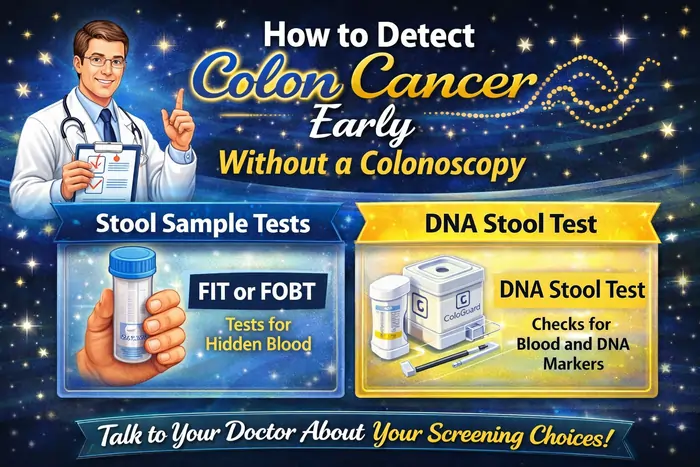
Some people hesitate about colonoscopy due to prep, sedation, or fear of complications. Fortunately, when you’re considering how to detect colon cancer early, colonoscopy is not the only route.
Alternatives for average‑risk individuals include:
- Annual FIT.
- Annual gFOBT (where still used).
- Stool DNA testing every 3 years.
- CT colonography at recommended intervals.
- Flexible sigmoidoscopy, sometimes combined with stool tests.
Cancer centers like MD Anderson explain that stool‑based tests are good at detecting existing cancers but less effective than colonoscopy at finding precancerous polyps; see their article on How to Detect Colon Cancer Without a Colonoscopy. If any of these non‑invasive tests are abnormal, colonoscopy becomes the next step.
Role of Symptoms in Early Detection (and Why You Shouldn’t Wait for Them)
Screening is meant for people without symptoms, but understanding early symptom patterns still matters when you’re thinking about how to detect colon cancer early.
Early colorectal cancer may cause:
- Subtle changes in bowel habits (diarrhea, constipation, or narrow stools).
- Occult blood in the stool (picked up on FIT or gFOBT).
- Mild anemia, fatigue, or occasional abdominal discomfort.
- Rarely, visible rectal bleeding or weight loss early on.
A practical discussion of early warning signs and testing triggers can be found in Mass General Brigham’s article Early Symptoms of Colorectal Cancer and When to Get Tested and the CDC’s Screening for Colorectal Cancer.
However, you should not wait for symptoms to appear. By the time obvious symptoms develop, the disease may already be more advanced. The safest approach is to combine symptom awareness with age‑ and risk‑based screening.
New and Emerging Approaches to Early Detection
Research is ongoing into new ways of how to detect colon cancer early with even less invasive and more convenient methods.
Areas of active study include:
- Blood‑based tests that look for tumor DNA or RNA fragments.
- Enhanced stool DNA panels with more markers.
- Improved imaging techniques for virtual colonoscopy.
- High‑resolution endoscopy and advanced optical tools.
The National Cancer Institute’s Screening Tests to Detect Colorectal Cancer and Polyps notes that blood‑based markers and advanced imaging are promising but still being evaluated. For now, standard stool tests and visual exams remain the core tools for early detection.
Practical Steps: How to Detect Colon Cancer Early in Your Own Life
Putting all this together, here’s how you can act on how to detect colon cancer early:
- Know your risk
- Check your age, family history, and any prior bowel conditions.
- Ask your doctor whether you are average or higher risk.
- Start screening on time
- If you’re average risk and 45 or older, choose a screening test and schedule it.
- If you’re higher risk, follow your provider’s advice on earlier start and shorter intervals.
- Choose a test you’ll actually do
- If you’re comfortable with procedures, colonoscopy is the most comprehensive.
- If you’re reluctant, consider FIT, stool DNA tests, or CT colonography—anything that gets you screened is better than doing nothing.
- Repeat tests at recommended intervals
- Annual FIT or gFOBT; every 3 years for stool DNA; every 5–10 years for visual exams, depending on the test and findings.
- Don’t ignore symptoms between screenings
- New rectal bleeding, persistent bowel changes, unexplained weight loss, or iron‑deficiency anemia should trigger evaluation, even if your last screening was “normal.”
You can find a simple, step‑by‑step overview of screening choices, intervals, and how to get started in the CDC’s Screening for Colorectal Cancer and the colorectal cancer alliance’s Screening & Prevention.
FAQs: How to Detect Colon Cancer Early
What does early detection of colon cancer mean?
It means finding polyps or early-stage cancer before symptoms develop, when treatment is easiest and most successful.
At what age should screening start?
Most guidelines recommend starting at age 45 for average-risk adults.
Who should start screening earlier than 45?
People with family history, genetic syndromes, or inflammatory bowel disease may need earlier screening.
What are the main ways to detect colon cancer early?
There are two main methods: stool-based tests and visual exams like colonoscopy.
What is the FIT test?
The fecal immunochemical test (FIT) checks for hidden blood in stool and is usually done once a year at home.
What is a stool DNA test?
It detects abnormal DNA and blood in stool and is typically done every 3 years.
What is the most accurate screening test?
Colonoscopy is considered the gold standard because it can detect and remove polyps in one procedure.
How often should I get a colonoscopy?
Usually every 10 years if results are normal and you are at average risk.
Are there non-invasive screening options?
Yes. Options include FIT, stool DNA tests, and CT colonography.
What happens if a stool test is positive?
You will need a follow-up colonoscopy to find the cause.
Can colon cancer be detected without symptoms?
Yes. Screening is designed to detect cancer before symptoms appear.
What are early warning signs of colon cancer?
Subtle signs include bowel habit changes, fatigue, anemia, or hidden blood in stool.
Why is colonoscopy considered the gold standard?
It allows doctors to see the entire colon and remove precancerous polyps immediately.
Are new screening methods being developed?
Yes. Researchers are exploring blood-based tests and improved imaging technologies.
What is the best screening test for me?
It depends on your risk level, preferences, and medical advice—the best test is the one you will actually complete regularly.