

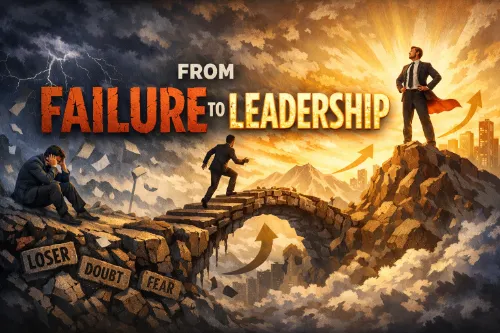
From the outside, leaders can look like people who always get it right—but if you dig into their stories, you almost always find a trail of mistakes, rejections, and flops they chose to learn from. “From Failure to Leadership” is really the story of how you respond when things go wrong, and how that response shapes your character, credibility, and impact.
Why Failure Is A Leadership Classroom, Not A Dead End
A common myth is that leaders lead because they don’t fail, but leadership research and real‑world stories show the opposite: strong leaders fail a lot and keep learning.
- Grand Canyon University’s business blog argues that failure is important in leadership because it builds character and resilience, giving leaders a chance to discover what doesn’t work and define themselves by new learning instead of setbacks.
- Leadership coaches at Advance Performance say the best leaders aren’t the ones who never stumble; they’re the ones who “stumble, adapt, and carry on,” using failure to shape a stronger mindset and more meaningful success.
- Forbes shares personal accounts from leaders who say that failures—missed promotions, bad hires, mismanaged projects—forced them to improve communication, collaboration, and decision‑making.
You can naturally link to GCU’s article “Why Failure Is Important in Leadership” and Forbes’ “The Failures That Helped Me Become a Better Leader” as anchor stories for this section.
Reframing Failure: From Identity To Information
The leadership “turning point” happens when someone stops treating failure as a verdict on who they are and starts treating it as information about what needs to change.
- Vistage, a CEO peer‑advisory network, emphasises that leaders who reduce the stigma of failure create a culture where mistakes are seen as data, not disgrace, and people feel safe to experiment and learn.
- John Barrett, a leadership author, notes that failure teaches resilience by showing that setbacks aren’t the end of the road but an opportunity to adapt, reflect, and return stronger.
- A Forbes Business Council article outlines seven steps leaders can use to learn from failure—acknowledge it, identify it early, respond with accountability, reflect, recover, and retain the lessons—so they treat failure as a “vital component of growth” rather than something to hide.
Vistage’s “4 Strategies Leaders Can Use to Learn from Failure” and Barrett’s “3 Transformative Lessons Every Leader Can Learn From Failure” are strong, practical guides to link when you talk about reframing failure.
How Failure Builds Core Leadership Qualities
Effective leadership is less about titles and more about qualities like resilience, humility, self‑awareness, and courage—all of which are forged in failure.
Resilience and adaptability
- GCU notes that failure builds resilience by forcing leaders to navigate uncertainty and “messy” situations, adapt their mindset, and find new approaches when the old ones no longer work.
- Barrett calls resilience the first big lesson of failure: you discover that setbacks are survivable and that you can adjust your strategy rather than giving up.
Humility and self‑reflection
- Failure humbles leaders by highlighting blind spots and limitations, pushing them into honest self‑reflection rather than ego protection.
- Radical Ignition’s founder writes that learning from failure requires leaders “willing to look in the mirror” and examine their own behaviour instead of blaming others for every setback.
Courage and vulnerability
- GCU’s leadership blog argues that the best leaders show vulnerability by admitting mistakes, which makes them more relatable and fosters trust and collaboration.
- Raconteur points out that mental health, self‑care, and supportive relationships help leaders stay courageous after failure instead of being paralysed by fear of getting it wrong again.
GCU’s leadership article and Radical Ignition’s “My Top 5 Leadership Lessons from Failures” are great external resources to support the claim that failure shapes character and leadership presence.
Stories: When Failure Became The Turning Point
Real‑world stories help your readers see themselves in the “from failure to leadership” journey.
- The blog The Right Questions shares “my many leadership failures,” including misjudged decisions and projects that went sideways, and how the author used reflection and feedback to grow as a leader.
- A Thrive Global article gathers stories from seven successful leaders who describe how painful failures and rejections forced them to reconfigure their approach and ultimately led to more satisfying careers.
- On LinkedIn, Scott Walker’s “Lessons in Leadership…failure” explains how a failed initiative became his most powerful teacher in humility, communication, and guiding teams through uncertainty.
You can link to Thrive Global’s “7 Successful Leaders Inspire You With Stories of Failure and Rejection” and The Right Questions post “You Can Learn From My Many Leadership Failures” as inspirational case studies.
Practical Framework: Turning Failure Into Leadership Growth
To move from theory to action, your article can offer a simple, step‑by‑step framework that leaders (or aspiring leaders) can use after a setback.
1. Acknowledge the failure honestly
Denial keeps you stuck; honest naming starts the learning process.
- Forbes Business Council suggests openly acknowledging that failure is “unavoidable” and a fundamental aspect of innovation and development.
- Radical Ignition encourages leaders to take accountability for their part—like losing a key employee—and ask what leadership behaviours contributed to the outcome.
2. Feel and process the emotions
You can’t think clearly about lessons if you’re in full shame, anger, or panic.
- GCU suggests giving yourself permission to feel uncomfortable emotions (guilt, embarrassment) and pairing this with self‑compassion—showing yourself the same grace you’d offer a colleague.
- Psychology Today’s leadership articles explain that emotional processing is a key component of psychological resilience, which helps leaders rebound from failure.
Psychology Today’s “Rebounding From Failure” describes how positive reinterpretation—looking for any constructive aspect of a failure—helps build resilience.
3. Analyse with curiosity, not blame
Leaders who grow from failure ask, “What happened and why?” instead of “Whose fault is this?”.
- Vistage advises leaders to analyse their own decision‑making, evaluate how quickly they can refocus on the mission, and share what they learn with their teams to reduce the negativity around failure.
- Barrett recommends identifying specific lessons—what went wrong, what was missing, and what you would do differently next time—rather than ruminating on the disappointment.
Vistage’s “4 Strategies Leaders Can Use to Learn from Failure” is a strong external resource for this reflective step.
4. Extract leadership lessons
You can invite readers to ask questions like:
- What did this failure reveal about my communication, delegation, or decision‑making?
- How did it expose weaknesses in our systems or culture?
- What new skills or perspectives do I need to develop?
- GCU lists key lessons leaders draw from failure: greater self‑awareness, improved collaboration, better communication, team building, and openness to divergent ideas.
- John Barrett summarises three core lessons: resilience, humility/self‑reflection, and innovation—each tied to specific “how to learn” practices.
Linking to GCU’s and Barrett’s pieces makes this section feel grounded and actionable.
5. Share the story with your team
A big leadership shift happens when you stop hiding failure and start narrating it as a shared learning experience.
- Vistage emphasises that leaders should “create a space where it’s safe to fail,” which includes being transparent about their own missteps and what they learned.
- Advance Performance argues that when leaders embrace failure openly, they reduce fear, unlock motivation, and model resilience for their teams.
You can naturally point to Vistage and Advance Performance’s “Why Great Leaders Embrace Failure” when you talk about building a “fail‑forward” culture.
6. Apply and iterate
None of this matters if behaviour doesn’t change. The leadership part is turning insight into different choices and systems.
- Leaders‑Building‑Leaders stresses being intentional about learning from failures—changing processes, creating checklists, seeking mentoring, or adjusting strategy based on what went wrong.
- Forbes recommends establishing systems to identify failures early, respond with accountability, build a recovery plan, and retain the memory of what happened so you don’t repeat it.
Leaders‑Building‑Leaders’ article “How to Learn From Your Failures” is a practical link here.
From Failure To Leadership Culture
As people move into leadership roles, the way they handle failure teaches everyone else how safe it is to experiment and speak up.
- Vistage notes that a “learning culture” depends on leaders openly acknowledging imperfections and mistakes and modelling curiosity rather than reactivity.
- Raconteur’s feature on lessons from failure highlights that resilience comes from three factors: psychology (how you frame struggle), self‑care, and a strong support network.
- Radical Ignition points out that taking responsibility for failures—like reflecting on why a key staff member left—builds trust and lays the foundations for innovation.
You can link to Raconteur’s “Lessons from failure: how business leaders can bounce back stronger” to support the culture and mental‑health angle.